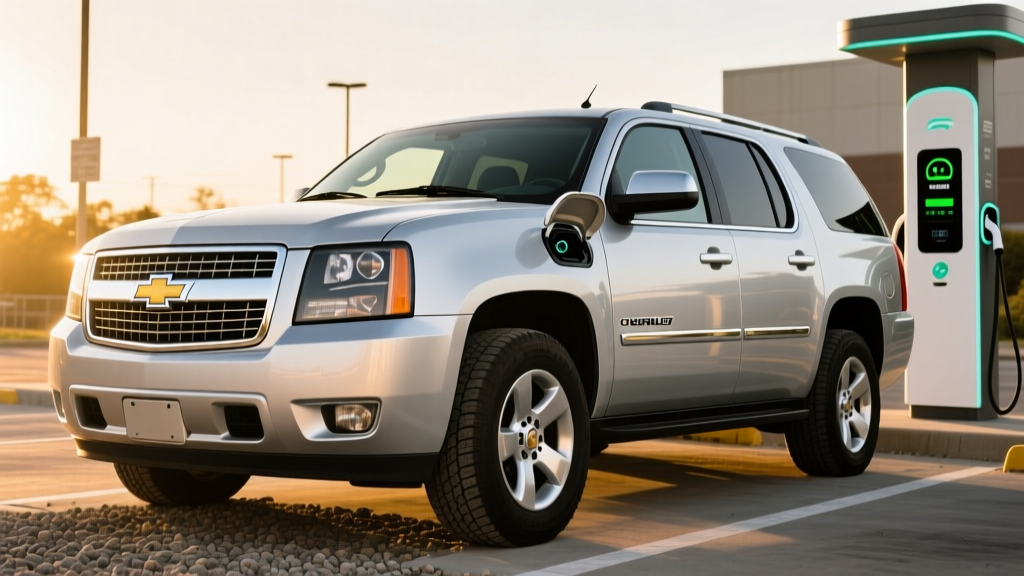
The 2010 Chevrolet Tahoe Hybrid was an engineering milestone — a full-size, body-on-frame SUV that used GM's two-mode hybrid system to cut fuel consumption by roughly 30% compared to its gas-only sibling. More than 15 years later, it remains one of the few hybrid systems ever bolted to a truck frame, and it still shows up on the used market at prices that tempt budget-minded families needing three rows and towing capability. But buying a 16-year-old hybrid SUV raises serious questions about battery longevity, parts availability, and whether the fuel savings justify the risk. This guide breaks down every number you need before signing the paperwork.
2010 Chevrolet Tahoe Hybrid: Key Specifications
| Specification | Value |
|---|---|
| Powertrain | 6.0L V8 + Two-Mode Hybrid System (2 electric motors) |
| Combined Horsepower | 332 hp (net system output) |
| Engine | 6.0L Vortec V8, 332 hp @ 5,100 rpm / 367 lb-ft @ 4,100 rpm (with Active Fuel Management) |
| Transmission | Two-mode continuously variable (EVT), electrically variable |
| Hybrid Battery | ~1.8 kWh NiMH (nickel-metal hydride), 300V nominal |
| EPA Fuel Economy | 21 city / 22 highway / 21 combined MPG |
| Gas-Only Tahoe (5.3L V8, 2010) | 15 city / 21 highway / 17 combined MPG |
| Towing Capacity | ~5,800 lbs (hybrid); ~7,700 lbs (gas-only 5.3L) |
| Drivetrain | RWD (2WD) or 4WD available |
| Curb Weight | ~5,889 lbs (4WD Hybrid) |
| Original MSRP | ~$52,970 (base, 2010) |
| Current Used Price (2026 est.) | $4,000–$9,000 depending on mileage/condition |
HEV vs. PHEV: What the Tahoe Hybrid Actually Is
Let's clear this up immediately: the 2010 Chevrolet Tahoe Hybrid is a conventional hybrid electric vehicle (HEV), not a plug-in hybrid (PHEV). It does not have a charge port. You cannot plug it in. The nickel-metal hydride (NiMH) battery pack charges exclusively through regenerative braking and the gasoline engine — exactly like a Toyota Prius, just on a much larger scale.
HEV vs. PHEV: Quick Distinction
| Feature | HEV (2010 Tahoe Hybrid) | PHEV (e.g., 2026 RAV4 Prime) |
|---|---|---|
| Plug-in Charging | No — charges via regen/engine only | Yes — Level 1/Level 2 charge port |
| Electric-Only Range | ~1–2 miles at very low speed | 30–45 miles typical |
| Battery Size | ~1.8 kWh NiMH | 18–22 kWh Li-ion typical |
| DC Fast Charging | N/A | Rare; some models support it |
| Federal Tax Credit (New) | Not eligible under §30D | Up to $7,500 if eligible (2026 rules) |
| Fuel Savings Mechanism | Engine assist, regen, cylinder deactivation | Electric-only commuting + engine for longer trips |
The Tahoe's two-mode hybrid system, co-developed with BMW and Chrysler (the "Global Hybrid Cooperation" partnership), uses two electric motors integrated into the transmission housing. Mode 1 handles low-speed driving with electric assist and regenerative braking. Mode 2 engages under heavy load — towing, highway merging — where the V8 does most of the work but the electric motors still provide torque fill and efficiency gains. The system also features Active Fuel Management (AFM), which deactivates four of the eight cylinders under light-load cruising.
How Many MPG Does the 2010 Tahoe Hybrid Get?
EPA Fuel Economy Breakdown
| Configuration | City MPG | Highway MPG | Combined MPG |
|---|---|---|---|
| 2010 Tahoe Hybrid (2WD) | 21 | 22 | 21 |
| 2010 Tahoe Hybrid (4WD) | 20 | 22 | 21 |
| 2010 Tahoe Gas (5.3L V8, 2WD) | 15 | 21 | 17 |
| 2010 Tahoe Gas (5.3L V8, 4WD) | 14 | 20 | 16 |
According to fueleconomy.gov, the 2010 Tahoe Hybrid achieves 21 MPG combined. That's a meaningful 4-MPG improvement over the gas-only 5.3L V8 Tahoe, which returns 17 combined in 2WD form. Over 15,000 annual miles at $3.50/gallon, that translates to roughly $625 per year in fuel savings for the hybrid — or about $3,125 over five years.
Real-World MPG vs. EPA Sticker
Owner-reported data on Fuelly and enthusiast forums clusters around 18–21 MPG combined for the 4WD model, with some drivers achieving 22–23 MPG on highway-biased commutes. The hybrid system's biggest advantage is in stop-and-go city driving, where regenerative braking and electric assist shine. However, real-world city MPG can dip to 17–19 if the battery pack has degraded — a critical factor for a 16-year-old vehicle. Highway driving at 75+ MPH largely bypasses the hybrid system's benefits, and you'll see numbers closer to the gas-only Tahoe.
Key insight: Unlike modern hybrids with larger battery packs, the Tahoe Hybrid's small 1.8 kWh NiMH pack provides minimal electric-only propulsion. You'll feel the electric motors assist from a stoplight (the Tahoe can creep at ~25 mph on electric power alone for about a mile), but sustained electric-only driving isn't realistic. The fuel savings come from the combined effect of regen braking, cylinder deactivation, and engine-off stops.
Powertrain Deep Dive: The Two-Mode Hybrid System
The 6.0L Vortec V8 (LYT engine code) produces 332 horsepower on its own, but the hybrid system's net output remains 332 hp because the electric motors supplement rather than add to peak power. The two electric motors, each rated at approximately 60 kW (80 hp), are housed inside the transmission and serve multiple roles:
- Motor/Generator A: Primarily handles engine starting, regenerative braking, and battery charging
- Motor/Generator B: Provides propulsion assist, additional regen, and enables electric-only creep
- Combined electric assist: Up to ~120 kW available in short bursts for acceleration
The transmission itself is a marvel — an electrically variable transmission (EVT) with four fixed gear ratios and two continuously variable modes. Under gentle acceleration, the system operates like a CVT, keeping the engine at its most efficient RPM. Under hard acceleration or towing, it locks into fixed ratios for direct mechanical power transfer, eliminating the "rubber band" feel that plagued early Toyota hybrid CVTs.
For towing, note that the hybrid model's maximum capacity drops to approximately 5,800 lbs (from 7,700 lbs on the gas model). The added weight of the hybrid system (~300 lbs) and the different rear axle gearing account for this reduction. If you regularly tow near maximum capacity, the gas-only Tahoe is the better tool.
Battery Health, Lifespan, and Replacement Cost
Original Hybrid Battery Warranty
When new, GM covered the Tahoe Hybrid's battery pack under its hybrid-specific warranty: 8 years / 100,000 miles (whichever came first). For a 2010 model, that factory warranty expired no later than 2018. Any battery replacement today is out-of-pocket or covered by an aftermarket warranty.
NiMH Battery Degradation: What to Expect
Nickel-metal hydride batteries were the hybrid industry standard before lithium-ion took over around 2012–2015. NiMH chemistry is more tolerant of temperature extremes and less prone to thermal runaway than early Li-ion cells, but it suffers from gradual capacity loss and "memory effect" if repeatedly cycled in a narrow state-of-charge window.
For a 2010 Tahoe Hybrid in 2026, the battery pack is 16 years old. Even with low mileage, NiMH cells degrade with age due to electrolyte breakdown and internal resistance increases. Expect a degraded pack to exhibit:
- Reduced regenerative braking capacity (the system limits regen to protect weak cells)
- More frequent engine engagement at stops (less electric-only idle time)
- Lower city MPG (dropping from 21 to 17–18 city)
- Possible "Service Hybrid System" or "Propulsion Power Reduced" warnings
Battery Replacement Cost
| Replacement Option | Estimated Cost (2026) | Notes |
|---|---|---|
| GM OEM refurbished pack | $2,500–$3,500 (parts + labor) | Limited availability; GM discontinued new OEM packs for this generation |
| Aftermarket refurbished (e.g., Green Bean Battery) | $1,500–$2,500 | Reconditioned NiMH cells; typically 1–3 year warranty |
| Individual module replacement | $300–$800 | Requires diagnostic scan to identify failed modules (the pack has 30 NiMH modules); DIY-friendly for experienced technicians |
| Used salvage yard pack | $400–$900 | Highest risk — unknown SoH (state of health); may last 2 years or 2 months |
Critical buyer advice: Before purchasing any 2010 Tahoe Hybrid, have the hybrid battery scanned with a GM-compatible OBD-II tool that reads individual module voltages. A healthy pack shows modules within 0.2V of each other. Any module more than 0.5V below the pack average signals imminent failure. This $100 diagnostic can save you $2,000+ in surprise repairs.
Is the 2010 Tahoe Hybrid Reliable?
The two-mode hybrid system itself proved surprisingly durable in long-term fleet use — government and corporate fleets that bought these Tahoes in bulk reported the hybrid components lasting 150,000+ miles with proper maintenance. The weak points are not the electric motors or transmission but the ancillary systems:
- Active Fuel Management (AFM) lifter failures: The 6.0L V8's cylinder-deactivation system is notorious for collapsed lifters, leading to expensive engine repairs ($2,000–$4,000). Many owners install an AFM disabler module (~$300) to prevent this.
- Hybrid battery cooling fan: Located behind the rear seat, this fan can clog with dust and fail, accelerating battery degradation. Cleaning it annually is essential.
- Electric power steering: The Tahoe Hybrid uses an electrically assisted steering rack. Failures are not common but are expensive (~$1,200) when they occur.
- Standard Tahoe issues: Transmission cooler line leaks, front suspension wear (upper ball joints, control arm bushings), and instrument cluster stepper motor failures all apply equally to hybrid and gas models.
The NHTSA vehicle page for the 2010 Tahoe Hybrid lists relatively few recalls and technical service bulletins specific to the hybrid system — a positive reliability signal. The hybrid-specific components (inverter, electric motors, EVT) have not been the subject of widespread failure campaigns.
Tax Credits, Pricing, and Ownership Economics
Does the 2010 Tahoe Hybrid Qualify for Any Tax Credit?
No. Under current IRS §30D rules (2026), the federal Clean Vehicle Credit applies only to new plug-in electric vehicles (BEVs and PHEVs) that meet battery sourcing, critical minerals, MSRP caps, and buyer income requirements. The 2010 Tahoe Hybrid is a conventional HEV with no plug, and even when it was new, it qualified only for the older Alternative Motor Vehicle Credit — which was phased out for GM vehicles years ago. There is no federal tax credit available for purchasing this vehicle in 2026.
Some states offer modest incentives for purchasing any used hybrid or efficient vehicle, but these vary by jurisdiction and change frequently. Check your state's energy office or department of environmental quality for current programs.
Used Pricing and Total Cost of Ownership
| Cost Factor | 2010 Tahoe Hybrid | 2010 Tahoe Gas (5.3L V8) |
|---|---|---|
| Used Purchase Price (est.) | $5,000–$8,000 | $4,500–$7,500 |
| Annual Fuel Cost (15K mi/yr, $3.50/gal) | ~$2,500 | ~$3,088 |
| Annual Insurance (est.) | $1,100–$1,500 | $1,000–$1,400 |
| Hybrid Battery Replacement (one-time) | $1,500–$3,500 | N/A |
| Estimated 3-Year Total Cost | $15,500–$22,500 | $15,000–$20,700 |
The fuel savings are real — roughly $588/year — but they're modest relative to the potential hybrid battery replacement cost. If the battery is healthy and lasts your entire ownership period, the hybrid saves money. If it fails within the first year, you'll spend more than you save. This is the core gamble of buying a 16-year-old hybrid.
Who Should Buy the 2010 Tahoe Hybrid — and Who Shouldn't
Pros
- ~21 MPG combined in a 5,900-lb, three-row SUV — still impressive for the segment
- Strong towing capability (~5,800 lbs) with hybrid efficiency
- Smooth, quiet low-speed driving with electric assist
- Proven two-mode hybrid system with good long-term durability records
- Low used purchase price ($5K–$8K range)
Cons
- 16-year-old NiMH battery pack is a financial risk ($1,500–$3,500 replacement)
- AFM lifter failure risk on the 6.0L V8 is a known, expensive issue
- No federal tax credit or incentive eligibility
- Hybrid-specific parts availability declining as the model ages
- Towing capacity reduced vs. gas-only model (5,800 vs. 7,700 lbs)
- Outdated infotainment, no modern ADAS features (no automatic emergency braking, no lane-keeping)
Decision Framework: Is the 2010 Tahoe Hybrid Right for You?
Choose the 2010 Tahoe Hybrid if: You need a three-row SUV on a tight budget, primarily drive in city/suburban conditions where the hybrid system delivers its best MPG gains, can verify battery health before purchase, and are comfortable with the risk of a $2,000+ battery replacement down the road.
Choose the gas-only 2010 Tahoe instead if: You tow frequently (the gas model's 7,700-lb capacity is meaningfully higher), drive mostly highway miles (where the hybrid advantage shrinks), want simpler maintenance with no high-voltage components, or plan to keep the vehicle 5+ years and want to avoid hybrid-specific repair risk.
Choose a newer PHEV or EV instead if: Your budget allows $25,000+. A used 2020–2022 Toyota RAV4 Prime (PHEV, 42 miles electric-only, ~94 MPGe) or a used Tesla Model Y will deliver dramatically lower operating costs, modern safety features, and available tax credits — without the 16-year-old battery gamble.
Hybrid vs. PHEV vs. EV: Which Fits Your Needs?
If you're researching the 2010 Tahoe Hybrid, you're likely weighing older hybrid technology against newer alternatives. Here's how the categories break down for a family-SUV buyer in 2026:
| Factor | HEV (2010 Tahoe Hybrid) | PHEV (e.g., 2026 Jeep Wrangler 4xe) | BEV (e.g., 2026 Kia EV9) |
|---|---|---|---|
| Used/New Price | $5K–$8K (used) | $35K–$55K (new/used) | $45K–$65K (new/used) |
| Electric-Only Range | ~1 mile at low speed | 25–45 miles | 250–350 miles |
| Fuel/Energy Cost (per mile) | ~$0.17 | ~$0.06 (electric) / ~$0.15 (gas) | ~$0.04–$0.06 |
| Home Charging Needed? | No | Yes, for full benefit | Yes, essential |
| Federal Tax Credit | None | Up to $7,500 (§30D, if eligible) | Up to $7,500 (§30D, if eligible) |
| Three-Row Seating? | Yes (8 passengers) | Limited options | Yes (Kia EV9, Rivian R1S) |
| Towing | ~5,800 lbs | ~3,500 lbs (4xe) | ~5,000 lbs (EV9) |
The 2010 Tahoe Hybrid occupies a narrow niche: it's the cheapest way to get a hybrid three-row SUV with real towing capability. But that low entry price comes with the reality of aging high-voltage components and zero modern safety technology. If your budget stretches to $30K+, a used PHEV like the Chrysler Pacifica Hybrid (minivan, 32 miles electric-only) or a used BEV crossover will serve most families better with lower long-term risk.
Frequently Asked Questions
How many MPG does the 2010 Chevrolet Tahoe Hybrid get in real-world driving?
The EPA rates it at 21 city / 22 highway / 21 combined MPG (2WD). Real-world owner reports cluster around 18–21 combined, with city driving often matching or slightly exceeding the EPA estimate when the battery is healthy. Highway driving at 75+ MPH typically yields 19–21 MPG. A degraded battery pack can drop city MPG to 17–18.
Can the 2010 Tahoe Hybrid drive on electric power only?
Only in very limited circumstances. The two-mode system can propel the Tahoe at up to ~25 mph on electric power alone for approximately one mile under light load — essentially creeping through a parking lot or stop-and-go traffic. This is not a plug-in hybrid; there is no meaningful electric-only range for commuting. The electric motors primarily assist the V8 and capture energy during braking.
What does it cost to replace the hybrid battery in a 2010 Tahoe?
Expect $1,500–$3,500 depending on the replacement route. Aftermarket refurbished NiMH packs from companies like Green Bean Battery run $1,500–$2,500 installed. OEM refurbished packs (if available) cost $2,500–$3,500. Individual module replacement, if only a few cells have failed, can cost $300–$800 but requires specialized diagnostics. Always get a module-level voltage scan before purchasing.
Is the 2010 Tahoe Hybrid eligible for any federal or state tax credits in 2026?
No federal tax credit applies. The IRS §30D Clean Vehicle Credit covers only new plug-in vehicles (BEVs and PHEVs) meeting specific battery sourcing, MSRP, and income requirements. The Tahoe Hybrid is a conventional HEV with no plug, and even its original Alternative Motor Vehicle Credit expired for GM years ago. Some states may have used-vehicle efficiency incentives — check your state energy office for current programs.
How does the 2010 Tahoe Hybrid compare to the GMC Yukon Hybrid and Cadillac Escalade Hybrid?
They're mechanically identical. All three used GM's two-mode hybrid system on the GMT900 platform with the same 6.0L V8, NiMH battery, and EVT transmission. The 2010 GMC Yukon Hybrid and 2010 Cadillac Escalade Hybrid share the same EPA ratings (21 combined for 2WD) and the same battery reliability profile. Choose based on interior quality preference and pricing — the Escalade Hybrid commands a premium on the used market despite identical hybrid hardware.
Should I buy a 2010 Tahoe Hybrid or a newer gas-only Tahoe?
If your budget is under $10,000 and you need three rows plus towing, the 2010 Hybrid offers meaningful fuel savings over the gas-only version — provided the battery checks out. If you can spend $15,000–$25,000, a 2015–2018 gas-only Tahoe (with the more reliable 5.3L EcoTec3 V8 and no AFM lifter issues) offers better reliability, modern safety features, and lower maintenance risk — just with worse fuel economy (~16–18 combined).
What maintenance does the hybrid system require?
Beyond standard Tahoe maintenance (oil changes, transmission fluid, brakes), the hybrid system requires: annual cleaning of the battery cooling fan/filter (behind the rear passenger-side panel), inverter coolant checks every 30,000 miles, and periodic OBD-II scans to monitor hybrid battery module voltages. The regenerative braking system significantly extends brake pad life — many owners report 80,000+ miles on original rear pads.
Sources: U.S. Department of Energy / fueleconomy.gov, NHTSA Vehicle Safety Data, IRS §30D Clean Vehicle Credit Guidelines.