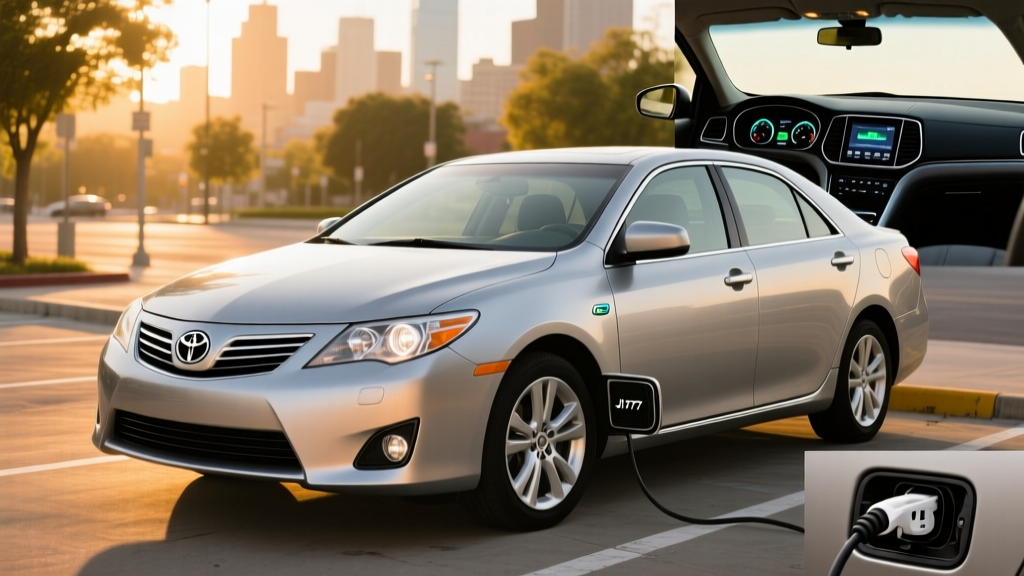
The 2009 Toyota Camry Hybrid sedan occupies a unique space in the used-car market: it's old enough to be dirt-cheap on the used lot, yet it carries Toyota's early hybrid reputation for bulletproof reliability. If you're cross-shopping this 15-year-old hybrid against newer gas sedans or considering it as a budget commuter, you need hard data on what the 2.4-liter hybrid powertrain actually delivers today — not what the brochure promised in 2009.
This guide breaks down the real-world fuel economy, hybrid battery health expectations, replacement costs, and whether this first-generation Camry Hybrid still makes financial sense for today's driver.
Fuel Economy: EPA Ratings vs. Real-World MPG
The 2009 Camry Hybrid uses Toyota's second-generation Hybrid Synergy Drive (HSD) system, pairing a 2.4-liter four-cylinder Atkinson-cycle engine with an electric motor. Unlike a plug-in hybrid (PHEV), this is a conventional hybrid (HEV) — it never plugs in. The battery recharges through regenerative braking and the gasoline engine.
| Metric | EPA Rating | Real-World Expectation (2026) |
|---|---|---|
| City MPG | 33 MPG | 30–35 MPG (regenerative braking favors stop-and-go) |
| Highway MPG | 34 MPG | 28–32 MPG (less regen opportunity, higher sustained speeds) |
| Combined MPG | 34 MPG | 29–33 MPG depending on battery health and driving style |
Source: EPA Fuel Economy Guide.
Real-world note: The Camry Hybrid's city MPG often matches or slightly exceeds its highway figure — a hallmark of Toyota's hybrid system. Regenerative braking recovers energy in stop-and-go traffic that a conventional gas car wastes as heat. On the highway, the electric motor contributes less and the Atkinson-cycle engine does the heavy lifting, reducing the hybrid advantage. Expect combined figures closer to 30–31 MPG in mixed driving if the original hybrid battery is still in service; a degraded battery will push fuel economy toward the high 20s.
Hybrid Powertrain: Engine, Motor, and Combined Output
The 2009 Camry Hybrid's powertrain was advanced for its era and remains mechanically straightforward:
| Component | Specification |
|---|---|
| Gasoline Engine | 2.4L 4-cylinder Atkinson-cycle (2AZ-FXE) |
| Engine Output | 147 hp @ 6,000 rpm / 138 lb-ft @ 4,400 rpm |
| Electric Motor | Permanent magnet synchronous, 30 kW (40 hp) |
| Combined Net Horsepower | 187 hp |
| Transmission | eCVT (electronically controlled continuously variable) |
| Hybrid Battery | Nickel-metal hydride (NiMH), 244.8V nominal, ~1.6 kWh gross |
| 0–60 mph | ~8.5 seconds (Car and Driver tested) |
The eCVT is not a belt-and-pulley CVT like those in some Nissan or Subaru models. Toyota's eCVT uses a planetary gearset to blend engine and motor power — there are no belts to wear, no cones to slip. This is one reason the Camry Hybrid's transmission is considered nearly indestructible.
HEV vs. PHEV vs. EV: Where the 2009 Camry Hybrid Fits
If you're weighing the 2009 Camry Hybrid against newer electrified options, the distinctions matter:
Conventional Hybrid (HEV) — 2009 Camry Hybrid
- No plug required. The battery charges via regen braking and the gas engine.
- No electric-only range. The motor assists the engine but cannot drive the car alone at meaningful speeds for any distance.
- Advantage: Simplicity, no charging infrastructure needed, proven long-term reliability.
- Limitation: Still burns gasoline 100% of the time; no EV-mode commuting.
Plug-In Hybrid (PHEV) — e.g., Toyota Prius Prime, RAV4 Prime
- Plugs in to a standard 120V outlet or Level 2 charger.
- 25–44 miles of electric-only range (model dependent) before the gas engine engages.
- Advantage: Most daily commutes completed on electricity alone; gas engine available for road trips.
- Limitation: Higher purchase price, requires charging access for full benefit.
Battery Electric Vehicle (BEV) — e.g., Tesla Model 3, Hyundai Ioniq 6
- No gasoline at all. 250–400+ miles of EPA range on a full charge.
- Advantage: Lowest per-mile fuel cost, zero tailpipe emissions, minimal maintenance.
- Limitation: Requires home or reliable public charging; higher upfront cost; range affected by cold weather.
Choose the 2009 Camry Hybrid if: You need a sub-$6,000 commuter, lack charging access, drive 10,000–15,000 miles/year, and want Toyota reliability without any plug-in logistics.
Choose a PHEV if: You have home charging, a sub-40-mile daily commute, and want to eliminate most gasoline use while keeping road-trip flexibility.
Choose a BEV if: You have reliable Level 2 home charging, want the lowest operating cost, and your typical trips fall within 200–300 miles.
Hybrid Battery Lifespan and Replacement Cost
The 2009 Camry Hybrid's NiMH battery pack is the single biggest variable in a used purchase. Here's what 15+ years of fleet data tells us:
Original Battery Warranty
Toyota warranted the hybrid battery for 8 years / 100,000 miles (10 years / 150,000 miles in CARB states: CA, CT, ME, MA, NJ, NY, OR, RI, VT, WA). That warranty has expired on all 2009 models unless the battery was replaced under warranty and the replacement carries its own coverage period.
Real-World Battery Degradation
NiMH batteries in Toyota hybrids degrade more gracefully than early lithium-ion packs, but 15-year-old cells are living on borrowed time. Common failure patterns:
- 120,000–180,000 miles: Typical lifespan for original NiMH packs in moderate climates. Many 2009 Camry Hybrids are now in or past this window.
- Heat is the enemy: Vehicles in AZ, TX, NV, and FL see earlier battery failures — often 100,000–140,000 miles.
- Gradual capacity loss: Unlike a sudden EV battery cliff, NiMH packs slowly lose capacity. You'll notice reduced EV-mode assist, slightly lower MPG, and more frequent engine cycling before total failure.
- Cell imbalance: Individual NiMH cells weaken unevenly. A single bad cell can trigger the hybrid system warning light and disable EV assist.
Battery Replacement Options and Costs (2026)
| Option | Cost Range | Warranty | Notes |
|---|---|---|---|
| New OEM Toyota battery | $3,000–$4,200 (parts + labor) | 3 yr / 36,000 mi | Dealer-installed; often uneconomical on a car worth $4,000–$7,000 |
| Remanufactured battery | $1,500–$2,500 (parts + labor) | 1–3 years typical | Replaced weak cells; quality varies by supplier (Green Bean Batteries, Dorman) |
| Used/salvage battery | $400–$900 (parts) + $300–$500 labor | 30–90 days | Highest risk; remaining lifespan unknown |
| Individual cell replacement | $200–$600 (DIY or specialist) | None/limited | Requires hybrid battery knowledge; identifies and swaps only bad cells |
For a 2009 Camry Hybrid with a fair market value of $4,000–$7,000 (depending on mileage and condition), a $3,500+ OEM battery replacement often doesn't pencil out. A quality remanufactured pack at $1,800–$2,200 installed is the most common path and can extend the car's life another 4–6 years.
Reliability and Long-Term Ownership Costs
Beyond the hybrid battery, the 2009 Camry Hybrid benefits from one of Toyota's most durable platforms:
- 2AZ-FXE engine: The Atkinson-cycle variant of Toyota's 2.4L four is well-proven. Timing chain (not belt), aluminum block. Common issue: excessive oil consumption in some 2AZ-FE/FXE engines from this era — check for TSBs and whether the engine was rebuilt or replaced under Toyota's oil-consumption warranty extension.
- eCVT transmission: Planetary gearset design is extraordinarily reliable. Fluid changes every 60,000 miles are recommended but often neglected — verify maintenance history.
- Inverter/cooling system: The hybrid inverter coolant pump can fail (Toyota issued a recall for certain model years). Confirm recall completion via NHTSA recall lookup.
- Brakes: Regenerative braking significantly reduces pad wear. Original brake pads lasting 80,000–100,000 miles is common.
- 12V auxiliary battery: Like all hybrids, the Camry has a standard 12V battery for accessories. If it dies, the hybrid system won't start — even with a full hybrid battery. Replace every 4–5 years with an AGM-spec battery.
Estimated Annual Operating Cost (2026)
At 12,000 miles/year, 30 MPG combined, and $3.40/gallon regular unleaded:
- Fuel cost: ~$1,360/year ($113/month)
- Insurance: ~$900–$1,200/year (varies by state, driver profile)
- Maintenance: ~$400–$600/year (oil changes, filters, tires — hybrid-specific maintenance is minimal)
- Total annual operating cost: ~$2,660–$3,160
For comparison, a 2009 Camry LE (non-hybrid, 2.4L, EPA 24 MPG combined) at the same mileage and fuel price costs roughly $1,700/year in fuel alone — $340 more annually. The hybrid premium pays for itself in fuel savings if you keep the car long enough and the hybrid battery holds up.
Used Pricing and Tax Credit Eligibility
The 2009 Camry Hybrid is well outside any current federal incentive window:
- Federal §30D New EV Credit: Not applicable — this credit covers new plug-in vehicles only. The 2009 Camry Hybrid is a conventional HEV with no plug and no qualifying battery capacity.
- Federal Used EV Credit (§25E): Not applicable — this credit (up to $4,000 or 30% of sale price) covers used plug-in EVs and PHEVs. Conventional hybrids do not qualify.
- State incentives: A handful of states offer used hybrid incentives or HOV lane access, but most have expired or apply only to plug-in vehicles. Check your state's DMV or energy office for current programs.
Current Used Market Pricing (Early 2026)
| Condition / Mileage | Price Range |
|---|---|
| Excellent, under 90,000 mi, hybrid battery confirmed healthy | $6,500–$8,000 |
| Good, 90,000–140,000 mi, battery original but functional | $4,500–$6,500 |
| Fair, 140,000+ mi, battery showing degradation or recently replaced | $3,000–$4,500 |
| Project/needs battery replacement | $1,800–$3,000 |
Pre-Purchase Checklist: What to Inspect
If you're seriously considering a 2009 Camry Hybrid, these steps are non-negotiable:
- Hybrid battery health check: Use a scan tool (Techstream or an OBD-II reader with hybrid data) to read individual battery block voltages. Variance greater than 0.3V between blocks indicates cell imbalance and impending failure.
- Hybrid battery cooling fan: Located behind the rear seat. Listen for it running; a clogged or failed fan causes battery overheating and accelerated degradation.
- Oil consumption test: Check oil level at purchase and monitor over the first 1,000 miles. Burning more than 1 quart per 1,200 miles indicates the known 2AZ-FXE oil-consumption issue.
- Inverter coolant pump: With the car ON (Ready mode, not just accessory), check the inverter coolant reservoir under the hood for fluid turbulence — this confirms the pump is circulating.
- Recall status: Run the VIN at NHTSA.gov to confirm all open recalls (including the hybrid inverter and brake actuator campaigns) were completed.
- Transmission fluid: Toyota calls the eCVT fluid "lifetime," but at 15 years old, it should have been changed at least twice. Dark or burnt-smelling fluid signals neglect.
Pros and Cons: The Honest Assessment
Pros
- Proven 30–34 MPG combined with no plug-in requirement
- Toyota reliability: eCVT and 2.4L engine are among the most durable in the industry
- Regenerative braking extends brake pad life significantly
- Low purchase price ($3,000–$7,000) with strong parts availability
- Comfortable ride, spacious trunk, straightforward controls
- No charging infrastructure needed — ideal for apartment dwellers
Cons
- Hybrid battery likely at or past end-of-life; replacement costs $1,500–$4,200
- Known oil-consumption issue on 2AZ-FXE engine
- No federal or state tax credits available for conventional hybrids
- Dated interior tech: no Apple CarPlay, no USB-C, basic infotainment
- Safety tech is pre-modern: no automatic emergency braking, no lane-keeping assist
- Hybrid battery degradation reduces MPG and performance over time
Frequently Asked Questions
How many MPG does the 2009 Toyota Camry Hybrid get?
The EPA rates it at 33 city / 34 highway / 34 combined MPG. In real-world 2026 driving with an aging NiMH battery, expect 29–33 MPG combined. City driving often yields better numbers than highway because regenerative braking recovers energy at low speeds.
Does the 2009 Camry Hybrid need to be plugged in?
No. This is a conventional hybrid (HEV), not a plug-in hybrid (PHEV). The battery charges through regenerative braking and the gasoline engine. There is no charge port, no electric-only driving range, and no need for any charging equipment.
Is the 2009 Camry Hybrid reliable?
The powertrain (engine + eCVT) is among the most reliable Toyota has ever built. The primary risk factor is the hybrid battery, which is now 15+ years old and likely near or past its service life. Budget $1,500–$2,500 for a remanufactured battery replacement if the original pack hasn't been replaced. The known 2AZ-FXE oil consumption issue should also be checked.
How much does it cost to replace the hybrid battery?
A new OEM Toyota battery runs $3,000–$4,200 installed, but most owners opt for a remanufactured pack at $1,500–$2,500 installed, which is more proportional to the car's value. Used/salvage batteries cost $700–$1,400 installed but carry significant risk.
Does the 2009 Camry Hybrid qualify for any tax credit?
No. Federal tax credits (§30D for new, §25E for used) apply only to plug-in electric vehicles and PHEVs. Conventional hybrids like the Camry Hybrid do not qualify. Some states previously offered hybrid incentives, but most have expired or shifted to plug-in vehicles only.
Hybrid vs. PHEV vs. EV — which should I choose?
The 2009 Camry Hybrid (HEV) makes sense if you need the cheapest possible reliable commuter with no charging logistics. A PHEV (like a used Prius Prime) suits drivers with home charging and short commutes who want partial electric driving. A full EV is best for drivers with reliable Level 2 charging who want the lowest per-mile cost and don't mind a higher upfront price.
What should I check before buying a used 2009 Camry Hybrid?
Prioritize: hybrid battery block voltage variance (under 0.3V), inverter coolant pump operation, oil consumption history, eCVT fluid condition, and NHTSA recall completion. A pre-purchase inspection at a Toyota dealer or hybrid specialist is worth the $150–$250 fee.
The Verdict: Is the 2009 Camry Hybrid Still Worth It?
At $3,000–$7,000 on the used market, the 2009 Toyota Camry Hybrid sedan remains one of the most cost-effective commuter cars available — if you budget for hybrid battery replacement. The 30–34 MPG real-world fuel economy saves roughly $300–$500 per year over the non-hybrid Camry, and the eCVT powertrain will likely outlast the car's body.
The smart buy: a well-maintained example at 100,000–130,000 miles with a recently replaced remanufactured battery, priced around $5,000–$6,000. Factor in $1,800–$2,200 for a battery replacement if it hasn't been done, and you're still into a reliable daily driver for under $8,000 total — a figure no new or certified-pre-owned electrified vehicle can match.
Just don't expect modern safety tech, infotainment, or any path to electric-only driving. This is a gasoline-sipping workhorse from Toyota's hybrid vanguard, and that's exactly what makes it a rational budget buy in 2026.