Quick Verdict: A Rare Toyota Hybrid in Nissan Clothing
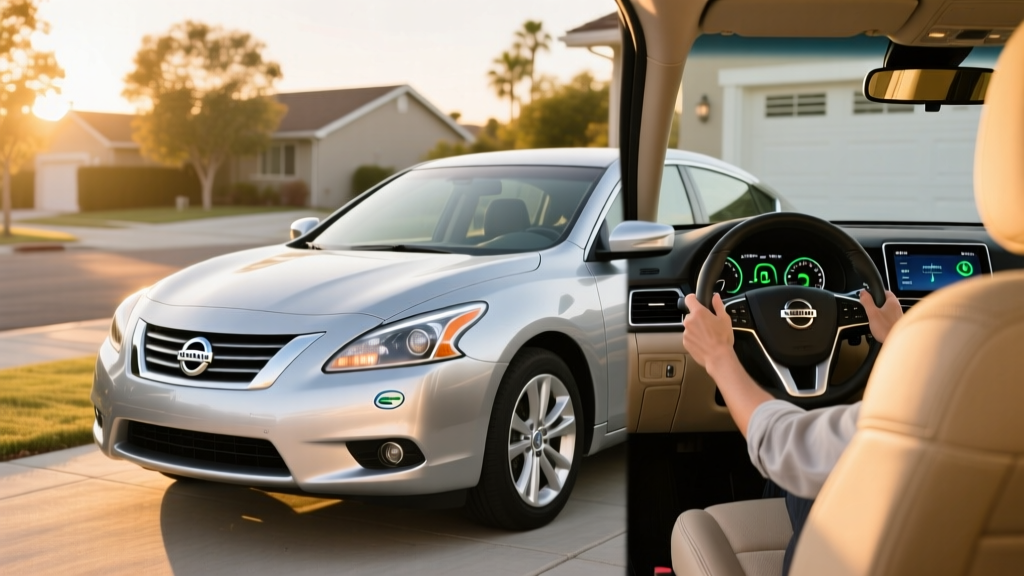
The 2009 Nissan Altima Hybrid occupies a strange place in automotive history. Nissan licensed Toyota's Hybrid Synergy Drive technology — the same proven system underpinning the Camry Hybrid of the same era — and dropped it into the Altima sedan. The result was a midsize hybrid with competitive fuel economy, smooth city driving, and Toyota-grade hybrid reliability, wrapped in Nissan's more aggressive styling. For used-car shoppers in 2026 evaluating the hybrid Nissan Altima 2009 model year, the critical questions are battery longevity, real-world MPG, and whether this discontinued hybrid still holds up against modern alternatives.
This guide covers every spec that matters: EPA fuel economy, powertrain details, battery warranty and replacement cost, and a clear-eyed look at who should (and shouldn't) buy one today.
HEV vs. PHEV vs. EV: Where the 2009 Altima Hybrid Fits
The 2009 Altima Hybrid is a conventional hybrid electric vehicle (HEV). It cannot plug in. It has no electric-only driving range. Its small battery recharges exclusively through regenerative braking and the gasoline engine. This is a fundamentally different architecture from a plug-in hybrid (PHEV) like the Toyota RAV4 Prime or a battery-electric vehicle (BEV) like the Tesla Model 3.
HEV vs. PHEV vs. EV — Key Differences
| Feature | HEV (2009 Altima Hybrid) | PHEV (e.g., 2026 RAV4 Prime) | BEV (e.g., 2026 Model 3) |
|---|---|---|---|
| Plugs in? | No | Yes (Level 1/2) | Yes (Level 1/2/DC) |
| Electric-only range | 0 miles | ~42 miles | ~340 miles |
| Battery size | ~1.6 kWh (NiMH) | 18.1 kWh (Li-ion) | 60-82 kWh (Li-ion) |
| Federal tax credit (§30D) | None | Up to $7,500* | Up to $7,500* |
| Gasoline required? | Yes | Yes (for trips beyond EV range) | No |
*§30D credit eligibility depends on MSRP caps, buyer income limits, and battery component/critical-mineral sourcing. See IRS.gov for current-year rules.
If you're cross-shopping the 2009 Altima Hybrid, you're comparing it against other used HEVs — the 2009 Toyota Camry Hybrid, Honda Civic Hybrid, or Ford Fusion Hybrid of the same era — not against modern PHEVs or EVs.
Fuel Economy: EPA MPG and Real-World Numbers
The 2009 Altima Hybrid carries EPA ratings of 35 MPG city / 33 MPG highway / 34 MPG combined, according to fueleconomy.gov. These numbers were competitive in 2009 and remain respectable for a midsize gasoline sedan today.
| Cycle | MPG |
|---|---|
| City | 35 |
| Highway | 33 |
| Combined | 34 |
Real-World MPG: What Owners Actually See
Hybrids tend to outperform their EPA city ratings in stop-and-go driving because regenerative braking recovers energy that a gas-only car wastes as heat. Many Altima Hybrid owners on forums and fuel-tracking sites report 36-38 MPG in mixed suburban driving, with city-heavy commutes occasionally pushing above 38 MPG.
However, sustained highway driving at 75+ MPH drops efficiency to the low 30s. Cold weather (below 35°F) reduces MPG by roughly 10-15%, as the engine runs more frequently to maintain cabin heat and the battery's charge-acceptance rate drops. A 2009 Altima Hybrid with 150,000+ miles and the original battery may see 1-3 MPG less than the sticker if the hybrid battery has degraded enough to reduce regen effectiveness.
Powertrain: Toyota's Hybrid System Under a Nissan Hood
The 2009 Altima Hybrid pairs a 2.5-liter inline-4 gasoline engine (QR25DE, producing 158 horsepower on its own) with an electric motor integrated into the transaxle. Combined system output is 198 horsepower, routed through an electronically controlled CVT (continuously variable transmission).
| Specification | Value |
|---|---|
| Engine | 2.5L inline-4 (QR25DE) |
| Engine HP | 158 hp @ 5,600 rpm |
| Electric motor | Permanent-magnet synchronous, 30 kW (40 hp) |
| Combined system HP | 198 hp |
| Transmission | eCVT (electronically controlled CVT) |
| Hybrid battery | Nickel-metal hydride (NiMH), ~1.6 kWh |
| Drivetrain | Front-wheel drive |
| 0-60 mph | ~7.8 seconds (est.) |
The Toyota-sourced hybrid transaxle (often referred to as the P510 unit) is the same architecture used in the 2007-2011 Camry Hybrid. This matters for reliability: that system has logged billions of real-world miles across Toyota and Lexus models, and its failure modes are well-documented and repairable.
Driving character is typical of 2000s-era Toyota hybrids: smooth, quiet electric-only starts from a stop, seamless engine engagement, and a noticeable CVT drone under hard acceleration. The Altima's sportier chassis tuning gives it marginally better handling than the Camry Hybrid, but the powertrain calibration prioritizes efficiency over performance.
Battery Lifespan, Degradation, and Replacement Cost
Battery Warranty & Lifespan Callout
Original warranty: Nissan covered the hybrid battery for 8 years / 100,000 miles (10 years / 150,000 miles in CARB states like California, New York, and Massachusetts). As of 2026, every 2009 Altima Hybrid is well past its factory hybrid-battery warranty.
Expected lifespan: Toyota/Nissan NiMH hybrid batteries of this generation typically last 150,000-200,000 miles before significant degradation, though many exceed 200,000 miles with reduced efficiency rather than outright failure.
Signs of Hybrid Battery Degradation
- Reduced MPG: A 2-5 MPG drop from baseline is often the first symptom. The battery can no longer accept or deliver full regenerative charge, so the engine runs more often.
- Frequent engine cycling: The gas engine starts and stops more aggressively, even at low speeds where electric-only mode would normally suffice.
- State-of-charge swings: The dashboard battery gauge rapidly fluctuates between near-full and near-empty.
- Diagnostic codes: P0A80 (replace hybrid battery pack) or individual module voltage-deviation codes (P0A7F-P0A8A range).
Replacement Cost in 2026
| Option | Cost Range | Notes |
|---|---|---|
| New OEM battery (Nissan dealer) | $3,000–$4,000 | Full pack, installed. May be hard to source for a 2009 model. |
| Remanufactured battery (specialty shop) | $1,800–$2,800 | Replaced weak NiMH modules, rebalanced. Common route for this era. |
| Used/salvage battery | $800–$1,500 | From a wrecked Altima/Camry Hybrid. Mileage and age are unknowns. |
| Individual module replacement | $400–$900 | Only the failed modules replaced. Budget option; requires a knowledgeable technician. |
Because the Altima Hybrid shares its hybrid architecture with the 2007-2011 Camry Hybrid, remanufactured packs and used modules are widely available from hybrid specialists. This is a significant advantage over orphaned hybrid models with no parts-sharing network.
Does the 2009 Altima Hybrid Qualify for Any Tax Credit?
No. The federal §30D New Clean Vehicle Credit applies only to new plug-in vehicles (PHEVs and BEVs) purchased new. The 2009 Altima Hybrid is a conventional HEV — it has no plug, no electric-only range, and was never eligible for the federal hybrid tax credit even when new (that credit expired for Nissan after the company hit its cap, and it applied only to qualifying HEVs purchased before 2010 under the old Energy Policy Act structure).
The Used Clean Vehicle Credit (§25E) — which offers up to $4,000 or 30% of the sale price for qualifying used EVs and PHEVs — also does not apply. Conventional hybrids are excluded from §25E. Only used BEVs and PHEVs with a plug qualify.
Some states offer their own incentives for hybrids, but these are rare and change frequently. Check your state's energy or DMV website for current programs.
Reliability and Ownership Costs
The 2009 Altima Hybrid benefits from one of the most proven hybrid powertrains ever built. The Toyota Hybrid Synergy Drive has demonstrated exceptional longevity across millions of vehicles. The NiMH battery chemistry is inherently stable and less prone to thermal runaway than early lithium-ion packs.
However, the Altima itself has some non-hybrid reliability concerns to watch:
- CVT transmission (non-hybrid models): The conventional Altima's Jatco CVT was notorious for premature failure. The hybrid uses a different eCVT (Toyota's planetary-gear design), which is far more robust. This is a reliability advantage for the hybrid.
- Brake wear: Regenerative braking reduces friction-brake use significantly. Many owners report original brake pads lasting 80,000+ miles.
- Power steering: Electric power steering rack issues have been reported on 2007-2009 Altimas, hybrid and non-hybrid alike.
- 12V battery: Like all hybrids, the Altima has a standard 12V auxiliary battery. If it dies, the car won't start even if the hybrid battery is full. Replace it on the standard 4-5 year interval.
Estimated Annual Ownership Costs (2026)
At 12,000 miles per year and $3.30/gallon regular unleaded, the 34 MPG combined rating yields roughly $1,165 per year in fuel costs. That's approximately $550-700 less per year than a comparable non-hybrid 2009 Altima 2.5S (rated at 23/31 MPG, ~26 combined), depending on your local gas prices.
Who Should Buy the 2009 Altima Hybrid — And Who Shouldn't
Buy It If:
- You want a cheap, fuel-efficient commuter sedan under $5,000
- Your commute is city-heavy (stop-and-go maximizes hybrid MPG advantage)
- You want Toyota hybrid reliability without Camry pricing
- You can't install a home charger (no plug needed)
- You drive 12,000+ miles/year and want to minimize fuel spend without a large upfront investment
Skip It If:
- The hybrid battery has already been flagged for replacement and the price doesn't reflect that cost
- You want electric-only driving or plug-in capability
- You want modern safety tech (blind-spot monitoring, automatic emergency braking — not available on this generation)
- You primarily drive highway miles at 75+ MPH (the hybrid advantage shrinks)
- You want eligibility for any federal or state EV/PHEV tax credit
Hybrid vs. PHEV vs. EV: Which Fits You?
If you're considering the 2009 Altima Hybrid but also wondering about a used PHEV or EV, here's the decision framework:
- HEV (this car): Best for budget buyers ($3,000-$6,000), no home charging access, high-mileage commuters who want simplicity. No plug, no range anxiety, no tax credit.
- Used PHEV (e.g., 2017+ Prius Prime, 2018+ Clarity PHEV): Best if you have home charging and a short commute (under 25 miles) but still need gas flexibility for road trips. Eligible for the §25E used-vehicle credit (up to $4,000) if price and income qualify.
- Used BEV (e.g., 2018+ Leaf, 2019+ Bolt): Best if you have reliable home Level 2 charging, drive under 200 miles/day, and want near-zero fuel maintenance. Also eligible for §25E credit. Battery health is the critical check.
Frequently Asked Questions
How many MPG does the 2009 Nissan Altima Hybrid get?
The EPA rates it at 35 MPG city, 33 MPG highway, and 34 MPG combined. Real-world mixed driving typically yields 34-38 MPG, with city-heavy routes trending higher and sustained highway driving trending lower. Cold weather reduces efficiency by 10-15%.
Is the 2009 Altima Hybrid a plug-in?
No. It is a conventional hybrid (HEV). The battery charges only through regenerative braking and the gasoline engine. There is no charging port and no electric-only driving mode.
How reliable is the 2009 Altima Hybrid's hybrid system?
Very reliable. The Toyota Hybrid Synergy Drive is one of the most proven hybrid systems ever produced, with NiMH batteries commonly lasting 150,000-200,000+ miles. The eCVT (planetary gearset, not a belt-driven CVT) is significantly more durable than the conventional Altima's Jatco CVT.
What does a replacement hybrid battery cost?
Expect $1,800-$2,800 for a remanufactured pack from a hybrid specialist, $3,000-$4,000 for a new OEM battery (if still available), or $800-$1,500 for a used salvage pack. Individual module replacement can cost as little as $400-$900 if only a few cells have failed.
Does the 2009 Altima Hybrid qualify for a tax credit?
No. It is not eligible for the federal §30D new-vehicle credit (HEVs excluded, and the vehicle is used) or the §25E used-vehicle credit (applies only to PHEVs and BEVs). No state currently offers a hybrid-specific purchase incentive for a vehicle of this age.
Can I still get parts for the 2009 Altima Hybrid?
Yes. The hybrid powertrain shares components with the 2007-2011 Toyota Camry Hybrid, so hybrid-specific parts (battery modules, inverter, transaxle) are available through Toyota's parts network and hybrid specialists. Conventional Altima body, suspension, and interior parts remain widely available.
How does it compare to the 2009 Camry Hybrid?
The two share the same fundamental hybrid powertrain. The Camry Hybrid was rated at 33/34/34 MPG (city/highway/combined) — nearly identical. The Altima Hybrid offers slightly sportier handling and styling; the Camry Hybrid has a more refined ride and a larger dealer/service network. In 2026, Camry Hybrids of this era tend to command a $500-$1,500 premium on the used market due to brand perception and parts availability.