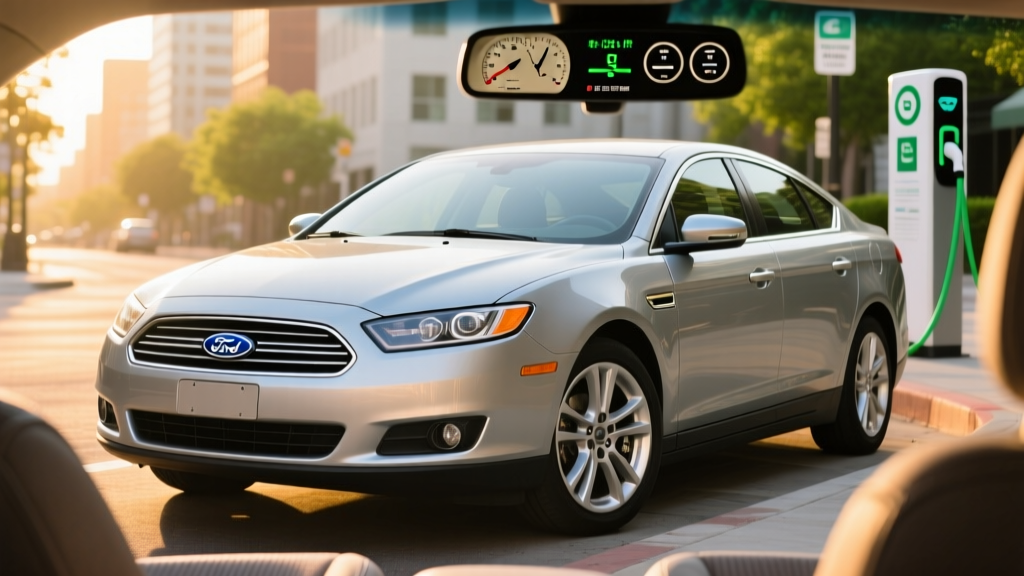
The 2009 Ford Fusion Hybrid was Ford's first serious entry into the midsize hybrid sedan segment, taking direct aim at the Toyota Camry Hybrid with a full hybrid powertrain that could operate on electric power alone at low speeds. More than 15 years later, these cars are still on the road in meaningful numbers, and the search for "2009 Ford hybrid" information remains steady among used-car shoppers looking for ultra-cheap, fuel-efficient daily drivers. This guide covers everything a 2026 buyer needs to know: real-world MPG, battery longevity, replacement costs, and whether a 2009 Fusion Hybrid still makes financial sense versus a modern PHEV or full EV.
2009 Ford Fusion Hybrid: Full Powertrain and Efficiency Specs
The 2009 Fusion Hybrid uses Ford's second-generation full hybrid system, co-developed with Aisin. It pairs a 2.5-liter Atkinson-cycle four-cylinder gasoline engine with a permanent-magnet AC synchronous electric motor, routed through an electronically controlled continuously variable transmission (eCVT). This is a conventional hybrid (HEV) — it charges its battery exclusively through regenerative braking and the gas engine. There is no plug, no charging port, and no electric-only driving range beyond brief low-speed assist.
| Specification | Value |
|---|---|
| Engine | 2.5L Atkinson-cycle I4 |
| Engine horsepower | 156 hp @ 6,000 rpm |
| Electric motor output | 106 hp (70 kW) |
| Combined system horsepower | 191 hp |
| Transmission | eCVT (planetary gearset) |
| Hybrid battery | 1.35 kWh NiMH (nickel-metal hydride) |
| Drivetrain | Front-wheel drive |
| 0-60 mph | ~8.7 seconds |
| Curb weight | 3,720 lbs |
| EPA City MPG | 41 |
| EPA Highway MPG | 36 |
| EPA Combined MPG | 39 |
How Many MPG Does the 2009 Ford Hybrid Actually Get?
The EPA rated the 2009 Fusion Hybrid at 41 city / 36 highway / 39 combined MPG, according to fueleconomy.gov. That city-biased rating is characteristic of full hybrids: the electric motor handles low-speed driving and stop-and-go traffic, where it is most efficient, while the gasoline engine dominates at sustained highway speeds.
| Driving Scenario | EPA Estimate | Real-World Expectation (2026) |
|---|---|---|
| City / stop-and-go | 41 MPG | 38–43 MPG |
| Highway (70 mph) | 36 MPG | 33–36 MPG |
| Combined mixed | 39 MPG | 35–40 MPG |
| Cold weather (below 32°F) | — | 30–35 MPG |
Real-world note: Hybrids routinely match or exceed their EPA city numbers because regenerative braking recovers energy that gas cars waste as heat. In warm-weather city driving, owners report 40+ MPG regularly. Highway efficiency drops because the gasoline engine carries the full load and the car's aerodynamics and weight (3,720 lbs) work against it at speed. Cold weather reduces MPG by 10-15% due to engine warm-up enrichment, reduced battery efficiency in the NiMH pack, and increased rolling resistance from winter tires.
At 15,000 miles per year and $3.25/gallon regular unleaded, annual fuel cost runs approximately $1,250 — competitive with many modern non-hybrid compacts and significantly cheaper than the non-hybrid 2009 Fusion 4-cylinder (EPA 23 combined, ~$2,115/year at the same mileage and fuel price).
HEV vs. PHEV vs. EV: Where Does the 2009 Ford Hybrid Fit?
Understanding the difference is critical before you buy:
- Conventional Hybrid (HEV) — like the 2009 Fusion Hybrid: Small battery (1.35 kWh NiMH), charges itself via regen braking and the gas engine. No plug. No electric-only range to speak of (the motor assists at low speeds but cannot sustain EV mode). You fuel it like a normal car and get better MPG.
- Plug-in Hybrid (PHEV) — like the Ford Escape PHEV or Toyota RAV4 Prime: Larger battery (typically 15-20 kWh), plugs into a wall outlet or Level 2 charger, delivers 25-42 miles of electric-only driving before the gas engine kicks in. Operates as a hybrid after the battery is depleted.
- Battery Electric Vehicle (BEV) — like the Ford Mustang Mach-E: No gas engine. Large battery (70-100+ kWh), 250-350+ miles of range, charges via Level 2 or DC fast charging. Zero tailpipe emissions.
The 2009 Fusion Hybrid is strictly an HEV. It will never appear on a charging station, and no amount of searching will reveal a plug on it. For a used buyer, this is actually an advantage: there is no charging infrastructure dependency, no degraded plug-in battery to worry about, and no behavioral change required from driving a conventional gas car.
Battery Longevity, Warranty, and Replacement Cost
The single biggest concern for any used hybrid buyer is the high-voltage traction battery. The 2009 Fusion Hybrid uses a 1.35 kWh nickel-metal hydride (NiMH) battery pack — not the lithium-ion chemistry found in modern EVs and PHEVs. NiMH is an older, well-understood chemistry with predictable degradation characteristics.
Original Battery Warranty: Ford covered the 2009 Fusion Hybrid's battery for 8 years / 100,000 miles (extended to 10 years / 150,000 miles in California Air Resources Board states). As of 2026, every original warranty has expired — even in CARB states, a 2009 model is now 17 years old.
Expected Battery Lifespan: NiMH hybrid batteries typically last 150,000 to 200,000+ miles before significant degradation. Many 2009 Fusion Hybrids are still running on their original packs. Unlike EV batteries, the small NiMH pack in an HEV is never deeply cycled — it operates in a narrow state-of-charge window (roughly 40-80%), which dramatically extends cycle life.
Battery replacement cost (2026):
- New OEM Ford battery pack: $2,500–$3,500 (parts only; installation adds $500–$1,000 at a dealer)
- Remanufactured/reconditioned pack: $1,200–$2,000 installed at an independent hybrid specialist
- Used pack from salvage yard: $400–$800 (risky — unknown remaining life)
- Individual cell/module replacement: $200–$600 if only one or two modules have failed (requires a shop with hybrid diagnostic capability)
For context, a full battery replacement at $3,000–$4,000 installed still makes economic sense if the car is otherwise sound, since the Fusion Hybrid's fuel savings over a non-hybrid are roughly $800–$900 per year at 15,000 miles. The replacement pays for itself in 3.5–5 years of continued driving.
Reliability and Common Issues at 17 Years Old
The 2009 Fusion Hybrid shares its platform and powertrain with the Ford Escape Hybrid and Mercury Milan Hybrid, and the hybrid system itself has proven remarkably durable. NHTSA records show no systemic hybrid-system recalls specific to the battery or inverter. Common issues to inspect on a 2026 used purchase include:
- 12V auxiliary battery: Like all hybrids, the Fusion has a conventional 12V battery that powers electronics and boots the hybrid system. These fail every 4-6 years and are an inexpensive fix (~$180-$250).
- Brake actuator / regenerative braking transition: Some owners report a clunk or hesitation when transitioning between regenerative and friction braking. The brake actuator assembly can fail and costs $800–$1,400 to replace.
- Coolant pump (hybrid system): The electric coolant pump that circulates fluid through the inverter can fail. Replacement runs $400–$700. Check for coolant leaks around the inverter area.
- eCVT transmission: Ford's eCVT (a planetary gearset, not a belt-driven CVT) is extremely robust. Failures are rare but expensive ($3,000+) if they occur.
- Aging rubber, suspension, and interior: At 17 years old, expect worn bushings, potentially leaking struts, and degraded weatherstripping. Budget $1,000–$2,000 for deferred maintenance if the previous owner neglected it.
Pricing and Tax Credit Eligibility in 2026
The 2009 Ford Fusion Hybrid originally MSRP'd at $27,995 (single well-equipped trim). In 2026's used market, expect to pay:
- $3,500–$5,500 for a clean-title example with 120,000–160,000 miles
- $5,500–$7,500 for a low-mileage (under 90,000 miles) or exceptionally maintained example
- Under $3,000 for high-mileage or salvage-title cars (proceed with caution on hybrid components)
Federal tax credit: The 2009 Fusion Hybrid does not qualify for the current IRS §30D Clean Vehicle Credit. That credit applies only to new qualifying EVs and PHEVs (and certain used EVs/PHEVs under the §25E used-vehicle credit, which requires a battery of at least 7 kWh — the Fusion Hybrid's 1.35 kWh NiMH pack falls far short). No federal incentive is available for purchasing a conventional HEV, new or used.
Some states offer modest rebates or HOV-lane access for hybrids, but these vary by jurisdiction and frequently change. Check your state's energy or DMV website for current programs.
Who Should Buy a 2009 Ford Fusion Hybrid — And Who Shouldn't
Pros
- Strong city MPG (41 EPA, often exceeded in real-world stop-and-go)
- No charging required — fuel it like any gas car
- Proven, durable hybrid powertrain with 200,000+ mile battery life
- Very low purchase price ($3,500–$7,500 used)
- Comfortable midsize sedan with good ride quality and interior space
- 191 combined hp is adequate for merging and passing
Cons
- Highway MPG (36) is unremarkable by 2026 standards
- No electric-only range — this is not a PHEV
- 17-year-old vehicle: expect age-related maintenance regardless of hybrid system
- No federal tax credit or incentive available
- NiMH battery replacement is a $2,500–$4,000 liability at end of life
- Outdated infotainment, no modern driver-assist features (no AEB, no lane-keep)
- Insurance and registration costs may exceed the car's value in some states
Choose the 2009 Fusion Hybrid if: You need a cheap, reliable commuter that excels in city traffic, you have no access to home or workplace charging (making a PHEV or EV impractical), and you're comfortable with a 17-year-old car's maintenance realities. It's an excellent budget choice for Uber/Lyft drivers in stop-and-go urban markets where the 41 MPG city rating directly impacts profitability.
Look elsewhere if: You can afford $25,000+ and want modern safety tech, you have home charging access and could benefit from a PHEV like the Toyota RAV4 Prime (42 miles EV range, 94 MPGe) or a full EV like the Chevrolet Equinox EV (319 miles, eligible for the $7,500 federal credit). The fuel savings of the Fusion Hybrid over a modern turbo-4 gas sedan (30-35 combined MPG) are real but modest — roughly $400–$600/year — and may not justify the age and maintenance risk if you have other options.
Frequently Asked Questions
Does the 2009 Ford Fusion Hybrid need to be plugged in?
No. The 2009 Fusion Hybrid is a conventional hybrid (HEV). Its 1.35 kWh NiMH battery charges exclusively through regenerative braking and the gasoline engine. There is no charging port. You simply fill it with regular unleaded gasoline.
How many miles can the 2009 Fusion Hybrid go on electric only?
Effectively zero sustained electric-only miles. The electric motor assists the gas engine at low speeds (typically under 47 mph under light throttle) and can propel the car very short distances on flat ground, but the battery is too small (1.35 kWh) to provide meaningful EV-only driving. If electric-only range is a priority, you need a PHEV or a full BEV.
Is the 2009 Ford Fusion Hybrid reliable?
The hybrid powertrain — engine, electric motor, eCVT, and inverter — has proven very reliable, with many examples exceeding 200,000 miles without major hybrid-component failure. The primary reliability risk at this age is the high-voltage NiMH battery (replacement cost $2,500–$4,000) and standard aging-car items: suspension, brakes, cooling system, and electronics. A pre-purchase inspection by a hybrid-qualified mechanic is strongly recommended.
What is the battery replacement cost for a 2009 Fusion Hybrid?
A new OEM NiMH battery pack costs $2,500–$3,500 for the part, with installation adding $500–$1,000 at a Ford dealer. Remanufactured packs from hybrid specialists run $1,200–$2,000 installed. Individual module replacement (if only one or two cells fail) can cost as little as $200–$600 at a shop equipped for hybrid diagnostics.
Does the 2009 Ford Fusion Hybrid qualify for any tax credit in 2026?
No. The federal §30D Clean Vehicle Credit applies only to new qualifying plug-in vehicles (EVs and PHEVs). The §25E used-vehicle credit requires a battery capacity of at least 7 kWh; the Fusion Hybrid's 1.35 kWh pack does not qualify. No federal incentive is available. Some state or local programs may offer minor benefits — check your jurisdiction.
How does the 2009 Fusion Hybrid compare to the Toyota Camry Hybrid of the same era?
The 2009 Camry Hybrid was rated at 33 city / 34 highway / 34 combined — notably lower than the Fusion Hybrid's 41/36/39. Ford's more aggressive use of electric assist and the Atkinson-cycle 2.5L gave it a clear city-MPG advantage. However, Toyota's hybrid system has a stronger long-term parts-availability network, and Camry Hybrid batteries tend to be slightly cheaper to replace. Both are solid used buys; the Fusion wins on paper MPG, the Camry on parts ecosystem.