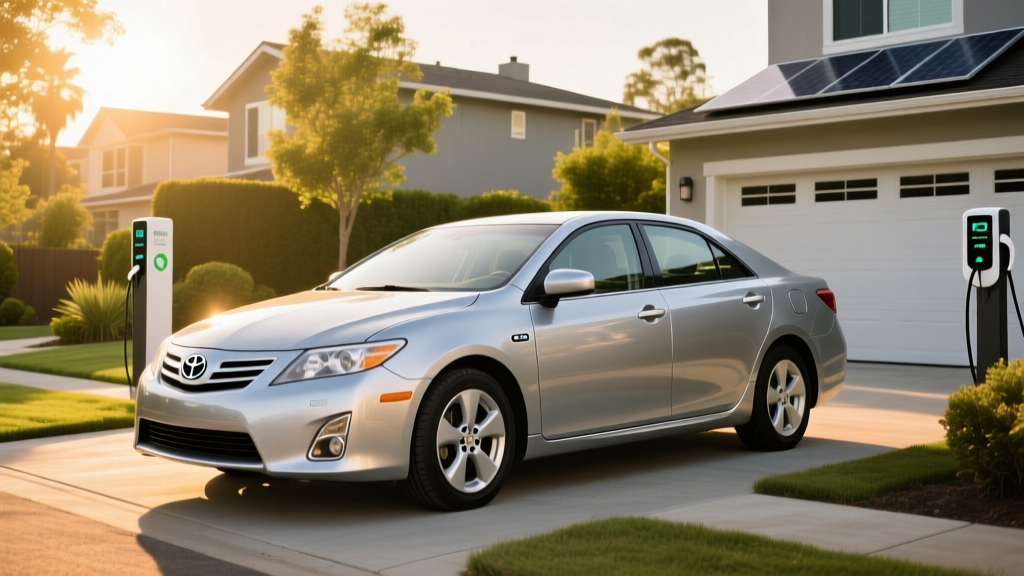
If you've been searching for camry hybrid mpg 2009 data, you're likely evaluating a used purchase or comparing an older hybrid against newer electrified options. The 2009 Toyota Camry Hybrid was one of the mainstream sedans that proved hybrid technology wasn't just for compact econoboxes — it delivered mid-size comfort with genuinely impressive fuel economy for its era. But how do those EPA numbers hold up in real-world driving nearly two decades later, and what does battery health look like on a 16-year-old hybrid?
This guide covers the 2009 Camry Hybrid's official MPG ratings, what you can actually expect at the pump today, battery longevity and replacement costs, and how it stacks up against modern HEVs, PHEVs, and full EVs in 2026.
2009 Camry Hybrid MPG: Official EPA Ratings vs. Real World
The EPA rated the 2009 Toyota Camry Hybrid at 33 MPG city / 34 MPG highway / 33 MPG combined. These figures come from the U.S. Department of Energy's fueleconomy.gov database, which remains the authoritative source for historical and current fuel-economy data.
| Metric | Value | |||
|---|---|---|---|---|
| City MPG | 33 | |||
| Highway MPG | 34 | |||
| Combined MPG | 33 | |||
| Fuel Type | Regular Unleaded (87 octane) | |||
| Fuel Tank Capacity | 17.2 gallons | |||
| EPA Estimated Range | ~567 miles per tank |
| Component | Specification |
|---|---|
| Engine | 2.4L 4-cylinder (2AZ-FXE, Atkinson cycle) |
| Engine Power | 147 HP @ 6,000 RPM |
| Electric Motor | Permanent-magnet synchronous, 40 HP (30 kW) |
| Combined System Output | 187 HP (net) |
| Transmission | ECVT (electronically controlled continuously variable) |
| Hybrid Battery | Nickel-Metal Hydride (NiMH), ~1.6 kWh (nominal) |
| 0–60 MPH | ~8.4 seconds |
| Drivetrain | Front-wheel drive |
The Atkinson-cycle engine sacrifices some low-end torque for greater thermal efficiency, while the electric motor fills in the torque gap during acceleration. The result is a powertrain that feels adequately responsive around town — the electric motor's instant torque makes stoplight launches surprisingly brisk — but isn't designed for aggressive highway merging. The ECVT is smooth and gearless, though it produces the characteristic "rubber-band" drone under hard acceleration that Toyota hybrids of this era are known for.
HEV vs. PHEV vs. EV: Which Powertrain Fits You?
The 2009 Camry Hybrid is a conventional hybrid (HEV), meaning it generates all its electricity internally through regenerative braking and the gasoline engine. You never plug it in. This is fundamentally different from a plug-in hybrid (PHEV) or a battery electric vehicle (BEV).
| Feature | HEV (e.g., 2009 Camry Hybrid) | PHEV (e.g., 2026 RAV4 Prime) | BEV (e.g., 2026 Model Y) |
|---|---|---|---|
| Plug-in Charging? | No | Yes (Level 1/2) | Yes (Level 1/2/DC) |
| Electric-Only Range | ~1 mile at low speed | 35–42 miles | 280–330+ miles |
| Battery Size | ~1.6 kWh (NiMH) | ~18 kWh (NMC/LFP) | 60–100 kWh (NMC/LFP) |
| Gasoline Required? | Yes, always | Only beyond electric range | No |
| Federal Tax Credit (§30D) | Not eligible | Up to $7,500 (if eligible) | Up to $7,500 (if eligible) |
| Best For | No charging access needed | Short commutes + road trips | Home charging + daily driving |
Battery Lifespan, Warranty, and Replacement Costs
For any used hybrid purchase, battery health is the single biggest financial risk. Here's what you need to know about the 2009 Camry Hybrid's NiMH pack.
How long do these batteries actually last? Toyota's NiMH packs from this generation have proven remarkably durable. Data from owner forums, repair shops, and fleet operators consistently show these batteries lasting 150,000–220,000 miles before significant degradation or failure. Some examples exceed 250,000 miles with gradual capacity loss rather than sudden failure. Heat is the primary enemy — vehicles in Arizona, Texas, and Southern California tend to see earlier battery failures than those in cooler climates.
Replacement costs in 2026:
- New OEM Toyota battery: $2,500–$3,500 (installed at a dealership)
- Refurbished/remanufactured battery: $1,200–$2,000 (installed at independent hybrid shops)
- Individual module replacement: $500–$900 (only the failed cells are swapped — viable when just one or two modules are weak)
- Used battery from salvage yard: $400–$800 (risky — unknown remaining life)
Before purchasing a 2009 Camry Hybrid, have a qualified technician perform a hybrid battery health scan using an OBD-II tool capable of reading individual module voltages. A healthy pack should show module voltage variance of less than 0.2V under load. Any variance exceeding 0.3V signals impending failure.
Does the 2009 Camry Hybrid Qualify for Any Tax Credit?
No. The 2009 Camry Hybrid does not qualify for the current federal §30D Clean Vehicle Credit. That credit applies only to new plug-in electric vehicles (PHEVs and BEVs) that meet battery sourcing, MSRP caps, and buyer income requirements as outlined by the IRS. Conventional hybrids like this Camry were never eligible for §30D.
The original federal hybrid tax credit for the Camry Hybrid (up to $2,600 under the Energy Policy Act of 2005) phased out for Toyota in 2007 after the manufacturer hit the 60,000-unit cap. So even at the time of purchase, a 2009 buyer received no federal incentive.
For used hybrid buyers in 2026, there are no federal tax credits available for purchasing a used HEV. Some states and local utilities offer rebates for used EVs and PHEVs, but conventional hybrids are almost universally excluded from current incentive programs.
2009 Camry Hybrid vs. Modern Alternatives in 2026
Is a 16-year-old hybrid still a smart buy? Here's how it compares to what's available today:
| Metric | 2009 Camry Hybrid (Used) | 2026 Camry Hybrid (New) | 2026 RAV4 Prime (PHEV) | 2026 Tesla Model Y (BEV) |
|---|---|---|---|---|
| Combined MPG / MPGe | 33 MPG (EPA) | 52 MPG (EPA) | 94 MPGe / 40 MPG gas | 123 MPGe |
| Electric-Only Range | ~1 mi | ~1 mi | 42 mi | 310+ mi |
| Approximate Price | $4,000–$7,500 | $29,995+ MSRP | $44,500+ MSRP | $44,990+ MSRP |
| Federal Tax Credit | None | None (HEV) | Up to $7,500* | Up to $7,500* |
| Annual Fuel/Energy Cost | ~$1,500 | ~$950 | ~$700 (mixed EV/gas) | ~$550 |
* Tax credit eligibility depends on MSRP caps, buyer income limits, battery sourcing requirements, and point-of-sale transfer rules. See IRS §30D guidelines for current-year details.
The 2009 Camry Hybrid's advantage in 2026 is purely financial: very low entry price with no charging infrastructure required. If you lack access to home or workplace charging, a conventional HEV remains the most practical electrified option. But the 2026 Camry Hybrid's 52 MPG combined rating — a 58% improvement — shows how far the technology has advanced. If you're spending $6,000 on a 2009 model and then face a $2,500 battery replacement, you're approaching the down payment on a far more efficient new hybrid.
Pros and Cons: Buying a 2009 Camry Hybrid in 2026
Pros
- Low purchase price ($4,000–$7,500 used)
- No plug-in charging required — works anywhere
- Toyota reliability and massive parts availability
- Still achieves 28–34 MPG real-world
- Comfortable mid-size sedan with solid trunk space
- Proven powertrain with extensive repair knowledge base
Cons
- Hybrid battery is 16+ years old — replacement likely imminent if not done
- No federal or state tax incentives
- Significantly lower MPG than modern hybrids (52 MPG for 2026 Camry)
- Outdated infotainment and safety technology
- NiMH battery less energy-dense than modern lithium packs
- Higher maintenance costs as vehicle ages (suspension, brakes, A/C)
Frequently Asked Questions
How many MPG does the 2009 Camry Hybrid get?
The EPA rates it at 33 MPG city, 34 MPG highway, and 33 MPG combined. In real-world 2026 driving, expect 28–32 MPG combined depending on driving style, climate, and battery health. City-heavy routes with frequent stops tend to yield the best numbers thanks to regenerative braking.
Can I plug in the 2009 Camry Hybrid?
No. The 2009 Camry Hybrid is a conventional hybrid (HEV), not a plug-in hybrid. It charges its small battery entirely through regenerative braking and the gasoline engine. There is no charging port and no electric-only driving range beyond very brief low-speed crawling.
How much does it cost to replace the hybrid battery?
In 2026, expect to pay $2,500–$3,500 for a new OEM battery at a Toyota dealer, or $1,200–$2,000 for a refurbished pack at an independent hybrid specialist. Individual module repairs can cost $500–$900 if only specific cells have failed.
Is the 2009 Camry Hybrid reliable?
Yes, with a caveat. The powertrain (engine, ECVT, hybrid system) is among the most reliable Toyota has ever built. The main risk is the aging NiMH battery. Beyond that, typical 16-year-old vehicle concerns apply: suspension wear, A/C system degradation, and potential oil consumption on the 2AZ-FXE engine (a known issue with this engine family at high mileage).
Should I buy a 2009 Camry Hybrid or a newer electrified car?
If your budget is under $8,000 and you have no access to plug-in charging, the 2009 Camry Hybrid remains a solid, efficient commuter. If you can spend $25,000+ and have home charging access, a newer hybrid, PHEV, or BEV will deliver dramatically better efficiency, modern safety features, and lower annual operating costs. A 2026 Camry Hybrid achieves 52 MPG combined — 58% more than the 2009 — while PHEVs and BEVs eliminate most or all gasoline use for daily driving.
Related reading
View all Hybrid & PHEV Hybrid Guide
2027 Kia Telluride Hybrid: MPG, Range, Pricing & What We Know
Everything we know about the 2027 Kia Telluride Hybrid: projected MPG, powertrain specs, pricing, tax credit eligibility, and how it stacks up against rivals.
 Hybrid Guide
2012 Lexus CT200h Hybrid: Real MPG, Battery Life & Used Buyer Guide
2012 Lexus CT200h hybrid gets 43 MPG combined EPA. Full specs, battery replacement cost, reliability data, and whether it still makes sense in 2026.
 Hybrid Guide
2015 Subaru XV Hybrid Review: MPG, Battery Life & Used Buyer's Guide
2015 Subaru XV Crosstrek Hybrid review: 31 MPG combined EPA, 0.6 kWh battery, AWD reliability, battery replacement costs, and used-buyer tips for 2026.