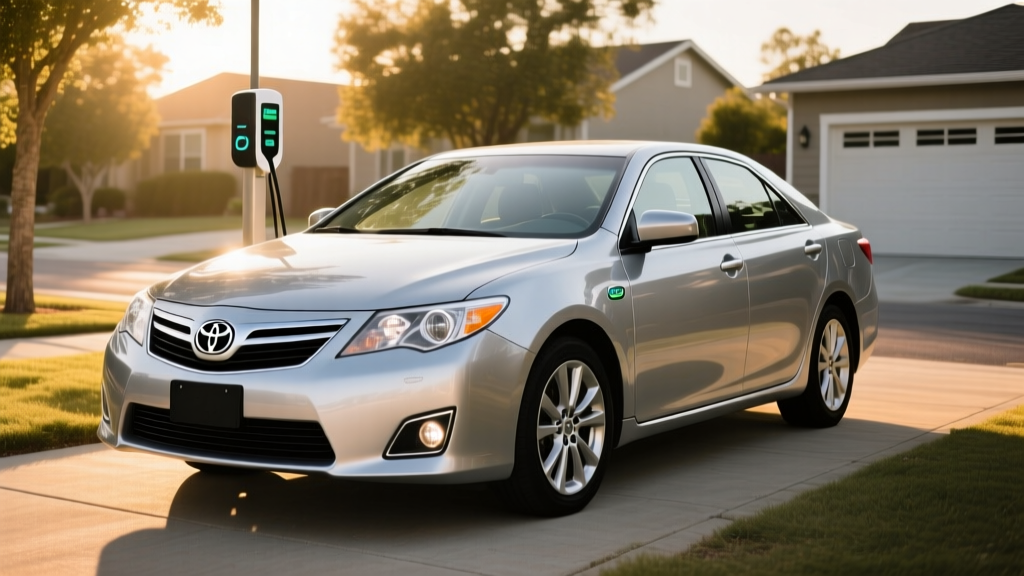
The 2008 Toyota Camry Hybrid occupies a unique spot in the used-car market nearly two decades after its debut. As one of the earliest mainstream hybrid sedans sold in the United States, it helped prove that electrified powertrains could deliver real-world fuel savings without sacrificing daily drivability. For buyers in 2026 searching for an ultra-affordable, fuel-efficient commuter — or evaluating whether a first-generation hybrid is still a sound investment — this guide breaks down every number that matters.
Before we get into the specs, a critical distinction: the 2008 Camry Hybrid is a conventional hybrid (HEV), not a plug-in hybrid (PHEV). It charges its own battery through regenerative braking and the gasoline engine. You never plug it in. This matters because it fundamentally changes how you evaluate the car compared to a PHEV or a full battery-electric vehicle (BEV).
Fuel Economy: EPA Ratings vs. Real-World MPG
The 2008 Camry Hybrid's headline number has always been its fuel efficiency. Here is the official EPA breakdown, sourced from fueleconomy.gov:
| Metric | EPA Estimate |
|---|---|
| City MPG | 33 MPG |
| Highway MPG | 34 MPG |
| Combined MPG | 34 MPG |
| Annual Fuel Cost (est.) | ~$1,550 (at $3.40/gal, 15,000 mi/yr) |
| Fuel Tank Capacity | 17.2 gallons |
| Total Range (est.) | ~585 miles |
Powertrain: Engine, Motor, and Combined Output
The 2008 Camry Hybrid pairs a 2.4-liter inline-four Atkinson-cycle gasoline engine with a permanent-magnet electric motor through Toyota's eCVT (electronically controlled continuously variable transmission). This is a series-parallel full hybrid system — the car can operate on the engine alone, the motor alone (at low speeds for short distances), or both simultaneously.
| Specification | Value |
|---|---|
| Gasoline Engine | 2.4L 4-cyl Atkinson-cycle (2AZ-FXE) |
| Engine Horsepower | 147 HP @ 6,000 RPM |
| Electric Motor Output | 40 HP (30 kW) |
| Combined Net Horsepower | 192 HP |
| Transmission | eCVT (planetary gearset) |
| Drivetrain | Front-wheel drive |
| 0–60 MPH | ~7.5 seconds |
The 192 combined horsepower figure was competitive with the four-cylinder Camry LE of the same era and gave the Hybrid respectable passing power. The eCVT is not a belt-driven CVT — it uses a planetary gearset that is mechanically simple and extremely durable, which is a significant reliability advantage over conventional automatic or belt-CVT transmissions.
Hybrid Battery: Specs, Lifespan, and Replacement Cost
The high-voltage traction battery in the 2008 Camry Hybrid is a nickel-metal hydride (NiMH) pack with a total capacity of approximately 1.6 kWh (usable capacity is significantly less, around 0.9–1.0 kWh, because the hybrid system maintains a state-of-charge window between roughly 40% and 80% to maximize longevity). This small buffer is why the battery lasts far longer than a BEV battery that cycles through its full capacity daily.
Battery Degradation and Real-World Longevity
NiMH batteries in Toyota's early hybrid systems have demonstrated exceptional longevity in practice. Data from owner surveys and fleet studies show that many 2007–2011 Camry Hybrid batteries reach 180,000–250,000 miles before requiring replacement. Some units have exceeded 300,000 miles. Degradation manifests as a gradual reduction in electric-only assist and a slight MPG decline (typically 1–3 MPG over 150,000 miles), rather than sudden failure.
Battery Replacement Cost in 2026
If the hybrid battery does fail, owners have several options:
- New OEM Toyota battery: $2,500–$3,500 (installed at a dealership)
- Refurbished/remanufactured battery: $1,200–$2,000 (installed at independent hybrid specialists)
- Individual cell module replacement: $400–$800 (requires a technician who can diagnose and swap individual NiMH modules within the pack — the most cost-effective option if only a few cells have degraded)
The cell-module repair approach is unique to NiMH packs and is not available for most modern NMC or LFP lithium-ion batteries, making the Camry Hybrid comparatively inexpensive to maintain at the battery level.
HEV vs. PHEV vs. EV: Where Does the Camry Hybrid Fit?
The 2008 Camry Hybrid is a conventional hybrid electric vehicle (HEV). It has no plug, no electric-only range to speak of (the motor assists at low speeds for roughly 1–2 miles under ideal conditions, but Toyota did not publish an electric-only range figure), and no external charging capability. Here is how it compares structurally to the other electrified options available to used-car buyers in 2026:
| Feature | 2008 Camry Hybrid (HEV) | Typical Used PHEV (e.g., 2017 Prius Prime) | Used BEV (e.g., 2018 Leaf) |
|---|---|---|---|
| Plugs In? | No | Yes (Level 1/2) | Yes (Level 1/2/DC) |
| Electric-Only Range | ~1 mi (low-speed assist) | ~25 mi | ~150 mi (degraded) |
| Total Range | ~585 mi | ~640 mi (combined) | ~150 mi |
| City MPG / MPGe | 33 MPG | ~55 MPG / 133 MPGe | ~112 MPGe |
| Gas Required? | Yes (always) | Yes (after EV range) | No |
| Home Charging Needed? | No | Recommended for EV range | Essential |
| Typical Used Price (2026) | $4,000–$7,500 | $12,000–$18,000 | $10,000–$16,000 |
The Camry Hybrid's advantage is simplicity: no plug, no charging infrastructure dependency, no range anxiety, and a proven powertrain with enormous parts availability. Its disadvantage is that it still burns gasoline for every mile — there is no zero-emission driving mode for daily commutes.
Does the 2008 Camry Hybrid Qualify for Any Tax Credits?
No. The 2008 Camry Hybrid does not qualify for the federal §30D New Clean Vehicle Credit, which applies only to new plug-in electric vehicles (BEVs and PHEVs) meeting specific battery-sourcing, MSRP, and buyer-income requirements under current IRS rules.
Additionally, the now-expired Alternative Motor Vehicle Credit (which once offered up to $3,150 for qualifying hybrids purchased new) ended for Toyota vehicles after September 30, 2007, when Toyota hit the 60,000-unit manufacturer cap. A 2008 model purchased new would not have been eligible, and no federal credit applies to used hybrid purchases.
The Used Clean Vehicle Credit (§25E) — up to $4,000 or 30% of the sale price, whichever is less — applies only to used BEVs and PHEVs with a battery capacity of at least 7 kWh. The Camry Hybrid's 1.6 kWh NiMH pack does not meet this threshold, so it is ineligible for the used-EV credit as well.
Some states and municipalities offer registration fee reductions, HOV lane access, or inspection exemptions for hybrid vehicles. Check your state's DMV or department of energy for current local incentives.
Reliability, Safety, and Ownership Costs
The 2008 Camry Hybrid's reliability record is one of its strongest selling points. Toyota's Hybrid Synergy Drive has proven to be among the most durable powertrain systems ever mass-produced. Key reliability factors:
- eCVT transmission: The planetary gearset has no belts, clutches, or torque converter to wear out. Failures are exceedingly rare.
- Brake wear: Regenerative braking handles most deceleration, so brake pads routinely last 80,000–120,000 miles.
- Engine longevity: The 2AZ-FXE Atkinson-cycle engine is under-stressed and well-documented. Timing chain (not belt) eliminates a common maintenance item. Expect 250,000+ miles with basic maintenance.
- No 12V alternator: The high-voltage system charges the 12V accessory battery through a DC-DC converter, eliminating another failure-prone component.
Safety Ratings
The 2008 Camry earned a 5-star overall rating from NHTSA in frontal and side crash tests. The IIHS rated it Good (the top score) in moderate overlap front and side impact tests. Standard safety equipment included front, side, and curtain airbags, ABS, and electronic stability control. You can verify specific crash-test data at NHTSA.gov.
Estimated Annual Ownership Costs (2026)
For a 2008 Camry Hybrid with ~150,000 miles, purchased for approximately $5,500:
| Cost Category | Estimated Annual Cost |
|---|---|
| Fuel (15,000 mi/yr, 34 MPG, $3.40/gal) | ~$1,500 |
| Insurance | ~$900–$1,200 |
| Maintenance (oil, tires, brakes) | ~$500–$800 |
| Registration / Taxes | ~$100–$300 (varies by state) |
| Estimated Total Annual Cost | ~$3,000–$3,800 |
Who Should Buy the 2008 Camry Hybrid — and Who Shouldn't
Pros
- 33–34 MPG combined with no plug-in requirement
- Proven, ultra-reliable hybrid powertrain
- Affordable used pricing ($4,000–$7,500)
- Inexpensive battery repair options (cell-level NiMH replacement)
- Spacious midsize sedan interior, comfortable ride
- Low brake wear from regenerative braking
- Strong parts availability and mechanic familiarity
Cons
- No electric-only driving range; gasoline always required
- No federal or state EV tax credit eligibility
- Dated interior technology (no Apple CarPlay, basic infotainment)
- NiMH battery is heavier and less energy-dense than modern lithium-ion
- Higher-mileage examples may need suspension or A/C work
- Fuel economy is modest compared to modern hybrids (2026 Prius: 57 MPG)
Decision Framework
Choose the 2008 Camry Hybrid if: You need a dirt-cheap, ultra-reliable commuter sedan; you have no access to home or workplace charging; you drive 10,000–20,000 miles per year in mixed city/highway conditions; and you want to minimize total cost of ownership without any plug-in dependency.
Choose a used PHEV (e.g., 2017+ Prius Prime) if: You have access to Level 1 or Level 2 charging at home, your daily commute is under 25 miles, and you want to drive mostly on electricity while retaining a gas engine for road trips.
Choose a used BEV (e.g., 2018+ Leaf, Bolt) if: You have reliable home charging, your daily driving is under 100 miles, you want zero tailpipe emissions, and you want to qualify for the up-to-$4,000 used clean vehicle credit.
Frequently Asked Questions
How many MPG does the 2008 Toyota Camry Hybrid get?
The EPA rates the 2008 Camry Hybrid at 33 MPG city, 34 MPG highway, and 34 MPG combined. In real-world city driving, many owners report 35–38 MPG thanks to the hybrid system's efficiency at low speeds. Highway driving at 70+ MPH typically yields 30–33 MPG.
Does the 2008 Camry Hybrid need to be plugged in?
No. The 2008 Camry Hybrid is a conventional hybrid (HEV). The battery is charged entirely by the gasoline engine and regenerative braking. There is no plug, no charging port, and no electric-only range of practical significance.
How long does the hybrid battery last, and what does replacement cost?
Toyota's NiMH hybrid batteries commonly last 180,000–250,000 miles before significant degradation. A new OEM replacement costs $2,500–$3,500 installed. Refurbished packs run $1,200–$2,000, and individual cell-module repairs can be done for $400–$800 at a qualified hybrid specialist.
Is the 2008 Camry Hybrid reliable?
Yes. The 2008 Camry Hybrid is widely regarded as one of the most reliable vehicles of its era. The eCVT planetary gearset, regenerative braking system, and under-stressed Atkinson-cycle engine all contribute to exceptional longevity. The primary age-related concern is the hybrid battery in high-mileage examples, but replacement options are affordable.
Does the 2008 Camry Hybrid qualify for any tax credit?
No. It does not qualify for the federal §30D new vehicle credit (which applies only to plug-in vehicles) or the §25E used clean vehicle credit (which requires a minimum 7 kWh battery). The original hybrid tax credit for Toyota ended in 2007 when the manufacturer hit its 60,000-unit cap.
How does the 2008 Camry Hybrid compare to a modern hybrid like the 2026 Prius?
The 2026 Toyota Prius achieves an EPA-estimated 57 MPG combined — roughly 68% better fuel economy than the 2008 Camry Hybrid's 34 MPG. Modern hybrids also benefit from lighter lithium-ion batteries, more powerful electric motors, and updated safety technology. However, the 2008 Camry Hybrid's used price of $4,000–$7,500 makes it accessible in a way that a new $29,000+ Prius is not, and the older car's total cost of ownership over 3–5 years can still be competitive when you factor in the lower purchase price.
What should I check before buying a used 2008 Camry Hybrid?
Prior to purchase, have a qualified technician perform a hybrid battery health check (measuring internal resistance and voltage variance across modules). Also inspect the inverter coolant pump (a known failure point that can overheat the hybrid system), check for transmission fluid condition, and verify that the regenerative braking feels smooth and consistent. A pre-purchase inspection at a Toyota dealership or hybrid specialist is strongly recommended for any example over 120,000 miles.