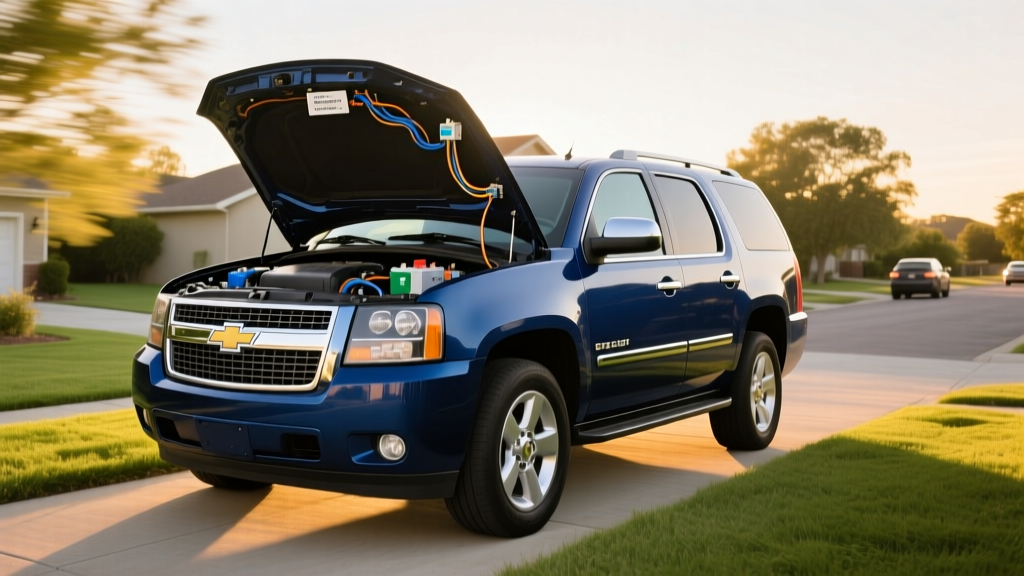
The 2008 Chevrolet Tahoe Hybrid was a landmark vehicle — the first full-size SUV to pair a V8 with a two-mode hybrid system, promising the towing muscle of a body-on-frame truck with the city fuel economy of a midsize sedan. Nearly two decades later, it remains a popular search for budget-minded families who need three rows and serious hauling capability without modern EV price tags. But with aging nickel-metal hydride (NiMH) batteries and discontinued production, buying a used 2008 Tahoe Hybrid requires careful evaluation.
This guide covers the exact EPA fuel economy figures, the two-mode hybrid powertrain, real-world MPG expectations, battery longevity and replacement costs, and whether this pioneering HEV still earns a spot in your driveway — or if a newer PHEV or full EV better serves your needs.
2008 Tahoe Hybrid Fuel Economy: EPA Numbers and Real-World MPG
The headline number that made the 2008 Tahoe Hybrid famous was its city fuel economy. Thanks to the two-mode hybrid system's ability to propel the SUV on electric power alone at low speeds, the Tahoe Hybrid achieved an EPA-estimated 21 MPG city / 22 MPG highway / 21 MPG combined — remarkable for a 5,800-pound, three-row SUV with a 5,300-pound towing capacity.
| Driving Cycle | EPA Estimate | Real-World Expectation |
|---|---|---|
| City | 21 MPG | 19–22 MPG |
| Highway | 22 MPG | 19–21 MPG |
| Combined | 21 MPG | 18–21 MPG |
For context, the conventional 2008 Tahoe with the 5.3L V8 and 4-speed automatic was rated at 14 MPG city / 20 MPG highway / 16 MPG combined. The hybrid's 31% combined improvement was substantial — and the city advantage was even larger (50% better than the gas model's 14 MPG city).
Two-Mode Hybrid Powertrain: How It Works
The 2008 Tahoe Hybrid used GM's Two-Mode Hybrid system, a collaboration between GM, BMW, and Chrysler (then DaimlerChrysler). This was not a mild hybrid or a simple start-stop system — it was a full parallel hybrid with two electric motors integrated into a specially designed 4-speed automatic transmission (the 2ML70).
| Component | Specification |
|---|---|
| Engine | 6.0L V8 (Vortec) with Active Fuel Management |
| Engine Output | 332 HP @ 5,100 RPM / 367 lb-ft @ 4,100 RPM |
| Electric Motors | Two 60 kW AC permanent-magnet motors |
| Combined System Output | 379 HP |
| Transmission | 2ML70 Electrically Variable Transmission (EVT), 4-speed |
| Drivetrain | Rear-wheel drive (2WD) or 4WD (i-4 mode) |
| Towing Capacity | 5,300 lbs (2WD) / 5,500 lbs (4WD) |
| 0–60 MPH | ~8.2 seconds |
| Curb Weight | ~5,840 lbs |
Mode 1 (Low-Speed / City): At speeds up to approximately 30 MPH, the Tahoe Hybrid can operate on electric power alone, with the V8 shut off. The two electric motors drive the wheels through a planetary gearset. When more power is needed or the battery depletes, the V8 seamlessly starts and contributes torque. This mode is where the dramatic city MPG improvement comes from.
Mode 2 (Highway / High-Load): Above ~30 MPH or under heavy acceleration, the system shifts into a second fixed-ratio mode where the engine and motors work in parallel through different gear ratios. This mode optimizes efficiency at cruising speeds while maintaining the ability to tow and haul.
The system also includes Active Fuel Management (AFM), which deactivates four of the V8's eight cylinders under light-load conditions (steady-state highway cruising), further improving highway efficiency. Regenerative braking captures kinetic energy during deceleration, recharging the hybrid battery.
HEV vs PHEV: What the 2008 Tahoe Hybrid Is (and Isn't)
It is critical to understand that the 2008 Tahoe Hybrid is a conventional hybrid electric vehicle (HEV), not a plug-in hybrid (PHEV). This distinction matters for ownership expectations:
| Feature | 2008 Tahoe Hybrid (HEV) | Modern PHEV (e.g., 2026 Tahoe PHEV) |
|---|---|---|
| Plug-in Charging | No — self-charging via engine + regen | Yes — plug into Level 1 or Level 2 |
| Electric-Only Range | ~1 mile at very low speeds | 30–50 miles typical |
| Battery Size | ~1.8 kWh (NiMH, usable ~0.9 kWh) | 15–25 kWh (NMC lithium-ion) |
| Federal Tax Credit (§30D) | No — credit expired long ago, HEVs ineligible | Up to $7,500 if sourcing/income rules met |
| Gas Required | Always — engine runs regularly | Only after battery depletes on longer trips |
| Home Charging Needed | No | Yes, for full benefit |
The Tahoe Hybrid's ~1.8 kWh NiMH battery pack is small by modern standards. It cannot be plugged in and provides only brief electric-only assist at very low speeds (parking lots, stop-and-go traffic under ~25 MPH). The gasoline engine is always the primary power source. This is fundamentally different from a PHEV, which offers 30–50 miles of genuine electric-only driving before the engine engages.
Battery Longevity, Warranty, and Replacement Cost
The hybrid battery is the single biggest concern for any used 2008 Tahoe Hybrid buyer. The NiMH pack was covered by GM's original hybrid battery warranty: 8 years / 100,000 miles (10 years / 150,000 miles in CARB states including California, New York, Massachusetts, and others). For a 2008 model, that factory warranty expired no later than 2018 in most states.
NiMH Degradation Reality: Nickel-metal hydride batteries degrade differently than modern lithium-ion packs. NiMH cells tend to lose capacity gradually but can also develop individual cell failures that reduce the entire pack's performance. Many 2008 Tahoe Hybrids still running today have had their original batteries replaced at least once.
Replacement Cost: A remanufactured hybrid battery pack for the 2008 Tahoe Hybrid typically costs between $2,500 and $4,000 including installation at an independent hybrid specialist. A new OEM battery from a GM dealer can exceed $5,500 installed. Some owners opt for individual cell reconditioning or replacement at hybrid specialty shops for $1,500–$2,500, though this is a temporary fix.
How to Evaluate Before Buying: Have a pre-purchase inspection performed by a technician with GM hybrid experience. They can scan the battery control module for state-of-charge (SoC) variance between cell blocks, check for stored hybrid-related diagnostic trouble codes (DTCs), and assess regenerative braking functionality. Wide SoC variance between cells is a strong indicator of impending pack failure.
Pricing and Tax Credit Eligibility
The 2008 Tahoe Hybrid originally carried an MSRP of approximately $50,490 for 2WD and $53,295 for 4WD — a significant premium over the gas-only Tahoe LT (~$38,000). GM offered a $2,200 federal tax credit at launch (under the older Energy Policy Act hybrid credit, which was separate from today's §30D credit), but this credit was fully phased out for GM by mid-2008 due to manufacturer volume caps.
As a used vehicle in 2026, the 2008 Tahoe Hybrid trades in a wide range depending on mileage, condition, and hybrid battery health:
- Project/Fair condition (high miles, battery needs replacement): $3,000–$5,000
- Good condition (100k–140k miles, battery functional): $5,500–$8,000
- Excellent/Low miles (under 90k, battery recently replaced): $8,500–$12,000
Tax Credit Reality: The 2008 Tahoe Hybrid does not qualify for any current federal tax credit. The IRS §30D Clean Vehicle Credit applies only to new plug-in electric vehicles (BEVs and PHEVs) meeting battery sourcing, MSRP caps, and buyer income limits. Conventional hybrids (HEVs) have never qualified for §30D. The now-expired used EV credit (§25E, up to $4,000) also requires a plug-in vehicle — HEVs are excluded. Check IRS.gov for current credit rules.
2008 Tahoe Hybrid vs Modern Alternatives: Which Fits You?
Choose the 2008 Tahoe Hybrid if:
- You need three rows, 5,300+ lbs towing, and body-on-frame durability on a sub-$10,000 budget
- Your driving is primarily city/suburban stop-and-go, where the two-mode system delivers its best MPG advantage
- You cannot charge at home (no garage, no outlet access) and need a self-charging hybrid
- You're mechanically inclined or have access to a hybrid specialist for battery maintenance
Choose a modern PHEV (e.g., 2026 Chrysler Pacifica PHEV, Toyota Grand Highlander Hybrid) if:
- You want 30+ miles of electric-only driving for daily commutes
- You can install a Level 2 home charger and want to minimize gasoline use
- You want current safety tech (automatic emergency braking, blind-spot monitoring, lane-keep assist)
- You want a factory battery warranty and modern infotainment
Choose a full BEV (e.g., Rivian R1S, Tesla Model X) if:
- You have reliable home charging and want zero tailpipe emissions
- Your daily driving is under 300 miles and you can plan DC fast-charging stops on road trips
- You want the lowest per-mile energy cost and minimal maintenance
- You qualify for the §30D tax credit to offset the higher purchase price
Pros and Cons: Honest Assessment
- 21 MPG city is exceptional for a full-size, body-on-frame SUV with V8 power
- 379 combined HP provides confident acceleration and highway merging
- 5,300–5,500 lb towing capacity — genuine truck capability
- Spacious three-row interior with 108.9 cu ft max cargo volume
- No plug-in charging required — works with existing gas infrastructure
- Low used purchase price (sub-$10k in good condition)
- Hybrid battery warranty expired; replacement costs $2,500–$5,500
- NiMH battery technology is outdated — less efficient than modern lithium-ion
- No modern ADAS features (no AEB, no lane-keep, no adaptive cruise)
- Outdated infotainment — no Apple CarPlay, Android Auto, or Bluetooth audio streaming
- Highway MPG (22 EPA, often 19–20 real-world) is only marginally better than modern gas V8 Tahoes
- No federal tax credit eligibility (new or used)
- Parts availability for hybrid-specific components is declining
Frequently Asked Questions
How many MPG does the 2008 Tahoe Hybrid get?
The EPA rates the 2008 Tahoe Hybrid at 21 MPG city, 22 MPG highway, and 21 MPG combined. Real-world owners average approximately 19–20 MPG combined, with city driving yielding the best results (sometimes exceeding 21 MPG) and sustained highway speeds above 70 MPH dropping to 18–19 MPG.
Can the 2008 Tahoe Hybrid drive on electric power only?
Only at very low speeds (under ~25–30 MPH) for short distances (roughly 1 mile or less). The 1.8 kWh NiMH battery is too small for meaningful electric-only range. This is a conventional HEV, not a PHEV — you cannot plug it in, and the gasoline engine is always the primary power source.
Is the 2008 Tahoe Hybrid reliable?
The 6.0L Vortec V8 and the 2ML70 transmission are generally robust, with many examples exceeding 200,000 miles with proper maintenance. The primary reliability concern is the hybrid battery pack, which has a finite lifespan and is now well beyond its factory warranty. Budget $2,500–$4,000 for a remanufactured battery replacement if the current pack shows signs of degradation. The Active Fuel Management system can also cause oil consumption issues on high-mileage examples — check for excessive oil use during a pre-purchase inspection.
What does it cost to replace the hybrid battery?
A remanufactured NiMH battery pack installed at an independent hybrid shop typically costs $2,500–$4,000. A new OEM battery from a GM dealer can exceed $5,500. Individual cell reconditioning is available for $1,500–$2,500 but may not provide long-term reliability.
Does the 2008 Tahoe Hybrid qualify for any tax credit?
No. The original $2,200 federal hybrid tax credit was fully phased out for GM by mid-2008. The current IRS §30D Clean Vehicle Credit and the used EV credit (§25E) both require plug-in electric vehicles (BEVs or PHEVs). Conventional hybrids (HEVs) like the Tahoe Hybrid are not eligible for any federal purchase incentive. Some states may offer minimal used-vehicle incentives, but these are rare and vary by jurisdiction — check your state's energy office for details.
Hybrid vs PHEV vs EV — which should I choose for a large family SUV?
If you need maximum towing (5,000+ lbs), three rows, and cannot charge at home, a used HEV like the 2008 Tahoe Hybrid fills a niche at a low entry price. If you can charge at home and want to eliminate most gasoline use on daily drives, a modern PHEV like the Chrysler Pacifica Hybrid (32 miles electric-only, 82 MPGe) is far more efficient. If your daily driving is predictable and under 300 miles, a three-row BEV like the Rivian R1S or Kia EV9 offers the lowest operating costs and zero tailpipe emissions — but at a significantly higher purchase price.
Is the 2008 Tahoe Hybrid AWD?
The 2008 Tahoe Hybrid was offered in 2WD (rear-wheel drive) and 4WD. The 4WD system uses a two-speed transfer case with an "i-4" mode that locks the center differential for slippery conditions. The 4WD version is rated at 5,500 lbs towing capacity (vs. 5,300 for 2WD) and carries a slightly higher curb weight.