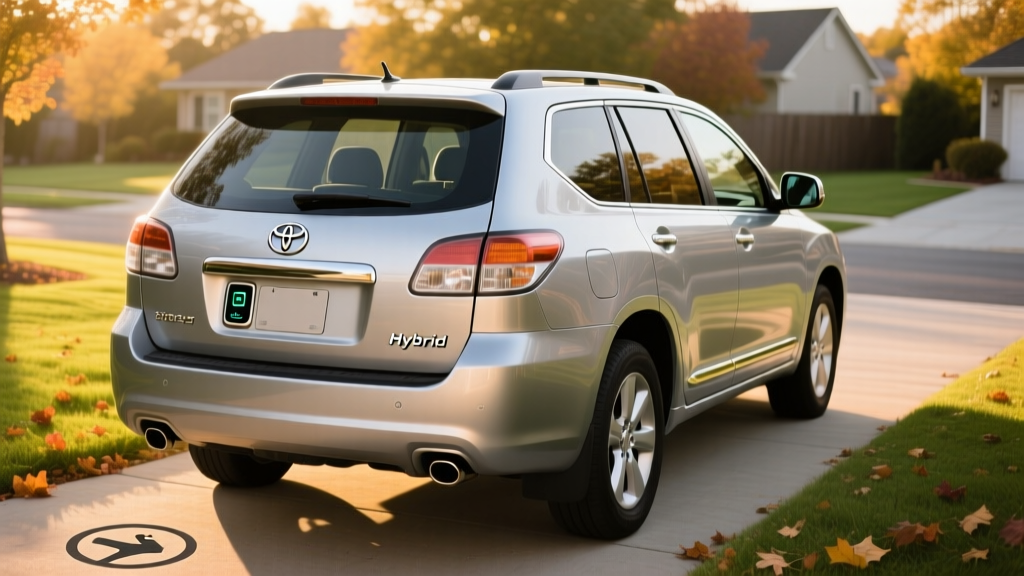
The 2008 Toyota Highlander Hybrid occupies an unusual space in the electrified-vehicle market nearly two decades after its debut. As one of the first three-row hybrid SUVs sold in the United States, it proved that a family hauler could sip fuel without sacrificing passenger space. Today, it remains a popular search among budget-minded buyers looking for a reliable hybrid at rock-bottom used prices. This guide covers everything you need to know before putting one in your driveway.
HEV vs PHEV vs EV: Where the 2008 Highlander Hybrid Fits
Understanding the Powertrain Categories
The 2008 Highlander Hybrid is a conventional hybrid electric vehicle (HEV). It does not plug in. Its nickel-metal hydride (NiMH) traction battery charges exclusively through regenerative braking and the gasoline engine. You fuel it at a gas station exactly like a conventional car — there is no charging port, no electric-only range to manage, and no home charger to install.
| Feature | HEV (e.g., 2008 Highlander Hybrid) | PHEV (e.g., RAV4 Prime) | BEV (e.g., Tesla Model Y) |
|---|---|---|---|
| Plugs in? | No | Yes | Yes |
| Electric-only range | 0 miles (motor assists only) | 20–42 miles typical | 250–350+ miles |
| Fueling / Charging | Gas station only | Gas + plug-in (120V/240V) | Plug-in only (L2/DCFC) |
| Home charger needed? | No | Recommended (Level 2) | Essential (Level 2) |
| Federal tax credit (new) | None | Up to $7,500 (§30D, if eligible) | Up to $7,500 (§30D, if eligible) |
If you are cross-shopping the 2008 Highlander Hybrid against modern PHEVs or EVs, the core trade-off is simplicity versus electrification depth. The HEV requires zero lifestyle change — no charging routine, no range planning — but it also delivers zero electric-only miles. You get improved fuel economy over the gas-only Highlander, nothing more.
Fuel Economy: EPA Ratings vs Real-World MPG
The question every hybrid buyer asks first: how many MPG does the 2008 Highlander Hybrid get? According to EPA data on fueleconomy.gov, the official ratings are:
| Driving Cycle | EPA Rating | Real-World Expectation |
|---|---|---|
| City | 27 MPG | 25–28 MPG (hybrids often match or beat EPA city) |
| Highway | 25 MPG | 22–25 MPG (less regen benefit at sustained speed) |
| Combined | 26 MPG | 23–27 MPG depending on terrain, climate, and driving style |
For context, the gas-only 2008 Highlander V6 AWD was rated at 18 city / 24 highway / 20 combined. The hybrid's advantage is most pronounced in city driving, where frequent stops allow regenerative braking to recapture energy and the electric motor handles low-speed propulsion. On long highway cruises, the gap narrows considerably because the gasoline engine does most of the work.
Real-world caveat: Owners reporting on fuel-tracking platforms commonly log combined averages between 23 and 27 MPG. Cold climates, aggressive acceleration, heavy cargo loads, and roof-rack accessories all push figures toward the lower end. A well-maintained example driven primarily in suburban stop-and-go traffic can match or slightly exceed the 26 MPG combined sticker.
Powertrain Specs: Engine, Motors, and Combined Output
| Specification | Detail |
|---|---|
| Engine | 3.3L V6 (3MZ-FE), Atkinson cycle |
| Engine horsepower | 208 HP @ 5,600 RPM |
| Electric motor | Front-mounted permanent-magnet AC synchronous motor |
| Combined system net horsepower | 270 HP (SAE net) |
| Transmission | Electronically controlled CVT (eCVT) |
| Drivetrain | AWD (e-Four: electric motor powers rear axle, no mechanical driveshaft) |
| Towing capacity | 3,500 lbs (when properly equipped) |
| 0–60 MPH | ~7.7 seconds (estimated) |
| Curb weight | ~4,500 lbs |
Toyota's Hybrid Synergy Drive in this generation pairs the 3.3-liter V6 with a front electric motor through a planetary gearset that functions as a continuously variable transmission. The rear axle is driven by a separate electric motor — Toyota's e-Four system — which engages during acceleration and low-traction conditions without a traditional driveshaft or rear differential linked to the engine.
The 270 HP combined output was genuinely competitive for a three-row SUV in 2008, and it still provides adequate merging and passing performance today. The eCVT delivers smooth, linear acceleration without the shift shock of a conventional automatic, though it can drone under hard acceleration as the engine holds at high RPM.
Hybrid Battery: Lifespan, Warranty, and Replacement Cost
Original Battery Warranty
When sold new, Toyota covered the 2008 Highlander Hybrid's NiMH traction battery for 8 years / 100,000 miles (10 years / 150,000 miles in California Air Resources Board states). That original factory warranty has expired on every surviving example as of 2026.
This is the top concern for any used hybrid buyer. The 2008 Highlander Hybrid uses a nickel-metal hydride (NiMH) battery pack — not the lithium-ion chemistry found in modern EVs and PHEVs. NiMH packs are well-understood and generally robust, but after 17+ years of service, capacity degradation and cell failure are legitimate risks.
Expected lifespan: Toyota's NiMH hybrid batteries from this era commonly reach 150,000–200,000 miles before significant degradation or failure. Some units last longer; others fail earlier, especially in hot climates where battery temperature management is less sophisticated than in current models. Many 2008 Highlanders on the road today have already had at least one battery replacement.
Replacement cost in 2026:
- New OEM Toyota battery: $3,000–$4,500 installed at a dealership
- Remanufactured/refurbished battery: $1,500–$2,500 installed at an independent hybrid specialist
- Used/salvage battery: $800–$1,500 (risky — unknown remaining life)
- DIY reconditioning (individual cell replacement): $200–$600 in parts, advanced skill required
Is the 2008 Highlander Hybrid reliable? Mechanically, the 3MZ-FE V6 and Toyota's hybrid transaxle have strong longevity records. The primary reliability risk is the aging hybrid battery. Before purchasing, request a hybrid battery health check — many Toyota dealerships and independent hybrid shops can read the battery's state of health (SoH) via OBD-II scan tool. Look for individual module voltage delta (imbalance between cells); a spread greater than 0.3V under load suggests imminent failure.
Pricing and Tax Credit Eligibility
The 2008 Highlander Hybrid is available only on the used market. As of early 2026, typical transaction prices fall in these ranges:
- High-mileage (160,000+ miles), fair condition: $4,000–$6,000
- Average condition (100,000–150,000 miles): $6,000–$9,000
- Low-mileage, excellent condition (under 100,000 miles): $9,000–$13,000
Original MSRP in 2008 started around $34,000 for the base Hybrid and reached roughly $40,000 for the Limited trim. Depreciation has been steep, which is typical for 17-year-old vehicles regardless of powertrain.
Does the 2008 Highlander Hybrid qualify for any tax credit?
No. The federal §30D new clean vehicle credit applies only to new vehicles, and the 2008 Highlander Hybrid has not been eligible since the original Toyota hybrid credit phase-out in the late 2000s. The used clean vehicle credit (up to $4,000 or 30% of sale price, whichever is less) under IRS rules requires the vehicle to be at least two model years old and to be a qualifying plug-in electric or fuel-cell vehicle. Because the 2008 Highlander Hybrid is a conventional HEV — it does not plug in — it does not qualify for the used EV credit. No federal incentive applies.
Some states and local utilities offer rebates for used hybrids, but these programs vary widely by jurisdiction and change frequently. Check your state energy office or utility provider for current offerings.
Who Should Buy This Hybrid vs a Modern PHEV or EV?
Pros
- Very low purchase price for a three-row AWD SUV
- No charging infrastructure needed — fuel at any gas station
- 26 MPG combined beats the gas Highlander by ~30% in city driving
- Toyota's hybrid drivetrain has a strong long-term reliability record
- e-Four AWD provides confident traction without fuel-economy penalty of mechanical AWD
- 3,500-lb towing capacity covers light trailers and boat hauling
Cons
- Hybrid battery is 17+ years old — replacement likely needed soon if not already done
- No electric-only driving, no plug-in capability
- No federal tax credit or incentive eligibility
- Dated interior technology (no modern infotainment, no Apple CarPlay/Android Auto, no ADAS beyond basic ABS/stability control)
- Safety equipment lacks modern features (no automatic emergency braking, no lane-keeping assist)
- NiMH battery is heavier and less energy-dense than modern lithium-ion packs
Decision Framework
Choose the 2008 Highlander Hybrid if: You need a three-row SUV on a sub-$10,000 budget, you have no access to home or workplace charging, you drive primarily in city/suburban conditions where the hybrid system shines, and you're comfortable budgeting $1,500–$4,000 for a potential battery replacement.
Choose a modern PHEV (e.g., Toyota RAV4 Prime, Hyundai Tucson PHEV) if: You can install a Level 2 home charger, you want 30–42 miles of electric-only commuting, you want modern safety tech, and your budget allows $35,000–$50,000 (potentially offset by the §30D tax credit if eligible).
Choose a full BEV (e.g., Kia EV9, Tesla Model Y) if: You have reliable home charging, you want zero tailpipe emissions, your daily driving is under 250 miles, and you want the lowest per-mile fuel cost and minimal drivetrain maintenance.
Choose a gas-only used SUV if: You drive mostly highway miles (where the hybrid advantage shrinks), you want the lowest possible upfront cost, and you don't want to risk a hybrid battery replacement expense.
Ownership Costs: What to Budget Beyond the Purchase Price
A cheap purchase price doesn't mean cheap ownership. Here's what to anticipate with a 2008 Highlander Hybrid in 2026:
- Hybrid battery replacement: Budget $1,500–$4,500 if the battery hasn't been recently replaced with a documented unit
- Inverter/coolant pump: The hybrid system inverter and electric water pump can fail on high-mileage examples — $800–$2,000 each to replace
- Brakes: Regenerative braking reduces pad wear significantly; expect 80,000–100,000+ miles on original pads in mixed driving
- Insurance: Typically comparable to the gas Highlander of the same year; no EV insurance premium applies
- Fuel cost: At 26 MPG combined and $3.50/gallon (2026 national average), annual fuel cost for 12,000 miles ≈ $1,615. The gas-only Highlander at 20 MPG would cost ≈ $2,100 — a savings of ~$485/year with the hybrid
- Registration: Standard fees; no EV surcharge applies since this is a hybrid
The fuel savings over the gas-only model are meaningful but modest — roughly $400–$500 per year at average mileage. That savings can be erased quickly by a single hybrid battery replacement, which is why pre-purchase battery diagnostics are essential.
Frequently Asked Questions
How many MPG does the 2008 Highlander Hybrid get?
The EPA rates it at 27 city / 25 highway / 26 combined. Real-world owners typically report 23–27 MPG combined depending on driving mix, climate, and vehicle condition. City-heavy driving favors the hybrid; highway-heavy driving narrows the gap with the gas model.
Does the 2008 Highlander Hybrid plug in?
No. It is a conventional hybrid (HEV). The battery charges only through regenerative braking and the gasoline engine. There is no charging port and no electric-only driving mode.
How far can it go on electric only?
Zero miles on electric-only propulsion. The electric motor assists the gasoline engine at low speeds and during acceleration, but the vehicle cannot drive on electricity alone for any meaningful distance. If electric-only range is a priority, you need a PHEV or BEV.
Is the hybrid battery reliable and what does replacement cost?
Toyota's NiMH hybrid batteries are generally robust, often lasting 150,000–200,000 miles. At 17+ years old, most surviving examples will need a replacement or have already had one. Expect to pay $1,500–$2,500 for a quality remanufactured battery or $3,000–$4,500 for a new OEM unit, installed.
Does the 2008 Highlander Hybrid qualify for any tax credit?
No federal tax credit applies. The §30D new vehicle credit and the used clean vehicle credit both require plug-in electric capability, which this conventional hybrid does not have. Check your state and local utility for any hybrid-specific rebates, but do not count on them.
Should I buy a 2008 Highlander Hybrid or save for a newer PHEV?
If your budget is strictly under $10,000 and you cannot charge at home, the 2008 Highlander Hybrid is a practical three-row option — but budget for a battery replacement. If you can stretch to $30,000+ and have home charging access, a newer PHEV like the RAV4 Prime delivers far more electric-only range, modern safety technology, and potential tax-credit eligibility.
What should I check before buying a used 2008 Highlander Hybrid?
Prioritize a hybrid battery health scan (module voltage balance and internal resistance), inverter coolant pump operation, transmission fluid condition, and a standard pre-purchase inspection covering suspension, brakes, and frame rust. Documentation of a recent battery replacement adds significant value.