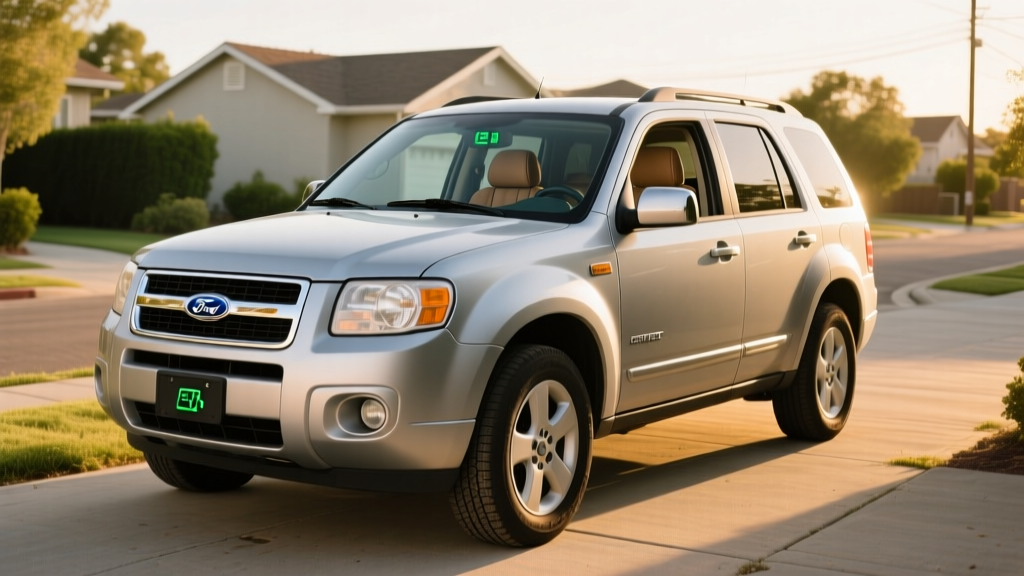
The 2008 Ford Escape Hybrid was one of the first mainstream SUVs to pair a gasoline engine with an electric motor for meaningful fuel savings — no plug required. Nearly two decades later, budget-minded shoppers still search for 2008 Ford Escape Hybrid MPG data to determine whether this early electrified SUV holds up as a used buy in 2026. The short answer: it delivers legitimate city fuel economy gains, but age, battery condition, and parts availability now matter more than the original sticker specs.
This guide breaks down the real EPA numbers, what you can actually expect on the road today, battery longevity concerns, and whether a 2008 Escape Hybrid still makes financial sense versus a newer hybrid, plug-in hybrid (PHEV), or full battery-electric vehicle (BEV).
2008 Ford Escape Hybrid MPG: EPA Numbers and Real-World Results
The 2008 Ford Escape Hybrid came in two drivetrain configurations with slightly different fuel economy ratings. Here are the official EPA figures as recorded on fueleconomy.gov:
| Configuration | City MPG | Highway MPG | Combined MPG | Annual Fuel Cost* |
|---|---|---|---|---|
| FWD (Front-Wheel Drive) | 34 | 30 | 32 | ~$1,650 |
| 4WD (Four-Wheel Drive) | 29 | 27 | 28 | ~$1,900 |
*Based on 15,000 miles/year at $3.50/gallon regular unleaded (2026 estimate).
Real-World MPG: What Owners Actually Report
Like most conventional hybrids (HEVs), the 2008 Escape Hybrid tends to perform better in city driving than on the highway. The electric motor handles low-speed stop-and-go traffic, where regenerative braking recaptures energy that a gas-only vehicle would waste as heat. Owners on Fuelly and hybrid forums commonly report:
- City driving: 30–36 MPG (FWD), depending on traffic density and driving style
- Highway driving: 26–30 MPG (FWD) — the 2.3L Atkinson-cycle engine works harder at sustained speed
- Mixed/combined: 28–33 MPG (FWD) in typical use
- Cold-weather penalty: Expect a 10–15% drop in winter months as the engine runs more frequently for cabin heat and battery warm-up
Powertrain: How the 2008 Escape Hybrid Works
The 2008 Escape Hybrid uses Ford's second-generation hybrid system, co-developed with Aisin. It is a conventional hybrid (HEV) — meaning it charges its own battery through regenerative braking and the gasoline engine. There is no plug, no electric-only driving mode of any meaningful distance, and no external charging capability.
| Gas Engine | 2.3L inline-4, Atkinson cycle |
| Engine Output | 133 hp @ 6,000 rpm / 129 lb-ft torque |
| Electric Motor | Permanent-magnet AC synchronous |
| Motor Output | 94 hp |
| Combined System Output | 155 hp |
| Transmission | Electronically controlled CVT (eCVT) |
| Hybrid Battery | ~1.3 kWh NiMH (Nickel-Metal Hydride), 330V nominal |
| Drivetrain | FWD or 4WD (eCVT-based) |
| 0-60 mph | ~10.5 seconds (FWD) |
| Curb Weight | ~3,780 lbs (FWD) |
Hybrid Battery Lifespan, Reliability, and Replacement Cost
This is the single most important question for anyone considering a 2008 Escape Hybrid in 2026. The original NiMH hybrid battery is now 17–18 years old. While Toyota's hybrid batteries in the Prius and Camry of similar vintage have demonstrated remarkable longevity, Ford's NiMH packs from this era are more variable.
| Battery Chemistry | Nickel-Metal Hydride (NiMH) |
| Battery Capacity | ~1.3 kWh (nominal) |
| Original Warranty | 8 years / 100,000 miles (federal emissions component warranty) |
| Warranty Status in 2026 | Expired for all units |
| Typical Battery Lifespan | 120,000–180,000 miles (varies widely by climate and use) |
| OEM Replacement Cost | $2,500–$4,000 (dealer-installed, if available) |
| Aftermarket/Refurbished | $1,200–$2,200 (reconditioned NiMH pack) |
| DIY Module Repair | $200–$600 (individual cell replacement by specialist shops) |
Signs of Hybrid Battery Degradation
When shopping for a used 2008 Escape Hybrid, watch for these red flags that indicate a failing traction battery:
- Reduced MPG: If the vehicle is returning below 24 MPG combined (FWD), the battery may no longer be contributing effectively
- Frequent engine running at stops: The engine should shut off at idle when the battery has sufficient charge; constant idling suggests the battery cannot sustain accessory loads
- Dashboard warning lights: A "Check Hybrid System" or wrench icon indicates the battery control module has detected faults
- Reduced regenerative braking: If the brake feel changes or regen seems weak, the battery may be rejecting charge due to degraded cells
Is the 2008 Escape Hybrid Reliable?
Mechanically, the 2.3L Duratec engine and eCVT transmission are robust. The eCVT has no traditional belts, clutches, or torque converter — it uses planetary gearsets that are inherently durable. The primary reliability risk is the hybrid battery and its associated power electronics (inverter, DC-DC converter). NHTSA records show relatively few powertrain complaints for this model year, though recall campaigns addressed brake-system concerns on early Escape Hybrids.
Beyond the hybrid system, standard 2008 Escape concerns apply: aging suspension components, rust in salt-belt states, and parts availability for a vehicle this old. Ford discontinued the Escape Hybrid after 2012, and some hybrid-specific components are becoming harder to source through dealer channels.
Does the 2008 Escape Hybrid Qualify for Any Tax Credit?
No. The 2008 Ford Escape Hybrid does not qualify for any current federal tax credit.
When new, the Escape Hybrid qualified for a federal Alternative Motor Vehicle Credit (not the current §30D Clean Vehicle Credit). That credit was a fixed amount ($2,600–$3,000 depending on the tax year) and was only available to the original purchaser. It has been unavailable for over a decade.
Under current IRS §30D rules, the Clean Vehicle Credit applies only to new qualifying plug-in electric vehicles (BEVs and PHEVs) meeting battery sourcing, MSRP caps, and buyer income limits. Conventional hybrids like the 2008 Escape Hybrid have never been eligible for §30D. The used-EV credit (§25E, up to $4,000) also requires the vehicle to be a plug-in EV or fuel cell vehicle — conventional HEVs are excluded.
- ❌ Federal §30D Clean Vehicle Credit — Not eligible (conventional HEV, not a plug-in)
- ❌ Federal §25E Used Clean Vehicle Credit — Not eligible (requires plug-in EV or FCV)
- ❌ Original Alternative Motor Vehicle Credit — Expired; was only for original purchasers
- ⚠️ Some states offer registration fee reductions for hybrids — check your state DMV
2008 Escape Hybrid vs. Modern Alternatives: HEV, PHEV, or BEV?
The used 2008 Escape Hybrid typically sells for $3,500–$6,500 in 2026 depending on mileage and condition. That puts it in competition with newer conventional hybrids, modern PHEVs, and entry-level EVs. Here's how the decision framework breaks down:
| Factor | 2008 Escape Hybrid (HEV) | Modern Used HEV (e.g., 2018–2022 RAV4 Hybrid) | PHEV (e.g., Escape PHEV) | Full BEV (e.g., Bolt EV, used Model 3) |
|---|---|---|---|---|
| Used Price Range | $3,500–$6,500 | $18,000–$28,000 | $22,000–$32,000 | $14,000–$25,000 |
| Combined MPG / MPGe | 28–32 MPG | 38–41 MPG | 40 MPG + 37 mi electric | 110–130 MPGe |
| Plug-In Required? | No | No | Yes (for max benefit) | Yes (always) |
| Battery Replacement Risk | High (17+ yr old NiMH) | Low (under warranty or newer) | Low (newer Li-ion) | Moderate–Low (varies) |
| Tax Credit Eligible? | No | No | Possibly (§25E used credit) | Possibly (§25E used credit) |
| Fuel Cost per Mile | ~$0.11 | ~$0.09 | ~$0.06–$0.09 | ~$0.04–$0.06 |
- Choose the 2008 Escape Hybrid if: Your budget is under $7,000, you need an SUV with cargo space, you drive primarily in the city (where hybrid efficiency shines), you have access to a trusted hybrid-savvy mechanic, and you accept the risk of a potential $1,500–$3,000 battery replacement.
- Choose a newer used HEV if: You can spend $18,000+ and want modern safety features, a battery still under warranty, and 38+ MPG combined without plug-in infrastructure.
- Choose a PHEV if: You have home charging access, your daily commute is under 35 miles, and you want electric-only driving for most trips with gas-engine backup for road trips.
- Choose a full BEV if: You have reliable home Level 2 charging, your daily driving is under 200 miles, and you want the lowest per-mile fuel cost and minimal maintenance.
Pros and Cons of the 2008 Ford Escape Hybrid in 2026
Pros
- Legitimate city MPG advantage (30–36 MPG in stop-and-go)
- No plug-in required — works with any fueling routine
- Low purchase price ($3,500–$6,500 used)
- SUV cargo utility with hybrid efficiency
- eCVT transmission is mechanically robust
- Runs on regular 87-octane unleaded
Cons
- Hybrid battery is 17+ years old — replacement likely needed
- No federal or state tax credit eligibility
- Highway MPG unremarkable (26–30 MPG)
- Outdated safety tech (no AEB, lane-keep, or blind-spot monitoring)
- Hybrid-specific parts becoming scarce
- Acceleration is sluggish (10.5 sec 0–60)
- 4WD version loses significant fuel economy vs. FWD
Frequently Asked Questions
How many MPG does the 2008 Ford Escape Hybrid get?
The EPA rates the FWD 2008 Escape Hybrid at 34 city / 30 highway / 32 combined MPG. The 4WD version is rated at 29 city / 27 highway / 28 combined. In real-world 2026 driving, expect 28–31 MPG combined for the FWD model, with city driving yielding the best results and highway driving the worst.
Does the 2008 Ford Escape Hybrid need to be plugged in?
No. The 2008 Escape Hybrid is a conventional hybrid (HEV). It charges its own NiMH battery through regenerative braking and the gasoline engine. You fuel it exactly like a standard gas vehicle. There is no plug, no charging port, and no electric-only driving mode.
How much does it cost to replace the hybrid battery?
An OEM replacement battery from a Ford dealer costs approximately $2,500–$4,000 installed, though availability is increasingly limited. Aftermarket refurbished NiMH packs run $1,200–$2,200. Some specialist hybrid shops can replace individual failed modules for $200–$600, extending battery life at lower cost. Factor this potential expense into your purchase decision.
Is the 2008 Escape Hybrid a good used buy in 2026?
It can be, but only at the right price and with a verified battery health check. At $3,500–$5,000 with a recently replaced or tested hybrid battery, it offers genuine city fuel savings and SUV practicality. At higher prices, or with an unknown battery condition, a newer conventional hybrid like a 2017–2020 Toyota RAV4 Hybrid offers far better efficiency, safety, and reliability for $15,000–$22,000.
How does the 2008 Escape Hybrid compare to a modern hybrid SUV?
Modern hybrid SUVs significantly outperform the 2008 Escape Hybrid. The current Toyota RAV4 Hybrid delivers 41 MPG combined (vs. 32 EPA for the '08 Escape), has 219 combined horsepower (vs. 155), includes standard automatic emergency braking and lane-keeping, and comes with an 8-year/100,000-mile hybrid battery warranty. The efficiency gap alone is roughly 28% — a meaningful fuel savings over time.
Does the 2008 Escape Hybrid qualify for any tax credits?
No federal tax credits are available for the 2008 Escape Hybrid in 2026. The original Alternative Motor Vehicle Credit expired over a decade ago and applied only to the original purchaser. Current §30D and §25E credits under the IRS apply exclusively to plug-in electric vehicles (BEVs and PHEVs), not conventional hybrids. Check your state DMV for any hybrid-specific registration benefits.
What should I check before buying a used 2008 Escape Hybrid?
Prior to purchase, have a hybrid-qualified mechanic perform a battery health diagnostic (checking individual module voltages and internal resistance). Verify there are no "Check Hybrid System" warning codes. Test that the engine shuts off at idle and that regenerative braking feels strong. Also check for rust on the undercarriage and standard pre-purchase items (compression test, transmission fluid condition, suspension wear).