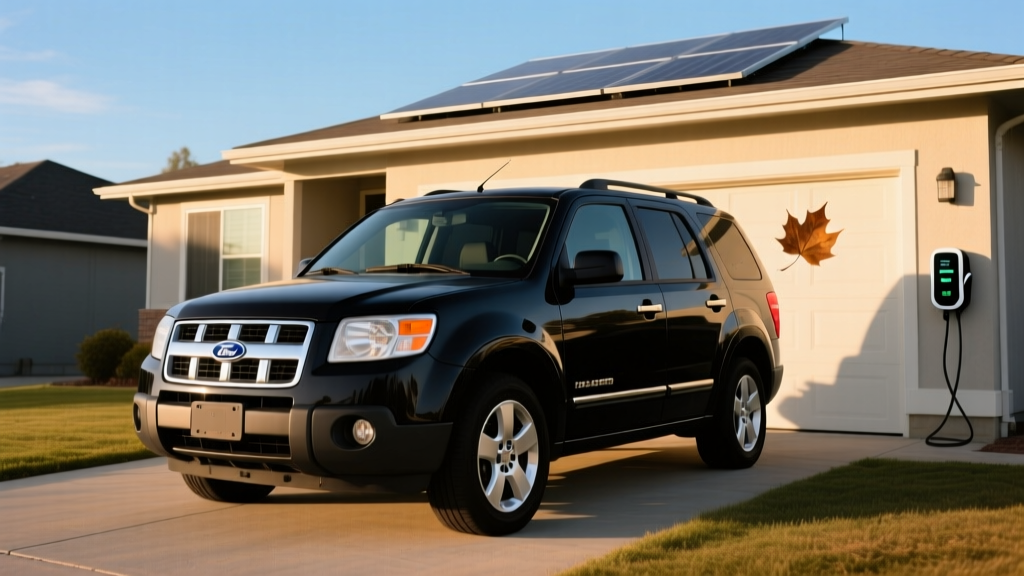
The 2008 Ford Escape Hybrid holds a unique place in American automotive history. As one of the first hybrid SUVs sold in the United States, it gave eco-minded families a practical alternative to the Toyota Prius hatchback — with higher seating, cargo versatility, and available all-wheel drive. Nearly two decades later, used examples still change hands, and the question buyers ask most is simple: what kind of MPG does the 2008 Ford Escape Hybrid actually get?
This guide covers the official EPA figures, real-world fuel economy data, battery longevity, reliability concerns, and how this pioneering HEV stacks up against modern hybrids, plug-in hybrids, and full EVs in 2026.
2008 Ford Escape Hybrid MPG: EPA Ratings and Real-World Numbers
The 2008 Escape Hybrid came in two drivetrain configurations: front-wheel drive (FWD) and all-wheel drive (AWD). Because the AWD version uses a rear electric motor that adds weight and mechanical drag, the EPA ratings differ between the two.
| Configuration | City MPG | Highway MPG | Combined MPG |
|---|---|---|---|
| FWD | 34 | 30 | 32 |
| AWD (4WD) | 29 | 27 | 28 |
Source: U.S. EPA / fueleconomy.gov
Hybrid powertrains inherently excel in stop-and-go city driving because regenerative braking recovers energy that would otherwise be lost as heat. The 2008 Escape Hybrid's EPA city rating (34 MPG FWD) is higher than its highway rating (30 MPG FWD) — the opposite of most gas-only vehicles.
In real-world ownership, drivers who do mostly urban commuting frequently report 32–36 MPG in the FWD model. Highway-heavy drivers at 75+ MPH tend to see 26–29 MPG. Cold weather reduces efficiency by 5–10% due to increased engine idling for cabin heat and reduced battery efficiency. Owners in mild climates with mixed driving commonly average 30–33 MPG overall.
Powertrain Specs: Engine, Motor, and Combined Output
The 2008 Escape Hybrid uses Ford's second-generation full-hybrid system, developed in partnership with Aisin (the same supplier behind Toyota's hybrid transaxles). It is a conventional hybrid (HEV) — meaning it generates all its own electricity from the gasoline engine and regenerative braking. There is no plug, no charging cable, and no electric-only driving range beyond brief low-speed maneuvers.
| Specification | Detail |
|---|---|
| Gasoline Engine | 2.3L Atkinson-cycle inline-4 |
| Engine Horsepower | 133 HP @ 6,000 RPM |
| Electric Motor | Permanent-magnet synchronous (94 HP / 70 kW) |
| Combined System Output | 155 HP |
| Transmission | Electronically controlled CVT (eCVT) |
| Hybrid Battery | ~1.8 kWh nickel-metal hydride (NiMH), 330V nominal |
| 0-60 MPH | ~10.5 seconds (estimated) |
| Drivetrain | FWD or AWD (rear electric motor on AWD) |
| Curb Weight | ~3,830 lbs (FWD) / ~3,970 lbs (AWD) |
The Atkinson-cycle engine sacrifices low-RPM torque for higher thermal efficiency — exactly the right tradeoff when an electric motor fills in the low-end gap. The eCVT is not a belt-and-cone CVT like those in some Nissan models; it's a planetary gearset that blends engine and motor power with no belts, pulleys, or traditional gears to wear out. This design has proven exceptionally durable.
HEV vs. PHEV vs. Full EV: Where Does the Escape Hybrid Fit?
Understanding the distinction between hybrid types is essential before comparing the 2008 Escape Hybrid to modern alternatives.
Conventional Hybrid (HEV) — 2008 Ford Escape Hybrid
- No plug required. The battery charges via the gas engine and regenerative braking.
- Electric-only range: Essentially zero — the electric motor assists at low speeds and during acceleration, but cannot propel the vehicle alone for meaningful distances.
- Battery size: ~1.8 kWh NiMH (small, designed for assist, not storage).
- Best for: Drivers without home charging access who want better fuel economy with zero behavior change.
Plug-In Hybrid (PHEV) — e.g., Toyota RAV4 Prime, Ford Escape PHEV (current-gen)
- Plugs in to charge. Level 1 (120V) or Level 2 (240V) charging at home or public stations.
- Electric-only range: Typically 25–42 miles on a full charge.
- Battery size: 14–18 kWh lithium-ion.
- No DC fast charging on most PHEVs (some exceptions like the Mitsubishi Outlander PHEV).
- Best for: Drivers with home charging who want daily electric commuting with a gas backup for road trips.
Battery Electric Vehicle (BEV) — e.g., Tesla Model Y, Hyundai Ioniq 5
- 100% electric. No gasoline engine.
- Range: 250–350+ miles EPA depending on model.
- Battery size: 60–100+ kWh lithium-ion.
- DC fast charging: 150–350 kW peak, 10–80% in 18–30 minutes.
- Best for: Drivers with reliable home or workplace charging who want zero tailpipe emissions and lowest per-mile fuel cost.
The 2008 Escape Hybrid is strictly an HEV. Ford did offer a plug-in Escape Hybrid in later generations (the Escape PHEV debuted for the 2020 model year), but the 2008 model has no plug-in capability.
Battery Lifespan, Reliability, and Replacement Cost
For a vehicle approaching 18 years old, battery health is the single biggest ownership variable. Here's what buyers and current owners need to know.
When new, the 2008 Ford Escape Hybrid's NiMH battery pack was covered by Ford's hybrid component warranty: 8 years / 100,000 miles (extended to 10 years / 150,000 miles in California Air Resources Board states including CA, NY, MA, and others adopting CARB standards).
As of 2026, all original battery warranties have expired on this model year.
NiMH Battery Longevity
Nickel-metal hydride batteries have a well-documented track record in early hybrids. Toyota Prius and Ford Escape Hybrid NiMH packs routinely last 150,000–200,000+ miles before significant capacity loss. Unlike the lithium-ion packs in modern EVs, NiMH chemistry degrades more gradually and is less sensitive to deep cycling.
However, age is a factor independent of mileage. A 2008 model with only 60,000 miles may still have a degraded battery simply due to 18 years of calendar aging. Heat exposure accelerates NiMH degradation, so vehicles from southern states may show more battery wear than those from cooler climates.
Battery Replacement Cost
If the hybrid battery fails or degrades to the point of unacceptable fuel economy (typically below 60% of original capacity), replacement options include:
- OEM replacement from Ford: $2,500–$3,500 for the battery pack alone, plus $500–$800 in labor. Total: approximately $3,000–$4,300.
- Aftermarket/remanufactured pack: $1,200–$2,000 from suppliers like Green Bean Battery or Dorman. These typically carry a limited lifetime warranty.
- Individual cell replacement: For DIY-inclined owners, replacing only the failed NiMH modules within the pack can cost $200–$500 in parts, but requires high-voltage safety knowledge.
General Reliability
The 2008 Escape Hybrid's powertrain — particularly the eCVT and hybrid system — has proven more reliable than the conventional Escape's automatic transmission. The planetary eCVT has no clutch packs, torque converters, or bands to fail. Common non-hybrid reliability concerns for this model year include:
- Electric power steering (EPS) module failures ($800–$1,200 repair)
- Brake actuator assembly wear (the regenerative braking system uses a unique brake actuator; replacement runs $1,000–$1,500)
- Rust on rear subframe and suspension components in salt-belt states
- Standard aging items: suspension bushings, wheel bearings, HVAC blend doors
The NHTSA recall database shows a small number of recalls for the 2008 Escape Hybrid, primarily related to brake system components and a potential throttle-body issue. Check any used example's VIN against the NHTSA database before purchase.
Tax Credits and Incentives: What Applies in 2026?
When the 2008 Escape Hybrid was new, it qualified for a federal tax credit under the Energy Policy Act of 2005 — a credit that phased out after Ford reached its 60,000-unit hybrid sales cap in 2009. That credit is long gone.
For 2026 used-vehicle purchases, the relevant incentive is the IRS §25E Used Clean Vehicle Credit, which provides up to $4,000 or 30% of the sale price (whichever is less) for qualifying used EVs and PHEVs. However, this credit applies only to plug-in electric vehicles — meaning the 2008 Ford Escape Hybrid, as a conventional HEV with no plug, does not qualify.
There are currently no federal tax credits available for purchasing a used conventional hybrid. Some states may offer registration fee reductions or emissions-testing exemptions for hybrid vehicles, but these vary by jurisdiction and are typically modest. Check your state's DMV or department of environmental quality for specifics.
Should You Buy a 2008 Escape Hybrid in 2026?
At 18 years old, this vehicle competes in the ultra-budget used-car segment. Here's a practical decision framework:
Choose the 2008 Escape Hybrid If:
- Your budget is $3,000–$6,000 and you need an SUV
- You drive mostly in the city (where its hybrid advantage is largest)
- You lack access to home or workplace charging (ruling out PHEVs and EVs)
- You want proven hybrid reliability without the cost of a newer model
- You can verify the hybrid battery's health via a pre-purchase scan tool reading
Look Elsewhere If:
- You drive mostly highway (the hybrid advantage shrinks; a conventional Escape or newer Corolla Hybrid may be comparable)
- You want modern safety tech (no automatic emergency braking, no lane-keeping assist, no backup camera on most trims)
- You need the latest infotainment (no Apple CarPlay, Android Auto, or modern Bluetooth audio)
- You want tax-credit eligibility (consider a used PHEV or EV instead)
- The hybrid battery shows significant degradation and replacement would push total cost above a newer alternative
Modern Alternatives to Consider
If your budget allows stretching into the $12,000–$25,000 range, newer hybrid and electrified SUVs offer substantially better fuel economy, safety, and technology:
- 2015–2019 Toyota RAV4 Hybrid: EPA 32–34 MPG combined, more modern safety features available (Toyota Safety Sense on 2017+ models), strong reliability record.
- 2020+ Ford Escape Hybrid (4th generation): EPA 37–41 MPG combined, available PHEV variant with 37 miles electric-only range, modern ADAS.
- 2018+ Honda CR-V Hybrid: EPA 38–40 MPG combined, spacious interior, Honda Sensing standard.
- Used PHEV option — Toyota RAV4 Prime (2021+): EPA 94 MPGe, 42 miles electric-only range, qualifies for the §25E used-EV credit up to $4,000.
Frequently Asked Questions
How many MPG does the 2008 Ford Escape Hybrid get?
The EPA rates the FWD model at 34 city / 30 highway / 32 combined MPG. The AWD version is rated at 29 city / 27 highway / 28 combined. Real-world owners typically see 30–36 MPG in mixed city driving (FWD) and 26–30 MPG in highway-dominant or AWD usage.
Does the 2008 Ford Escape Hybrid need to be plugged in?
No. It is a conventional hybrid (HEV), not a plug-in hybrid. The battery charges through regenerative braking and the gasoline engine. There is no charging port and no electric-only driving range to speak of.
How far can the 2008 Escape Hybrid drive on electric power alone?
Essentially zero miles. The electric motor assists the gasoline engine during acceleration and can propel the vehicle at very low speeds (under ~25 MPH) for short distances on flat ground, but the 1.8 kWh NiMH battery is far too small to sustain electric-only driving. This is fundamentally different from a PHEV, which can travel 25–42 miles on electricity alone.
Is the 2008 Ford Escape Hybrid reliable?
The hybrid powertrain (eCVT, motor, and battery) has proven remarkably durable, with many examples exceeding 200,000 miles on the original hybrid components. However, the vehicle is now 18 years old, and age-related failures in suspension, steering, and brake components are common. A pre-purchase inspection focusing on hybrid battery state-of-charge, brake actuator health, and subframe rust is essential.
What does it cost to replace the hybrid battery?
An OEM Ford replacement pack runs approximately $3,000–$4,300 installed. Aftermarket remanufactured packs cost $1,200–$2,000. Given that a clean 2008 Escape Hybrid sells for roughly $3,500–$6,000 in 2026, a full OEM battery replacement can represent 50–100% of the vehicle's value — making an aftermarket pack or cell-level repair the more economical choice.
Does the 2008 Escape Hybrid qualify for any tax credit?
No. The original federal hybrid tax credit for this model expired in 2009 when Ford hit the 60,000-unit sales cap. The current §25E used clean vehicle credit (up to $4,000) applies only to plug-in vehicles (PHEVs and BEVs), not conventional hybrids. There are no federal incentives for buying a used HEV in 2026.
What's the difference between the 2008 Escape Hybrid and a modern PHEV?
A conventional hybrid like the 2008 Escape uses a small battery (~1.8 kWh) to assist the gas engine — you never plug it in, and it has no meaningful electric-only range. A modern PHEV like the current Ford Escape PHEV has a much larger battery (~14.4 kWh), a plug for charging, and can drive approximately 37 miles on electricity alone before the gas engine engages. PHEVs offer dramatically lower fuel costs for drivers who can charge at home, but require charging infrastructure that HEVs do not.