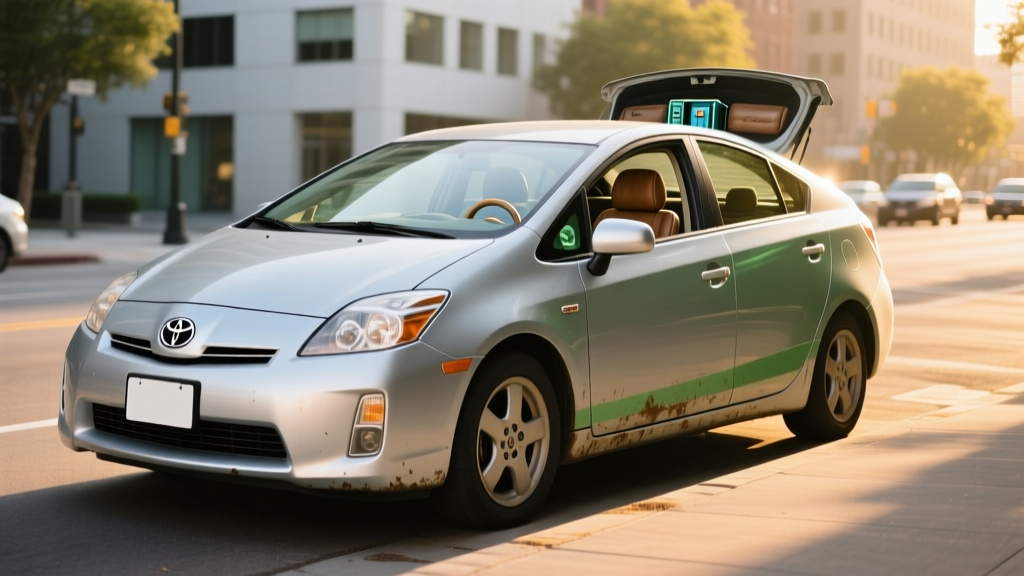
The 2007 Toyota Prius hybrid remains one of the most searched used hybrids on the market nearly two decades after its debut. For budget-conscious buyers eyeing a cheap, fuel-efficient daily driver — or current owners wondering about battery replacement — the second-generation (XW20) Prius still commands attention. But how does a 2007 Prius stack up in 2026 against modern hybrids and EVs? This guide covers real-world MPG expectations, battery longevity, replacement costs, and whether this aging hybrid is still a smart buy.
2007 Toyota Prius Hybrid: Quick Specs at a Glance
| Spec | Value |
|---|---|
| Powertrain | 1.5L 4-cyl + electric motor (HEV) |
| Combined Horsepower | 110 hp (net system output) |
| Engine Output | 76 hp @ 5,000 rpm / 82 lb-ft torque |
| Electric Motor Output | 67 hp (50 kW) / 295 lb-ft torque |
| Hybrid Battery | 1.3 kWh NiMH (nominal), ~0.9 kWh usable |
| EPA MPG (City / Hwy / Combined) | 60 / 51 / 46 MPG (original EPA; revised to ~46 combined under modern testing) |
| Transmission | eCVT (planetary gearset) |
| 0–60 mph | ~10.0 seconds |
| Curb Weight | ~2,932 lbs |
| Original MSRP (2007) | $22,175 (Base) – $23,770 (Touring) |
| Current Used Price (2026 est.) | $3,500 – $7,500 depending on mileage/condition |
| Original Hybrid Battery Warranty | 8 years / 100,000 miles (10 yr / 150,000 mi in CARB states) |
The 2007 Prius is a conventional hybrid (HEV). It has a small nickel-metal hydride (NiMH) battery that charges exclusively through regenerative braking and the gasoline engine. It cannot be plugged in. The later Prius Prime (introduced for the 2017 model year) is a plug-in hybrid (PHEV) with a larger lithium-ion battery, an electric-only driving mode (~25–44 miles depending on year), and a charging port. The 2007 model has no EV-only range beyond very low-speed, short-distance creeping on battery power — typically under 1 mile at speeds below 25 mph.
How Many MPG Does the 2007 Toyota Prius Hybrid Get?
The 2007 Prius was originally rated by the EPA at an eye-popping 60 city / 51 highway / 55 combined. However, the EPA revised its testing methodology in 2008 to include higher speeds, air conditioning use, and cold-weather starts. Under the revised methodology that fueleconomy.gov now displays retroactively, the 2007 Prius is rated at:
| Driving Cycle | EPA MPG |
|---|---|
| City | 48 MPG |
| Highway | 45 MPG |
| Combined | 46 MPG |
Real-World MPG: What Owners Actually Report
Fuelly.com owner data and long-term tests consistently show the 2007 Prius averaging between 42 and 48 MPG combined in real-world driving — very close to the revised EPA figure. Several factors influence where you'll land:
- City driving favors the Prius: Frequent stops allow regenerative braking to recharge the NiMH battery, enabling more electric-motor assist. Expect 48–52 MPG in stop-and-go traffic.
- Highway driving reduces efficiency: Above 65 mph, aerodynamic drag dominates and the 1.5L engine does most of the work. Expect 40–44 MPG at 75+ mph.
- Cold weather penalty: In sub-40°F temperatures, expect a 10–15% reduction (roughly 38–42 MPG combined) as the engine runs longer to heat the cabin and warm the battery.
- Aging battery effect: A degraded NiMH pack reduces the electric motor's contribution, dropping real-world MPG to the mid-to-high 30s if the battery is significantly worn.
Bottom line: a well-maintained 2007 Prius with a healthy battery will deliver 44–48 MPG combined for most drivers — still exceptional for a 19-year-old vehicle.
Powertrain Deep Dive: How the 2007 Prius Hybrid System Works
The second-generation Prius uses Toyota's Hybrid Synergy Drive (HSD), a series-parallel hybrid architecture that remains the foundation of Toyota's hybrid lineup today. Here's how the components break down:
- 1.5L Atkinson-cycle 4-cylinder (1NZ-FXE): Produces 76 hp and 82 lb-ft of torque. The Atkinson cycle delays intake valve closing, sacrificing some power density for greater thermal efficiency.
- Permanent magnet electric motor (MG2): Delivers 67 hp (50 kW) and a robust 295 lb-ft of torque from zero rpm — this is what gives the Prius its surprisingly punchful off-the-line feel at low speeds.
- Generator/starter motor (MG1): Primarily functions as a generator to charge the battery and start the gasoline engine; it can also modulate the effective gear ratio of the planetary eCVT.
- NiMH battery pack: 1.3 kWh nominal capacity (28 modules, 7.2V nominal). Usable capacity is roughly 0.9 kWh — the system keeps a buffer to prevent deep discharge and extend cell life.
- Planetary gearset (eCVT): Not a traditional belt-and-cone CVT. It's a single-ratio planetary gear that seamlessly blends engine and motor power with zero shift shock.
Combined net system output is 110 hp. The 0–60 mph time of approximately 10 seconds was acceptable for 2007 but feels leisurely by 2026 standards — the current-generation (2025+) Prius makes 194 hp and hits 60 in about 7.0 seconds.
Hybrid Battery Longevity: Lifespan, Degradation, and Replacement Cost
Toyota originally warranted the 2007 Prius hybrid battery for 8 years / 100,000 miles (extended to 10 years / 150,000 miles in California and states adopting CARB emissions standards). As of 2026, all original factory warranties have expired. However, real-world data shows many original NiMH packs lasting 150,000–200,000+ miles before significant degradation — a testament to Toyota's conservative state-of-charge buffering.
Signs of Hybrid Battery Degradation
On the 2007 Prius, watch for these symptoms of a failing NiMH pack:
- Reduced fuel economy: A drop from 45+ MPG to the mid-30s indicates the battery can no longer hold sufficient charge for meaningful electric-motor assist.
- State-of-charge (SoC) swings: The dashboard battery gauge rapidly fluctuates between full and near-empty — a sign of weak or imbalanced modules.
- Engine running constantly: The gas engine starts more frequently and stays on longer, even at low speeds and stops.
- Check engine / hybrid system warning: Diagnostic trouble codes P0A80 (replace hybrid battery pack) or individual module voltage deviation codes (e.g., P0A7F) indicate end of life.
2007 Prius Battery Replacement Cost Breakdown
| Option | Cost Range | Warranty | Notes |
|---|---|---|---|
| New OEM Toyota pack | $2,000 – $2,800 (part) + $500–$800 labor | 1 year / unlimited miles (dealer) | Best longevity; increasingly hard to source for 2nd-gen |
| Remanufactured pack (e.g., Dorman, Green Bean) | $1,200 – $1,800 installed | 1–3 years depending on supplier | Rebalanced used modules; good mid-tier option |
| Individual module replacement | $300 – $600 (parts + DIY or indie shop labor) | None typically | Only viable if 1–2 modules are bad; requires voltage-matching |
| Used salvage pack | $400 – $800 installed | 30–90 days typical | Highest risk — unknown remaining life; a gamble |
For most 2026 buyers of a used 2007 Prius, a remanufactured pack at $1,200–$1,800 represents the best value — it restores factory MPG and typically adds another 80,000–120,000 miles of service. Factor this into your purchase budget if the original battery hasn't been replaced.
Is the 2007 Toyota Prius Hybrid Reliable?
The second-generation Prius (2004–2009) is widely regarded as one of the most reliable vehicles Toyota has ever built. Key reliability data points:
- Consumer Reports consistently rated the 2004–2009 Prius as "Above Average" to "Much Better Than Average" for overall reliability across most model years.
- eCVT durability: The planetary gearset has no belts, clutches, or friction bands to wear. Failures are extremely rare and typically linked to neglected coolant maintenance.
- Brake longevity: Regenerative braking handles most deceleration, so friction brake pads often last 80,000–100,000+ miles.
- Common failure points: The combination meter (dashboard display) can fail — a $200–$400 repair. The 12V auxiliary battery (a standard lead-acid, separate from the hybrid pack) needs replacement every 4–6 years. The coolant heat storage system (CHS) tank and water pump can develop leaks around 120,000+ miles.
- NHTSA recalls: Check nhtsa.gov/recalls by VIN for any outstanding recalls. The 2007 Prius had relatively few — mainly related to steering intermediate shafts and curtain airbag inflators on some units.
With proper maintenance (especially transaxle fluid changes every 60,000 miles and inverter coolant service), a 2007 Prius can comfortably reach 250,000–300,000 miles before major mechanical work beyond the hybrid battery.
Tax Credits and Incentives: Does the 2007 Prius Qualify?
No. The 2007 Toyota Prius does not qualify for any current federal tax credit in 2026. Here's why:
- The federal §30D Clean Vehicle Credit (up to $7,500) applies only to new qualifying plug-in EVs and PHEVs with sufficient battery capacity — not to conventional hybrids (HEVs) and not to used vehicles under the §25E used-EV credit (which requires a plug-in vehicle).
- Toyota's hybrid credit allocation was exhausted in 2007 anyway — the original Prius qualified for a $3,150 federal income tax credit when new, but Toyota hit the 250,000-vehicle manufacturer cap in mid-2007, phasing out credits for subsequent buyers.
- State/local incentives: Some states offer used hybrid or high-MPG vehicle rebates, but these are rare and vary widely. Check your state's energy office or DMV for current programs.
For buyers seeking tax incentives, a new 2025–2026 Prius Prime PHEV may qualify for up to $7,500 under §30D (subject to MSRP caps, buyer income limits, and battery-sourcing requirements — see IRS.gov for current rules). A used Prius Prime (model year 2017+) may qualify for the §25E Used Clean Vehicle Credit of up to $4,000 (30% of sale price, capped at $4,000, with income limits).
2007 Prius vs. Modern Hybrids and EVs: What's Changed?
To put the 2007 Prius in context, here's how it compares to the current-generation Prius and a popular compact EV:
| Spec | 2007 Prius (HEV) | 2025 Prius LE (HEV) | 2025 Ioniq 6 SE (BEV) |
|---|---|---|---|
| Powertrain | 1.5L + NiMH HEV | 2.0L + Li-ion HEV | 77.4 kWh BEV |
| Combined HP | 110 hp | 194 hp | 168 hp |
| 0–60 mph | ~10.0 sec | ~7.0 sec | ~7.1 sec |
| EPA Combined MPG / MPGe | 46 MPG | 57 MPG | 140 MPGe |
| Range | ~470 mi (11.9 gal) | ~620 mi (10.8 gal) | 305 mi (EPA) |
| Plug-in capable? | No | No (Prime PHEV is) | Yes (AC + DC) |
| Tax credit eligible? | No | No (Prime may qualify) | Up to $7,500 (§30D) |
| Price (2026) | $3,500–$7,500 (used) | $28,350 MSRP (new) | $38,650 MSRP (new) |
The efficiency gains are notable: the 2025 Prius achieves 57 MPG combined — an 11 MPG improvement — while delivering nearly double the horsepower. But the 2007 Prius's sub-$7,500 entry price remains its strongest argument for budget buyers.
Who Should Buy the 2007 Toyota Prius Hybrid?
✅ Choose the 2007 Prius If:
- You need a cheap, ultra-efficient commuter under $7,500
- You drive mostly in the city (where hybrid MPG shines)
- You want Toyota reliability with a massive enthusiast/DIY community
- You can't install a home charger (no plug needed)
- You want low running costs: 46 MPG at $3.25/gal = ~$0.07/mile in fuel
❌ Skip the 2007 Prius If:
- You need modern safety tech (no automatic emergency braking, no backup camera standard)
- You want highway passing power (110 hp feels thin at 70+ mph)
- You're unwilling to budget $1,500+ for a potential battery replacement
- You want tax credits or incentives
- You prefer Bluetooth, Apple CarPlay, or modern infotainment
Frequently Asked Questions
How many MPG does the 2007 Toyota Prius hybrid get in real driving?
Under the EPA's revised testing methodology, the 2007 Prius is rated at 48 city / 45 highway / 46 combined MPG. Real-world owner data clusters around 42–48 MPG combined, with city driving yielding the best results and sustained highway speeds above 70 mph pulling efficiency down to around 40–43 MPG. A degraded hybrid battery can drop real-world figures into the mid-30s.
Does the 2007 Prius need to be plugged in?
No. The 2007 Prius is a conventional hybrid (HEV). Its small NiMH battery charges entirely through regenerative braking and the gasoline engine. There is no charging port and no plug-in capability. If you want a plug-in Prius, look at the Prius Prime (2017 model year and later), which offers 25–44 miles of electric-only range.
How much does it cost to replace a 2007 Prius hybrid battery?
A remanufactured NiMH pack typically costs $1,200–$1,800 installed. A new OEM Toyota pack runs $2,500–$3,600 installed but is increasingly difficult to source for this generation. Individual module replacement (if only 1–2 cells are bad) can be done for $300–$600 but is a short-term fix. Budget at least $1,500 for a battery replacement when purchasing a high-mileage 2007 Prius that still has its original pack.
Is the 2007 Prius reliable at high mileage?
Yes, with caveats. The powertrain (engine + eCVT) is extremely durable and routinely reaches 250,000+ miles. The hybrid battery is the primary high-cost wear item, typically needing replacement between 150,000–200,000 miles if it hasn't been replaced already. Other common issues at high mileage include the combination meter display, inverter coolant pump, and the 12V auxiliary battery — all relatively affordable repairs.
Hybrid vs. PHEV vs. EV — which should I choose in 2026?
Choose a conventional hybrid (HEV) like the 2007 Prius if you can't charge at home, want the lowest upfront cost, and drive mostly in the city. Choose a PHEV (like a used Prius Prime) if you can charge at home and want 25–44 miles of electric commuting with a gas engine for road trips. Choose a full EV (BEV) if you have home charging, want the lowest per-mile operating cost (~$0.03–$0.05/mile on home electricity vs. $0.07+/mile on gas in a hybrid), qualify for tax credits, and your daily driving is under ~250 miles. The 2007 Prius occupies a very specific niche: the cheapest possible way to get 45+ MPG with zero lifestyle changes.