2018 MKZ Hybrid Trunk Space: What You Actually Get
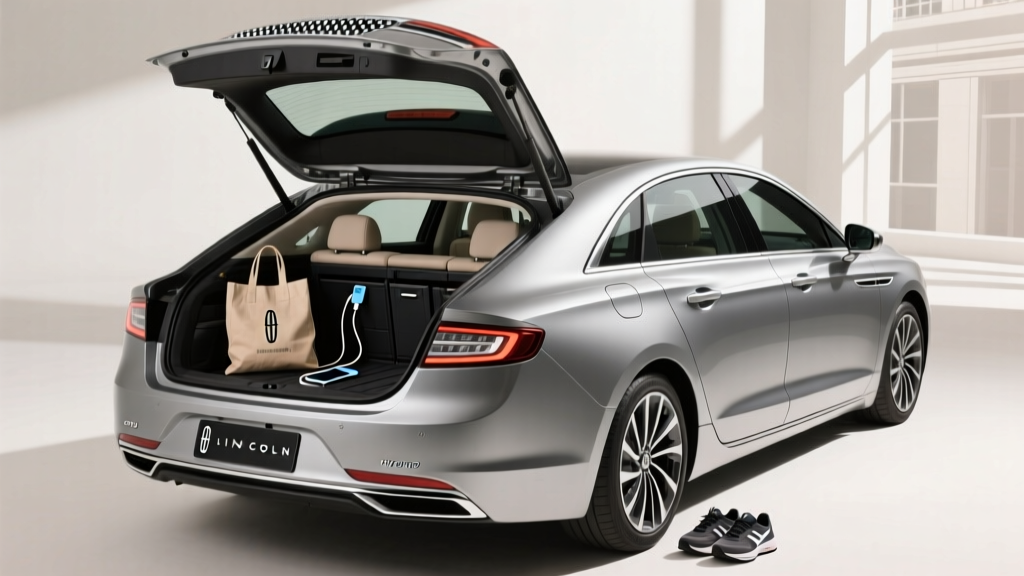
If you've been searching for the 2018 MKZ Hybrid trunk space answer, here's the number that matters: 15.4 cubic feet. That's identical to the gasoline-only MKZ — a significant advantage over many competing hybrids of the same era, which sacrificed cargo room to accommodate battery packs beneath the trunk floor or behind the rear seats.
Lincoln engineered the second-generation MKZ Hybrid (2013–2020) so the 1.4 kWh lithium-ion traction battery sits low and forward, preserving a full-depth trunk with a flat load floor. The 60/40 split-folding rear seatback also remains functional, letting you extend cargo length for longer items. For context, the 2018 Toyota Camry Hybrid offered 15.1 cu-ft, and the 2018 Ford Fusion Hybrid (the MKZ's platform-mate) matched it at 16.0 cu-ft. The MKZ's 15.4 cu-ft is competitive for the midsize luxury sedan class and easily swallows two large suitcases plus carry-ons.
| Spec | Value |
|---|---|
| Trunk Volume | 15.4 cu-ft |
| Powertrain | 2.0L Atkinson-cycle I-4 + electric motor (188 hp combined) |
| Transmission | eCVT (planetary gearset) |
| EPA MPG (City / Hwy / Combined) | 42 / 39 / 41 |
| Fuel Tank | 13.5 gal |
| Total Range | ~553 miles |
| 0–60 mph | ~8.3 sec |
| Hybrid Battery | 1.4 kWh, lithium-ion |
| Drivetrain | FWD (AWD not available on Hybrid) |
| Curb Weight | ~3,713 lbs |
Fuel Economy: EPA Numbers vs. Real-World MPG
The EPA rates the 2018 Lincoln MKZ Hybrid at 42 mpg city, 39 mpg highway, and 41 mpg combined. These figures hold across all trims (Premiere, Select, Reserve, Black Label) because the powertrain is identical.
| Driving Cycle | EPA MPG | Real-World Expectation |
|---|---|---|
| City | 42 mpg | 40–45 mpg (hybrids excel in stop-and-go) |
| Highway | 39 mpg | 35–39 mpg (aero drag and higher engine load) |
| Combined | 41 mpg | 37–42 mpg (varies by climate and driving mix) |
Why city MPG exceeds highway: Like all conventional hybrids (HEVs), the MKZ Hybrid recovers kinetic energy during braking and deceleration, converting it to battery charge that powers low-speed electric driving. In urban traffic with frequent stops, the electric motor handles a larger share of propulsion. On sustained highway cruising, the gasoline engine carries most of the load, which is why the highway figure drops to 39 mpg.
Cold-weather caveat: Expect a 10–15% MPG reduction in sub-freezing temperatures. The engine runs more often to generate cabin heat and maintain battery temperature, and winter fuel blends carry slightly less energy per gallon. Owners in northern climates typically report 35–37 mpg combined in January versus 42+ mpg in July.
Powertrain Deep Dive: How the MKZ Hybrid Drives
The 2018 MKZ Hybrid pairs a 2.0-liter Atkinson-cycle inline-four (141 hp, 129 lb-ft) with a permanent-magnet synchronous electric motor (120 hp, 166 lb-ft). Through Ford's eCVT planetary gearset, combined system output is 188 horsepower. The eCVT is not a belt-driven continuously variable transmission — it uses a fixed-ratio planetary gearset that blends engine and motor torque seamlessly, with no rubber bands or slipping clutches. This design is mechanically simpler and more durable than traditional CVTs.
Acceleration to 60 mph takes approximately 8.3 seconds. That's adequate for merging and passing but noticeably relaxed compared to the 2.0L EcoBoost AWD MKZ (245 hp, ~6.5 sec). The trade-off is fuel economy: the EcoBoost AWD is rated at just 23 mpg combined versus the Hybrid's 41.
The hybrid system operates in several modes automatically:
- EV Mode: Short low-speed bursts on electric power alone (up to ~25 mph, roughly 1 mile max on the 1.4 kWh pack)
- Hybrid Mode: Seamless blending of engine and motor for optimal efficiency
- Regen Braking: Motor acts as a generator during deceleration, recharging the battery
- Engine-Only: Sustained highway cruising where the engine is most efficient
HEV vs. PHEV vs. EV: Which Powertrain Fits You?
The 2018 MKZ Hybrid is a conventional hybrid (HEV) — it cannot be plugged in and has no meaningful electric-only range. Lincoln never produced a plug-in hybrid (PHEV) version of the MKZ, though Ford offered the Fusion Energi PHEV on the same platform. Here's how the three electrified powertrain types compare for a used-car buyer in 2026:
| Factor | HEV (e.g., MKZ Hybrid) | PHEV (e.g., Fusion Energi) | BEV (e.g., Tesla Model 3) |
|---|---|---|---|
| Plug-in Required? | No — gas only | Yes (Level 1 or 2) | Yes (Level 2 or DC fast) |
| Electric-Only Range | ~1 mile at low speed | 20–40 miles typical | 250–350+ miles |
| Total Range | ~553 miles | ~400+ miles (gas + electric) | 250–350 miles |
| Fuel Cost (per mile) | ~$0.09 (at $3.50/gal) | ~$0.05 electric / $0.09 gas | ~$0.04 (at $0.14/kWh) |
| Home Charging Needed? | No | Recommended (Level 2) | Essential (Level 2) |
| Maintenance | Oil changes + standard | Oil changes + standard | Minimal (no engine) |
| Used Price (2026 est.) | $16,000–$22,000 | $15,000–$20,000 | $18,000–$28,000 |
| Best For | No garage/charger access | Short commute + home charging | Home charging + lower running costs |
Choose the MKZ Hybrid (HEV) if you lack access to home or workplace charging, want a luxury sedan with strong city fuel economy, and prefer the simplicity of fueling up at any gas station. It's also the right call if you regularly take long road trips where charging infrastructure may be sparse.
Consider a PHEV instead if you have a garage with a 120V or 240V outlet and your daily commute is under 30 miles — you'd drive mostly on electricity and only use gas on longer trips.
Consider a full EV (BEV) if you can install a Level 2 home charger, want the lowest per-mile fuel cost, and are ready to plan around DC fast-charging on road trips.
Hybrid Battery Longevity, Warranty & Replacement Cost
The 2018 MKZ Hybrid's 1.4 kWh lithium-ion battery is far smaller than an EV pack and operates within a narrow state-of-charge window (roughly 40–80% SoC), which dramatically reduces cell stress. This is why hybrid batteries routinely outlast their warranty periods.
Battery Warranty Coverage (Original)
- Federal emissions warranty: 8 years / 80,000 miles (hybrid battery and related components)
- CARB-state warranty: 10 years / 150,000 miles in California and states that follow CARB standards (NY, MA, CT, VT, ME, RI, NJ, MD, OR, WA, CO, MN, NV, NM, VA)
- What's covered: Battery pack, battery control module, DC-DC converter, electric motor, eCVT assembly
- Capacity threshold: Warranty triggers if the battery fails to hold sufficient charge to maintain hybrid system function — unlike EVs, there's no published 70% SoH threshold
Real-world longevity data: Ford/Lincoln's hybrid system (shared with the Fusion Hybrid) has proven exceptionally durable. Taxi fleets running the Fusion Hybrid have logged 200,000–300,000+ miles on original battery packs. For a 2018 model in 2026, most examples will have 60,000–120,000 miles — well within the battery's expected lifespan.
Battery replacement cost: If the pack does fail outside warranty, expect $2,000–$3,500 for a refurbished or new replacement including labor at an independent hybrid specialist. A Lincoln dealer may quote $3,500–$5,000 for a new OEM pack. Third-party reconditioned packs are increasingly available and can bring costs closer to $1,500–$2,500.
Longevity tips for used buyers:
- Check the battery state of health (SoH) via an OBD-II scanner with hybrid-compatible software (e.g., FORScan)
- Avoid prolonged storage at very low or very high states of charge
- Regular driving actually helps — the battery benefits from frequent charge/discharge cycles
- Ensure the battery cooling system (air ducts near the rear seat) isn't blocked by cargo or debris
Tax Credits and Incentives: What Applies in 2026?
Because the 2018 MKZ Hybrid is a conventional hybrid (HEV) with no plug-in capability, it does not qualify for the federal §30D new clean vehicle credit (up to $7,500) or the §25E used clean vehicle credit (up to $4,000). Both credits require the vehicle to have a battery capacity of at least 7 kWh and plug-in charging capability — criteria that only PHEVs and BEVs meet.
According to the IRS clean vehicle credit guidelines, conventional hybrids are excluded from federal purchase incentives. However, some states and localities offer their own rebates or HOV-lane access for any electrified vehicle, including HEVs. Check your state's energy office or DMV for current programs — these vary by jurisdiction and change frequently.
For used buyers, the practical incentive is the vehicle's low running cost: at 41 mpg combined and $3.50/gallon gas, you'd spend roughly $1,280/year on fuel driving 15,000 miles — compared to $2,100/year in a comparable non-hybrid luxury sedan rated at 25 mpg combined.
Reliability, Safety, and Known Issues
The 2018 MKZ Hybrid benefits from Ford's mature hybrid architecture, which was in its third generation by this model year. Major reliability concerns are uncommon. The NHTSA gave the MKZ a 5-star overall safety rating, and the IIHS rated it Good in most crashworthiness categories.
Known issues to check on a used 2018 MKZ Hybrid:
- eCVT whine: A subtle whirring under acceleration is normal; loud grinding or clunking is not
- 12V battery drain: Like many modern cars, the MKZ can drain its 12V auxiliary battery if left unused for weeks — keep it on a maintainer if stored
- Infotainment (SYNC 3):strong> Generally reliable but can be slow to boot; ensure software updates were applied
- Brake feel: The transition between regenerative and friction braking can feel slightly grabby at low speeds — this is normal for the system, not a defect
- Recall check: Always run the VIN through NHTSA's recall lookup before purchasing
Pros, Cons, and the Used-Buyer Verdict
Pros
- 15.4 cu-ft trunk — no cargo compromise vs. gas model
- 41 mpg combined EPA; routinely exceeds 42 mpg in city driving
- Quiet, comfortable ride with luxury amenities
- Proven hybrid system with strong longevity record
- No charging infrastructure required
- Competitive used pricing ($16K–$22K in 2026)
Cons
- Modest 188 hp — acceleration is relaxed, not sporty
- FWD only — AWD unavailable on the Hybrid trim
- Outdated SYNC 3 infotainment by 2026 standards
- No plug-in option — can't access HOV lanes or EV credits
- Lincoln discontinued the MKZ after 2020 — limited dealer support long-term
- Interior materials don't quite match German rivals of the same era
Verdict: The 2018 MKZ Hybrid is one of the best used hybrid sedans for buyers who prioritize trunk space, fuel economy, and luxury comfort without needing to install a home charger. Its 15.4 cu-ft trunk answers the cargo-capacity question decisively, and the 41 mpg combined rating keeps running costs low. If AWD or punchy acceleration matters, look elsewhere. But for daily commuting, road trips, and hassle-free electrified driving, this MKZ remains a strong value.
Frequently Asked Questions
How many MPG does the 2018 MKZ Hybrid get?
The EPA rates it at 42 mpg city, 39 mpg highway, and 41 mpg combined. Real-world owners frequently report 40–45 mpg in city driving and 35–39 mpg on the highway, with cold weather reducing those figures by 10–15%.
Can you plug in the 2018 MKZ Hybrid?
No. The MKZ Hybrid is a conventional hybrid (HEV). It charges its small 1.4 kWh battery entirely through regenerative braking and the gasoline engine. There is no charging port. Lincoln never offered a plug-in hybrid (PHEV) version of the MKZ.
How long will the hybrid battery last?
Ford/Lincoln hybrid batteries routinely last 150,000–200,000+ miles. The original warranty covers 8 years/80,000 miles (10 years/150,000 miles in CARB states). For a 2018 model, the federal warranty may still have remaining coverage through the 2026 model year if under 80,000 miles.
What does it cost to replace the MKZ Hybrid battery?
Expect $2,000–$3,500 at an independent hybrid specialist for a refurbished pack, or $3,500–$5,000 at a Lincoln dealer for a new OEM unit. Complete failures are rare on this generation.
Does the 2018 MKZ Hybrid qualify for any tax credit?
No. Federal clean vehicle credits (§30D for new, §25E for used) require plug-in capability and a battery of at least 7 kWh. The MKZ Hybrid meets neither criterion. Some state-level incentives for hybrids may apply — check your local program.
Is the MKZ Hybrid trunk the same size as the gas model?
Yes. Both the hybrid and gasoline 2018 MKZ offer 15.4 cubic feet of trunk space. The hybrid battery is positioned so it does not intrude into the cargo area.
Does the 2018 MKZ Hybrid have AWD?
No. All-wheel drive was available on the 2.0L EcoBoost gasoline model but not on the Hybrid. The Hybrid is front-wheel drive only.