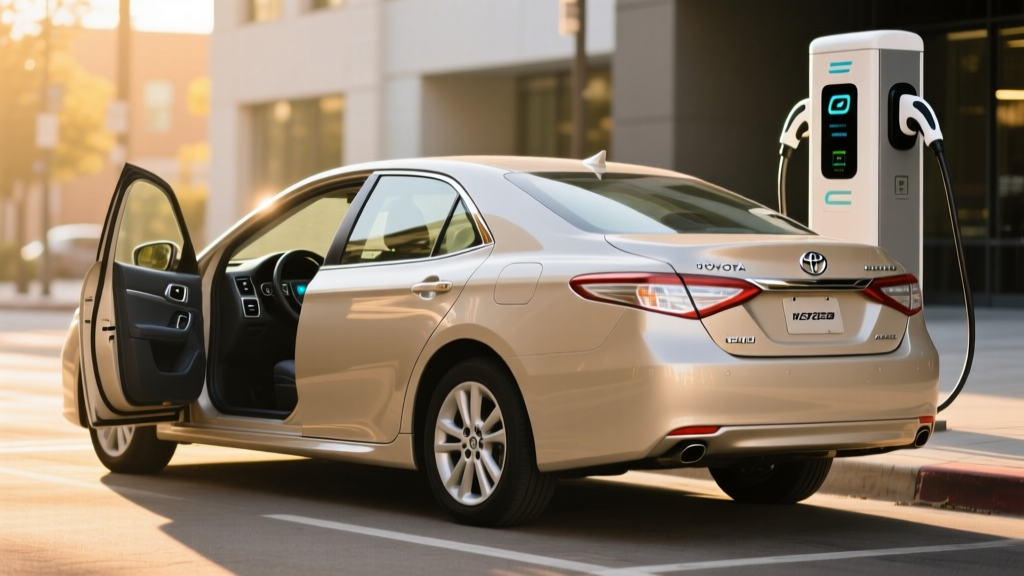
The 2007 Toyota Camry Hybrid was one of the first mainstream midsize sedans to pair a four-cylinder gasoline engine with an electric motor, delivering fuel economy that still impresses nearly two decades later. For used-car shoppers researching the 2007 Toyota Camry Hybrid sedan MPG, the numbers tell a compelling story: an EPA-rated 33 mpg city, 34 mpg highway, and 34 mpg combined. But as with any 19-year-old hybrid, the real questions center on battery longevity, replacement costs, and whether this generation still delivers meaningful fuel savings in 2026.
This guide breaks down every efficiency figure, powertrain spec, and ownership consideration you need before buying a used 2007 Camry Hybrid.
2007 Toyota Camry Hybrid MPG: EPA Ratings and Real-World Results
The 2007 Camry Hybrid's EPA fuel economy ratings were among the best in its class at launch. Toyota's Hybrid Synergy Drive system prioritizes electric-motor assist at low speeds, which gives it a slight city-driving advantage — unusual for a conventional hybrid of this era.
| Driving Condition | EPA MPG | Real-World Expectation (2026) |
|---|---|---|
| City | 33 mpg | 30–35 mpg |
| Highway | 34 mpg | 30–33 mpg |
| Combined | 34 mpg | 30–34 mpg |
Real-World MPG Note: Hybrids like the 2007 Camry often exceed EPA city estimates in stop-and-go traffic thanks to regenerative braking and electric-only low-speed operation. However, a 19-year-old nickel-metal hydride (NiMH) battery with significant mileage may no longer deliver peak efficiency. Expect real-world combined fuel economy between 28 and 34 mpg depending on battery state of health (SoH), tire condition, and driving style. Data from fueleconomy.gov confirms the original EPA ratings.
Powertrain Specs: Engine, Motor, and Combined Output
The 2007 Camry Hybrid uses Toyota's second-generation Hybrid Synergy Drive, combining a 2.4-liter inline-four Atkinson-cycle gasoline engine with a permanent-magnet electric motor through a planetary-gear continuously variable transmission (eCVT).
| Specification | Value |
|---|---|
| Gasoline Engine | 2.4L 4-cylinder Atkinson-cycle (147 hp) |
| Electric Motor | Permanent-magnet synchronous (40 hp / 30 kW) |
| Combined Net Output | 192 hp |
| Transmission | eCVT (planetary gearset) |
| Hybrid Battery | NiMH, ~1.6 kWh (nominal) |
| 0–60 mph | ~8.6 seconds |
| Drivetrain | Front-wheel drive |
| Fuel Tank | 17.2 gallons |
| Total Driving Range | ~585 miles (at 34 mpg combined) |
The combined 192 hp output actually exceeded the gasoline-only 2007 Camry four-cylinder (158 hp), giving the Hybrid a noticeable acceleration advantage in merging and passing situations. The eCVT has no traditional belts or pulleys — it uses a planetary gearset that is widely regarded as one of the most reliable transmissions Toyota has ever built.
HEV vs PHEV vs EV: Where Does the 2007 Camry Hybrid Fit?
The 2007 Camry Hybrid is a conventional hybrid electric vehicle (HEV). It cannot be plugged in. The small NiMH battery charges exclusively through regenerative braking and engine-generated power. This is fundamentally different from a plug-in hybrid (PHEV) or a battery electric vehicle (BEV).
| Feature | HEV (2007 Camry Hybrid) | PHEV (e.g., 2026 RAV4 Prime) | BEV (e.g., 2026 Camry-equivalent EV) |
|---|---|---|---|
| Plug-in Charging | No | Yes | Yes |
| Electric-Only Range | ~1 mile at low speed | 35–42 miles | 250–350+ miles |
| Battery Capacity | ~1.6 kWh (NiMH) | ~18.1 kWh (Li-ion) | 60–85+ kWh (Li-ion/LFP) |
| DC Fast Charging | No | No (most PHEVs) | Yes (50–350 kW) |
| Tailpipe Emissions | Yes (reduced vs gas) | Yes (when engine runs) | None |
| Federal Tax Credit (New) | None | Up to $7,500 (§30D) | Up to $7,500 (§30D) |
| Used EV Credit (§25E) | Not eligible | Not eligible | Up to $4,000 |
Who should choose the 2007 Camry Hybrid? Budget-conscious drivers who want better fuel economy without changing their fueling habits. There are no charging requirements, no range anxiety, and no plug-in infrastructure to worry about. It's ideal for buyers spending under $6,000 on a reliable daily commuter.
Who should look at a PHEV or BEV instead? Drivers with home charging access, longer commutes, and higher budgets who want greater electric-only operation, modern safety tech, and eligibility for federal tax credits.
Hybrid Battery Lifespan, Warranty, and Replacement Cost
The biggest concern for any used hybrid buyer is the traction battery. The 2007 Camry Hybrid uses a nickel-metal hydride (NiMH) battery pack — a chemistry known for durability but not immune to age-related degradation.
Original Hybrid Battery Warranty: Toyota covered the 2007 Camry Hybrid's battery for 8 years / 100,000 miles (10 years / 150,000 miles in California and states adopting CARB emissions standards). This warranty has expired for all 2007 models as of 2015–2017.
Expected Battery Lifespan: NiMH packs in the Camry Hybrid typically last 150,000–200,000 miles before significant capacity loss. Many examples exceed 200,000 miles with gradual efficiency decline rather than sudden failure.
Battery Replacement Cost (2026 Estimates)
| Option | Estimated Cost | Notes |
|---|---|---|
| New OEM Toyota Battery | $2,500–$3,500 | Installed at dealership; best longevity |
| Refurbished/Reconditioned Pack | $1,000–$1,800 | Replaced cells; variable quality; 1–3 year warranty typical |
| Used Salvage-Yard Battery | $500–$900 | Unknown SoH; gamble on remaining life |
| Individual Cell Replacement (DIY/Shop) | $300–$700 | Requires diagnostic tool to identify bad cells; labor-intensive |
Before purchasing, request a hybrid battery health check from a Toyota dealer or independent hybrid specialist. A scan tool can read individual module voltages — any module reading significantly below the others signals impending failure. Also watch for the "Check Hybrid System" warning light and reduced fuel economy as early degradation indicators.
Is the 2007 Camry Hybrid Reliable?
The 2007 Camry Hybrid benefits from Toyota's reputation for overengineering hybrid components. The eCVT transmission, in particular, has no clutch packs, bands, or torque converters to wear out — it's a simple planetary gearset with very few failure points.
Key reliability considerations specific to this model year:
- Hybrid battery degradation is the primary long-term expense. Budget $1,500–$3,500 for eventual replacement if the original pack is still in the vehicle.
- Brake longevity is excellent. Regenerative braking handles most deceleration, so friction brake pads often last 80,000–100,000+ miles.
- Water pump and inverter coolant pump failures have been reported on high-mileage examples. Replacement costs $300–$600.
- The 12V auxiliary battery (standard lead-acid) should be replaced every 4–5 years like any other vehicle.
According to NHTSA records, the 2007 Camry Hybrid has no widespread safety recalls specific to its hybrid system, though standard Camry recalls (e.g., floor mat/accelerator pedal) may apply.
Used Pricing and Tax Credit Eligibility in 2026
The 2007 Camry Hybrid was originally priced around $26,500 MSRP. In today's used market, examples typically sell between $3,500 and $7,000 depending on mileage, condition, and battery health.
Federal Tax Credit Status:
- The 2007 Camry Hybrid does NOT qualify for the new-vehicle §30D Clean Vehicle Credit — it is a used HEV, not a new PHEV or BEV.
- It does NOT qualify for the §25E Used Clean Vehicle Credit — that credit applies only to used BEVs and PHEVs (vehicles capable of plug-in electric operation), not conventional HEVs.
- No current federal tax incentive exists for purchasing a used conventional hybrid.
- Some states may offer registration discounts, HOV lane access, or emissions-test exemptions for hybrids — check your state's DMV for specifics.
Source: IRS.gov Clean Vehicle Credits
Pros and Cons of the 2007 Camry Hybrid in 2026
Pros
- 34 mpg combined still competitive with many new gas-only sedans
- Proven, reliable eCVT with minimal failure points
- Low purchase price ($3,500–$7,000 used)
- No plug-in charging required — fuel anywhere
- Strong regenerative braking extends brake pad life
- 192 hp combined output outperformed the gas-only 4-cylinder
Cons
- Hybrid battery likely at or past original lifespan
- No federal or state EV/PHEV tax credits available
- Outdated safety tech (no automatic emergency braking, lane-keep, or blind-spot monitoring)
- NiMH battery less energy-dense than modern Li-ion
- Interior and infotainment feel dated by 2026 standards
- Higher-mileage examples may need battery replacement soon after purchase
2007 Camry Hybrid vs Modern Alternatives
If you're cross-shopping the 2007 Camry Hybrid against newer options, here's how the efficiency and cost picture compares:
| Metric | 2007 Camry Hybrid (Used) | 2026 Toyota Camry Hybrid (New) | 2026 Toyota Prius (New) |
|---|---|---|---|
| EPA Combined MPG | 34 mpg | 51 mpg | 57 mpg |
| Combined HP | 192 hp | 225 hp | 196 hp |
| Battery Chemistry | NiMH (~1.6 kWh) | Li-ion (~1.6 kWh) | Li-ion (~4.08 kWh) |
| Battery Warranty | Expired | 10 yr / 150,000 mi | 10 yr / 150,000 mi |
| Starting Price | $3,500–$7,000 | ~$29,500 | ~$29,500 |
| Safety Tech | ABS, stability control | TSS 3.0 (AEB, LKA, ACC) | TSS 3.0 (AEB, LKA, ACC) |
The 2007 model delivers roughly 60–65% of the fuel economy of a current-generation Camry Hybrid. For a buyer on a tight budget who drives under 10,000 miles per year, the fuel-cost savings of a newer hybrid may not justify the $22,000+ price difference. But for high-mileage commuters, the newer model's 51 mpg combined rating and warranty coverage make a strong financial case.
Frequently Asked Questions
How many MPG does the 2007 Toyota Camry Hybrid get?
The EPA rates the 2007 Camry Hybrid at 33 mpg city, 34 mpg highway, and 34 mpg combined. Real-world results from owners typically range from 28 to 35 mpg combined, with city driving often yielding the best numbers due to regenerative braking and electric-motor assist at low speeds.
Does the 2007 Camry Hybrid need to be plugged in?
No. The 2007 Camry Hybrid is a conventional hybrid (HEV), not a plug-in hybrid (PHEV). The battery charges through regenerative braking and the gasoline engine. You never plug it in — you simply refuel with gasoline as you would any other car.
How far can the 2007 Camry Hybrid drive on electric only?
Effectively less than 1 mile at very low speeds (under 25 mph) on a full battery charge. This is not a vehicle designed for meaningful electric-only driving. The electric motor primarily assists the gasoline engine to reduce fuel consumption, not to replace it.
Is the 2007 Camry Hybrid reliable, and what does a battery replacement cost?
Yes, the 2007 Camry Hybrid is widely regarded as reliable. The eCVT transmission is exceptionally durable. The main long-term expense is the NiMH hybrid battery, which typically lasts 150,000–200,000 miles. Replacement costs range from $500 (used salvage) to $3,500 (new OEM), with refurbished packs in the $1,000–$1,800 range being the most common choice for a vehicle of this age and value.
Does the 2007 Camry Hybrid qualify for any tax credit?
No. The 2007 Camry Hybrid does not qualify for any current federal tax credit. The §30D Clean Vehicle Credit applies only to new PHEVs and BEVs, and the §25E Used Clean Vehicle Credit applies only to used plug-in vehicles. Conventional hybrids (HEVs) are not eligible for either. Some states may offer minor perks like HOV lane access or emissions-test exemptions — check your local DMV.
Should I buy a 2007 Camry Hybrid or a newer hybrid?
If your budget is under $7,000 and you drive fewer than 12,000 miles per year, the 2007 Camry Hybrid offers excellent value with 34 mpg combined and low running costs. If you drive more, commute long distances, or prioritize modern safety features (AEB, lane-keeping, adaptive cruise), a newer Camry Hybrid (51 mpg) or Prius (57 mpg) will save significantly more on fuel over time and comes with a full 10-year hybrid battery warranty.