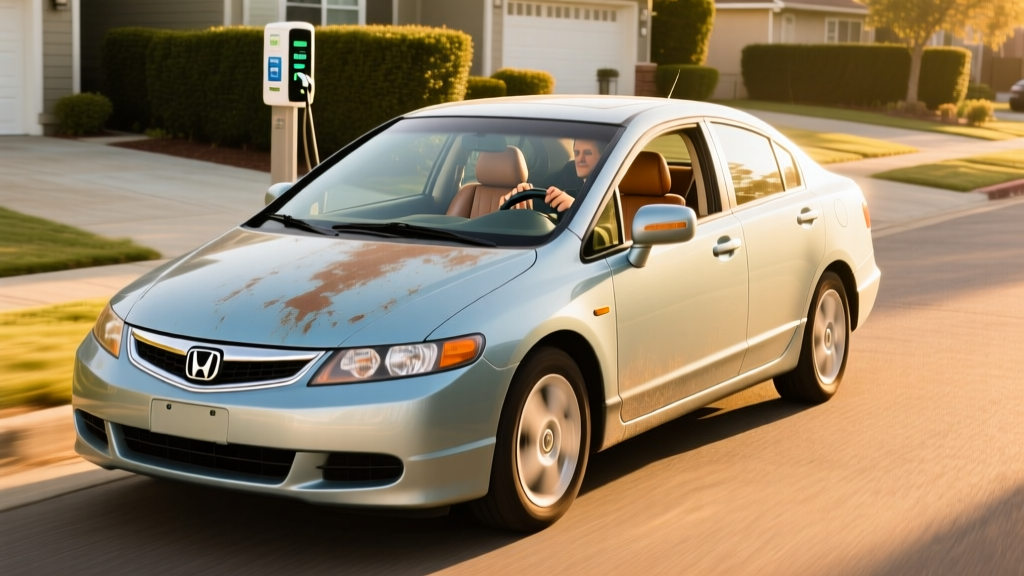
The 2007 Honda Civic Hybrid was one of the earliest mainstream hybrids sold in the United States, competing directly with the second-generation Toyota Prius at a time when hybrid technology was still proving itself. Nearly two decades later, buyers researching the 07 Honda Civic Hybrid MPG are typically looking at this car on the used market as an ultra-budget commuter — often priced between $3,000 and $6,000 in 2026. The question isn't just what the EPA sticker says; it's whether a 19-year-old hybrid battery and Honda's early IMA (Integrated Motor Assist) system still deliver meaningful fuel savings today.
This guide covers the real-world fuel economy you can expect, the critical battery reliability concerns every buyer should know, and whether this first-generation Civic Hybrid still makes financial sense compared to a newer used hybrid, a modern plug-in hybrid (PHEV), or a battery-electric vehicle (BEV).
2007 Honda Civic Hybrid MPG: EPA Ratings vs. Real-World Results
The 2007 Civic Hybrid uses Honda's first-generation IMA parallel-hybrid system, which pairs a small electric motor sandwiched between the gasoline engine and the continuously variable transmission (CVT). Unlike Toyota's Hybrid Synergy Drive, which can propel the car on electric power alone at low speeds, Honda's IMA system always requires the gasoline engine to be running when the car is in motion. This architectural difference directly affects real-world MPG.
| Driving Cycle | EPA Rating | Real-World Expectation (2026) |
|---|---|---|
| City | 49 MPG | 38–44 MPG |
| Highway | 51 MPG | 42–48 MPG |
| Combined | 42 MPG (revised 2008+ label)* | 36–42 MPG |
*Note: The original 2007 window sticker listed 49 city / 51 highway under the pre-2008 EPA testing methodology. When the EPA revised its testing procedures for the 2008 model year to better reflect real-world driving, the 2007 Civic Hybrid was retroactively re-rated to approximately 40 city / 45 highway / 42 combined on fueleconomy.gov. Always use the revised numbers for realistic planning.
How the IMA Hybrid System Works (HEV, Not PHEV)
It's essential to understand that the 2007 Honda Civic Hybrid is a conventional hybrid electric vehicle (HEV). It does not plug in. There is no electric-only driving range. The small nickel-metal hydride (NiMH) battery pack — rated at just 0.35 kWh gross capacity — is recharged exclusively through regenerative braking and the gasoline engine. You fuel it at a gas station exactly like a conventional car.
| Feature | HEV (e.g., 07 Civic Hybrid) | PHEV (e.g., 2026 Toyota RAV4 Prime) | BEV (e.g., 2026 Hyundai Ioniq 5) |
|---|---|---|---|
| Plugs in? | No | Yes (Level 1/2) | Yes (Level 1/2/DC) |
| Electric-only range | 0 miles | 25–42 miles | 250–350+ miles |
| Battery size | ~0.35 kWh (NiMH) | 13–20 kWh (NMC/LFP) | 58–84 kWh (NMC/LFP) |
| Fuel source | Gasoline only | Gasoline + electricity | Electricity only |
| Federal tax credit (§30D) | Not eligible | Up to $7,500* | Up to $7,500* |
| Home charging needed? | No | Recommended for benefit | Essential |
*§30D credit eligibility for new PHEVs and BEVs depends on MSRP caps, buyer income limits, battery sourcing requirements, and manufacturer sales thresholds. See IRS.gov for current-year rules. Used hybrids and PHEVs may qualify for the separate §25E used clean vehicle credit (up to $4,000) if eligibility criteria are met.
Powertrain Specifications and Performance
The 2007 Civic Hybrid's powertrain is modest by modern standards, designed for efficiency rather than performance. Here are the exact specifications:
| Specification | Value |
|---|---|
| Gasoline engine | 1.3L i-DSI 4-cylinder (8-valve) |
| Engine horsepower | 93 HP @ 6,000 RPM |
| Engine torque | 89 lb-ft @ 4,600 RPM |
| Electric motor (IMA) | 15 kW (20 HP) / 76 lb-ft torque assist |
| Combined system output | 110 HP @ 6,000 RPM |
| Transmission | Continuously Variable (CVT) |
| 0–60 MPH | ~11.5 seconds |
| Drivetrain | Front-wheel drive |
| Curb weight | ~2,850 lbs |
| Fuel tank capacity | 13.2 gallons |
| Total driving range (est.) | ~480–550 miles per tank |
The 1.3L i-DSI engine uses Honda's dual-and-sequential ignition system — two spark plugs per cylinder — to improve combustion efficiency at low RPM. The IMA motor provides its peak assist during acceleration from a stop, smoothing out the small engine's torque deficit. At steady-state cruising, the electric motor contributes little, which is why highway MPG isn't dramatically better than a conventional Civic of the same era.
The Critical Issue: Hybrid Battery Degradation and Replacement Cost
| Option | Cost Range | Warranty | Notes |
|---|---|---|---|
| OEM Honda replacement | $2,000–$2,800 (parts + labor) | Typically 1 year | Available through dealers; may require special order for a 2007 model |
| Aftermarket refurbished NiMH pack | $900–$1,500 (parts + labor) | 1–3 years typical | Reconditioned cells; quality varies by vendor |
| Aftermarket new NiMH pack | $1,500–$2,200 (parts + labor) | 3–5 years typical | Companies like Bumblebee Batteries or Dorman offer direct-fit replacements |
| Individual cell replacement (DIY-savvy) | $200–$500 (parts only) | None | Requires electrical knowledge; not recommended for most buyers |
When evaluating a used 2007 Civic Hybrid, ask the seller for documentation of any IMA battery replacement. A car with a recently replaced aftermarket battery (within the last 2–3 years) is generally a better buy than one still on its original 19-year-old pack. You can also check the IMA battery's state of charge behavior during a test drive: if the battery gauge drops rapidly under acceleration or fails to recharge during deceleration, the pack is degraded.
Reliability Beyond the Battery: What Else Goes Wrong?
The 2007 Civic Hybrid's gasoline powertrain — the 1.3L i-DSI engine and CVT — has a mixed reliability record. Here are the most commonly reported issues among long-term owners:
- CVT transmission shudder/judder: The CVT fluid degrades over time and can cause hesitation or shuddering during acceleration. A CVT fluid drain-and-fill (not a flush) with Honda HMMF fluid every 30,000 miles is critical. Many neglected examples need CVT replacement at $3,000–$4,500.
- Motor mount deterioration: The engine/transmission motor mounts are rubber and tend to crack or collapse by 120,000–150,000 miles, causing vibration at idle. Replacement runs $400–$700.
- 12V auxiliary battery drain: The IMA system's interaction with the 12V battery can cause premature 12V battery failure if the car sits for extended periods. A dead 12V battery prevents the IMA system from booting, even if the hybrid battery is healthy.
- A/C compressor strain: The A/C compressor is driven by the engine, and running A/C reduces fuel economy by 3–5 MPG in city driving — a noticeable hit on a car optimized for efficiency.
Overall, the 2007 Civic Hybrid's non-hybrid mechanical components are similar in longevity to the conventional 2006–2011 Civic generation, which can reach 200,000+ miles with proper maintenance. The hybrid-specific components (IMA battery, IMA motor) are the wildcard that determines whether this car is a bargain or a money pit.
Does the 2007 Honda Civic Hybrid Qualify for Any Tax Credit?
No. The 2007 Honda Civic Hybrid does not qualify for the federal §30D new clean vehicle tax credit, which applies only to new BEVs and PHEVs meeting current battery sourcing and MSRP requirements. The original hybrid tax credit that existed in 2006–2007 (up to $2,100 for the Civic Hybrid) was phased out after Honda reached its 60,000-unit manufacturer cap in mid-2007, and that credit has not been available for over 15 years.
For buyers purchasing a used 2007 Civic Hybrid in 2026, the §25E used clean vehicle credit (up to $4,000 or 30% of sale price, whichever is less) is also unlikely to apply. The §25E credit requires the vehicle to be at least two model years old (which the 2007 qualifies for) but also requires the vehicle to be a qualified plug-in electric vehicle or fuel cell vehicle. Conventional hybrids (HEVs) like the Civic Hybrid are excluded from §25E eligibility. Only PHEVs and BEVs qualify.
In short: expect to pay the full negotiated used-car price with no federal tax incentive. Some states may offer minimal used-EV rebates, but these almost always target plug-in vehicles. Check your state's energy office for any applicable programs.
Who Should Buy the 2007 Civic Hybrid in 2026 — And Who Shouldn't?
✓ Good Fit If:
- You need an ultra-budget commuter under $5,000
- Your commute is stop-and-go city driving (where hybrid assist shines)
- You cannot install home charging (no garage, apartment living)
- You drive fewer than 10,000 miles per year
- You have access to a trusted independent mechanic familiar with Honda hybrids
✗ Look Elsewhere If:
- You want reliable hybrid MPG without battery replacement risk
- You drive mostly highway miles (minimal hybrid benefit)
- You want electric-only driving or plug-in capability
- You need modern safety features (no ESC standard, no backup camera)
- Your budget allows $12,000+ for a newer, more reliable used hybrid
If your budget can stretch to $10,000–$15,000, a 2014–2019 Toyota Prius (third or early fourth generation) delivers 50+ MPG combined with a far more mature hybrid system, better reliability data, and more readily available replacement parts. If you have home charging access and can spend $25,000+, a used PHEV like the 2019–2022 Toyota Prius Prime or Honda Clarity Plug-In Hybrid offers 25+ miles of electric-only range plus hybrid operation — and may still qualify for the §25E used clean vehicle credit.
Frequently Asked Questions
How many MPG does the 2007 Honda Civic Hybrid actually get in 2026?
Expect 36–42 MPG combined in real-world driving with a healthy IMA battery. City driving with frequent stops yields the best results (38–44 MPG), while sustained highway driving above 70 MPH drops to 42–48 MPG. If the IMA battery is degraded or failed, expect 28–32 MPG combined — essentially the efficiency of a conventional 1.3L Civic with the added weight of a non-functioning hybrid system.
Can I plug in the 2007 Honda Civic Hybrid to charge it?
No. The 2007 Civic Hybrid is a conventional HEV with no plug-in capability. The small 0.35 kWh NiMH battery charges exclusively through regenerative braking and the gasoline engine. You refuel it only at a gas station. If you want a Honda with plug-in capability, look at the 2018–2022 Honda Clarity Plug-In Hybrid (47 miles electric-only range) or the 2023+ Honda Accord Hybrid (HEV, no plug) as alternatives.
How much does it cost to replace the IMA battery on a 2007 Civic Hybrid?
Between $900 and $2,800 depending on whether you choose an aftermarket refurbished pack ($900–$1,500 installed), an aftermarket new pack ($1,500–$2,200 installed), or an OEM Honda replacement ($2,000–$2,800 installed). Given that a clean 2007 Civic Hybrid sells for $3,000–$6,000 in 2026, a battery replacement can represent 25–50% of the car's value — a critical factor in your purchase decision.
Is the 2007 Civic Hybrid more reliable than a 2007 Prius?
Generally, no. The second-generation Toyota Prius (2004–2009) has a more robust hybrid system with a larger battery, more electric assist capability, and better-documented long-term reliability. The Prius's NiMH battery tends to last 150,000–200,000 miles before significant degradation, while the Civic Hybrid's smaller IMA battery often needed replacement at 80,000–120,000 miles even under the original ownership period. The Prius also achieves 46 MPG combined (revised EPA) versus the Civic Hybrid's 42 MPG combined.
Does the 2007 Civic Hybrid qualify for any federal or state tax credits?
No federal tax credits are available for purchasing a used 2007 Civic Hybrid in 2026. The original hybrid tax credit was phased out in 2007, and the current §30D and §25E credits apply only to plug-in vehicles (PHEVs and BEVs), not conventional hybrids. State incentives vary but similarly favor plug-in vehicles. Consult a tax professional for any local programs.
Sources: EPA fuel economy data from fueleconomy.gov; federal tax credit rules from IRS.gov; safety ratings from NHTSA.gov.