The 2007 Honda Civic Hybrid at a Glance
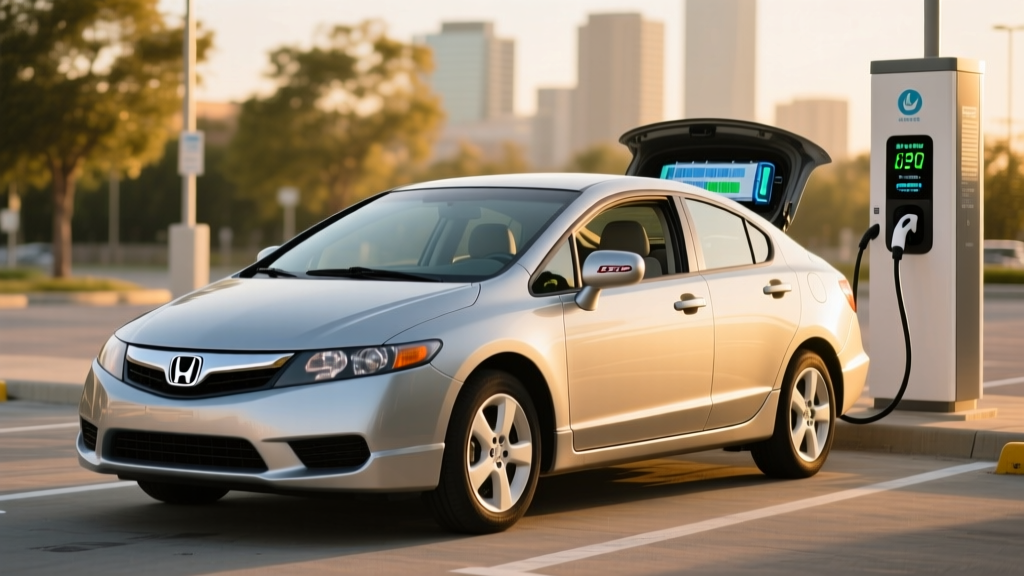
The 2007 Honda Civic Hybrid occupies a specific niche in the used-car market: an early mainstream hybrid sedan that prioritized fuel economy over performance, built during Honda's Integrated Motor Assist (IMA) era. Nearly two decades after its debut, it remains a budget-friendly entry point for drivers seeking hybrid efficiency without the complexity of a plug-in hybrid (PHEV) or the charging infrastructure demands of a full battery-electric vehicle (BEV).
But buying a 19-year-old hybrid in 2026 raises legitimate questions. What happens when the IMA battery fails? Does the real-world MPG still hold up? And how does this first-generation Civic Hybrid stack up against modern HEVs, PHEVs, and EVs on total cost of ownership? This guide answers each of those with hard data.
| Specification | 2007 Honda Civic Hybrid |
|---|---|
| Powertrain | 1.3L i-VTEC I4 + IMA electric motor |
| Combined Horsepower | 110 hp @ 6,000 rpm |
| Combined Torque | 123 lb-ft @ 1,000-2,500 rpm |
| Transmission | CVT (continuously variable) |
| EPA MPG (City / Hwy / Combined) | 40 / 43 / 42 |
| Fuel Tank Capacity | 12.4 gallons |
| Total Driving Range | ~520 miles |
| Hybrid Battery | NiMH, ~0.5 kWh (nominal) |
| 0–60 mph | ~10.5 seconds |
| Original MSRP (2007) | $22,600 |
| Typical Used Price (2026) | $3,000–$6,500 |
| Hybrid Battery Warranty (Original) | 8 years / 80,000 miles (10 yr / 100k in CARB states) |
HEV vs. PHEV: Where the 2007 Civic Hybrid Fits
The 2007 Honda Civic Hybrid is a conventional hybrid electric vehicle (HEV). It cannot be plugged in. It has no meaningful electric-only driving range. The IMA system uses a small electric motor sandwiched between the engine and transmission to assist during acceleration, enable idle stop-start, and capture energy during regenerative braking. The nickel-metal hydride (NiMH) battery recharges exclusively from the engine and regen — never from a wall outlet.
| Feature | HEV (e.g., 2007 Civic Hybrid) | PHEV (e.g., 2026 Toyota Prius Prime) | BEV (e.g., 2026 Tesla Model 3) |
|---|---|---|---|
| Plug-in Charging | No | Yes | Yes |
| Electric-Only Range | None (motor assist only) | 25–45 miles typical | 250–360 miles typical |
| Battery Size | ~0.5 kWh (NiMH) | 10–18 kWh (Li-ion) | 50–82 kWh (Li-ion) |
| Gasoline Engine | Yes (primary) | Yes (backup) | No |
| Home Charging Required | No | Recommended | Essential |
| Federal Tax Credit (§30D) | Not eligible | Up to $7,500 (if eligible) | Up to $7,500 (if eligible) |
| Used Vehicle Credit (§25E) | Not eligible (too old) | Not eligible (too old) | Up to $4,000 if MY ≤ 2024 & ≤$25k |
This distinction matters because many shoppers conflate HEVs with PHEVs. The Civic Hybrid will never drive on electricity alone at meaningful speeds — the IMA motor provides a maximum of 15 kW of assist and cannot propel the car without the gasoline engine running. If you want electric-only commuting, you need a PHEV or BEV.
Fuel Economy: EPA Ratings and Real-World MPG
The EPA rated the 2007 Honda Civic Hybrid at 40 MPG city, 43 MPG highway, and 42 MPG combined when equipped with the CVT transmission. These figures come from fueleconomy.gov, the official EPA source.
| Driving Scenario | EPA Rating | Real-World Expectation |
|---|---|---|
| City (stop-and-go) | 40 MPG | 38–44 MPG (regen helps in traffic) |
| Highway (70 mph cruise) | 43 MPG | 36–40 MPG (aero drag, less regen benefit) |
| Combined | 42 MPG | 37–41 MPG |
| Cold Weather (below 35°F) | N/A | 32–36 MPG (engine runs more for heat) |
One counterintuitive trait of early Honda IMA hybrids: highway MPG can actually drop below city MPG in real driving. The EPA's highway test cycle is gentle and short, favoring the Civic Hybrid's lean-burn capability and low aerodynamic drag at modest speeds. On a sustained 70–75 mph interstate run, expect 36–40 MPG — still excellent, but below the sticker number.
City driving, where regenerative braking and idle stop-start do the most work, often yields results at or slightly above the EPA city estimate. Owners on Fuelly and similar tracking platforms report lifetime averages in the 37–41 MPG range, which aligns with the combined estimate when driving conditions are mixed.
Compared to the 2007 non-hybrid Civic EX (25/36/29 MPG with automatic), the hybrid delivers roughly 45% better combined fuel economy — a gap you'll feel at the pump, especially with current fuel prices.
IMA Powertrain: How It Works and What It Delivers
The 2007 Civic Hybrid pairs a 1.3-liter i-VTEC four-cylinder engine with Honda's Integrated Motor Assist system. The IMA motor is a thin, brushless DC unit mounted directly on the crankshaft between the engine and the CVT. Combined output is 110 horsepower and 123 lb-ft of torque.
The IMA system provides three key functions:
- Motor assist: The electric motor adds torque during acceleration, reducing the load on the gasoline engine and improving fuel economy.
- Idle stop: The engine shuts off at stops (when conditions allow) and restarts almost instantly via the IMA motor, eliminating idling fuel consumption.
- Regenerative braking: During deceleration, the IMA motor reverses function to act as a generator, converting kinetic energy into electrical energy to recharge the NiMH battery.
The 1.3L engine can also deactivate cylinders under light-load cruising — a feature Honda called Variable Cylinder Management (VCM) on this generation — dropping to three cylinders to reduce pumping losses. This is one reason the highway EPA number is relatively high.
Performance is adequate but not quick. The 0–60 mph time of approximately 10.5 seconds puts it well behind modern hybrids like the 2026 Toyota Prius (7.2 seconds for the 194-hp AWD model). Passing power at highway speeds requires planning. The CVT keeps the engine in its efficient band but drones noticeably under hard acceleration.
Battery Health, Reliability, and Replacement Cost
The single biggest ownership concern for a 2007 Civic Hybrid in 2026 is the IMA battery. This is a nickel-metal hydride (NiMH) pack with a nominal capacity of roughly 0.5 kWh — tiny by modern standards, but sufficient for the IMA system's assist and regen duties.
Original Hybrid Battery Warranty: 8 years / 80,000 miles in most states; 10 years / 100,000 miles in California Air Resources Board (CARB) states (CA, CT, ME, MA, NJ, NY, OR, RI, VT, WA). For a 2007 model, this warranty expired no later than 2017 in CARB states. Any battery replacement is now an out-of-pocket expense.
How long do these batteries last? The first-generation Civic Hybrid IMA batteries had a well-documented pattern of premature degradation. Honda issued a class-action settlement and extended warranties on 2006–2008 models, but those extensions have long since expired. Typical first-owner battery life was 80,000–120,000 miles. If the original battery is still in the car, it is almost certainly degraded or already replaced at least once.
Replacement cost in 2026:
- OEM Honda replacement (dealer): $2,000–$3,500 installed — often uneconomical given the car's value.
- Aftermarket/remanufactured NiMH pack: $1,200–$1,800 installed from hybrid-specialist shops.
- Used/salvage pack: $400–$800 for the battery alone, but remaining life is a gamble.
- DIY cell-level rebuild: $200–$500 in individual NiMH D-cell sub-packs for those with technical skill and proper safety equipment.
Is it reliable overall? The 2007 Civic Hybrid has mixed reliability marks. The conventional mechanical components — engine, CVT, suspension, brakes — are typical Honda-durable. But the IMA battery and its associated electronics (the IMA inverter, the BCM — Battery Condition Module) are known weak points. The CVT on this generation also has some failure reports above 150,000 miles, though it's less common than battery issues.
According to NHTSA records, the 2007 Civic Hybrid has relatively few safety recalls, which is a positive sign for structural and electrical integrity. The main advisories relate to the passenger-side airbag inflator (Takata recall — check VIN status) and the powertrain control module software.
2026 Purchase Price, Operating Costs, and Tax Credits
A 2007 Honda Civic Hybrid in 2026 typically sells for $3,000–$6,500 depending on mileage, condition, and whether the IMA battery has been recently replaced. A clean example with a fresh aftermarket battery and under 120,000 miles commands the top of that range.
Federal tax credit status: The 2007 Civic Hybrid does not qualify for any current federal tax credit. The §30D new-vehicle credit applies only to new purchases, and the §25E used-EV credit (up to $4,000) applies only to model-year 2024 or older vehicles priced at $25,000 or less — but only for BEVs and PHEVs, not conventional HEVs. The original hybrid tax credit that existed in 2007 (up to $2,150 for this model) phased out for Honda in 2007 and is long gone. Check the IRS clean vehicle credits page for current eligibility rules.
Annual fuel cost estimate: At 40 MPG combined and $3.40/gallon (2026 national average for regular unleaded), driving 12,000 miles per year costs roughly $1,020 in fuel. Compare this to the 2007 non-hybrid Civic (29 MPG combined): approximately $1,407 per year. The hybrid saves about $387 annually at the pump.
Insurance: Typically $800–$1,200 per year for a 2007 Civic Hybrid, depending on driver profile and state — comparable to the non-hybrid Civic. Insurers do not generally surcharge older hybrids.
Who Should Buy the 2007 Civic Hybrid in 2026?
Pros
- 42 MPG combined EPA — still competitive with modern non-hybrid compacts
- No plug-in infrastructure needed — works with gas stations only
- Low purchase price ($3,000–$6,500)
- Honda mechanical durability (engine, brakes, suspension)
- Low insurance and registration costs
- Regen braking extends brake pad life significantly
Cons
- IMA battery replacement is likely needed ($1,200–$3,500)
- No electric-only driving capability
- Slow acceleration (10.5 sec 0–60)
- No modern safety tech (no AEB, no lane-keeping, no backup camera standard)
- Original hybrid warranty expired years ago
- No federal or state tax credit eligibility
- Highway MPG falls short of EPA sticker in real driving
Choose the 2007 Civic Hybrid if: You need a cheap, efficient commuter car, have no access to home or workplace charging, drive mostly in the city where regen benefits are maximized, and can budget for a potential IMA battery replacement. It works well as a secondary car, a first car for a new driver, or a budget-minded commuter vehicle.
Choose a modern HEV (e.g., 2026 Toyota Prius, Hyundai Elantra Hybrid) if: You can spend $25,000–$32,000 and want modern safety features (AEB, adaptive cruise, lane centering), a full factory warranty, and 50+ MPG without battery-replacement risk.
Choose a PHEV (e.g., 2026 Toyota Prius Prime) if: You have home charging access and a short commute (under 40 miles) and want to drive primarily on electricity while retaining a gas engine for road trips. The §30D credit may reduce the price by up to $7,500 if you meet income and sourcing requirements.
Choose a BEV (e.g., 2026 Chevrolet Equinox EV, Tesla Model 3) if: You have reliable home Level 2 charging, want zero tailpipe emissions, minimal maintenance, and can invest $30,000+ upfront for dramatically lower per-mile energy costs (roughly $0.04–$0.06/mile on electricity vs. $0.085/mile on gas at 40 MPG).
Maintenance Tips for a 2007 Civic Hybrid in 2026
If you own or are considering a 2007 Civic Hybrid, these maintenance priorities will maximize longevity:
- Verify IMA battery state of health. Use an OBD-II scanner with Honda-specific software (or visit a hybrid-specialist shop) to check battery voltage spread across individual cells. A healthy pack shows cells within 0.1V of each other. Wider spreads indicate imbalance and impending failure.
- Don't ignore the IMA warning light. If the IMA system light illuminates, the car will still drive, but the electric assist, regen, and idle-stop functions may be disabled. Fuel economy drops to roughly that of a non-hybrid Civic (~29 MPG combined) until the issue is resolved.
- Keep the battery cooling fan clean. The IMA battery has a dedicated cooling fan and intake, typically located near the rear seat or trunk area. Blocked airflow accelerates battery degradation. Vacuum the intake screen periodically.
- Use the car regularly. NiMH batteries degrade faster when sitting unused for weeks. Drive the car at least once a week, ideally with some moderate braking to exercise the regen system.
- Replace the 12V auxiliary battery proactively. Like all hybrids, the Civic Hybrid has a standard 12V battery that powers the ECU and accessories. If it dies, the car won't start — even if the IMA pack is fully charged. Replace every 4–5 years.
- Check for the Takata airbag recall. Enter your VIN at nhtsa.gov/recalls to confirm the passenger-side inflator has been replaced. This is a free repair at any Honda dealer.
Frequently Asked Questions
How many MPG does the 2007 Honda Civic Hybrid get?
The EPA rates it at 40 MPG city, 43 MPG highway, and 42 MPG combined. In real-world driving, expect 37–41 MPG combined, with highway driving at 70+ mph often yielding 36–40 MPG and city driving occasionally reaching 42–44 MPG thanks to regenerative braking.
Does the 2007 Civic Hybrid need to be plugged in?
No. The 2007 Civic Hybrid is a conventional HEV, not a PHEV. The IMA battery recharges through regenerative braking and the gasoline engine. There is no plug, no charging port, and no electric-only driving mode.
How much does it cost to replace the hybrid battery?
An OEM Honda replacement runs $2,000–$3,500 installed at a dealer. Aftermarket remanufactured packs cost $1,200–$1,800 installed. Used/salvage packs are $400–$800 but carry unknown remaining life. DIY cell rebuilds are possible for $200–$500 in parts but require technical skill and safety precautions when working with high-voltage NiMH cells.
Does the 2007 Honda Civic Hybrid qualify for any tax credit?
No. The original federal hybrid tax credit (up to $2,150) expired for Honda in 2007. The current §30D clean vehicle credit applies only to new BEVs and PHEVs, and the §25E used-vehicle credit excludes conventional HEVs. There is no federal, and typically no state, incentive for purchasing this vehicle in 2026.
Is the 2007 Civic Hybrid reliable?
The mechanical components (engine, transmission, suspension) are generally reliable in line with other Honda products of this era. The primary concern is the IMA battery, which has a documented history of premature degradation in 2006–2008 models. Budget $1,200–$2,500 for a battery replacement if the current pack hasn't been recently replaced. The CVT is generally durable but watch for shuddering or slipping above 150,000 miles.
How does it compare to a modern hybrid like the 2026 Prius?
The 2026 Toyota Prius delivers 57 MPG combined (LE trim), 194 horsepower, standard AWD availability, and a full suite of ADAS features (automatic emergency braking, adaptive cruise, lane centering) for a starting MSRP around $28,550. The 2007 Civic Hybrid trails on every metric except purchase price. If your budget allows $25,000+, a modern hybrid offers dramatically better efficiency, safety, warranty coverage, and performance. The 2007 Civic Hybrid makes sense only as a sub-$6,500 budget purchase where low running costs are the priority over features and warranty protection.
Can I still get parts and service for a 2007 Civic Hybrid?
Yes. Honda dealers and independent shops can still service the 2007 Civic Hybrid. Mechanical parts (brakes, suspension, engine components) remain widely available. IMA-specific parts (battery packs, inverters) are available through Honda parts channels and a robust aftermarket ecosystem of hybrid-specialist suppliers. The car shares many components with the 2006–2011 Civic platform, one of the highest-volume vehicles of its era.