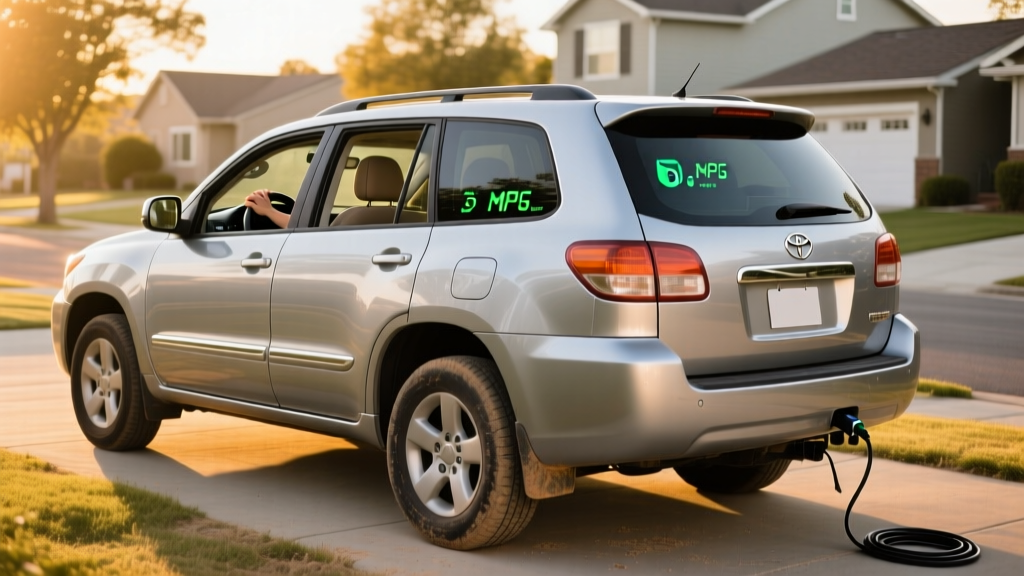
The 2006 Toyota Highlander Hybrid was one of the first mainstream hybrid SUVs to reach American driveways, pairing a 3.3-liter V6 with Toyota's Hybrid Synergy Drive. Nearly two decades later, it remains a popular used-vehicle search — especially among buyers curious about the 06 Toyota Highlander Hybrid MPG and whether this early hybrid still delivers meaningful fuel savings. This guide covers the EPA numbers, real-world expectations, battery longevity, replacement costs, and how this pioneer stacks up against modern hybrids, PHEVs, and full EVs in 2026.
EPA Fuel Economy: What the Sticker Says
The 2006 Highlander Hybrid was rated by the EPA under the older testing methodology (pre-2008 revision). Toyota published the following figures, which remain the official reference on fueleconomy.gov:
| Metric | Value |
|---|---|
| City MPG | 31 (original EPA estimate) |
| Highway MPG | 27 (original EPA estimate) |
| Combined MPG | 28 (original EPA estimate) |
| Fuel Tank Capacity | 17.2 gallons |
| Estimated Total Range | ~480 miles |
Important context: In 2008, the EPA revised its testing cycles to better reflect real-world driving (adding cold-start, aggressive acceleration, and A/C load). Under the revised methodology, the 2006 Highlander Hybrid's ratings were retroactively adjusted downward to approximately 25 city / 26 highway / 25 combined. This is the number you'll typically see on the current fueleconomy.gov listing and is a more honest baseline.
Real-World MPG: What Owners Actually Report
Hybrid fuel economy is highly sensitive to driving style, terrain, and climate. Based on aggregated owner data from Fuelly and enthusiast forums, here's what to expect from a well-maintained 2006 Highlander Hybrid today:
- City / suburban driving: 24–27 MPG — hybrids shine in stop-and-go traffic where regenerative braking recaptures energy and the electric motor handles low-speed propulsion.
- Highway (65–75 mph): 22–25 MPG — the Highlander Hybrid's aerodynamics and weight (~4,500 lbs) work against it at sustained speed, where the V6 carries most of the load.
- Cold weather (below 35°F): Expect a 10–15% drop, landing around 20–22 MPG combined. The engine runs more frequently to provide cabin heat and maintain battery temperature.
- Mountainous terrain: 18–21 MPG on steep grades, though regenerative braking on descents partially offsets the climb penalty.
Powertrain: How the Hybrid System Works
The 2006 Highlander Hybrid uses Toyota's second-generation Hybrid Synergy Drive (HSD), a full-hybrid (parallel) system capable of operating on electric power alone at low speeds. Here are the key specifications:
| Component | Specification |
|---|---|
| Gas Engine | 3.3L V6 (3MZ-FE), 208 hp @ 5,600 rpm |
| Electric Motor | Permanent-magnet synchronous, ~120 kW peak |
| Combined Net Horsepower | 270 hp |
| Transmission | Electronically controlled CVT (eCVT) |
| Drivetrain | AWD (electronic on-demand rear motor, no mechanical driveshaft) |
| 0–60 mph | ~6.6 seconds (Car and Driver tested) |
| Hybrid Battery | Nickel-Metal Hydride (NiMH), ~1.8 kWh (nominal) |
| Towing Capacity | 3,500 lbs (when properly equipped) |
The AWD system in this generation is noteworthy: rather than a traditional driveshaft and rear differential, a second electric motor at the rear axle provides torque to the rear wheels only when slippage is detected or during hard acceleration. This "e-Four" system reduces parasitic loss compared to mechanical AWD, contributing to the hybrid's efficiency advantage over the gas-only V6 Highlander.
HEV vs PHEV vs EV: Where Does This Highlander Fit?
The 2006 Highlander Hybrid is a conventional hybrid (HEV) — it has no plug, no electric-only range to speak of (the NiMH battery provides roughly 1 mile of EV-mode driving at very low speeds), and it charges its small battery entirely through regenerative braking and engine power. This distinction matters because buyers sometimes confuse HEVs with plug-in hybrids or full EVs.
| Feature | HEV (this Highlander) | PHEV (e.g., 2026 RAV4 Prime) | BEV (e.g., 2026 Ioniq 5) |
|---|---|---|---|
| Plug-in charging? | No | Yes | Yes |
| Electric-only range | ~1 mile (low speed) | 35–42 miles | 250–310+ miles |
| Battery size | ~1.8 kWh (NiMH) | ~18.1 kWh (NMC) | 58–77.4 kWh (NMC/LFP) |
| Gas engine? | Yes | Yes | No |
| Federal tax credit (§30D)? | No (expired) | Up to $7,500* | Up to $7,500* |
| Home charging needed? | No | Recommended | Essential |
*§30D credit eligibility depends on MSRP caps, buyer income limits, battery sourcing requirements, and manufacturer caps. See IRS.gov for current rules.
Who should choose this HEV? Drivers who want better fuel economy than a gas-only SUV but lack access to home or workplace charging. The 2006 Highlander Hybrid requires zero behavioral change — you fuel it like any other vehicle. It's also a practical choice for those who tow (3,500-lb capacity), need AWD for snow, and want to avoid the higher upfront cost of a PHEV or EV.
Who should look elsewhere? If you have a short commute under 30 miles and can install a Level 2 home charger, a modern PHEV like the 2026 Toyota RAV4 Prime (42 miles electric-only, ~94 MPGe on electricity) will deliver dramatically lower operating costs. If your commute is longer but predictable, a full EV eliminates gas entirely and has far fewer moving parts.
Battery Lifespan, Warranty & Replacement Cost
For a nearly 20-year-old hybrid, battery health is the single biggest ownership question. Here's what the data shows:
Signs of hybrid battery degradation:
- Noticeable drop in MPG (e.g., falling from 25 to 18–20 combined)
- More frequent engine cycling (the gas engine runs when it previously wouldn't)
- State-of-charge gauge fluctuating rapidly
- Check Engine or hybrid system warning lights (codes P0A80, P0A7F, or individual module imbalance codes)
Replacement options and costs (2026 estimates):
| Option | Cost Range | Warranty | Notes |
|---|---|---|---|
| New OEM Toyota NiMH pack | $3,500–$5,000 (parts + labor) | 1–3 years (dealer) | Becoming difficult to source for this generation; some dealers quote higher or decline the job |
| Refurbished / reconditioned pack | $1,500–$2,800 | 1–2 years | Individual modules replaced and balanced; quality varies by vendor |
| Used salvage pack | $500–$1,200 | 30–90 days | Highest risk — remaining life is unknown; best as a temporary fix |
| Individual module replacement | $300–$800 (DIY or independent shop) | None to 1 year | Only viable if 1–3 modules are bad; requires voltage-matching expertise |
Given that a clean 2006 Highlander Hybrid trades for roughly $5,000–$9,000 in the current used market, a $4,000+ OEM battery replacement is a significant percentage of the vehicle's value. Many owners opt for refurbished packs or sell the vehicle when the battery fails.
Tax Credits and Incentives: What Applies Today?
The 2006 Toyota Highlander Hybrid originally qualified for a federal hybrid tax credit of $2,200 under the Energy Policy Act of 2005. However, this credit was subject to a manufacturer cap (Toyota hit its 60,000-vehicle phase-out threshold in 2007), and it has been fully unavailable for Toyota purchases since late 2007. The credit was claimed on the original purchase — it does not transfer to subsequent used-vehicle owners.
For used-EV buyers in 2026: The federal §25E used clean vehicle credit (up to $4,000 or 30% of sale price, whichever is less) applies only to qualified plug-in EVs and fuel-cell vehicles — not to conventional hybrids like this Highlander. A used 2006 Highlander Hybrid purchase does not qualify for any current federal tax credit.
Some states offer inspection exemptions or HOV-lane access for older hybrids, but these programs have largely sunset or been replaced by EV-specific incentives. Check your state's DMV or energy office for any remaining provisions.
Ownership Economics: Is It Still Worth It in 2026?
Let's compare the 2006 Highlander Hybrid against its gas-only counterpart and a modern alternative to understand the real cost picture:
| Vehicle | Purchase Price (est.) | Annual Fuel Cost* | 5-Year Fuel Total | 5-Year Total (purchase + fuel) |
|---|---|---|---|---|
| 2006 Highlander Hybrid (25 MPG combined) | $7,000 | $2,100 | $10,500 | $17,500 |
| 2006 Highlander V6 AWD gas (19 MPG combined) | $5,500 | $2,763 | $13,815 | $19,315 |
| 2026 RAV4 Hybrid (39 MPG combined) | $34,000 | $1,346 | $6,730 | $40,730 |
*Based on $3.50/gallon regular unleaded. Actual costs vary by region and driving patterns. Source: fueleconomy.gov
The 2006 Highlander Hybrid saves approximately $1,800 over five years compared to the gas-only version of the same era, primarily through lower fuel consumption. That savings narrows or disappears if a battery replacement is needed. Compared to a new 2026 RAV4 Hybrid, the older vehicle wins on upfront cost but loses on fuel efficiency, safety technology, warranty coverage, and reliability certainty.
Reliability and Common Issues Beyond the Battery
The 3MZ-FE V6 engine in the 2006 Highlander Hybrid is generally regarded as one of Toyota's more durable powerplants, with examples exceeding 250,000 miles with proper maintenance. The eCVT transmission has no belts, clutches, or traditional wear items and tends to outlast the vehicle itself. However, age-related issues are now the primary concern:
- Inverter coolant pump: Known failure point; replacement runs $400–$700. Failure can overheat the inverter and trigger hybrid system shutdown.
- Brake actuator / accumulator: The regenerative braking system uses an electric brake actuator that can fail around 120,000–160,000 miles. Replacement is $1,200–$2,000 at a dealer.
- Rear electric motor (AWD models):
Rare failures, but the rear motor and its inverter are expensive to replace if they occur. - Standard aging items: Suspension bushings, struts, wheel bearings, and rubber hoses are all reaching end-of-life at this vehicle's age regardless of powertrain type.
Overall, IIHS rated the 2006 Highlander "Acceptable" in the frontal offset crash test (the highest rating available at the time for that test), but it lacks modern active safety features like automatic emergency braking, lane-keeping assist, or blind-spot monitoring.
Frequently Asked Questions
How many MPG does the 2006 Toyota Highlander Hybrid get?
The revised EPA rating is 25 city / 26 highway / 25 combined. Real-world owners typically see 22–27 MPG combined depending on driving conditions, with city driving yielding the best results and highway or cold-weather driving reducing economy to 20–23 MPG.
Can I plug in the 2006 Highlander Hybrid to charge it?
No. This is a conventional hybrid (HEV), not a plug-in hybrid (PHEV). It has no charging port. The battery charges exclusively through regenerative braking and the gasoline engine. Toyota did not introduce a plug-in Highlander until the concept stage, and a production Highlander PHEV has never been sold in the US.
How much does a replacement hybrid battery cost?
Expect to pay $1,500–$5,000 depending on whether you choose a refurbished pack, a new OEM pack, or individual module replacement. Given the vehicle's current market value of $5,000–$9,000, this is a significant investment relative to the car's worth.
Is the 2006 Highlander Hybrid reliable?
The powertrain (V6 engine + eCVT) is fundamentally robust and many examples have exceeded 200,000 miles. The primary reliability risk at this age is the hybrid battery, brake actuator, and inverter coolant pump — all age- and mileage-dependent failure points. If the battery has been replaced or tested healthy, the vehicle can be a dependable daily driver.
Does the 2006 Highlander Hybrid qualify for any tax credit?
No. The original $2,200 federal hybrid credit expired for Toyota in 2007 and was only available to the original purchaser. The current §25E used clean vehicle credit applies only to plug-in EVs and fuel-cell vehicles, not conventional hybrids. No federal tax incentive is available for purchasing a used 2006 Highlander Hybrid in 2026.
Should I buy this or a newer hybrid?
If your budget is under $10,000 and you need a 7-passenger AWD SUV with no plug-in requirement, the 2006 Highlander Hybrid is one of the few options at this price point. However, a pre-purchase inspection of the hybrid battery (voltage balance across all modules) is essential. If you can afford $25,000+, a 2018–2022 Highlander Hybrid offers 28–35 MPG combined, modern safety tech, and remaining battery warranty — a substantially lower-risk proposition.
Related reading
View all Hybrid & PHEV Hybrid Guide
2006 Toyota Highlander Hybrid Limited: MPG, Reliability & Used Buyer's Guide
Is the 2006 Toyota Highlander Hybrid Limited still worth buying? We break down its 25 MPG combined, hybrid battery lifespan, replacement costs, and ownership reality.
 Hybrid Guide
2026 Porsche 911 GTS Hybrid: MPG, Performance & T-Hybrid Tech Explained
2026 Porsche 911 GTS Hybrid review: T-Hybrid powertrain specs, 584 HP, EPA MPG, 1.9 kWh battery, pricing at $164,900, and real-world driving data.
 Hybrid Guide
2013 Honda Insight Hybrid Review: Real MPG, Battery Life & Used Buyer Guide
2013 Honda Insight hybrid owner's guide: 42 MPG combined EPA, IMA battery lifespan, replacement costs, reliability data, and how it stacks up in 2026.