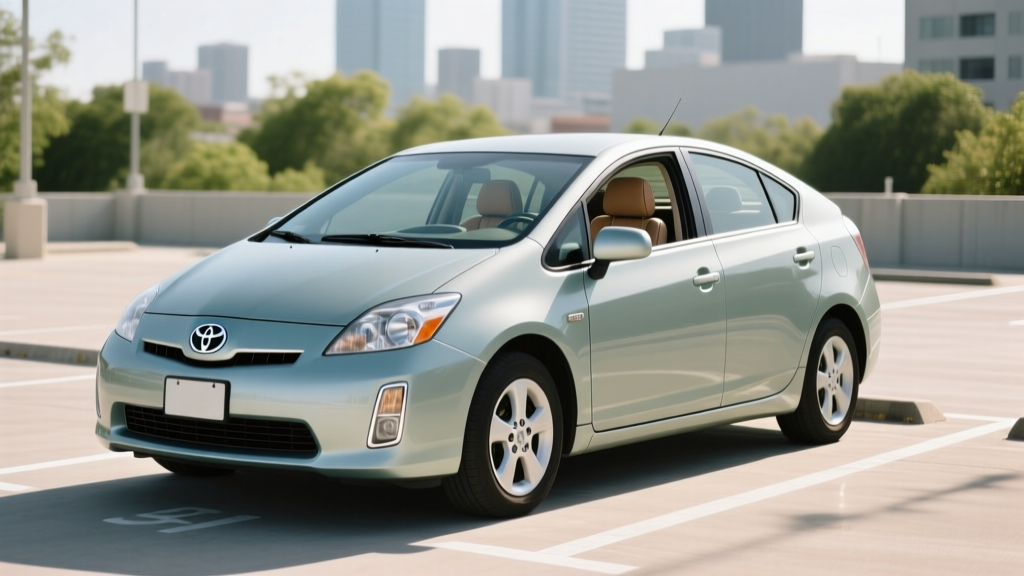
The 2005 Toyota Prius hybrid remains one of the most consequential vehicles in automotive history. As the second-generation model that brought hybrid technology to the mainstream, it established the template that every modern electrified vehicle builds on. Nearly two decades later, thousands of these cars are still on the road — a testament to Toyota's engineering — but prospective buyers and current owners need clear, honest data on what this hybrid delivers today.
Whether you are considering a used 2005 Prius as an ultra-low-cost commuter, evaluating one for a teenager's first car, or simply trying to understand how far hybrid tech has come, this guide covers the exact numbers that matter: real-world MPG, battery lifespan and replacement cost, powertrain specs, and how this pioneer stacks up against modern hybrids, PHEVs, and full EVs.
How Many MPG Does the 2005 Toyota Prius Hybrid Get?
The EPA rated the 2005 Toyota Prius at 48 MPG combined — a figure that still holds up remarkably well against many current compact hybrids. Here is the official breakdown from fueleconomy.gov:
| Driving Cycle | EPA MPG | Real-World Expectation |
|---|---|---|
| City | 60 MPG | 50–58 MPG (hybrids often exceed EPA in city due to regen braking) |
| Highway | 51 MPG | 42–48 MPG (aerodynamic drag and sustained engine load reduce efficiency) |
| Combined | 48 MPG | 44–52 MPG depending on driving mix |
Why real-world often beats the EPA in the city: Unlike conventional gas cars, the Prius uses regenerative braking to recapture energy during stop-and-go driving. The electric motor handles low-speed propulsion, so the gasoline engine shuts off at lights and in traffic. This means city-heavy commutes can actually yield higher MPG than highway cruising — the opposite of a gas-only car.
Highway reality check: At sustained 70–75 mph speeds, the 1.5L Atkinson-cycle engine is doing most of the work with less assistance from the electric motor. Expect 42–48 MPG on the freeway. Cold weather and short trips will push figures toward the lower end; warm climates and moderate-speed suburban driving produce the best results.
Powertrain Specs: Engine, Motor, and Combined Output
The 2005 Prius uses Toyota's Hybrid Synergy Drive (HSD), a series-parallel full-hybrid system that was genuinely advanced for its era. Here are the exact figures:
| Gasoline Engine | 1.5L inline-4, Atkinson cycle (70 HP @ 5,000 rpm, 82 lb-ft torque) |
| Electric Motor | Permanent-magnet synchronous (67 HP, 295 lb-ft torque) |
| Combined Net Output | 110 HP (engine + motor combined) |
| Transmission | Continuously Variable Transmission (CVT) — planetary gearset |
| Hybrid Battery | 1.3 kWh nickel-metal hydride (NiMH), 201.6V nominal |
| 0–60 mph | ~9.8 seconds |
| Drivetrain | Front-wheel drive |
| Curb Weight | ~2,932 lbs |
| Fuel Tank | 11.9 gallons |
| Total Range (est.) | ~540–590 miles per tank |
Important distinction — this is a conventional hybrid (HEV), not a plug-in: The 2005 Prius charges its 1.3 kWh NiMH battery entirely through regenerative braking and the gasoline engine. You never plug it in. The battery is small by modern standards — it exists to buffer energy for acceleration assist and engine-off coasting, not to drive extended distances on electricity alone. The car can operate in EV mode at very low speeds (under ~25 mph, for about 1 mile), but this is not a meaningful electric-only range.
HEV vs. PHEV vs. Full EV: Which Fits You?
The 2005 Prius is a conventional hybrid (HEV). Understanding where it sits in the electrified-vehicle spectrum helps clarify whether it's the right tool for your needs — or whether a modern PHEV or BEV would serve you better.
Conventional Hybrid (HEV)
Example: 2005 Toyota Prius
Battery: 1.3 kWh NiMH
Plug in? No
Electric-only range: ~1 mi at low speed
Best for: No home charging access, budget buyers, high-mileage commuters
Plug-in Hybrid (PHEV)
Example: 2026 Toyota Prius Prime
Battery: 13.6 kWh Li-ion
Plug in? Yes (Level 1 or Level 2)
Electric-only range: 44 miles EPA
Best for: Home charging available, daily commutes under 44 mi, road-trip flexibility
Battery Electric (BEV)
Example: 2026 Hyundai Ioniq 6
Battery: 77.4 kWh
Plug in? Yes (Level 1, 2, or DC fast)
Electric-only range: 361 miles EPA
Best for: Home charging, lowest operating cost, zero tailpipe emissions
Choose the 2005 Prius HEV if:
- You cannot install a home charger (apartment, street parking, landlord restrictions)
- Your total vehicle budget is under $6,000
- You drive 15,000+ miles per year and need maximum fuel savings without plug-in infrastructure
- You want the lowest-maintenance electrified option — no charging habits to manage
Look at a modern PHEV or BEV instead if:
- You have access to home Level 2 charging
- Your daily commute is under 40 miles (a PHEV covers it entirely on electricity)
- You want to qualify for federal or state EV/PHEV tax credits (the 2005 Prius does not)
- You value modern safety features (AEB, lane-keeping, adaptive cruise) not available in 2005
Hybrid Battery Lifespan, Reliability, and Replacement Cost
The single biggest concern for any used Prius buyer is the hybrid battery. The 2005 Prius uses a nickel-metal hydride (NiMH) pack — a proven, durable chemistry, but one that degrades with age and heat exposure.
Typical battery lifespan: Data from Prius owner communities and repair shops shows that the 2005 Prius NiMH battery commonly lasts 150,000–200,000 miles or 12–18 years before significant degradation triggers a check-engine light or noticeable MPG loss. Some units fail earlier (especially in hot climates like Arizona or Texas); others have exceeded 250,000 miles.
Signs of battery degradation:
- MPG dropping 5–10+ below normal (e.g., from 48 to 38–40 combined)
- Frequent engine running at stoplights (battery can't sustain electric-only idle)
- SOC (state-of-charge) gauge fluctuating wildly or staying in the red zone
- Diagnostic trouble codes P0A80 (replace hybrid battery pack) or individual module imbalance codes
Battery replacement options and costs:
| Option | Cost Range | Warranty | Notes |
| New OEM Toyota battery | $2,200–$2,800 (parts + labor) | 3 yr / 36,000 mi | Most reliable; available through Toyota dealers |
| Refurbished/reconditioned pack | $1,000–$1,600 | 1–3 yr (varies by vendor) | Individual modules replaced and rebalanced; quality varies |
| Used/salvage battery | $500–$900 | 30–90 days typically | Highest risk; may already have degraded modules |
| Individual module replacement | $300–$600 (DIY-capable shops) | None or limited | Replace only bad modules; requires cell-balancing expertise |
Is the 2005 Prius reliable overall? Beyond the battery, the 2005 Prius is one of the most reliable vehicles Toyota has built. The 1.5L Atkinson-cycle engine is under-stressed and routinely exceeds 250,000 miles with basic maintenance. The planetary-gearset CVT has no belts or clutches to wear and is virtually bulletproof. Common wear items include the inverter coolant pump (recall-covered on some units), combination meter display failures, and the bladder-type fuel tank sending unit. None of these are catastrophic, and parts remain widely available.
Pricing: Used Market Value and Tax Credit Eligibility
The 2005 Toyota Prius no longer has an MSRP — it is available only on the used market. As of early 2026, typical transaction prices are:
- High-mileage (180,000+ mi), fair condition: $2,500–$3,800
- Average mileage (120,000–160,000 mi), good condition: $4,000–$5,500
- Lower mileage (under 100,000 mi), excellent condition: $5,500–$7,500
Does the 2005 Prius Qualify for Any Tax Credit?
No. The 2005 Toyota Prius does not qualify for the federal §30D new-vehicle tax credit (which applies only to new EVs and PHEVs meeting battery-sourcing and MSRP requirements). It also does not qualify for the §25E used-EV credit ($4,000 or 30% of sale price, whichever is lower) because that credit applies only to used battery electric vehicles and plug-in hybrids — not conventional hybrids. The 2005 Prius, as an HEV that cannot be plugged in, is ineligible for any federal electrification incentive.
Some states previously offered hybrid tax credits or HOV-lane access for the Prius, but these programs have long since expired or transitioned to PHEV/BEV-only eligibility. Check your state's current energy or DMV website for any remaining local incentives, but do not expect any for a conventional hybrid of this vintage.
2005 Prius vs. Modern Hybrids and PHEVs: What Has Changed?
To put the 2005 Prius in context, here is how it compares to the current-generation Toyota Prius and Prius Prime (PHEV) for the 2026 model year:
| Spec | 2005 Prius (HEV) | 2026 Prius (HEV) | 2026 Prius Prime (PHEV) |
|---|---|---|---|
| Combined MPG (gas) | 48 | 57 | 52 (hybrid mode) |
| Electric-Only Range | ~1 mi | N/A | 44 mi EPA |
| Combined HP | 110 | 196 | 220 |
| 0–60 mph | ~9.8 sec | ~7.0 sec | ~6.6 sec |
| Battery Chemistry | NiMH (1.3 kWh) | Li-ion (0.9 kWh) | Li-ion (13.6 kWh) |
| Plug-In Capable | No | No | Yes (Level 1 & 2) |
| DC Fast Charge | N/A | N/A | No |
| Battery Warranty | Expired | 10 yr / 150,000 mi | 10 yr / 150,000 mi |
| Starting MSRP (new) | N/A (used only) | ~$29,500 | ~$34,500 |
| Federal Tax Credit | None | None (HEV) | Up to $3,750 (§30D)* |
*The 2026 Prius Prime's federal tax credit depends on IRS §30D battery-sourcing and critical-mineral requirements, buyer income caps ($150K single / $300K joint), and MSRP caps ($55,000 for sedans). Verify current eligibility at irs.gov before purchasing.
The performance and efficiency gap is significant. The 2026 Prius delivers 9 more MPG combined with nearly double the horsepower, thanks to a lighter lithium-ion battery, a more efficient 2.0L Dynamic Force engine, and improved aerodynamics. The Prius Prime adds 44 miles of electric-only driving — enough to cover most daily commutes without burning a drop of gasoline — while still offering a combined 52 MPG on road trips when the battery is depleted.
Pros and Cons of the 2005 Toyota Prius Today
✓ Pros
- Excellent fuel economy (44–50 MPG real-world)
- Extremely reliable powertrain; planetary CVT virtually indestructible
- Very low purchase price ($2,500–$7,500 used)
- No plug-in charging required — works for apartment dwellers
- Cheap to insure and maintain
- Huge aftermarket and salvage parts availability
- Spacious hatchback cargo area for its class
✗ Cons
- Hybrid battery likely near end-of-life; $1,000–$2,800 replacement
- No modern safety tech (no AEB, lane-keeping, blind-spot monitor)
- Sluggish acceleration (9.8 sec 0–60) compared to modern hybrids
- Dated interior; no Apple CarPlay, Android Auto, or backup camera
- No federal or state tax credit eligibility
- Higher emissions than a modern HEV, PHEV, or BEV
- Some 2005-specific issues: combination meter failure, inverter coolant pump
Frequently Asked Questions
How many MPG does the 2005 Toyota Prius hybrid get in real driving?
The EPA rates it at 60 city / 51 highway / 48 combined. In real-world mixed driving, most owners see 44–50 MPG. City-heavy routes with frequent stops can push toward the EPA city figure thanks to regenerative braking, while sustained highway driving at 70+ mph typically yields 42–48 MPG.
How far can the 2005 Prius go on electric only?
Essentially not far enough to matter. The 2005 Prius is a conventional hybrid (HEV), not a plug-in. Its EV mode works only at very low speeds (under ~25 mph) for roughly 1 mile — useful for creeping through a parking lot, but not a meaningful electric-only commute. If you want substantial electric-only driving, look at a PHEV like the Toyota Prius Prime (44 miles EV range) or a full BEV.
Is the 2005 Prius hybrid reliable?
Yes, with one major caveat. The engine, CVT, and overall drivetrain are among the most reliable Toyota has ever produced, routinely exceeding 200,000–250,000 miles. The primary risk is the aging NiMH hybrid battery, which typically lasts 150,000–200,000 miles. Budget $1,000–$2,800 for a replacement or refurbishment if the battery hasn't been recently addressed.
What does it cost to replace the hybrid battery in a 2005 Prius?
A new OEM Toyota battery runs $2,200–$2,800 installed. Refurbished packs cost $1,000–$1,600, and used/salvage batteries are $500–$900. Individual module replacement at a hybrid specialist can cost $300–$600. Given the car's value, a refurbished pack or module-level repair is usually the most cost-effective choice.
Does the 2005 Prius qualify for any tax credit?
No. The 2005 Prius is a conventional hybrid (HEV), not a plug-in vehicle. The federal §30D new clean vehicle credit and the §25E used clean vehicle credit both require a plug-in capable vehicle (BEV or PHEV). No federal tax incentive is available for this vehicle. State hybrid incentives that existed in the mid-2000s have expired.
Should I buy a 2005 Prius or a newer hybrid?
If your budget is under $6,000 and you cannot plug in at home, the 2005 Prius remains one of the cheapest-per-mile vehicles you can own. If you can spend $15,000+, a 2016+ Prius (fourth generation) offers significantly better safety, a more refined ride, a lithium-ion battery with better longevity, and 52+ MPG. If you have home charging, a used PHEV like the 2017+ Prius Prime eliminates most gasoline use on daily commutes while keeping road-trip flexibility.
Final Verdict: Who Should Buy the 2005 Toyota Prius Hybrid?
The 2005 Prius is a smart buy if:
- You need a sub-$6,000 commuter with the lowest possible fuel cost
- You lack access to plug-in charging and need a true no-plug hybrid
- You drive 15,000+ miles/year and want to minimize gas spend without EV infrastructure
- You're mechanically inclined or have access to a hybrid-savvy independent shop
Look elsewhere if:
- You want modern safety features (automatic emergency braking, lane assist)
- You can install a Level 2 charger — a PHEV will save more on fuel daily
- You want federal tax credits (only available on qualifying new or used PHEVs/BEVs)
- You expect to keep the car 5+ years without budgeting for a battery replacement
The 2005 Toyota Prius hybrid proved that electrified powertrains could work at scale. It remains a remarkably efficient, durable, and practical vehicle nearly two decades later. Its limitations — aging battery, absent safety tech, no plug-in capability — are the trade-offs of buying a pioneer. For the right buyer, those trade-offs are well worth the $3–5 per gallon savings at the pump.