The Original Hybrid Icon: Why the 2005 Prius Still Matters
The second-generation Toyota Prius (model code NHW20, produced for model years 2004–2009) was the vehicle that proved hybrid technology could work at scale. Two decades later, the 2005 Prius hybrid remains one of the most searched used vehicles among budget-conscious commuters and hypermilers. With a used market price typically between $3,500 and $7,000 depending on mileage and condition, it occupies a unique niche: a proven, ultra-efficient daily driver that requires zero plug-in infrastructure.
This guide covers everything a 2026 buyer needs to know — real-world MPG, battery health assessment, replacement costs, and how the 2005 Prius compares to modern hybrids, plug-in hybrids, and full EVs on total cost of ownership.
HEV vs PHEV: Where the 2005 Prius Fits
Before diving into specs, it's critical to understand what the 2005 Prius is — and what it isn't.
Conventional Hybrid (HEV) — 2005 Prius
- No plug required. The battery charges exclusively through regenerative braking and the gasoline engine.
- No electric-only range beyond very low-speed, short-distance creep (under 1 mile at parking-lot speeds).
- Refuels like a gas car — fill up at any station, no charging station needed.
Plug-in Hybrid (PHEV) — Modern Equivalent (e.g., 2026 Prius Prime)
- Plugs into a wall outlet or Level 2 charger to charge a larger battery (13.6 kWh usable on the current Prius Prime).
- Up to 44 miles of electric-only range (EPA) before the gas engine engages.
- Eligible for the §30D federal tax credit (up to $3,750, subject to income and sourcing rules) — the 2005 Prius HEV is not.
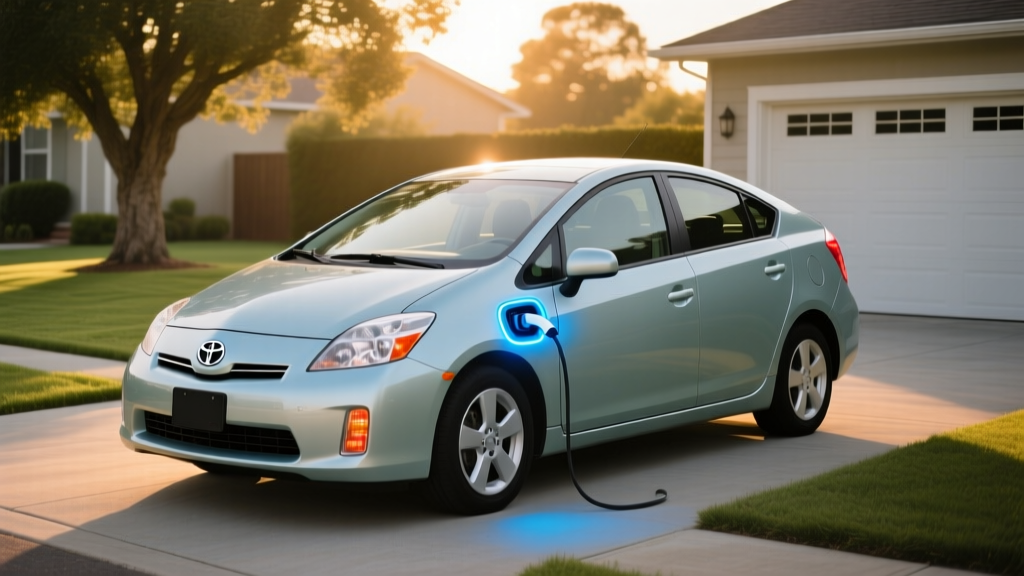
The 2005 Prius is strictly a conventional series-parallel hybrid. You never plug it in. This is an advantage for apartment dwellers or anyone without access to home charging, but it means zero electric-only commuting capability.
Fuel Economy: EPA Ratings and Real-World MPG
The 2005 Prius was rated by the EPA under the older, more generous testing methodology. When adjusted to the current testing standard (which the EPA retroactively applied to older models on fueleconomy.gov), the numbers are:
| Metric | 2005 Prius (Revised EPA) | 2026 Prius LE (Comparison) |
|---|---|---|
| City MPG | 48 | 57 |
| Highway MPG | 45 | 56 |
| Combined MPG | 46 | 57 |
| Fuel Tank (gallons) | 11.9 | 11.4 |
| Total Range (miles) | ~547 | ~649 |
| Annual Fuel Cost* | ~$1,050 | ~$850 |
*Based on 15,000 miles/year, 55% city driving, $3.20/gallon regular unleaded (2026 national average estimate).
Real-World MPG: What Owners Actually Report
The revised EPA combined rating of 46 MPG is achievable but not guaranteed. Real-world data from owner communities and FuelEconomy.gov user estimates show a wide spread:
- City-heavy driving (stop-and-go, under 45 mph): 44–52 MPG. Hybrids excel here because regenerative braking recovers energy and the engine shuts off at stops.
- Highway cruising (65–75 mph): 38–44 MPG. Aerodynamic drag dominates at high speed, and the small 1.5L engine works harder.
- Cold weather (below 35°F): Expect a 5–12% drop, roughly 38–43 MPG combined. The engine runs more frequently to maintain cabin heat and battery temperature.
- Hypermiler techniques (pulse-and-glide, minimal HVAC): Some owners report 55–60+ MPG, but this requires deliberate driving style compromises.
Powertrain and Performance Specs
| Specification | 2005 Toyota Prius |
|---|---|
| Powertrain Type | Series-parallel hybrid (Toyota HSD) |
| Gasoline Engine | 1.5L inline-4, Atkinson cycle (70 hp / 82 lb-ft) |
| Electric Motor | Permanent magnet synchronous (67 hp / 295 lb-ft) |
| Combined Net Horsepower | 110 hp |
| Transmission | eCVT (planetary gearset, no traditional belts) |
| 0–60 mph | ~9.8 seconds |
| Top Speed | ~106 mph (electronically limited) |
| Drivetrain | Front-wheel drive |
| Curb Weight | 2,890 lbs |
| Hybrid Battery | 1.3 kWh (nominal), NiMH, 201.6V |
| Emissions Rating | SULEV / AT-PZEV (California-certified states) |
The Toyota Hybrid Synergy Drive (HSD) in the 2005 Prius uses a planetary gearset — not a belt-driven CVT — to seamlessly blend power from the gas engine and electric motor. This design has no clutch packs, torque converters, or traditional transmission components to wear out, which is a major factor in the car's longevity reputation.
Performance is modest by 2026 standards. The 9.8-second 0–60 time feels adequate in city traffic but strained during highway merging. The electric motor's 295 lb-ft of torque is available from zero RPM, giving the Prius surprisingly responsive off-the-line acceleration for a car with only 110 combined horsepower.
Hybrid Battery Health: The $2,000 Question
For any used 2005 Prius buyer, the high-voltage NiMH hybrid battery is the single biggest financial risk. Here's what you need to know:
Original Warranty (Long Expired)
Toyota warranted the hybrid battery for 8 years / 100,000 miles (10 years / 150,000 miles in California and states adopting CARB emissions standards). On a 2005 model, this warranty expired no later than 2015 in non-CARB states or 2015 in CARB states. You are purchasing this vehicle entirely out of warranty.
Expected Battery Lifespan
NiMH batteries in the second-gen Prius have proven more durable than early skeptics predicted. Real-world data shows:
- Typical lifespan: 150,000–220,000 miles before significant degradation or failure, though some units exceed 300,000 miles.
- Age factor: A 20-year-old NiMH pack is at elevated risk regardless of mileage. Calendar degradation (cell imbalance, electrolyte breakdown) occurs even in low-mileage examples.
- Failure mode: Individual cell modules weaken, causing the pack to cycle more aggressively, which accelerates further degradation. The car throws a "red triangle of death" (master warning) and hybrid system diagnostic codes (P0A80, P3000-series).
Battery Replacement Cost in 2026
- New OEM Toyota pack: $2,000–$2,500 (part only), $2,800–$3,600 installed at a dealer.
- Refurbished/remanufactured pack: $1,000–$1,800 installed from independent hybrid specialists. Quality varies — look for vendors offering at least a 1-year warranty.
- Individual cell module replacement: $300–$600 if only 1–2 modules are bad, but this is a short-term fix on a 20-year-old pack. Other modules will likely follow.
- Aftermarket new pack (e.g., Dorman): $1,800–$2,400 installed.
Reliability and Common Issues Beyond the Battery
The 2005 Prius earns a strong reliability reputation overall, but two decades of real-world use have exposed specific weak points:
- Inverter coolant pump: The electric water pump circulating coolant through the hybrid inverter can fail silently. If the inverter overheats, replacement costs $1,500–$2,500. Check that the inverter coolant reservoir is visibly circulating when the car is in READY mode.
- Combination meter (dashboard): A known solder-joint failure causes the instrument cluster to go blank or display erratic readings. Repair: $200–$400 from specialized rebuilders; $800+ for a new unit.
- Steering intermediate shaft: A clunking noise when turning at low speed indicates wear in the telescoping intermediate shaft. Toyota issued a service bulletin. Replacement: $300–$500.
- Brake actuator: The electro-hydraulic brake actuator (which blends regenerative and friction braking) can develop internal leaks after 150,000+ miles. This is an expensive repair — $1,200–$2,000 — and triggers multiple warning lights.
- 12V auxiliary battery: Located in the trunk, this small AGM battery powers the computers that boot the hybrid system. If it dies, the car won't start even with a full hybrid battery. Replacement: $180–$250 for an AGM-specific unit (Optima DS46B24R or equivalent).
- Catalytic converter theft: The Prius catalytic converter contains high precious-metal content and is a frequent theft target. A replacement catalytic shield ($200–$350 installed) is strongly recommended.
2005 Prius vs. Modern Alternatives: Decision Framework
The used hybrid market in 2026 offers choices the 2005 Prius buyer should weigh carefully. Here's a direct comparison:
| Vehicle | Combined MPG / MPGe | Electric-Only Range | Typical Used Price (2026) | Federal Tax Credit |
|---|---|---|---|---|
| 2005 Toyota Prius (HEV) | 46 MPG | None | $3,500–$7,000 | None |
| 2017–2019 Toyota Prius Prime (PHEV) | 54 MPG / 133 MPGe | 25 miles | $16,000–$22,000 | None (used credit may apply) |
| 2026 Toyota Prius LE (HEV, new) | 57 MPG | None | $29,445 MSRP | None (HEVs ineligible for §30D) |
| 2026 Toyota Prius Prime (PHEV, new) | 52 MPG / 127 MPGe | 44 miles | $34,445 MSRP | Up to $3,750 (§30D, income/sourcing rules apply) |
| 2026 Hyundai Kona Electric (BEV) | 129 MPGe | 261 miles (EPA) | $34,985 MSRP | Up to $7,500 (§30D, income/sourcing rules apply) |
Sources: fueleconomy.gov, Toyota USA specifications, IRS §30D guidance.
Who Should Buy the 2005 Prius?
Pros
- Extremely low purchase price ($3,500–$7,000)
- 46 MPG combined — still competitive with many 2026 hybrids
- No plug-in required; works for apartment dwellers
- Proven, well-documented powertrain with massive aftermarket support
- Very low annual fuel cost (~$1,050/year at 15,000 miles)
- Low insurance premiums (typically $800–$1,200/year)
- Strong DIY community; many repairs possible at home
Cons
- Hybrid battery replacement risk ($1,500–$3,600) on a 20-year-old pack
- No modern safety features (no AEB, lane-keep, blind-spot monitoring)
- Modest performance (9.8s 0–60, soft brakes)
- Dated interior technology (no Bluetooth audio, basic navigation)
- High mileage examples may need suspension, brake actuator, or inverter work
- No federal tax credit or incentive eligibility
- Catalytic converter theft target
Decision Framework: Is the 2005 Prius Right for You?
Choose the 2005 Prius if:
- Your total vehicle budget is under $8,000 and you need maximum MPG.
- You drive primarily in city/suburban conditions (under 50 mph) where the hybrid system shines.
- You cannot charge at home and a PHEV or BEV is impractical.
- You're comfortable budgeting $1,500–$3,000 for a potential hybrid battery replacement within the first two years of ownership.
- You prioritize fuel savings over safety technology and infotainment.
Choose a newer PHEV (e.g., used Prius Prime) or BEV if:
- You have home charging access and a short commute (under 30 miles) — a PHEV or BEV eliminates most gasoline use entirely.
- Modern safety features (automatic emergency braking, lane-keeping) are non-negotiable.
- You want to qualify for the used clean vehicle credit (up to $4,000 under IRC §25E for qualified used EVs/PHEVs priced under $25,000 from a dealer, subject to income caps).
- You plan to keep the vehicle 5+ years and want lower long-term maintenance risk from a newer platform.
Choose a new 2026 Prius (HEV) if:
- You want 57 MPG combined with a full factory warranty (3yr/36k basic, 5yr/60k powertrain, 10yr/150k hybrid battery).
- You can afford the $29,445+ MSRP and prefer zero immediate repair risk.
5-Year Ownership Cost Estimate
Assuming a $5,000 purchase price, 15,000 miles/year, and one hybrid battery replacement in year 3:
| Cost Category | 5-Year Total |
|---|---|
| Purchase Price | $5,000 |
| Fuel (15k mi/yr × 5 yr ÷ 46 MPG × $3.20/gal) | $5,217 |
| Insurance (avg $1,000/yr) | $5,000 |
| Maintenance (oil, tires, brakes, fluids) | $2,500 |
| Hybrid Battery Replacement (refurbished, year 3) | $1,500 |
| Registration & Taxes (avg $200/yr) | $1,000 |
| Total 5-Year Cost | $20,217 |
| Cost Per Mile | $0.27 |
For comparison, a 2026 Toyota Corolla LE (gas-only, 35 MPG combined, ~$23,000 MSRP) would cost approximately $0.42/mile over the same period including purchase depreciation, higher fuel costs, and standard maintenance. The 2005 Prius wins on pure cost-per-mile — but only if the hybrid battery holds up or is replaced economically.
Frequently Asked Questions
How many MPG does the 2005 Prius hybrid get?
The EPA revised rating is 48 city / 45 highway / 46 combined MPG. In real-world city driving, many owners see 44–52 MPG. Highway driving at 70+ mph drops to 38–44 MPG. Cold weather reduces combined efficiency by roughly 5–12%.
Does the 2005 Prius need to be plugged in?
No. The 2005 Prius is a conventional hybrid (HEV), not a plug-in hybrid. The 1.3 kWh NiMH battery charges entirely through regenerative braking and the gasoline engine. You fuel it exclusively at gas stations.
Is the 2005 Prius reliable, and what does a battery replacement cost?
The powertrain is proven reliable, with the planetary eCVT and Atkinson-cycle engine capable of 250,000+ miles with basic maintenance. The main risk is the high-voltage NiMH battery, which typically lasts 150,000–220,000 miles but is now 20 years old on any 2005 example. Replacement costs $1,000–$1,800 for a refurbished pack or $2,800–$3,600 for a new OEM pack installed at a dealer.
Does the 2005 Prius qualify for any tax credit?
No. The 2005 Prius does not qualify for the federal §30D new clean vehicle credit (it's used and is a conventional HEV, not a PHEV or BEV). It also does not qualify for the §25E used clean vehicle credit, which applies only to used plug-in electric vehicles and battery-electric vehicles purchased from a dealer for under $25,000. Some states may offer inspection exemptions or HOV lane access for older hybrids — check your state's DMV.
How does the 2005 Prius compare to a full EV like the Chevy Bolt?
A used 2020–2022 Chevy Bolt EV ($12,000–$18,000 in 2026) offers 259 miles of EPA range, zero gasoline, and lower per-mile "fuel" costs if you charge at home ($0.04–$0.06/mile on residential electricity vs. $0.07/mile on gas in the Prius). However, the Bolt requires home charging access, costs roughly 2–3× more to purchase, and may have higher insurance premiums. The 2005 Prius makes sense when upfront budget is the primary constraint and charging access is unavailable.
What should I check before buying a used 2005 Prius?
Prioritize: (1) hybrid battery module voltage balance via OBD-II scan, (2) inverter coolant circulation, (3) brake actuator function (firm pedal, no warning lights), (4) combination meter operation, (5) full service history showing regular oil changes (5W-30, every 5,000 miles), and (6) underbody inspection for catalytic converter presence and condition. A pre-purchase inspection by a hybrid-experienced mechanic ($100–$200) is strongly recommended.