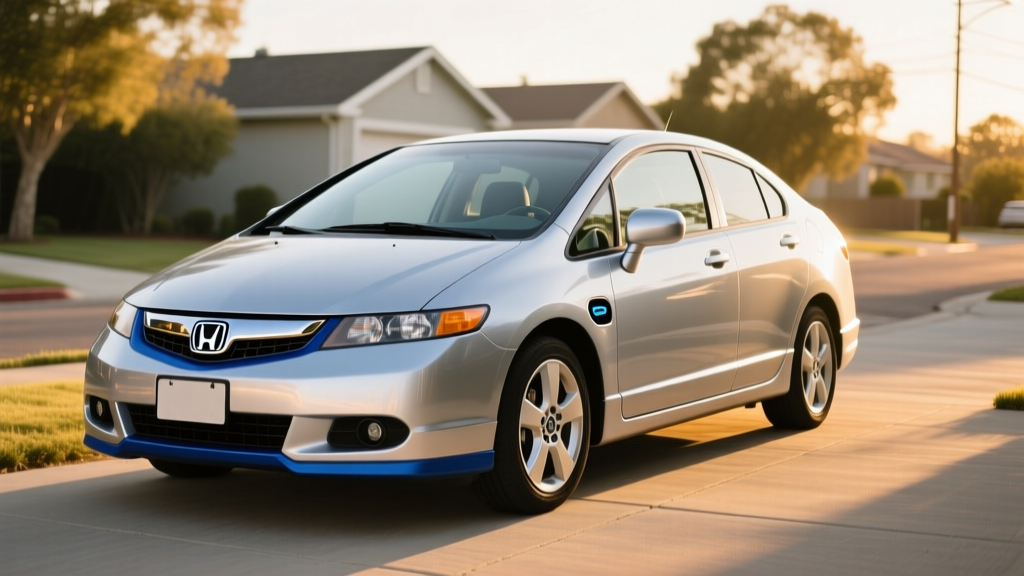
The 2005 Honda Insight hybrid holds a unique place in automotive history. As Honda's first gasoline-electric hybrid sold in the United States, this two-seat, three-door hatchback proved that extreme fuel efficiency was achievable without sacrificing everyday usability. Nearly two decades later, used examples still attract buyers looking for ultra-low fuel costs. But with aging nickel-metal hydride (NiMH) batteries and discontinued production, prospective owners need clear data on what this car actually delivers — and what it might cost to keep on the road.
This guide covers the 2005 Honda Insight hybrid's real-world fuel economy, powertrain specs, battery longevity, replacement costs, and whether it still earns a spot in your driveway versus a modern hybrid or full EV.
2005 Honda Insight Hybrid: Quick Verdict
The 2005 Insight is a conventional hybrid (HEV) — it charges its small battery through regenerative braking and the gasoline engine, never from a wall outlet. It achieves remarkable city fuel economy (up to 60-63 MPG EPA) but shows its age in highway efficiency, cargo space, and technology. For budget-conscious commuters who drive primarily in stop-and-go traffic, a well-maintained 2005 Insight remains one of the cheapest-per-mile vehicles you can buy. For anyone needing highway range, modern safety features, or back seats, newer hybrids or EVs are the better choice.
HEV vs. PHEV: Where the 2005 Insight Fits
The 2005 Honda Insight is a conventional hybrid (HEV). It cannot be plugged in and has no electric-only driving range. Understanding the difference matters for buyers comparing it to modern alternatives:
| Feature | Conventional Hybrid (HEV) | Plug-In Hybrid (PHEV) | Battery Electric (BEV) |
|---|---|---|---|
| Plugs in to charge? | No | Yes | Yes |
| Electric-only range | None (motor assists engine) | 20–50 miles typical | 200–400+ miles |
| Battery size | 0.5–1.5 kWh | 8–25 kWh | 50–120+ kWh |
| Gas engine? | Yes (primary power) | Yes (backup + highway) | No |
| Federal tax credit (new) | None | Up to $7,500 (§30D) | Up to $7,500 (§30D) |
| Example (2005 era) | Honda Insight, Prius | N/A (PHEVs didn't exist) | N/A |
The Insight's Integrated Motor Assist (IMA) system uses a thin electric motor sandwiched between the engine and transmission to assist the gasoline engine during acceleration and capture energy during braking. It never drives the car on electricity alone at meaningful speeds.
Fuel Economy: EPA Ratings vs. Real-World MPG
Fuel economy is the 2005 Insight's defining feature. Honda offered two transmission choices, and the EPA ratings differ significantly between them. Here is the full breakdown from fueleconomy.gov:
| Transmission | City MPG | Highway MPG | Combined MPG | Annual Fuel Cost* |
|---|---|---|---|---|
| 5-Speed Manual | 60 | 66 | 63 | ~$850 |
| CVT Automatic | 57 | 56 | 56 | ~$950 |
*Based on 15,000 miles/year at $3.50/gallon regular unleaded (2026 estimate). Actual costs vary by region and driving habits.
Real-World MPG: What Owners Actually Report
The 2005 Insight is one of the rare vehicles where real-world fuel economy can exceed the EPA sticker — particularly in city driving. The IMA system's aggressive regenerative braking and engine auto-stop feature reward stop-and-go commuting. Based on owner reports aggregated by Fuelly and hybrid forums:
- City / suburban driving: 55–70 MPG (manual owners who hypermile regularly report 70+)
- Highway (65-75 mph): 45–55 MPG (the Insight's 67-hp engine works hard at speed, and the lean-burn advantage diminishes)
- Cold weather (below 40°F): Expect a 10–20% drop, landing around 45–55 MPG combined as the engine runs richer and the battery provides less assist
- Mixed real-world average: Most owners report 50–60 MPG combined without any special driving techniques
Real-World Range Reality: With a 10.6-gallon fuel tank and 55 MPG real-world average, expect roughly 580 miles per tank in mixed driving. Hypermilers have documented 700+ mile tanks, but plan for 500–600 miles under normal conditions.
Powertrain and Performance Specs
| Specification | 2005 Honda Insight (Manual) | 2005 Honda Insight (CVT) |
|---|---|---|
| Engine | 1.0L 3-cylinder (67 hp) | 1.0L 3-cylinder (67 hp) |
| Electric Motor (IMA) | 10 kW (13 hp) | 10 kW (13 hp) |
| Combined Output | 73 hp @ 5,700 rpm | 73 hp @ 5,700 rpm |
| Torque | 92 lb-ft (engine) + 36 lb-ft (motor) | 92 lb-ft (engine) + 36 lb-ft (motor) |
| 0–60 mph | ~10.5 seconds | ~11.5 seconds |
| Transmission | 5-speed manual | Continuously variable (CVT) |
| Drivetrain | Front-wheel drive | Front-wheel drive |
| Curb Weight | 1,850 lbs | 1,878 lbs |
| Fuel Tank | 10.6 gallons | 10.6 gallons |
| Body Style | 3-door hatchback, 2 seats | 3-door hatchback, 2 seats |
The Insight's 1.0-liter three-cylinder engine is tiny by any standard, but its aluminum construction and the car's sub-1,900-pound curb weight make it surprisingly adequate around town. The IMA electric motor fills in torque at low RPMs where the small engine is weakest. On highway on-ramps and steep grades, however, the Insight's limited power is obvious — merging requires planning and patience.
Battery Health, Warranty, and Replacement Costs
This is the single biggest concern for anyone buying a 2005 Insight today. The IMA battery is a nickel-metal hydride (NiMH) pack rated at approximately 6.5 Ah / ~0.5 kWh — tiny by modern standards, but sufficient for its assist-only role.
Original Battery Warranty
When new, Honda covered the IMA battery for 8 years / 80,000 miles (10 years / 150,000 miles in CARB states like California, New York, and Massachusetts). That original warranty has expired on every 2005 Insight by now.
Battery Degradation and Lifespan
NiMH batteries in the Insight typically last 10–15 years or 120,000–180,000 miles before significant degradation. Degradation manifests as:
- Reduced electric assist during acceleration (the car feels sluggish)
- More frequent engine auto-starts (less energy captured from regen)
- Dropping fuel economy (from 60+ to 45–50 MPG)
- IMA warning light or battery-state-of-charge gauge fluctuation
- In severe cases: the car enters "limp mode" with reduced power
Battery Replacement Costs (2026 Estimates)
| Option | Cost Range | Details |
|---|---|---|
| New OEM Honda IMA battery | $2,000–$3,500 (if available) | Honda has largely discontinued new IMA batteries for first-gen Insight; availability is extremely limited |
| Refurbished / remanufactured pack | $1,000–$2,000 | Aftermarket hybrid battery shops rebuild packs with new NiMH cells; quality varies by vendor |
| Used salvage-yard battery | $300–$800 | Lowest cost but highest risk — remaining lifespan unknown; may last 1–5 years |
| Aftermarket lithium conversion | $1,500–$3,000 | Some specialty shops offer Li-ion IMA replacements with better longevity and lighter weight |
| DIY cell-level rebuild | $200–$500 (parts) | For technically inclined owners; involves replacing individual NiMH sub-cells; requires high-voltage safety knowledge |
12V Battery Note: Like all hybrids, the Insight also has a conventional 12V auxiliary battery that powers the electronics and starts the IMA system. If the 12V dies, the car won't start even if the IMA pack is healthy. Budget $100–$180 for a standard 12V replacement every 4–5 years.
Reliability and Common Issues
The 2005 Insight's powertrain is fundamentally simple and Honda's build quality from this era is strong. However, age and hybrid-specific components introduce predictable issues:
- IMA battery failure: The #1 issue. Most 2005 Insights will need at least one battery replacement in their lifetime.
- CVT shudder (automatic models): The early Honda CVT can develop a low-speed shudder, often resolved with a CVT fluid flush using Honda HMMF fluid. If neglected, it can lead to transmission failure ($2,000–$4,000).
- Electric power steering (EPS): Some units fail, triggering an EPS warning light. Replacement runs $800–$1,500.
- Lean-burn NOx sensor: The manual-transmission Insight uses lean-burn combustion for peak efficiency. The NOx sensor that monitors this system can fail ($200–$400 part).
- A/C compressor: Electrically driven; failures are uncommon but expensive ($1,000+).
- Rust: Check rear wheel arches, underbody, and battery tray mounting points — especially in salt-belt states.
Despite these items, many Insights have crossed 200,000+ miles with basic maintenance. The car's simplicity — no turbo, no complex emissions equipment, lightweight construction — works in its favor for longevity.
Pricing and Tax Credit Eligibility
Used Market Pricing (2026)
The 2005 Honda Insight was discontinued after the 2006 model year (replaced by the second-generation Insight in 2010). Used pricing in 2026:
- High-mileage / needs battery work: $1,500–$3,000
- Good condition, IMA battery functional: $3,500–$5,500
- Low-mileage, excellent condition, new battery: $6,000–$9,000 (collector-grade examples occasionally list higher)
Federal and State Tax Credits
The 2005 Honda Insight does not qualify for any current federal tax credit. The IRS §30D Clean Vehicle Credit applies only to new qualifying vehicles (or used EVs under §25E, which requires a battery-electric or fuel-cell vehicle with at least 7 kWh of battery capacity — the Insight's ~0.5 kWh NiMH pack does not meet this threshold).
When the Insight was new, it qualified for a modest federal income tax deduction (not a credit) for clean-fuel vehicles, but that provision expired long ago. No state currently offers incentives for purchasing a 20-year-old conventional hybrid.
Who Should Buy the 2005 Honda Insight Hybrid?
Pros
- Exceptional city fuel economy (55–70 MPG real-world)
- Ultra-low fuel cost (~$70–85/month at 15K miles/year)
- Lightweight and nimble in urban traffic
- Simple mechanics; DIY-friendly for basic maintenance
- Very low purchase price ($2,000–$6,000)
- Strong hypermiling community and aftermarket support
Cons
- Only two seats — no rear passenger space
- Limited cargo room (12.3 cu ft behind seats)
- Slow acceleration (0–60 in ~10.5–11.5 seconds)
- Highway MPG drops significantly above 65 mph
- IMA battery replacement likely needed ($1,000–$3,000)
- No modern safety features (no ESC, limited crash protection)
- Parts availability declining as the model ages
- No plug-in capability or electric-only range
Decision Framework
Choose the 2005 Honda Insight if:
- You commute in city/suburban traffic and want the lowest possible fuel cost
- You only need two seats and minimal cargo space
- You're comfortable with a 20-year-old vehicle and potential battery replacement costs
- You can't install a home charger (no plug-in needed)
- Your budget is under $6,000
Choose a modern hybrid (Toyota Prius, Honda Civic Hybrid) if:
- You need four doors and rear seats
- You want modern safety features (AEB, lane-keeping, blind-spot monitoring)
- You want a warranty and predictable maintenance costs
- You drive significant highway miles
Choose a PHEV (Prius Prime, RAV4 Prime) if:
- You have home charging access and a short commute (25–45 miles electric-only)
- You want to drive mostly on electricity but need gas for road trips
- You qualify for the up-to-$7,500 federal tax credit on new PHEVs
Choose a full EV (Chevrolet Bolt, Hyundai Kona Electric) if:
- You have reliable home Level 2 charging
- Your daily driving is under 200 miles
- You want zero tailpipe emissions and minimal maintenance
- You qualify for federal/state EV incentives
Frequently Asked Questions
How many MPG does the 2005 Honda Insight hybrid get?
The EPA rates the 2005 Insight at 60 city / 66 highway / 63 combined MPG with the 5-speed manual, and 57 city / 56 highway / 56 combined with the CVT automatic. In real-world driving, most owners average 50–60 MPG combined, with city driving often exceeding 60 MPG and highway driving falling to 45–55 MPG at speeds above 65 mph.
Does the 2005 Honda Insight need to be plugged in?
No. The 2005 Insight is a conventional hybrid (HEV). Its small IMA battery recharges through regenerative braking and the gasoline engine. There is no plug, no charging port, and no electric-only driving mode.
How far can the 2005 Insight go on electric only?
It cannot. The IMA system's 10 kW electric motor only assists the gasoline engine — it never propels the car independently at any meaningful speed. The engine shuts off at stops (auto-stop) to save fuel, but the car always needs gasoline to move.
Is the 2005 Honda Insight reliable?
The powertrain is fundamentally reliable and many examples exceed 200,000 miles. The main reliability concern is IMA battery degradation, which is expected on any 20-year-old NiMH pack. CVT models need regular fluid changes. Parts availability is becoming a concern as Honda discontinues support for first-generation components.
What does it cost to replace the IMA battery?
Expect $1,000–$2,000 for a refurbished/remanufactured NiMH pack from a hybrid battery specialist, $300–$800 for a used salvage battery (risky), or $1,500–$3,000 for an aftermarket lithium conversion. New OEM Honda batteries are largely discontinued and extremely difficult to source in 2026.
Does the 2005 Honda Insight qualify for any tax credit?
No. The 2005 Insight does not qualify for the current federal §30D Clean Vehicle Credit (new vehicles only) or the §25E Used Clean Vehicle Credit (requires a battery-electric or fuel-cell vehicle with ≥7 kWh battery capacity). No state incentives apply to a conventional hybrid of this age.
Is the 2005 Insight a good car for a daily commuter?
For a solo commuter with a city-heavy route, it's excellent — few cars cost less per mile to fuel. For highway commuters, anyone carrying passengers regularly, or drivers who prioritize modern safety technology, a newer hybrid like the Toyota Prius (57 MPG combined, 5 seats, modern safety suite) is a far better daily driver.
How does the 2005 Insight compare to the Toyota Prius of the same era?
The 2005 Insight gets better city MPG (60 vs. ~48 for the 2005 Prius) but the Prius offers four doors, five seats, more cargo space, and a more usable highway driving experience. The Prius's larger battery and more powerful hybrid system also make it feel more responsive. For most buyers, the second-hand 2004–2009 Prius is the more practical choice; the Insight wins only for solo commuters prioritizing maximum MPG.
Sources: U.S. Department of Energy / fueleconomy.gov (EPA fuel economy data); IRS.gov (§30D and §25E clean vehicle credit rules); Honda Automobile Owners Reference (2005 Insight specifications).