Quick Verdict: A Pioneer That Still Has Legs — With Caveats
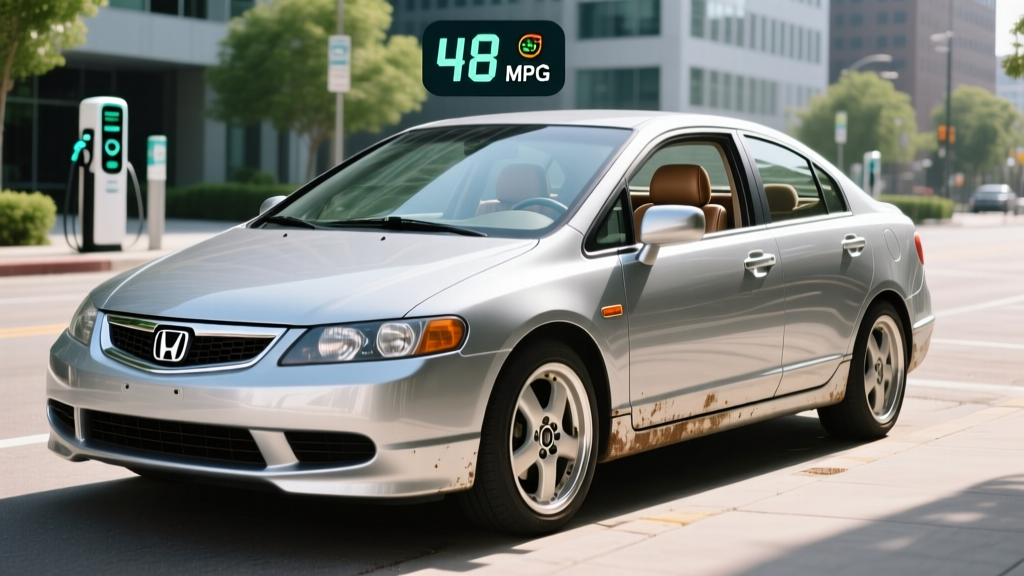
The 2005 Honda Civic Hybrid was one of the first mainstream hybrid-electric vehicles sold in the United States, arriving at a time when the Toyota Prius was just beginning to reshape the compact car segment. Nearly two decades later, used examples still appear on the market, often priced between $2,500 and $5,500 depending on mileage and condition. For budget-conscious commuters who understand what they're getting into — particularly the reality of an aging Integrated Motor Assist (IMA) battery — the 2005 Civic Hybrid can still deliver meaningful fuel savings. But it's critical to go in with eyes open about battery replacement costs, outdated safety equipment, and how far hybrid technology has advanced since.
This guide covers everything a used-car buyer in 2026 needs to know: EPA fuel economy versus real-world MPG, the IMA system's architecture, battery lifespan and replacement options, and whether this first-generation hybrid still makes sense compared to a modern HEV, PHEV, or full BEV.
Understanding the 2005 Civic Hybrid: HEV Basics
The 2005 Honda Civic Hybrid is a conventional hybrid electric vehicle (HEV). It does not plug in. It cannot drive on electric power alone for any meaningful distance. Instead, it uses Honda's Integrated Motor Assist (IMA) system — a parallel hybrid architecture where a small electric motor is sandwiched between the gasoline engine and the transmission, providing supplemental torque during acceleration and enabling regenerative braking to recapture energy.
HEV vs. PHEV — Where Does the 2005 Civic Hybrid Fit?
| Feature | HEV (2005 Civic Hybrid) | PHEV (e.g., 2026 Toyota Prius Prime) | BEV (e.g., 2026 Chevy Equinox EV) |
|---|---|---|---|
| Plugs in? | No | Yes | Yes |
| Electric-only range | 0 miles (motor assists only) | ~44 miles | 250-315+ miles |
| Battery size | ~0.35 kWh (NiMH) | ~13.6 kWh (Li-ion) | 85+ kWh (Li-ion) |
| Gas engine? | Yes — primary power | Yes — backup | No |
| Federal tax credit (new) | None (expired long ago) | Up to $3,750 (§30D) | Up to $7,500 (§30D) |
| Used EV credit (§25E) | Not eligible | Up to $4,000 | Up to $4,000 |
The 2005 Civic Hybrid is a conventional HEV. It generates all its electricity from the gas engine and regenerative braking — no plug required.
Fuel Economy: EPA Ratings vs. Real-World MPG
Fuel economy is the primary reason anyone considers a hybrid, and the 2005 Civic Hybrid delivered strong numbers for its era. Here's how the EPA rated it:
| Cycle | EPA Rating | Real-World Expectation (2026) |
|---|---|---|
| City | 49 MPG | 42–48 MPG |
| Highway | 51 MPG | 44–50 MPG |
| Combined | 50 MPG | 43–49 MPG |
Source: fueleconomy.gov
Why real-world MPG may fall short: The 2005 Civic Hybrid's EPA ratings were measured under the older, less aggressive testing methodology that predated 2008 adjustments. In practice, drivers who maintain steady speeds on flat terrain in moderate temperatures can approach or even exceed the EPA combined figure. However, aggressive driving, cold weather (below 40°F), and hilly terrain will push real-world fuel economy into the low-to-mid 40s. A degraded IMA battery — common on high-mileage examples — will also reduce the electric motor's assist, causing the gas engine to work harder and dropping MPG by 3–8 mpg depending on severity.
City vs. highway note: Unlike the EPA sticker, real-world owners often find that the 2005 Civic Hybrid achieves slightly better fuel economy in city driving than on the highway. This is typical of parallel hybrids: regenerative braking recaptures energy during stop-and-go traffic, and the electric motor's torque assist is most valuable at low speeds. Sustained highway speeds above 70 mph reduce the IMA system's contribution.
Powertrain & Specifications
| Specification | 2005 Honda Civic Hybrid |
|---|---|
| Engine | 1.3L i-DSI 4-cylinder (8-valve) |
| Engine HP / Torque | 85 hp @ 5,700 rpm / 87 lb-ft @ 3,300 rpm |
| Electric Motor (IMA) | 15 kW (20 hp) / 76 lb-ft |
| Combined System Output | 93 hp @ 5,700 rpm |
| Transmission | CVT (Continuously Variable) |
| Battery Type | Nickel-Metal Hydride (NiMH) |
| Battery Capacity | ~0.35 kWh (nominal) |
| Drivetrain | Front-wheel drive |
| Curb Weight | ~2,698 lbs |
| 0-60 mph | ~10.8 seconds |
| Fuel Tank | 13.2 gallons |
| Total Range (est.) | ~570–660 miles |
The IMA system is modest by modern standards. The 15 kW electric motor cannot propel the car on its own — it only assists the gasoline engine during acceleration and enables idle stop (engine shut-off at red lights). Honda's lean-burn 1.3L i-DSI engine uses two spark plugs per cylinder for more complete combustion, contributing to the strong fuel economy figures. The CVT keeps the engine in its most efficient RPM range, though it produces the characteristic "rubber band" drone under hard acceleration that CVT critics often note.
IMA Battery Lifespan, Degradation & Replacement Costs
⚠ Battery Warranty Status
Honda originally covered the IMA battery under its hybrid system warranty for 8 years / 80,000 miles (10 years / 150,000 miles in California and states adopting CARB emissions standards). As of 2026, every 2005 Civic Hybrid is well past its original warranty coverage. Any battery failure is an out-of-pocket expense for the owner.
The IMA battery in the 2005 Civic Hybrid is a nickel-metal hydride (NiMH) pack — the same chemistry used in the contemporary Toyota Prius. NiMH batteries are durable but not immortal. Most original IMA batteries in the 2005 Civic Hybrid have either already been replaced or are operating in a significantly degraded state.
Signs of IMA Battery Degradation
- IMA warning light on the dashboard
- Noticeable drop in fuel economy (5+ MPG below expected)
- Reduced regenerative braking — the charge gauge rarely reaches full
- Engine idle stop no longer activates at red lights
- Calibration errors (the battery gauge rapidly fluctuates)
Battery Replacement Options & Costs (2026)
| Option | Cost Range | Notes |
|---|---|---|
| New OEM Honda IMA battery | $2,000–$3,000 | Increasingly difficult to source; Honda may discontinue |
| Refurbished/remanufactured pack | $1,000–$1,800 | Available from third-party suppliers; warranty typically 1–3 years |
| Individual cell replacement (DIY) | $150–$400 | Requires technical skill; replaces only failed cells within the pack |
| Grid charger + deep cycling | $100–$300 | Can extend life of mildly degraded packs; not a fix for hard failures |
For a car worth $3,000–$5,000, a $2,500 OEM battery replacement is a tough economic decision. Most owners opt for refurbished packs or individual cell swaps. A grid charger (such as those from hybrid-battery specialty vendors) can help balance cells and extend pack life if caught early, but it won't resurrect a pack with multiple hard-failed cells.
Reliability, Safety & Ownership Realities
The 2005 Civic Hybrid's non-hybrid mechanical components — suspension, brakes, steering, interior — are shared with the seventh-generation Civic platform, which is generally reliable and inexpensive to maintain. The CVT transmission has a mixed reputation: while not as failure-prone as some early Nissan CVTs, Honda's CVT from this era can develop issues past 150,000 miles, particularly if fluid was never changed.
Safety is a significant concern by 2026 standards. The 2005 Civic was not tested by the IIHS in its modern protocol, and it lacks:
- Electronic stability control (ESC) — not federally mandated until 2012
- Side curtain airbags (optional, not standard on all trims)
- Any form of advanced driver-assistance systems (ADAS) — no automatic emergency braking, lane keeping, or blind-spot monitoring
- Modern crash-structure engineering
NHTSA gave the 2005 Civic 4 stars for frontal driver protection and 4 stars for frontal passenger protection in its testing, but side-impact ratings were lower without the optional side airbags. For reference, the NHTSA database can be searched by VIN for specific recall and rating data.
Common Issues Beyond the IMA Battery
- CVT shudder/judder: Often resolved with a CVT fluid drain-and-fill using Honda HMMF fluid
- Motor mount wear: The engine motor mounts (especially the passenger-side) are known to fail around 100,000–130,000 miles
- A/C compressor: The electrically-assisted A/C system can develop leaks or compressor failures
- 12V battery drain: Parasitic drains from the IMA system can kill the conventional 12V battery if the car sits for extended periods
- Cracked exhaust manifold: A known issue on the 1.3L i-DSI; causes a ticking noise and check-engine light
Tax Credits & Purchase Economics in 2026
The 2005 Honda Civic Hybrid originally qualified for a federal income tax credit under the Energy Policy Act of 2005 — but that credit was a fixed dollar amount (typically $2,100) that phased out for Honda in 2007 after the manufacturer hit 60,000 qualifying vehicle sales. This credit has not been available for over 18 years.
Under current IRS rules (IRS §30D), the federal clean vehicle credit applies only to new qualifying EVs and PHEVs with battery capacity of at least 7 kWh. The 2005 Civic Hybrid, as a conventional HEV with a ~0.35 kWh battery, does not qualify for any current federal tax credit.
The §25E used clean vehicle credit (up to $4,000 or 30% of sale price, whichever is less) applies only to used EVs and PHEVs with at least 7 kWh of battery capacity — again, excluding conventional hybrids like this Civic.
Total cost picture for a 2026 buyer:
| Cost Factor | Estimate |
|---|---|
| Purchase price (used, 120k–170k miles) | $2,500–$5,500 |
| Potential IMA battery replacement | $1,000–$3,000 |
| Annual fuel cost (15k mi/yr @ 45 MPG, $3.40/gal) | ~$1,133/yr |
| Insurance (varies widely) | $600–$1,200/yr |
| Federal/state tax credit | $0 |
2005 Civic Hybrid vs. Modern Alternatives
✓ Pros
- Low purchase price ($2,500–$5,500 used)
- Strong real-world fuel economy (43–49 MPG combined)
- No plug-in required — fuels like a normal gas car
- Honda's non-hybrid mechanicals are cheap to repair
- Lightweight and easy to park
- Simple technology — any mechanic can work on the gas engine
✗ Cons
- IMA battery replacement is likely needed (or already done)
- No electric-only driving capability
- Outdated safety — no ESC, limited airbags, no ADAS
- Slow acceleration (10.8 sec 0-60)
- CVT transmission can be a failure point at high miles
- No federal or state tax credit eligibility
- OEM parts availability declining
How Does It Compare to What You Can Buy Today?
| Vehicle | Combined MPG | Price Range | Tax Credit |
|---|---|---|---|
| 2005 Honda Civic Hybrid (used) | 43–49 MPG | $2,500–$5,500 | None |
| 2026 Toyota Corolla Hybrid (new HEV) | 50–54 MPG | $23,500–$28,000 | None |
| 2026 Toyota Prius Prime (new PHEV) | 52 MPG + 44 mi EV | $33,000–$40,000 | Up to $3,750 |
| 2026 Hyundai Elantra Hybrid (new HEV) | 50–54 MPG | $25,000–$30,000 | None |
A modern compact hybrid like the Corolla Hybrid or Elantra Hybrid matches or exceeds the 2005 Civic Hybrid's fuel economy while offering contemporary safety features (standard ESC, AEB, lane-keeping), full manufacturer warranties, and no battery-degradation gamble. The trade-off is spending $20,000+ more upfront. For buyers whose budget is strictly under $6,000, the 2005 Civic Hybrid remains one of the most fuel-efficient vehicles available at that price point — provided the IMA battery is healthy.
Who Should Buy the 2005 Civic Hybrid — And Who Shouldn't
Decision Framework
Choose the 2005 Civic Hybrid if:
- Your total vehicle budget is under $6,000 and you need maximum MPG
- You have a trusted mechanic who can inspect the IMA battery before purchase
- You drive primarily in city/suburban conditions where hybrid efficiency shines
- You're comfortable accepting outdated safety technology
- You plan to keep the car 2–4 years as a budget commuter
Look elsewhere (modern HEV, PHEV, or BEV) if:
- You need current safety features (AEB, blind-spot monitoring, backup camera)
- You want electric-only driving capability (look at a PHEV)
- You drive more than 20,000 miles/year and want warranty protection
- You want to claim a federal tax credit (requires a qualifying new EV/PHEV)
- You live in a state with strict emissions inspections that flag IMA system faults
Frequently Asked Questions
How many MPG does the 2005 Civic Hybrid actually get?
The EPA rated it at 49 city / 51 highway / 50 combined. In real-world 2026 driving with a healthy IMA battery, expect 43–49 MPG combined depending on driving style, climate, and terrain. City driving often yields better results than highway because regenerative braking recaptures energy in stop-and-go traffic.
Does the 2005 Civic Hybrid plug in?
No. It is a conventional hybrid (HEV), not a plug-in hybrid (PHEV). The small NiMH battery charges exclusively through the gasoline engine and regenerative braking. There is no plug, no charging port, and no electric-only driving range.
Is the 2005 Civic Hybrid reliable?
The gasoline engine and chassis are generally reliable and inexpensive to maintain. The primary reliability risk is the IMA battery, which is likely at or beyond its useful lifespan in 2026. CVT transmission issues and motor mount failures are secondary concerns. Overall reliability depends heavily on maintenance history and whether the IMA battery has been replaced.
How much does it cost to replace the IMA battery?
A new OEM battery costs $2,000–$3,000 but may be difficult to source. Refurbished packs run $1,000–$1,800. DIY cell-level repairs can be done for $150–$400 but require technical knowledge. Given the car's value, most owners choose refurbished packs or cell-level repairs.
Does the 2005 Civic Hybrid qualify for any tax credit?
No. The original federal hybrid tax credit for this model phased out in 2007. Current IRS §30D and §25E credits apply only to vehicles with at least 7 kWh of battery capacity — the Civic Hybrid's ~0.35 kWh pack does not qualify. Check IRS.gov for current credit rules.
Hybrid vs. PHEV vs. EV — which should I choose?
If you can charge at home and want to eliminate most gasoline use, a PHEV (like the Prius Prime) or a full BEV (like the Chevy Equinox EV) offers electric-only daily commuting. If you can't charge at home or need the lowest upfront cost, a conventional HEV like the Civic Hybrid or a modern Corolla Hybrid requires no lifestyle change. A BEV makes the most sense for drivers with home charging, predictable daily mileage under 250 miles, and access to DC fast charging for road trips.
Can I still get parts for a 2005 Civic Hybrid?
Mechanical parts (brakes, suspension, engine components) are widely available because they're shared with the seventh-generation Civic. IMA-specific parts — the battery pack, the IMA motor, and the IPU (Intelligent Power Unit) fan — are becoming harder to source through Honda dealers but remain available from aftermarket and salvage suppliers.