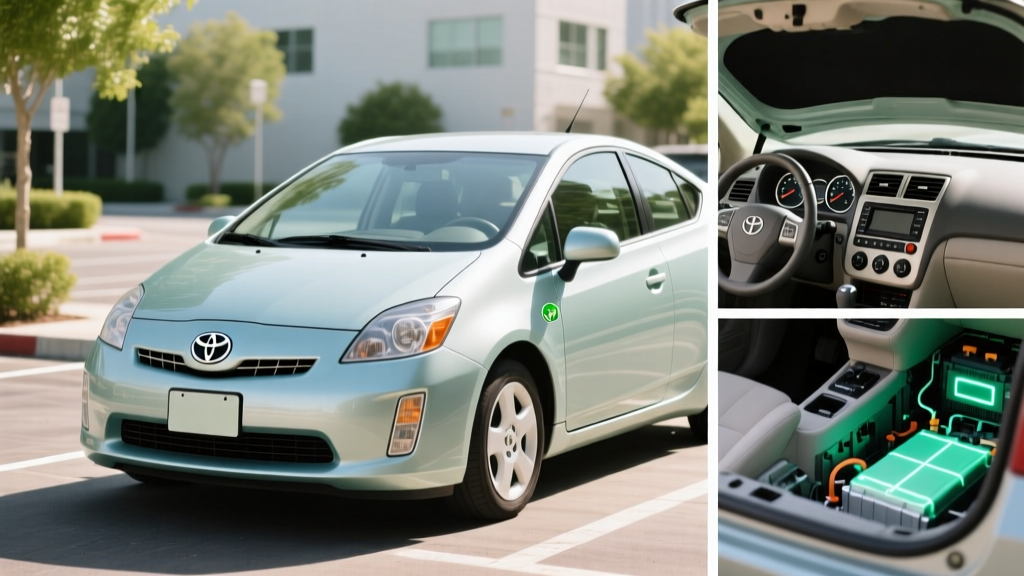
The 2003 Toyota Prius hybrid changed the automotive landscape. As the second-generation model (designated NHW20 in Japan, but the first Prius sold widely in the United States), it introduced the world to the practical gasoline-electric hybrid at scale. More than two decades later, this compact liftback remains a fixture on the used market — and a common search for budget-conscious commuters, first-time hybrid buyers, and automotive history enthusiasts alike.
If you're researching a 2003 Toyota Prius hybrid as a potential purchase or just want to understand what this pioneering vehicle delivers in real-world driving, this guide covers the exact numbers: EPA MPG, powertrain specs, battery longevity, replacement costs, and how it stacks up against modern hybrids, PHEVs, and full EVs available in 2026.
2003 Toyota Prius Hybrid: Key Specs at a Glance
| Specification | 2003 Toyota Prius (NHW20) |
|---|---|
| Powertrain Type | Conventional Hybrid (HEV) — no plug |
| Gasoline Engine | 1.5L 4-cylinder Atkinson-cycle, 70 hp |
| Electric Motor | Permanent magnet synchronous, 67 hp (50 kW) |
| Combined System Output | ~100 hp (net) |
| EPA Fuel Economy | 60 city / 51 highway / 55 combined (original sticker) |
| Revised EPA Rating (post-2008 method) | 45 city / 41 highway / 42 combined |
| Hybrid Battery | Nickel-Metal Hydride (NiMH), 1.3 kWh |
| Transmission | Planetary e-CVT (power-split device) |
| 0-60 mph | ~9.9 seconds |
| Cargo Volume | 11.2 cu ft (rear seats up) |
| Curb Weight | ~2,890 lbs |
How Many MPG Does the 2003 Prius Hybrid Actually Get?
The revised EPA rating of 42 MPG combined (45 city / 41 highway) remains the benchmark, but real-world results vary considerably depending on driving conditions, vehicle maintenance, and — critically — the health of the hybrid battery.
Real-World MPG: What Owners Report
| Driving Scenario | Expected MPG | Notes |
|---|---|---|
| City / stop-and-go | 44-50 MPG | Hybrids excel here — regen braking recaptures energy |
| Highway (65-70 mph) | 38-43 MPG | Aero drag and less regen benefit; engine runs more often |
| Combined mixed driving | 40-46 MPG | Healthy battery and proper tire pressure assumed |
| Cold weather (below 35°F) | 34-40 MPG | Engine runs more for cabin heat; battery less efficient |
| Degraded hybrid battery | 30-38 MPG | Motor assist reduced; engine compensates |
The Prius's Atkinson-cycle engine and power-split hybrid system are inherently more efficient in city driving, where the electric motor handles low-speed propulsion and regenerative braking recharges the battery constantly. On the highway, the gasoline engine does more of the work, and the aerodynamic profile — while sleek for 2003 — creates drag that limits efficiency at sustained high speeds.
Key insight: Unlike a full EV, the 2003 Prius doesn't suffer range loss from cold weather in the same dramatic way, but you will see a 5-8 MPG penalty in winter months due to the engine running more frequently to provide cabin heat and maintain battery temperature.
Understanding the Powertrain: How the 2003 Prius Works
The 2003 Prius uses Toyota's Hybrid Synergy Drive (second generation), a series-parallel hybrid system built around a planetary gear set — what Toyota calls the power-split device. This is not a conventional transmission. Instead, it seamlessly blends torque from the 1.5-liter gasoline engine and the 50 kW (67 hp) electric motor.
Here's how the system manages power flow:
- Low-speed / light load: The electric motor drives the wheels independently; the gasoline engine stays off
- Moderate acceleration: Both the engine and motor contribute, with the power-split device blending their output
- Hard acceleration: The engine runs at peak output while the motor provides maximum assist from the NiMH battery
- Deceleration / braking: The motor reverses role to become a generator, sending regenerative energy back to the battery
- Idle / stopped: The engine shuts off completely — zero fuel consumption at stoplights
The combined net output is approximately 100 horsepower. That figure sounds modest — and it is. The 2003 Prius was never designed for performance. Its 0-60 mph time of roughly 9.9 seconds reflects the efficiency-first engineering. But the electric motor's instant torque delivery makes it feel surprisingly responsive in city traffic at 0-35 mph, where most daily driving occurs.
This Is a Conventional Hybrid (HEV), Not a Plug-In
| Feature | Conventional Hybrid (HEV) e.g., 2003 Prius | Plug-in Hybrid (PHEV) e.g., 2026 Prius Prime | Battery Electric (BEV) e.g., 2026 Tesla Model 3 |
|---|---|---|---|
| Plug-in Charging | No | Yes (Level 1/2) | Yes (Level 1/2/DC fast) |
| Electric-Only Range | Negligible (<1 mi assist) | 25-44 miles (EPA) | 250-400+ miles (EPA) |
| Battery Size | 1.3 kWh (NiMH) | 13.6 kWh (Li-ion) | 50-100 kWh (Li-ion/LFP) |
| Gasoline Required | Yes — always | Yes — for longer trips | No |
| Typical MPG / MPGe | 42 MPG combined | 48 MPG + 127 MPGe | 120-140 MPGe |
| Federal Tax Credit (2026) | None | Up to $7,500 (§30D) | Up to $7,500 (§30D) |
Hybrid Battery Life, Degradation, and Replacement Cost
For any used 2003 Prius buyer, the hybrid battery is the single most important — and most expensive — component to evaluate. Here's what you need to know about longevity and cost.
Original Battery Warranty
How Long Does the Battery Actually Last?
The nickel-metal hydride (NiMH) battery in the 2003 Prius has proven remarkably durable. Real-world data and owner reports indicate:
- Typical lifespan: 150,000-250,000 miles before significant degradation or failure
- Age factor: NiMH batteries also degrade with time. A 2003 Prius is now over 22 years old — most original batteries have been replaced at least once
- Failure signs: Reduced MPG (5-10+ MPG drop), frequent engine running, dashboard warning lights, reduced regenerative braking
Battery Replacement Cost (2026 Pricing)
| Replacement Option | Cost Range | Notes |
|---|---|---|
| New OEM Toyota battery | $2,000-$2,600 (parts + labor) | Available through Toyota dealers; includes warranty |
| Refurbished / reconditioned pack | $800-$1,500 | Third-party suppliers; replaces failed cells only; variable quality |
| Used salvage battery | $400-$900 | Pulled from wrecked Prius; condition unknown; risky |
| Aftermarket new battery | $1,500-$2,200 | Companies like Green Bean Battery offer warranties; NiMH compatible |
Practical advice: If you're buying a 2003 Prius today, assume you will need to budget $1,500-$2,500 for a battery replacement unless the seller can provide documentation of a recent replacement. A pre-purchase hybrid battery health check (available at most Toyota dealers and hybrid specialists) is essential. Ask for the battery's state-of-health (SoH) reading and the voltage delta between individual modules.
Is the 2003 Prius Reliable Beyond the Battery?
The short answer: yes. The 2003 Prius earned a reputation as one of the most reliable vehicles Toyota has ever produced — provided the hybrid battery is healthy.
Beyond the battery, the Prius's mechanical simplicity works in its favor:
- No conventional transmission: The planetary e-CVT has no belts, clutches, or friction bands to wear out. Failures are extremely rare
- No starter motor or alternator: The motor-generator units (MG1 and MG2) handle engine starting and electrical generation, eliminating common failure points in gas cars
- Regenerative braking: Reduces wear on the friction brake pads — many Prius owners report 80,000-120,000+ miles on original brake pads
- Engine longevity: The 1.5L Atkinson-cycle engine is under-stressed and runs at lower RPMs than conventional engines; 200,000+ miles is common with regular oil changes
Common non-battery issues to watch for on a 2003 Prius:
- 12V auxiliary battery: A standard lead-acid 12V battery boots the car's computers. It typically lasts 3-5 years and costs $100-$200 to replace. If the car won't power on, this is often the culprit — not the hybrid battery
- Combination meter (dashboard display): The center LCD screen can develop dead pixels or fail; replacement runs $200-$500
- Inverter coolant pump: An electric pump circulates coolant through the hybrid inverter. Failure can cause overheating and inverter damage ($1,000-$2,500 repair). Check for coolant turbulence in the reservoir when the car is in READY mode
- Steering intermediate shaft: Some 2003-2008 Prius models developed clunking in the steering column; Toyota issued service bulletins for this
Does the 2003 Prius Qualify for Any Tax Credits?
No. The 2003 Toyota Prius does not qualify for the current federal §30D Clean Vehicle Credit. That credit applies only to new plug-in electric vehicles (PHEVs and BEVs) that meet battery sourcing, MSRP caps, and buyer income requirements.
The original Prius did qualify for a federal tax credit of up to $3,150 when it was new — but that credit expired and was structured entirely differently from today's rules. There is no current federal or state incentive for purchasing a used conventional hybrid.
If you're comparing the 2003 Prius against a modern PHEV or EV, factor in this incentive gap: a new 2026 Prius Prime PHEV may qualify for up to $7,500 in federal credits (subject to income limits of $150,000 single / $300,000 joint, MSRP caps of $55,000 for sedans, and battery component sourcing requirements). That credit can significantly narrow the price gap between a used 2003 HEV and a brand-new PHEV.
Who Should Buy a 2003 Toyota Prius — and Who Shouldn't
Choose the 2003 Prius If:
- You need the cheapest possible commute car ($3,000-$6,000 used market)
- Your driving is mostly city / suburban under 45 mph
- You want to avoid plug-in charging entirely (no garage/outlet access)
- You value proven reliability and Toyota parts availability
- You're comfortable budgeting $1,500-$2,500 for a potential battery replacement
Skip the 2003 Prius If:
- You want modern safety tech (no AEB, blind-spot monitoring, or backup camera)
- You need highway passing power (100 hp is thin at 70 mph)
- You want electric-only driving capability (consider a PHEV or BEV)
- You want to qualify for federal/state EV tax credits
- The vehicle you're eyeing has 180,000+ miles with no documented battery replacement
The Modern Alternative: 2026 Toyota Prius / Prius Prime
For context, the current-generation Toyota Prius (redesigned for 2023 and carried forward to 2026) delivers a dramatically different experience:
- 2026 Prius HEV: 196 combined hp, 0-60 in 7.2 seconds, EPA 57 MPG combined (LE FWD) — starting around $29,000 MSRP
- 2026 Prius Prime PHEV: 220 combined hp, 0-60 in 6.6 seconds, EPA 44 miles electric-only + 48 MPG combined, ~$34,000 MSRP (before potential $7,500 credit)
The performance and technology gap is enormous. But if your budget is firmly under $7,000, the 2003 Prius remains a rational, efficient choice.
Frequently Asked Questions
How many MPG does the 2003 Toyota Prius hybrid get?
The revised EPA rating is 45 city / 41 highway / 42 combined MPG. Real-world owners typically see 40-46 MPG in mixed driving with a healthy battery, and up to 50 MPG in city conditions. Cold weather and a degraded battery can reduce this to 30-38 MPG.
How far can the 2003 Prius go on electric only?
Essentially zero meaningful distance. The 2003 Prius is a conventional hybrid (HEV), not a plug-in. The electric motor provides brief low-speed assist (under 1 mile at speeds below 25 mph), but it cannot drive on electricity alone in any practical sense. For real electric-only range, you'd need a PHEV like the Prius Prime (25-44 miles) or a full EV.
Is the 2003 Prius reliable, and what does a battery replacement cost?
Yes — the 2003 Prius is widely regarded as one of Toyota's most reliable models. The e-CVT has no wearable friction components, and the engine is under-stressed. The main concern is the NiMH hybrid battery, which typically lasts 150,000-250,000 miles. Replacement costs range from $800 (refurbished) to $2,600 (new OEM). Budget for this expense on any 2003 model unless the seller proves a recent replacement.
Does the 2003 Prius qualify for a federal tax credit?
No. The current §30D federal tax credit applies only to new plug-in vehicles (PHEVs and BEVs) meeting specific battery sourcing, MSRP, and buyer income requirements. The 2003 Prius, as a used conventional hybrid, qualifies for no federal or state purchase incentives.
Hybrid vs. PHEV vs. EV — which should I choose?
HEV (like the 2003 Prius): Best for drivers without home charging access who want maximum simplicity and the lowest purchase price. No plug, no range anxiety, just better MPG. PHEV (like the Prius Prime): Ideal for drivers who can charge at home and want 25-44 miles of electric commuting plus a gas engine for longer trips. Best of both worlds. BEV (like the Tesla Model 3 or Hyundai Ioniq 6): Best for drivers with reliable home charging, commutes under 250 miles, and a desire to eliminate gasoline entirely. Higher upfront cost, lowest operating cost, and access to federal tax credits up to $7,500.
What should I check before buying a used 2003 Prius?
Request a hybrid battery health report (module voltage delta and internal resistance), verify the inverter coolant pump is functioning (visible turbulence in the coolant reservoir), check for dashboard warning lights, confirm the 12V battery is recent, and look for documentation of any prior hybrid battery replacement. A pre-purchase inspection at a Toyota dealer or hybrid specialist ($100-$200) is a wise investment on a 22-year-old vehicle.