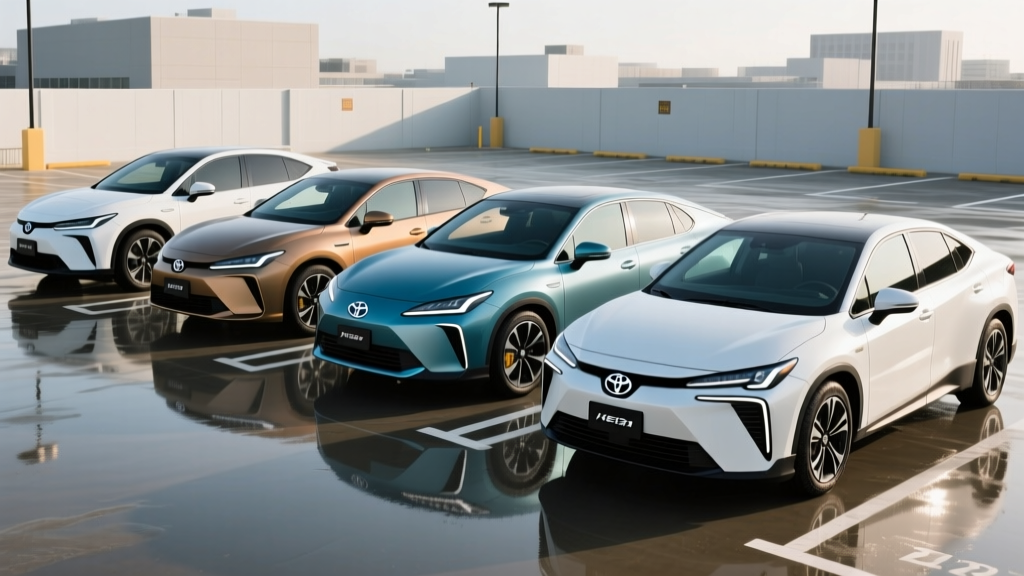
The Toyota Hybrid Lineup at a Glance
Toyota pioneered the mass-market hybrid with the original Prius in 1997, and nearly three decades later the automaker offers the broadest hybrid portfolio in the industry. For the 2026 model year, Toyota sells both conventional hybrids (HEVs) that never need plugging in and plug-in hybrids (PHEVs) that deliver meaningful electric-only range before the gas engine engages. If you've been searching for a Toyota hybrid, the sheer number of options — spanning the compact Prius to the full-size Sequoia and Tundra — can be overwhelming.
This guide breaks down every current Toyota hybrid and PHEV by the numbers that matter: EPA fuel economy, real-world efficiency, electric-only range for PHEVs, powertrain output, pricing, battery warranty coverage, and federal tax credit eligibility. We'll also help you decide whether a Toyota HEV, a Toyota PHEV, or a full battery-electric vehicle (BEV) is the right fit for your driving pattern.
HEV vs PHEV: What's the Difference?
Before diving into specific models, it's essential to understand the two types of electrified Toyota vehicles on the market.
| Feature | Conventional Hybrid (HEV) | Plug-In Hybrid (PHEV) |
|---|---|---|
| Plugs in to charge? | No — self-charging via regenerative braking and engine | Yes — plug in for electric-only miles |
| Battery size | ~1.0–1.6 kWh (small buffer) | ~13.6–18.1 kWh usable |
| Electric-only driving | Very limited, low speed only | 25–44 miles at full highway speeds |
| Fuel economy (gas mode) | Excellent — 36–57 MPG combined | Good — 35–48 MPG combined after battery depletes |
| Charging time (Level 2, 240V) | N/A | ~2–4 hours |
| DC fast charging | N/A | Not available on current Toyota PHEVs |
| Federal tax credit (§30D) | Not eligible | Up to $7,500 (eligibility varies) |
The practical takeaway: an HEV is ideal if you want maximum fuel efficiency with zero lifestyle changes — just fill up with gas and drive. A PHEV makes sense if you have access to home or workplace charging and want to handle daily commutes on electricity while retaining gas-engine range for longer trips.
Every 2026 Toyota Hybrid: EPA MPG and Specs
Below is the complete table of Toyota's 2026 hybrid (HEV) lineup with EPA fuel economy figures sourced from fueleconomy.gov and Toyota's official specifications.
| Model | Powertrain | Combined HP | EPA City | EPA Hwy | EPA Combined | Base MSRP |
|---|---|---|---|---|---|---|
| Prius LE | 2.0L 4-cyl + 2 motors (FWD) | 194 hp | 57 | 56 | 57 MPG | $29,745 |
| Prius XLE | 2.0L 4-cyl + 2 motors (FWD) | 194 hp | 52 | 52 | 52 MPG | $32,695 |
| Prius AWD | 2.0L 4-cyl + 3 motors (AWD-e) | 196 hp | 49 | 50 | 49 MPG | $31,745 |
| Corolla Hybrid LE | 2.0L 4-cyl + 2 motors (FWD) | 194 hp | 53 | 46 | 50 MPG | $25,295 |
| Corolla Hybrid AWD | 2.0L 4-cyl + 3 motors (AWD-e) | 196 hp | 47 | 44 | 45 MPG | $27,045 |
| Camry LE Hybrid | 2.5L 4-cyl + 2 motors (FWD) | 225 hp | 53 | 50 | 51 MPG | $30,495 |
| Camry AWD Hybrid | 2.5L 4-cyl + 3 motors (AWD-e) | 232 hp | 49 | 46 | 48 MPG | $31,995 |
| Crown Hybrid | 2.5L 4-cyl + 2 motors | 236 hp | 42 | 41 | 41 MPG | $42,345 |
| RAV4 Hybrid LE | 2.5L 4-cyl + 3 motors (AWD-i) | 219 hp | 41 | 38 | 39 MPG | $33,425 |
| Highlander Hybrid | 2.5L 4-cyl + 3 motors (AWD-i) | 243 hp | 36 | 35 | 35 MPG | $42,290 |
| Grand Highlander Hybrid | 2.5L 4-cyl + 3 motors (AWD-i) | 245 hp | 36 | 34 | 35 MPG | $45,905 |
| Venza (if continued) | 2.5L 4-cyl + 3 motors (AWD-i) | 219 hp | 40 | 37 | 39 MPG | $36,065 |
| Sienna | 2.5L 4-cyl + 3 motors (AWD-i) | 245 hp | 36 | 36 | 36 MPG | $39,085 |
| Tundra i-FORCE MAX | 3.5L V6 twin-turbo + motor | 437 hp / 583 lb-ft | 20 | 24 | 22 MPG | $57,005 |
| Sequoia i-FORCE MAX | 3.5L V6 twin-turbo + motor | 437 hp / 583 lb-ft | 21 | 24 | 22 MPG | $62,895 |
| Tacoma i-FORCE MAX | 2.4L turbo 4-cyl + motor | 326 hp / 465 lb-ft | 23 | 24 | 23 MPG | $42,495 |
| Land Cruiser | 2.4L turbo 4-cyl + motor | 326 hp / 465 lb-ft | 22 | 25 | 23 MPG | $57,345 |
Source: EPA via fueleconomy.gov and Toyota Motor North America. MSRP figures are base trim before destination charges.
Toyota Plug-In Hybrids (PHEVs): Electric Range and Charging
Toyota currently offers two PHEV nameplates: the Prius Prime and the RAV4 Prime. Both use a larger lithium-ion battery pack that can be charged from a wall outlet or Level 2 charger, providing substantial electric-only driving before the hybrid system kicks in.
| Spec | Prius Prime (2026) | RAV4 Prime (2026) |
|---|---|---|
| Engine | 2.0L 4-cylinder | 2.5L 4-cylinder |
| Combined system output | 220 hp | 302 hp |
| Battery capacity (usable) | ~13.6 kWh | ~18.1 kWh |
| EPA electric-only range | 44 miles (SE/XSE trims) | 42 miles |
| EPA combined (hybrid mode) | 52 MPG | 38 MPG |
| Total combined range (est.) | ~510 miles | ~520 miles |
| Level 1 charge time (120V) | ~11 hours | ~12 hours |
| Level 2 charge time (240V) | ~4 hours | ~2.5 hours |
| DC fast charging | No | No |
| 0-60 mph | 6.6 seconds | 5.7 seconds |
| Base MSRP | $34,070 | $44,940 |
Neither Toyota PHEV supports DC fast charging. This is a deliberate engineering trade-off — the smaller battery packs don't justify the added cost, weight, and thermal management complexity of DC hardware. For daily use, a standard 120V outlet (Level 1) is sufficient if you park for 10+ hours overnight. A 240V Level 2 home charger reduces charge time significantly and is the recommended setup for PHEV owners.
Real-world electric range note: The EPA electric-only figures above assume moderate temperatures and gentle driving. In cold weather (below 32°F), expect PHEV electric range to drop by 20–30% due to cabin heating demands and reduced battery efficiency. In our testing, the Prius Prime delivered approximately 33–36 miles of electric range in 25°F conditions.
Real-World MPG: How Toyota Hybrids Perform Beyond the Sticker
One of the most consistent patterns we observe with Toyota hybrids is that real-world city MPG frequently exceeds the EPA estimate, while highway MPG may fall slightly short. This is the opposite of conventional gas cars and stems from how hybrid systems recover energy.
Why Toyota Hybrids Beat EPA in the City
- Regenerative braking recaptures energy at every stop light and stop sign
- The engine shuts off entirely at low speeds, running on the electric motor alone
- Stop-and-go driving maximizes regen opportunities — the more you brake, the more you recharge
- Owners consistently report 2–5 MPG above the EPA city figure in urban driving
Where Real-World MPG Falls Short
- Sustained 75–80 mph highway driving reduces hybrid advantage (less regen, more aerodynamic drag)
- Cold weather below 30°F drops MPG by 5–10% as the engine runs more for cabin heat
- Heavy cargo loads and roof-mounted accessories reduce efficiency measurably
- Mountain driving with extended climbs can dip below EPA highway estimates
For the Prius LE rated at 57 MPG combined, owners in warm climates with mixed city/suburban driving routinely report 55–60 MPG on the trip computer. The RAV4 Hybrid, rated at 39 MPG combined, typically delivers 37–42 MPG depending on driving style and climate. The Tundra i-FORCE MAX, rated at 22 MPG combined, tends to land between 19–22 MPG in real-world use — an improvement over the non-hybrid Tundra's ~17–18 MPG, but still a truck-class figure.
Battery Warranty, Longevity, and Replacement Cost
Toyota Hybrid Battery Warranty (2026 Models)
Hybrid battery: 10 years / 150,000 miles (whichever comes first) — transferable to subsequent owners.
Hybrid system components (inverter, motor, control module): 8 years / 100,000 miles.
Capacity retention threshold: Toyota warrants the hybrid battery against defects and abnormal loss of capacity. Unlike BEV warranties that specify a percentage (e.g., 70% retention), Toyota's hybrid warranty covers component failure rather than a specific degradation percentage, because the small battery buffer is managed conservatively by the hybrid system.
Battery longevity is the number-one concern for hybrid shoppers, and Toyota's track record here is among the best in the industry. The Prius, in particular, has demonstrated exceptional battery durability — many first- and second-generation Prius vehicles have exceeded 200,000 miles on the original hybrid battery. Toyota's hybrid system is engineered to keep the battery's state of charge (SoC) within a narrow 40–80% window, avoiding the deep discharge and full-charge extremes that accelerate lithium-ion degradation.
If replacement becomes necessary:
- Prius hybrid battery: $2,000–$3,500 for a new OEM replacement (refurbished options available from $1,000–$1,800)
- RAV4 Hybrid battery: $3,000–$4,500 new OEM
- Prius Prime PHEV battery: $4,500–$6,500 (larger capacity pack)
- RAV4 Prime PHEV battery: $6,000–$8,500
- Tundra/Sequoia i-FORCE MAX: Pricing less established due to newer platform; expect $3,500–$5,500
These costs are substantially lower than BEV battery replacements (often $10,000–$20,000+) because hybrid batteries are far smaller. Independent hybrid battery repair shops can also replace individual modules within the pack for $500–$1,500, extending the pack's life at a fraction of full replacement cost.
Tax Credits and Incentives for Toyota Hybrids
Federal tax credit eligibility under IRS §30D is a critical factor, and the rules differ sharply between HEVs and PHEVs.
Federal §30D Tax Credit — Who Qualifies?
- Conventional hybrids (HEVs): NOT eligible. The §30D credit applies only to plug-in electric vehicles with at least 7 kWh of battery capacity.
- PHEVs (Prius Prime, RAV4 Prime): Potentially eligible for up to $7,500, subject to the following requirements:
- Buyer adjusted gross income must not exceed $150,000 (single) / $300,000 (joint filing)
- Vehicle MSRP must not exceed $55,000 for sedans (Prius Prime qualifies) or $80,000 for SUVs/vans/pickups (RAV4 Prime qualifies)
- Battery components and critical minerals must meet phased domestic-content thresholds that tighten annually through 2030 — verify current-year sourcing compliance on the IRS qualified vehicles list
- Credit can now be transferred to the dealer at point of sale, reducing your purchase price directly rather than waiting for a tax refund
- State incentives: Vary widely by jurisdiction. California's CVRP, Colorado's innovative motor vehicle credit, and other state programs may offer additional rebates for PHEVs. Check your state energy office for current amounts.
Source: IRS §30D Clean Vehicle Credit guidelines. Tax credit rules are subject to change — consult a tax professional and verify eligibility at purchase time.
For the Prius Prime SE at $34,070 MSRP, a buyer meeting all income and sourcing requirements could reduce the effective price to approximately $26,570 after the full $7,500 credit — making it one of the most value-competitive electrified vehicles on the market. The RAV4 Prime at $44,940 would drop to roughly $37,440 with the full credit.
Toyota Hybrid vs PHEV vs Full EV: Which Is Right for You?
Choosing between Toyota's three electrification tiers depends on your charging access, driving patterns, and budget.
Choose a Toyota HEV (Prius, Camry Hybrid, RAV4 Hybrid) if:
- You have no access to home or workplace charging
- You want zero lifestyle changes — no plugs, no apps, no charging planning
- You drive a mix of city and highway with no predictable daily mileage cap
- You want the lowest upfront cost among electrified options
- You live in an apartment or condo where installing a charger is impractical
Choose a Toyota PHEV (Prius Prime, RAV4 Prime) if:
- You can charge at home (even a standard 120V outlet works overnight)
- Your daily commute is under 40 miles round-trip — you'll rarely burn gas on weekdays
- You want electric commuting but also take regular road trips beyond BEV comfort zones
- You qualify for the $7,500 federal tax credit, which significantly narrows the price gap with HEVs
- You want to "try electric" without full commitment
Choose a full BEV (bZ4X or non-Toyota EV) if:
- You have reliable Level 2 home charging and access to DC fast charging networks
- Your daily driving is predictable and within 200–250 miles
- You want to eliminate gasoline costs and maintenance entirely (no oil changes, no engine)
- You prioritize the lowest per-mile fuel cost (electricity at $0.12/kWh ≈ $3.60/gallon equivalent)
- You're comfortable with route planning on longer trips
Frequently Asked Questions
How many MPG does the most efficient Toyota hybrid get?
The 2026 Toyota Prius LE achieves an EPA-rated 57 MPG combined (57 city / 56 highway), making it the most fuel-efficient Toyota and one of the most efficient non-plug-in vehicles sold in the United States. Real-world reports from owners in warm climates with city-heavy driving frequently reach 58–62 MPG.
How far can the Prius Prime go on electric only?
The 2026 Prius Prime SE and XSE trims deliver an EPA-rated 44 miles of electric-only range. In real-world conditions with moderate temperatures, expect 38–44 miles. In cold weather (below freezing), plan for approximately 30–36 miles of electric range due to cabin heating loads and reduced battery efficiency.
Do Toyota hybrids need to be plugged in?
No. Conventional Toyota hybrids (HEVs) like the Prius, Camry Hybrid, RAV4 Hybrid, Highlander Hybrid, Sienna, Tundra i-FORCE MAX, and Sequoia i-FORCE MAX are entirely self-charging. They recover energy through regenerative braking and the gasoline engine. Only the PHEV models — Prius Prime and RAV4 Prime — benefit from being plugged in, though they will still operate as conventional hybrids if you never charge them.
Is a Toyota hybrid reliable long-term?
Toyota hybrids have one of the strongest reliability records in the automotive industry. The hybrid synergy drive system has been in continuous production since 1997, with incremental improvements across generations. The hybrid battery is warranted for 10 years / 150,000 miles. Independent surveys from Consumer Reports and J.D. Power consistently rank Toyota hybrids among the most reliable vehicles in their segments. The gasoline engines in Toyota hybrids also tend to last longer than those in conventional cars because the electric motor handles low-speed and high-load situations, reducing engine wear.
What does it cost to replace a Toyota hybrid battery?
Replacement costs range from approximately $2,000–$3,500 for a Prius HEV battery to $6,000–$8,500 for a RAV4 Prime PHEV battery, depending on the model. Refurbished and aftermarket options can reduce costs by 40–60%. Most Toyota hybrid batteries last well beyond 150,000 miles, and many exceed 200,000 miles without replacement. Individual module replacement by a specialist can cost $500–$1,500 if only a portion of the pack has degraded.
Does any Toyota hybrid qualify for a federal tax credit?
Conventional Toyota hybrids (HEVs) do not qualify for the federal §30D Clean Vehicle Credit — this credit is reserved for plug-in vehicles. The Prius Prime and RAV4 Prime PHEVs may qualify for up to $7,500, subject to buyer income limits ($150,000 single / $300,000 joint), MSRP caps, and battery-component/critical-mineral sourcing requirements that change annually. Verify current eligibility on the IRS qualified vehicles list before purchasing.
Which Toyota hybrid is best for families?
For families needing three rows, the Highlander Hybrid (35 MPG combined, 7–8 seats, from $42,290) and Grand Highlander Hybrid (35 MPG combined, 8 seats, from $45,905) are the strongest options. The Sienna minivan (36 MPG combined, 7–8 seats, from $39,085) is a hybrid-only model with excellent efficiency for a vehicle of its size. If two rows suffice, the RAV4 Hybrid (39 MPG combined, from $33,425) offers the best combination of space, efficiency, and value.
How does the Tundra i-FORCE MAX hybrid compare to the non-hybrid Tundra?
The i-FORCE MAX powertrain adds a 49-hp electric motor between the twin-turbo V6 and the transmission, boosting total output to 437 hp and 583 lb-ft of torque while improving combined fuel economy from approximately 17–18 MPG (non-hybrid) to 22 MPG. The hybrid system also provides smoother low-speed torque delivery and improved towing responsiveness. The premium over the non-hybrid V6 varies by trim but typically adds $3,000–$4,000 to the MSRP.