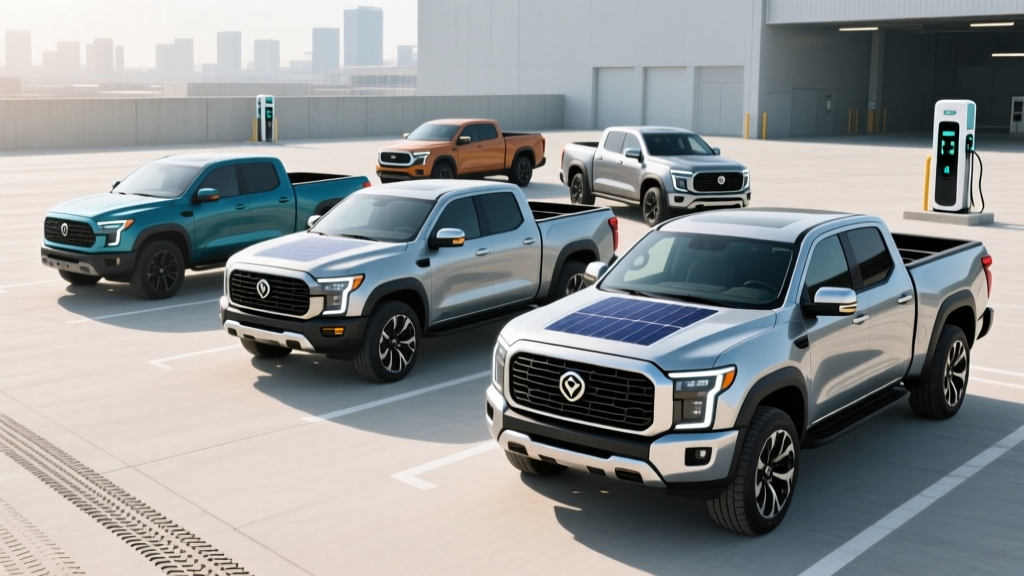
The plug-in hybrid pickup truck segment has matured from a single option into a legitimate battleground. For 2026, buyers now have multiple PHEV trucks to choose from — each pairing an electric motor with a gasoline engine to deliver short-range zero-emission commuting and long-haul capability without range anxiety. But the spec sheets vary wildly: electric-only range spans from 21 to 40+ miles, battery sizes differ by nearly 10 kWh, and federal tax credit eligibility hinges on sourcing rules that change year to year.
This guide breaks down every PHEV truck currently on sale in the US for the 2026 model year, with exact EPA figures, real-world efficiency notes, battery warranties, and a clear framework for deciding whether a plug-in hybrid pickup — or a full BEV or conventional HEV — is the right call for your driveway.
HEV vs PHEV Trucks: What's the Difference?
Before comparing specific models, it's critical to distinguish between a conventional hybrid (HEV) and a plug-in hybrid (PHEV). The confusion is common, and the ownership experience differs significantly.
| Feature | Conventional Hybrid (HEV) | Plug-In Hybrid (PHEV) |
|---|---|---|
| Plugs in to charge? | No — regenerative braking only | Yes — Level 1 (120V) or Level 2 (240V) |
| Electric-only range | 0–1 mile at low speed | 21–42 miles (model dependent) |
| Battery size | 1–2 kWh | 12–20 kWh usable |
| Federal tax credit | None | Up to $7,500 (eligibility varies) |
| Best for | Drivers without home charging access | Drivers with home/garage charging who want EV commuting + gas backup |
| Fuel economy when battery depleted | Strong (hybrid-optimized) | Moderate (heavier due to larger battery) |
For this guide, we focus on PHEV trucks — pickups that can plug in and drive meaningful distances on electricity alone. If you lack access to any plug (home, workplace, or public), a conventional HEV like the Ford Maverick Hybrid or Toyota Tundra i-FORCE MAX is likely a better fit, since PHEVs lose much of their advantage when never charged.
2026 PHEV Trucks: Full Spec Comparison
Here's every plug-in hybrid pickup currently available in the US market for 2026, with manufacturer and EPA-sourced data:
| Spec | Jeep Gladiator 4xe | Chevrolet Silverado 1500 PHEV | Ram 1500 Ramcharger |
|---|---|---|---|
| Powertrain Type | PHEV (parallel) | PHEV (parallel) | EREV (range-extended) |
| Engine | 2.0L turbo I4 | 2.7L turbo I4 | 3.6L V6 (generator only) |
| Electric Motor | Integrated in 8-speed trans | Front + rear e-motors | Dual e-motors (AWD) |
| Combined HP | 375 hp / 470 lb-ft | ~420 hp (est.) | 663 hp / 615 lb-ft |
| Battery (usable kWh) | 17.3 kWh (NMC) | ~18 kWh (NMC) | 92 kWh (NMC) |
| EPA Electric-Only Range | 28 miles | ~30 miles (est.) | ~145 miles (preliminary) |
| Total Combined Range | ~370 miles | ~450 miles (est.) | ~690 miles |
| EPA MPG (gas mode, combined) | 24 MPG combined | ~23 MPG combined (est.) | ~28 MPG combined (est.) |
| MPGe (electric + gas) | 49 MPGe | ~50 MPGe (est.) | ~65 MPGe (est.) |
| Level 2 Charge Time (0–100%) | ~2.5 hrs at 7.4 kW | ~3 hrs at 7.2 kW | ~10 hrs at 11.5 kW |
| DC Fast Charge? | No | No | Yes — up to 80 kW |
| 0–60 mph | ~6.5 sec | ~6.0 sec (est.) | 4.4 sec |
| Towing Capacity | 5,500 lbs | ~9,000 lbs (est.) | ~10,000 lbs (est.) |
| Base MSRP | $55,490 | ~$58,000 (est.) | $69,995 |
| §30D Tax Credit (2026) | Up to $3,750 | Eligibility TBD | Up to $7,500 (est.) |
Sources: fueleconomy.gov, manufacturer press sites. Estimated figures are based on announced specs for models not yet fully EPA-certified at publication.
Electric-Only Range: What the EPA Number Actually Means
The EPA electric-only range figure assumes a mix of city and highway driving at moderate temperatures. Real-world results vary, and for PHEV trucks — which tend to be heavy and boxy — the deviations are significant.
- Jeep Gladiator 4xe (EPA: 28 mi): Expect 22–26 miles in mixed driving. Highway-only at 75 mph drops this to ~18 miles. Cold weather (below 32°F) can reduce electric range by 20–30%, yielding as little as 16–19 miles.
- Ram 1500 Ramcharger (EPA: ~145 mi preliminary): The Ramcharger's massive 92 kWh battery gives it BEV-like range before the V6 generator kicks in. Real-world highway testing suggests ~110–125 miles in warm conditions, falling to ~90–100 miles in cold weather. This is preliminary — final EPA certification may adjust.
- Chevy Silverado 1500 PHEV (~30 mi EPA est.): Similar to the Gladiator, expect 24–28 miles in moderate conditions. Highway driving and cold weather reduce this proportionally.
A key nuance: PHEVs with smaller batteries (Gladiator, Silverado) rely heavily on regenerative braking in city driving to stretch electric range. On flat highways at sustained speed, there's minimal regen opportunity, so the battery depletes faster per mile. The Ramcharger's EREV architecture — where the gas engine never drives the wheels directly — behaves more like a BEV with a built-in generator, giving it more predictable range depletion.
Charging a PHEV Truck: What You Need to Know
Plug-in hybrid trucks charge much like full EVs, but with critical differences in speed and infrastructure needs.
| Level | Power (kW) | Typical Miles Added/Hour | Best For |
|---|---|---|---|
| Level 1 (120V outlet) | 1.2–1.4 kW | 3–5 miles of electric range | Overnight top-up for small PHEV batteries (Gladiator, Silverado) |
| Level 2 (240V home charger) | 7.2–11.5 kW | 18–40 miles of range | Daily full recharge for all PHEV trucks |
| DC Fast Charge | 50–80 kW (Ramcharger only) | ~100+ miles in 30 min | Road trips; only available on Ramcharger |
The kW vs kWh distinction matters here. Your PHEV's battery capacity is measured in kilowatt-hours (kWh) — the total energy it stores. The charger's output is measured in kilowatts (kW) — how fast it delivers energy. A 17.3 kWh battery charging at 7.4 kW will fill in roughly 2.5 hours (minus taper losses).
Most PHEV trucks with smaller batteries (under 20 kWh) do not support DC fast charging. The Gladiator 4xe and Silverado PHEV charge exclusively on AC power (Level 1 or Level 2). This is a practical limitation: small batteries charge quickly enough on Level 2 that manufacturers haven't added DC hardware. The Ramcharger is the exception — its 92 kWh pack is large enough to justify DC fast-charge capability.
Home charging cost: At the US average electricity rate of ~$0.17/kWh, fully charging the Gladiator's 17.3 kWh battery costs about $2.94. That covers ~28 miles of electric driving — roughly $0.105 per mile, compared to ~$0.18 per mile for a gas truck averaging 20 MPG at $3.60/gallon.
Tax Credit Eligibility for PHEV Trucks in 2026
Federal tax credits for PHEVs fall under IRS §30D, the same rules governing full EVs. However, PHEV credits are calculated differently based on battery capacity and component sourcing.
- Battery capacity: Must have at least 7 kWh of battery capacity (all current PHEV trucks qualify)
- MSRP cap: Vans, SUVs, and pickups capped at $80,000 MSRP
- Buyer income limits: AGI ≤ $150,000 (single) / $225,000 (head of household) / $300,000 (joint)
- Critical minerals requirement: $3,750 credit if a percentage of critical minerals are sourced from the US or FTA partners (percentage increases annually)
- Battery components requirement: $3,750 credit if battery components are manufactured or assembled in North America (percentage increases annually)
- FEOC restriction: Vehicles with battery components from a "foreign entity of concern" (primarily China) are disqualified entirely
- Point-of-sale transfer: Eligible buyers can transfer the credit to the dealer for an upfront price reduction
Important: The maximum credit is $7,500, but most PHEV trucks in 2026 will qualify for either $3,750 (meeting one of the two sourcing requirements) or $7,500 (meeting both). Sourcing rules tighten each year, so a model that qualifies for the full $7,500 in 2025 may only qualify for $3,750 in 2026. Always verify current eligibility on the fueleconomy.gov tax credit page before purchasing.
Reliability, Battery Warranty, and Replacement Costs
Hybrid and PHEV battery longevity remains a top buyer concern — and it's the area where manufacturer warranties have evolved significantly.
- Jeep Gladiator 4xe: 8 years / 100,000 miles (whichever comes first), covering battery capacity below 70% of original
- Chevrolet Silverado 1500 PHEV: 8 years / 100,000 miles, covering below 70% capacity
- Ram 1500 Ramcharger: 8 years / 100,000 miles (estimated, pending final confirmation)
Federal law mandates a minimum of 8 years/80,000 miles for hybrid battery warranties in states that follow EPA emissions standards. California-emissions states (CARB) require 10 years/150,000 miles for certain hybrid components.
Replacement cost reality: If a PHEV truck battery fails outside warranty, replacement costs range from approximately $6,000 to $9,000 for the Gladiator and Silverado (smaller batteries), and potentially $15,000+ for the Ramcharger's 92 kWh pack. However, field data from earlier PHEV models (Pacifica Hybrid, Wrangler 4xe) suggests that catastrophic battery failure is rare — gradual degradation of 1–2% per year is more typical, meaning most batteries retain 80–85% capacity at the 8-year mark.
Overall reliability: PHEV powertrains add complexity — you're maintaining both an electric drivetrain and an internal combustion engine. That means oil changes, spark plugs, and transmission fluid on the gas side, plus coolant loop maintenance for the battery thermal management system. Historically, Jeep's 4xe powertrain has shown average reliability, while Stellantis (Ram) and GM's hybrid systems are newer to the truck segment and lack long-term track records. Check NHTSA for any open recalls or technical service bulletins before purchasing.
PHEV Truck vs Full EV vs Gas Truck: Which Is Right for You?
- You have home charging (garage or driveway with a 240V outlet) and a commute under 30 miles round-trip
- You regularly tow or take long road trips and don't want to plan around DC fast chargers
- You want meaningful fuel savings without the full-EV price premium
- You live in an area with limited public charging infrastructure
- You have reliable home Level 2 charging and rarely tow over 5,000 lbs
- Your daily driving is under 200 miles and you want the lowest per-mile operating cost
- You want to eliminate all gasoline expenses and engine maintenance
- You qualify for the full $7,500 federal credit on an eligible BEV
- You have no access to any plug — no garage outlet, no workplace charger
- Your daily driving regularly exceeds 60+ miles (PHEV electric range won't cover it)
- You tow heavy loads daily (gas/HEV trucks avoid the weight penalty of large PHEV batteries)
- You want the lowest upfront purchase price
Frequently Asked Questions
How many MPG does a PHEV truck get?
It depends on whether the battery is charged. With a full battery, PHEV trucks achieve 49–65 MPGe (miles per gallon equivalent) in combined driving. Once the battery depletes and the truck operates as a conventional hybrid, expect 23–28 MPG combined — similar to a mild-hybrid gas truck. The key economic advantage comes from daily commutes within the electric-only range, where gasoline consumption drops to near zero.
How far can a PHEV truck go on electric only?
Current PHEV trucks range from ~28 miles (Jeep Gladiator 4xe) to ~145 miles (Ram 1500 Ramcharger, preliminary). Most parallel PHEV pickups cluster around 25–35 miles of EPA-rated electric range. The Ramcharger's EREV architecture, with its much larger 92 kWh battery, is an outlier that functions more like a BEV with an onboard generator for extended trips.
Do PHEV trucks qualify for the $7,500 federal tax credit?
They can, but eligibility depends on multiple factors: the buyer's adjusted gross income, the vehicle's MSRP (must be under $80,000 for trucks), and whether the battery's critical minerals and components meet North American sourcing thresholds. Many PHEV trucks in 2026 qualify for $3,750 (meeting one sourcing requirement) rather than the full $7,500. Always check current eligibility at fueleconomy.gov and consult a tax professional for your specific situation.
Are PHEV trucks reliable? What if the battery dies?
PHEV powertrains carry the maintenance burden of both a gas engine and an electric drivetrain, but battery failures within the warranty period are uncommon based on data from existing 4xe and hybrid owners. All current PHEV trucks carry at least 8-year/100,000-mile battery warranties. Out-of-warranty battery replacement ranges from ~$6,000 to $15,000+ depending on the model and battery size. Gradual degradation (1–2% per year) is normal; sudden failure is rare.
Can I charge a PHEV truck at a DC fast charger?
Most PHEV trucks cannot. The Jeep Gladiator 4xe and Chevrolet Silverado PHEV charge only on AC power (Level 1 at 120V or Level 2 at 240V). The Ram 1500 Ramcharger is the exception, supporting DC fast charging up to ~80 kW thanks to its much larger 92 kWh battery. If DC fast charging is important to you, the Ramcharger is currently the only option.
Is a PHEV truck better than a full EV truck?
Neither is universally better — it depends on your driving pattern. A PHEV truck excels for drivers who want electric commuting but need unrestricted towing and road-trip range without charging stops. A full EV truck (like the Ford F-150 Lightning or Rivian R1T) offers lower operating costs, zero tailpipe emissions, and less mechanical complexity, but requires charging infrastructure planning for long trips. If your commute is short and you charge at home nightly, a PHEV may use almost no gasoline on weekdays while retaining full gas-truck capability on weekends.
Pros and Cons: The PHEV Truck Trade-Offs
- 25–145 miles of electric-only driving eliminates gasoline use on short commutes
- No range anxiety — gas engine provides 370–690 miles of total range
- Lower fuel costs for daily driving (~$0.10/mile electric vs ~$0.18/mile gas)
- Federal tax credit of $3,750–$7,500 for eligible buyers
- Retains full towing and payload capability of a conventional truck
- Regenerative braking reduces brake wear in daily driving
- Higher purchase price than equivalent gas trucks ($55K–$70K+ base MSRP)
- Must maintain two powertrains (engine + electric motor/battery)
- Small-battery PHEVs (Gladiator, Silverado) lack DC fast charging
- Heavier than gas-only counterparts, reducing payload slightly
- Electric range drops significantly in cold weather (20–30% loss below 32°F)
- Tax credit eligibility is complex and changes annually
The PHEV truck occupies a specific niche: it's the bridge vehicle for buyers who want electric daily driving but aren't ready — or able — to commit to a full BEV. If your routine involves a sub-30-mile commute, access to a home charger, and occasional long trips or towing, a plug-in hybrid pickup delivers tangible fuel savings without lifestyle compromise. If you can't charge at home, the math collapses — and a conventional hybrid or gas truck makes more financial sense.