Introduction: The Hybrid SUV Balancing Act
Finding the perfect sport utility vehicle often feels like a zero-sum game. If you prioritize passenger and cargo space, you typically sacrifice fuel efficiency. Conversely, if you demand high miles per gallon (MPG), you are usually relegated to compact sedans. However, the modern hybrid SUV market has completely disrupted this paradigm. By pairing efficient electric motors with capable gasoline engines, automakers have engineered vehicles that deliver outstanding fuel economy without compromising on utility. But with dozens of options on the market, how do you systematically rank and choose the right one? This comprehensive how-to guide will walk you through the exact methodology for evaluating, comparing, and ranking the best hybrid SUVs based on two critical metrics: fuel economy and cargo capacity.
Step 1: Decode EPA Fuel Economy Ratings for Hybrids
Before you can rank hybrid SUVs, you must understand how to interpret their efficiency data. The EPA Fuel Economy website provides standardized testing results, but not all MPG numbers are created equal. For hybrid vehicles, the "Combined MPG" is your most valuable metric, as it represents a weighted average of 55% city and 45% highway driving. This is particularly important for hybrids, which often achieve higher MPG in city driving due to regenerative braking and low-speed electric-only operation.
When evaluating contenders, look closely at the gap between city and highway numbers. A hybrid SUV that achieves 42 MPG city but drops to 35 MPG highway is optimized for urban commuting and school runs. If your lifestyle involves heavy interstate road trips, you may want to prioritize a model with a smaller city-highway discrepancy, or even consider a plug-in hybrid electric vehicle (PHEV) if you have home charging capabilities. Understanding these nuances is the first step in creating an accurate, personalized ranking.
Step 2: Map Out Your Real-World Cargo Requirements
Cargo space is notoriously difficult to evaluate using brochure numbers alone. Automakers use the SAE J1100 measurement standard, which calculates volume by filling the cabin with a specific set of dimensional blocks. While this provides a baseline, it does not account for the shape of the cargo area, the intrusion of wheel wells, or the load-in height. To properly rank SUVs for your needs, you must conduct a physical audit of your typical cargo.
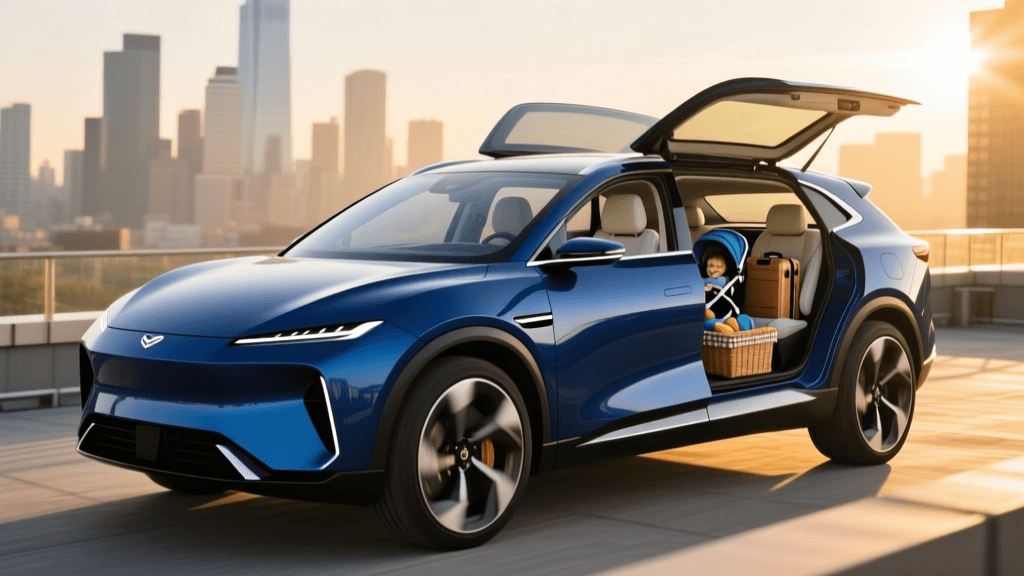
Start by measuring the items you haul most frequently. A standard double stroller requires roughly 20 to 25 cubic feet of space, but its rigid frame dictates that the cargo area must have specific width and height dimensions. Use a laser measure or a standard tape measure to find the distance between the wheel wells, as this narrow point often dictates whether large, flat items like plywood or large dog crates will fit. If you frequently transport camping gear, golf clubs, or large furniture boxes, measure the longest dimension of your items and compare it to the SUV's maximum cargo depth with the rear seats folded. Furthermore, pay attention to the load-in height. A hybrid SUV with a low load floor makes lifting heavy groceries or loading a dog significantly easier, even if the total cubic footage is slightly lower than a competitor's.
Step 3: Compare the Top Contenders Using a Data Matrix
To put this methodology into practice, we have ranked five of the most popular compact hybrid SUVs on the market. This matrix cross-references their EPA-estimated combined MPG with their maximum cargo capacity, providing a clear snapshot of how they balance efficiency and utility.
| Vehicle Model | Combined MPG | Cargo (Seats Up) | Max Cargo (Seats Folded) | Best Use Case |
|---|---|---|---|---|
| Toyota RAV4 Hybrid | 40 MPG | 37.6 cu ft | 69.8 cu ft | Best overall balance of MPG and reliability |
| Honda CR-V Hybrid | 40 MPG | 36.3 cu ft | 76.5 cu ft | Maximum cargo volume with top-tier efficiency |
| Ford Escape Hybrid | 39 MPG | 34.4 cu ft | 60.8 cu ft | Urban commuting with modest cargo needs |
| Hyundai Tucson Hybrid | 38 MPG | 38.7 cu ft | 80.3 cu ft | Hauling bulky items and large family gear |
| Kia Sportage Hybrid | 38 MPG | 39.5 cu ft | 73.7 cu ft | Best rear-seat legroom and upright cargo space |
As the data illustrates, the Honda CR-V Hybrid and Toyota RAV4 Hybrid dominate the efficiency category, both achieving an impressive 40 MPG combined. However, if maximum cargo volume is your primary directive, the Hyundai Tucson Hybrid offers a massive 80.3 cubic feet of space with the rear seats folded, easily outclassing the competition. The Kia Sportage Hybrid, meanwhile, offers the most cargo space behind the second row, making it ideal for families who rarely fold their seats down but need ample room for daily gear.
Step 4: Factor in Powertrain Architecture and Battery Placement
When ranking hybrid SUVs, it is crucial to understand how the hybrid powertrain affects the vehicle's physical layout. According to the Department of Energy's Alternative Fuels Data Center, hybrid vehicles utilize complex battery packs and power electronics that must be packaged somewhere within the vehicle's chassis. In older or poorly engineered hybrids, these batteries were placed under the cargo floor, which raised the load-in height and eliminated the possibility of a spare tire.
Today, most top-tier hybrid SUVs mount their lithium-ion or nickel-metal hydride batteries beneath the rear seats or in the center tunnel. When evaluating a vehicle at the dealership, physically check the cargo floor. Lift the false floor to see if a spare tire is included or if the space is hollowed out for battery storage. Additionally, if you are considering stepping up to a Plug-in Hybrid Electric Vehicle (PHEV) for even greater fuel savings, be aware that the significantly larger battery pack required for electric-only driving often encroaches on cargo space or eliminates under-floor storage entirely. For example, the RAV4 Prime PHEV sacrifices a small amount of under-floor storage compared to the standard RAV4 Hybrid due to its 18.1 kWh battery pack. If you frequently use the hidden cargo bins for storing charging cables, emergency kits, or groceries that might leak, this trade-off must be factored into your final ranking.
Step 5: Evaluate Safety and Visibility in the Context of Cargo
A highly efficient SUV with massive cargo space is only a good choice if it can safely protect your family and your gear. When loading a hybrid SUV to its maximum cargo capacity, the added weight changes the vehicle's center of gravity and braking dynamics. Furthermore, stacking cargo to the roofline can severely obstruct rearward visibility, making you reliant on digital rearview mirrors or backup cameras.
Pay attention to the rear window's shape. Some modern SUVs feature aggressively raked rear glass for aerodynamic efficiency, which severely limits the height of items you can stack in the back. If you regularly transport tall items like floor lamps or large potted plants, a boxier SUV design will serve you much better, even if it sacrifices a fraction of an MPG on the highway. Before finalizing your ranking, consult crash test ratings from the Insurance Institute for Highway Safety (IIHS). Look specifically for models that have earned Top Safety Pick awards, as these vehicles have demonstrated superior crashworthiness and advanced crash avoidance technologies. During your test drive, load the cargo area with boxes or luggage to simulate a real-world scenario. Check your blind spots, test the automatic emergency braking with the added weight, and ensure that the cargo tie-downs and netting are sufficient to secure your items during sudden stops.
Conclusion: Finalizing Your Hybrid SUV Ranking
Ranking the best hybrid SUVs by fuel economy and cargo space is not about finding a single, universally perfect vehicle; it is about identifying the optimal intersection of efficiency and utility for your specific lifestyle. By systematically decoding EPA ratings, conducting a physical audit of your cargo needs, analyzing comparative data matrices, and verifying powertrain packaging, you can cut through the marketing noise. Whether you ultimately choose the cargo-dominant Hyundai Tucson Hybrid, the efficiency-focused Toyota RAV4 Hybrid, or the spacious Honda CR-V Hybrid, applying this comprehensive how-to methodology ensures that your next vehicle purchase will be both economically and practically sound.