The Beginner’s Guide to Choosing a Family Hybrid SUV
When starting a family or upgrading your current ride, the intersection of interior space, passenger comfort, and fuel efficiency becomes your top priority. Gas prices fluctuate, and family road trips require serious cargo capacity for strollers, groceries, sports gear, and luggage. This is where the family hybrid SUV shines. By combining a traditional gasoline engine with an electric motor, these vehicles offer the spaciousness of a traditional SUV without the painful penalty at the fuel pump.
For beginners, navigating the hybrid market can feel overwhelming. Automakers throw around terms like 'cubic feet,' 'shoulder room,' and 'MPGe' without always explaining what they mean for your daily life. This complete guide will break down the best family hybrid SUVs on the market today, ranked specifically by their passenger volume and cargo utility, ensuring you make an informed, practical decision for your household.
Decoding the Dimensions: What Do the Numbers Actually Mean?
Before diving into the rankings, it is crucial to understand how interior space is measured. Cargo volume is measured in cubic feet (cu ft). Automakers usually provide three numbers for three-row SUVs: space behind the third row, space behind the second row (with the third row folded), and maximum space (with all rear seats folded). For two-row SUVs, you will see space behind the rear seats and maximum space.
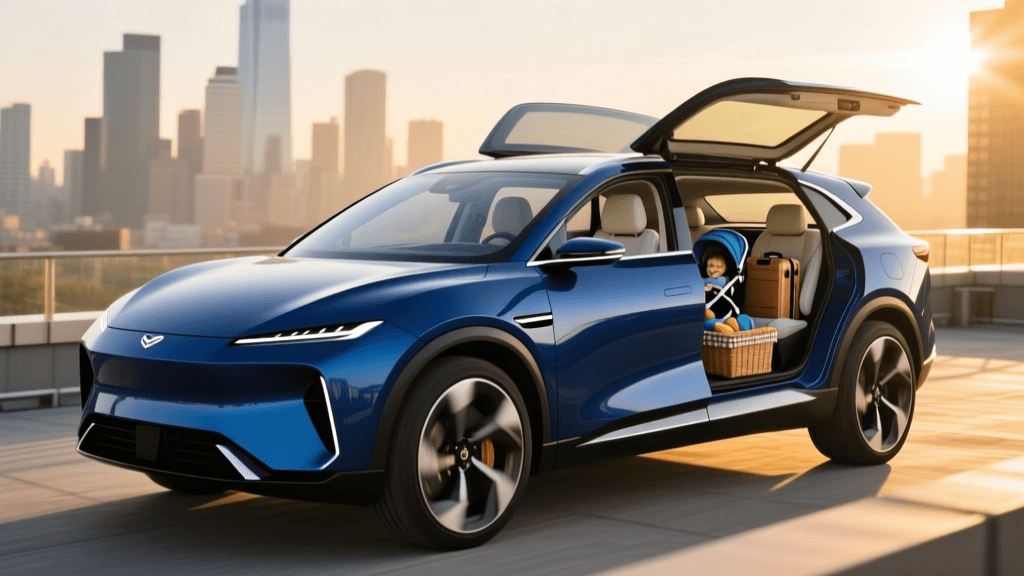
Passenger volume is also measured in cubic feet and represents the total interior space available for occupants. However, for families, legroom and shoulder room are often more practical metrics. Ample shoulder room prevents sibling squabbles in the backseat, while sufficient legroom ensures rear-facing car seats do not force the front passenger to sit uncomfortably close to the dashboard.
Beginner Tip: Never rely solely on cubic feet numbers. A trunk with 40 cubic feet of space but a narrow, sloping roofline might not fit a bulky double stroller, whereas a boxier 35-cubic-foot trunk might swallow it with ease. Always measure the trunk opening width and height, and bring your stroller to the dealership for a real-world test.
The 2024 Family Hybrid SUV Space Rankings
Below is our ranked data table comparing the top hybrid SUVs based on maximum cargo capacity, total passenger volume, and combined fuel economy.
| Rank & Model | Max Cargo (cu ft) | Cargo Behind 3rd/2nd Row | Passenger Vol (cu ft) | Combined MPG |
|---|---|---|---|---|
| 1. Toyota Grand Highlander Hybrid | 97.5 | 20.6 / 57.9 | 143.5 | 34 MPG |
| 2. Kia Sorento Hybrid | 75.5 | 12.6 / 45.0 | 134.3 | 34 MPG |
| 3. Honda CR-V Hybrid | 76.5 | N/A / 39.3 | 106.0 | 40 MPG |
| 4. Toyota RAV4 Hybrid | 69.8 | N/A / 37.5 | 98.9 | 39 MPG |
| 5. Hyundai Tucson Hybrid | 80.3 | N/A / 38.7 | 107.5 | 38 MPG |
1. Toyota Grand Highlander Hybrid: The Three-Row Titan
If your family requires three rows of seating but you refuse to sacrifice fuel economy, the Toyota Grand Highlander Hybrid is the undisputed champion. Unlike the standard Highlander, the 'Grand' version offers a genuinely usable third row that can comfortably accommodate teenagers or adults on longer trips. Behind the third row, you get 20.6 cubic feet of space—enough for a week's worth of groceries or a couple of carry-on suitcases. Fold the third row down, and you are greeted with a massive 57.9 cubic feet of cargo room.
The Grand Highlander Hybrid MAX powertrain delivers a robust 362 horsepower, ensuring that merging onto the highway with a fully loaded cabin is effortless. With an EPA-estimated 34 MPG combined, it saves families thousands of dollars annually compared to traditional V6 three-row SUVs.
2. Kia Sorento Hybrid: The Midsize Value Champion
The Kia Sorento Hybrid hits the sweet spot for growing families who occasionally need a third row but do not want to drive a massive, truck-like vehicle. The third row is best reserved for small children or very short trips, as legroom is tight. However, the cargo versatility is excellent. With 12.6 cubic feet behind the third row, it is slightly smaller than the Toyota, but folding the third row opens up 45.0 cubic feet of highly usable, boxy space.
Kia also equips the Sorento with a wealth of standard family-friendly tech, including rear occupant alert (to remind you to check the backseat before exiting) and safe exit assist, which prevents doors from opening if a cyclist or car is approaching from behind.
3. Honda CR-V Hybrid: The Compact Cargo Miracle
For families with one or two children who do not need a third row, the Honda CR-V Hybrid is a masterclass in packaging. Honda’s engineers have maximized every inch of the interior, resulting in a class-leading 39.3 cubic feet of cargo space behind the rear seats, and an impressive 76.5 cubic feet with the seats folded flat. The rear doors open to a near 90-degree angle, making it incredibly easy to load and unload bulky rear-facing car seats.
Furthermore, the CR-V Hybrid boasts an outstanding 40 MPG combined. It is the ideal commuter and weekend warrior for families who want to minimize their carbon footprint and gas station visits without compromising on interior utility.
4. Toyota RAV4 Hybrid: The Reliable All-Rounder
The Toyota RAV4 Hybrid remains a staple in suburban driveways for good reason. It offers bulletproof reliability, standard all-wheel drive (AWD), and a very respectable 37.5 cubic feet of cargo space behind the second row. While it slightly trails the CR-V in total passenger volume, its rugged, boxy design makes it easy to stack gear up to the ceiling. The RAV4 Hybrid is perfect for active families who frequently haul muddy dogs, camping gear, and sporting equipment.
Standard Hybrids vs. Plug-In Hybrids (PHEVs) for Families
As a beginner, you might wonder if you should opt for a Plug-In Hybrid Electric Vehicle (PHEV) instead of a standard hybrid. Standard hybrids (HEVs) charge their batteries through regenerative braking and the gas engine; you simply fill them with gas and drive. PHEVs, on the other hand, have larger batteries that can be plugged into a wall outlet, offering 25 to 40 miles of pure electric driving before the gas engine turns on.
Choose a PHEV if: You have a garage or driveway where you can install a charger, and your daily school drop-offs and grocery runs total less than 30 miles. You will essentially drive an EV all week and use gas only for weekend road trips.
Choose a Standard Hybrid if: You live in an apartment, park on the street, or lack access to reliable charging infrastructure. Standard hybrids offer seamless, stress-free efficiency with zero changes to your daily routine.
Safety First: Checking Crash Test Ratings
Space and efficiency mean nothing if your family is not protected. When shopping for a family SUV, always cross-reference your choices with the IIHS Top Safety Pick Awards. The Insurance Institute for Highway Safety conducts rigorous crash tests, including the challenging side-impact and passenger-side small overlap tests. Vehicles like the Honda CR-V and Toyota Grand Highlander consistently earn top marks for their advanced driver-assistance systems (ADAS) and structural integrity.
Additionally, consult the NHTSA 5-Star Safety Ratings provided by the federal government. Pay special attention to the rollover resistance ratings, which are particularly important for taller, top-heavy SUVs. Ensuring your chosen hybrid has automatic emergency braking (AEB) with pedestrian detection and blind-spot monitoring is non-negotiable for family hauling.
Maximizing Your Fuel Economy on Family Road Trips
Once you have selected your spacious hybrid SUV, you will want to get the most out of your fuel tank. According to the EPA's Hybrid Side-by-Side Comparison Tool, real-world fuel economy can vary based on driving habits. To maximize efficiency during loaded family road trips, utilize your vehicle's ECO drive mode, which softens throttle response and optimizes the climate control system. Keep your tires inflated to the exact PSI listed on the driver’s door jamb, as under-inflated tires can reduce hybrid efficiency by up to 3%. Finally, rely on regenerative braking by coasting to a stop rather than slamming on the brakes, which feeds valuable energy back into the hybrid battery.
Final Thoughts for First-Time Hybrid Buyers
Choosing the right family hybrid SUV is about balancing your spatial needs with your budget and daily routine. If you need maximum passenger capacity and three usable rows, the Toyota Grand Highlander Hybrid is unmatched. If you want a compact footprint with surprisingly deep cargo space and stellar MPG, the Honda CR-V Hybrid is the smartest buy. By understanding how to read cargo dimensions, prioritizing top-tier safety ratings, and choosing the right hybrid powertrain for your lifestyle, you will secure a vehicle that serves your family efficiently and comfortably for years to come.