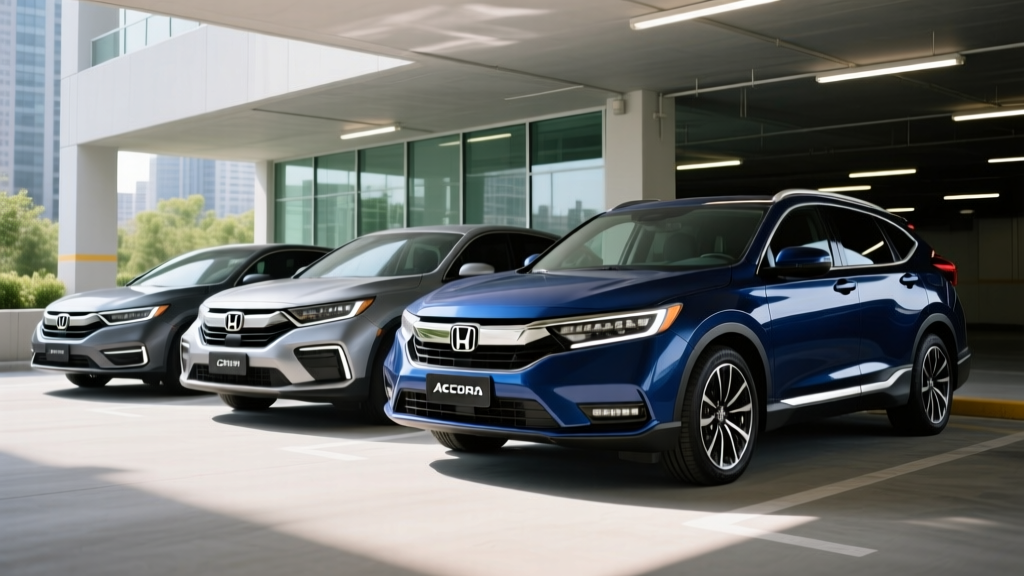
Honda's hybrid lineup has expanded to cover three of its most popular nameplates—the Accord, CR-V, and Civic—and leasing has become one of the most practical ways to access these powertrains without committing to long-term ownership. For 2026, Honda hybrid lease offers vary significantly across trims and regions, and the math behind whether to lease, buy, or finance depends on your driving habits, local incentives, and how you value the latest hybrid efficiency gains.
This guide breaks down every current Honda hybrid model available for lease, the real-world MPG you can expect, battery longevity concerns, federal tax credit eligibility, and a framework for deciding whether a Honda hybrid—or a full EV—makes sense for your next vehicle.
Honda's 2026 Hybrid Lineup: Which Models Qualify?
Honda currently offers conventional hybrid (HEV) versions of three core models for the 2026 model year. It's critical to understand that these are self-charging hybrids—they do not plug in. Honda does not currently sell a plug-in hybrid (PHEV) in the U.S. market, having discontinued the Clarity Plug-In Hybrid after the 2021 model year.
HEV vs. PHEV: What Honda Buyers Need to Know
| Feature | Honda HEV (Accord, CR-V, Civic) | PHEV (e.g., Toyota RAV4 Prime) |
|---|---|---|
| Plug-in charging required? | No — regenerative braking & engine recharge the battery | Yes — plug in for electric-only driving |
| Electric-only range | Less than 1 mile at low speeds | 25–42 miles typical |
| Battery size | 1.0–1.5 kWh (small buffer) | 14–18 kWh usable |
| Federal tax credit (§30D) | Not eligible | Up to $7,500 if eligible |
| Home charger needed? | No | Recommended (Level 2) |
This distinction matters enormously for lease shoppers. Because Honda's hybrids are HEVs, they do not qualify for the IRS §30D federal clean vehicle credit, which is reserved for plug-in electric vehicles with at least 7 kWh of battery capacity. However, some states and utilities offer rebates for conventional hybrids—check your local programs.
2026 Honda Accord Hybrid: Lease Specs and Real-World MPG
The Accord Hybrid remains Honda's efficiency flagship, pairing a 2.0-liter Atkinson-cycle four-cylinder engine with a two-motor hybrid system for a combined output of 204 horsepower and 247 lb-ft of torque. For 2026, the Accord Hybrid is available in Sport, Sport-L, and EX-L trims.
| Spec | Value |
|---|---|
| Powertrain | 2.0L I-4 + 2-motor hybrid system |
| Combined HP | 204 hp |
| Combined torque | 247 lb-ft |
| EPA city MPG | 51 |
| EPA highway MPG | 44 |
| EPA combined MPG | 48 |
| Fuel tank | 12.8 gallons |
| Total range | ~614 miles |
| Hybrid battery | ~1.06 kWh lithium-ion |
| 0–60 mph | ~7.1 seconds |
| Starting MSRP (Sport) | $33,995 |
| Hybrid battery warranty | 8 years / 100,000 miles (10 yr / 150,000 mi in CARB states) |
| Driving Condition | EPA Estimate | Real-World Expectation |
|---|---|---|
| City | 51 MPG | 48–55 MPG (hybrids often exceed EPA in stop-and-go) |
| Highway (70 mph) | 44 MPG | 40–44 MPG |
| Combined | 48 MPG | 44–50 MPG depending on driving mix |
| Cold weather (below 30°F) | — | 38–44 MPG (engine runs more for cabin heat) |
The Accord Hybrid's two-motor system operates primarily in electric drive mode at low and moderate speeds, with the gasoline engine acting as a generator. At highway speeds, the engine can mechanically connect to the wheels via a lock-up clutch for optimal efficiency. This is why city MPG actually exceeds highway MPG—a characteristic unique to hybrids that rewards urban and suburban drivers.
Accord Hybrid Lease Pricing Snapshot
As of early 2026, Honda Accord Hybrid lease offers through Honda Financial Services typically range from $349 to $429 per month for 36-month terms with $2,500–$3,500 due at signing, depending on trim and regional incentives. Sport trim leases tend to anchor the lower end, while EX-L with navigation pushes toward $429. Always verify current offers on Honda's build-and-price tool and cross-reference with local dealer inventory, as regional bonus cash and loyalty incentives can shift monthly payments by $30–$50.
2026 Honda CR-V Hybrid: Lease Specs and Family Practicality
The CR-V Hybrid accounts for roughly half of all CR-V sales, and for good reason. The two-motor hybrid system produces 204 horsepower and 247 lb-ft of torque—the same powertrain architecture as the Accord, tuned for the SUV's higher curb weight. For 2026, the CR-V Hybrid is available in Sport, Sport-L, and Sport Touring trims, with the top trim offering standard AWD.
| Spec | FWD | AWD |
|---|---|---|
| Powertrain | 2.0L I-4 + 2-motor hybrid system | |
| Combined HP | 204 hp | |
| EPA city / highway / combined | 43 / 36 / 40 MPG | 40 / 34 / 37 MPG |
| Fuel tank | 14.0 gallons | |
| Total range | ~560 miles | ~518 miles |
| Cargo volume (rear seats up) | 39.3 cu ft | |
| Starting MSRP (Sport FWD) | $35,995 | |
| Towing capacity | 1,000 lbs | |
The CR-V Hybrid's real-world fuel economy is heavily influenced by driving style and climate. In temperate city driving, owners regularly report 42–45 MPG, exceeding the EPA city estimate. Highway-heavy commutes at 75+ mph will drop that figure to the mid-30s. Cold weather is the great equalizer: expect a 10–15% efficiency reduction when temperatures dip below freezing, as the gasoline engine must run more frequently to provide cabin heating and maintain battery temperature.
CR-V Hybrid Lease Pricing Snapshot
CR-V Hybrid lease offers for 2026 generally fall between $379 and $469 per month on 36-month terms. The Sport FWD trim is the lease value leader, while the Sport Touring AWD commands the premium end. Honda frequently layers conquest cash (typically $500–$1,000) for buyers switching from competing brands, which can be applied as a capitalized cost reduction to lower monthly payments.
2026 Honda Civic Hybrid: The Efficiency Bargain
Reintroduced for the 2025 model year after a brief hiatus, the Civic Hybrid returned with Honda's latest two-motor system and quickly became the most fuel-efficient non-plug-in vehicle in Honda's lineup. For 2026, the Civic Hybrid is available in Sport and Sport Touring trims.
| Spec | Value |
|---|---|
| Powertrain | 2.0L I-4 + 2-motor hybrid system |
| Combined HP | 200 hp |
| Combined torque | 232 lb-ft |
| EPA city MPG | 50 |
| EPA highway MPG | 47 |
| EPA combined MPG | 49 |
| Fuel tank | 10.6 gallons |
| Total range | ~519 miles |
| 0–60 mph | ~7.2 seconds |
| Starting MSRP (Sport) | $29,845 |
The Civic Hybrid's 49 MPG combined rating is exceptional, and real-world city driving frequently yields 50–54 MPG thanks to the system's heavy reliance on electric propulsion at lower speeds. This is the Honda hybrid that makes the strongest case for lease value: a sub-$30,000 starting MSRP translates to lease offers as low as $289–$349 per month with modest money down, making it one of the most affordable ways into a new hybrid in 2026.
Battery Longevity: What Hybrid Lease Shoppers Should Know
Honda Hybrid Battery Warranty
All 2026 Honda hybrid models carry the following battery warranty coverage:
- Standard coverage: 8 years or 100,000 miles (whichever comes first)
- CARB-state coverage: 10 years or 150,000 miles — applies in California and states that follow CARB emissions standards (Colorado, Connecticut, Delaware, Maine, Maryland, Massachusetts, Minnesota, Nevada, New Jersey, New Mexico, New York, Oregon, Pennsylvania, Rhode Island, Vermont, Virginia, Washington)
- What's covered: Battery capacity loss below functional threshold, manufacturing defects
For lease customers, battery longevity is largely a non-issue. A standard 36-month lease falls well within the 8-year warranty period, and you'll return the vehicle before the battery reaches the age where degradation becomes a concern. Honda's hybrid batteries are small (roughly 1.0–1.5 kWh) and are never deeply cycled—the system maintains a charge buffer, using only a portion of total capacity. This shallow-cycling strategy is why hybrid batteries routinely last 150,000–200,000+ miles in real-world use.
If you're considering purchasing rather than leasing, a hybrid battery replacement for a Honda Accord or CR-V typically runs $2,000–$4,000 at a dealership, though refurbished units are increasingly available for $1,000–$2,000. Third-party hybrid battery specialists offer replacements at even lower cost. According to fueleconomy.gov, Honda's hybrid systems have demonstrated strong long-term reliability in consumer surveys and J.D. Power dependability studies.
Do Honda Hybrids Qualify for Tax Credits?
This is the most common question we get, and the answer requires precision:
- Federal §30D clean vehicle credit ($7,500): Honda's conventional hybrids (Accord, CR-V, Civic) do NOT qualify. The §30D credit requires a vehicle to have at least 7 kWh of battery capacity and the ability to be recharged from an external source (i.e., it must be a PHEV or BEV). Honda's hybrids have roughly 1 kWh batteries and cannot plug in.
- Federal used clean vehicle credit (§25E, up to $4,000): Also does not apply to conventional hybrids—same plug-in requirement.
- State incentives: Some states offer modest rebates or reduced registration fees for hybrids. For example, certain utility companies in California and the Northeast offer $250–$500 rebates for hybrid purchases. Check your state energy office or utility provider.
- Lease-specific advantage: When you lease any vehicle, the leasing company (Honda Financial Services) is the legal owner and may pass through any applicable commercial clean vehicle credits (§45W) as a capitalized cost reduction. However, for conventional hybrids, there are no federal credits to pass through.
For buyers specifically seeking federal tax credit eligibility, a plug-in hybrid like the Toyota RAV4 Prime or a full BEV like the Honda Prologue (Honda's only current EV, which does qualify for up to $7,500 in point-of-sale credit depending on sourcing and income requirements) would be necessary. The IRS maintains the official eligibility list, which is updated regularly.
Lease vs. Buy: Decision Framework for Honda Hybrid Shoppers
Choose a Honda Hybrid Lease If:
- You drive 10,000–15,000 miles per year (within standard lease mileage limits)
- You want the latest Honda Safety Sensing suite and infotainment updates every 3 years
- You prefer predictable monthly costs without repair risk (the full warranty covers the lease term)
- You don't want to worry about long-term battery replacement costs
- Your local Honda dealer has competitive lease offers with money-down flexibility
Choose to Buy (Finance) If:
- You drive more than 15,000 miles per year (excess mileage penalties on leases are typically $0.15–$0.25/mile)
- You plan to keep the vehicle 7+ years to amortize the purchase price
- You want to modify the vehicle or don't want wear-and-tear return scrutiny
- You can take advantage of a low-rate promotional APR from Honda Financial Services
Choose a Full EV (e.g., Honda Prologue) If:
- You have reliable home Level 2 charging access
- You qualify for the $7,500 federal credit (check income caps: $150K single / $300K joint, and MSRP caps)
- Your daily commute is under 250 miles round-trip
- You want zero tailpipe emissions and lower per-mile "fuel" costs (electricity vs. gasoline)
Pros and Cons: Honda Hybrid Leasing in 2026
Pros
- 48–49 MPG combined on Accord and Civic Hybrid—among the best non-PHEV numbers available
- No plug-in charging required—works with existing gas-station infrastructure
- Strong reliability record; hybrid battery warranty covers any standard lease term
- Competitive lease pricing: Civic Hybrid as low as ~$289/mo, Accord Hybrid ~$349/mo
- Honda Sensing ADAS suite standard on all trims (adaptive cruise, lane-keeping, collision mitigation)
- Spacious interiors; Accord Hybrid retains full trunk volume vs. non-hybrid
Cons
- No federal tax credit eligibility—conventional HEVs don't qualify for §30D
- AWD availability limited (CR-V Hybrid only; Accord and Civic Hybrid are FWD)
- Engine noise under hard acceleration—CVT-like drone from the e-CVT system
- Lease return fees and mileage overage penalties can add up for high-mileage drivers
- Honda does not offer a PHEV option—buyers wanting electric-only range must look to competitors
- Towing capacity limited to 1,000 lbs on CR-V Hybrid (vs. 1,500 lbs on gas-only CR-V AWD)
Frequently Asked Questions
How many MPG does the Honda Accord Hybrid get in real-world driving?
The EPA rates the 2026 Accord Hybrid at 51 city / 44 highway / 48 combined MPG. In real-world testing, city drivers frequently achieve 48–55 MPG thanks to the hybrid system's electric-dominant low-speed operation. Highway driving at 70–75 mph typically yields 40–44 MPG. Cold weather can reduce combined efficiency to the 38–44 MPG range.
How far can a Honda hybrid go on electric only?
Honda's current hybrids are conventional HEVs, not plug-in hybrids. They can travel less than one mile on electric power alone at very low speeds (under 25 mph in ideal conditions). The gasoline engine kicks in for sustained acceleration and higher speeds. If you need meaningful electric-only range (25–40 miles), you'd need to look at a PHEV from another manufacturer, such as the Toyota RAV4 Prime or Hyundai Tucson PHEV.
Is the Honda hybrid system reliable, and what does battery replacement cost?
Honda's two-motor hybrid system has a strong reliability track record, with the hybrid battery covered by an 8-year/100,000-mile warranty (10 years/150,000 miles in CARB states). Real-world data suggests these batteries routinely last 150,000–200,000+ miles. If replacement is needed out of warranty, expect $2,000–$4,000 at a dealership, or $1,000–$2,000 for a refurbished unit from a hybrid specialist.
Does the Honda CR-V Hybrid qualify for any tax credit?
No. The CR-V Hybrid is a conventional hybrid (HEV) with a ~1 kWh battery and no plug-in capability. The federal §30D clean vehicle credit requires at least 7 kWh of battery capacity and external rechargeability—criteria only met by PHEVs and BEVs. Some state utility programs offer small hybrid rebates ($250–$500), but there is no federal tax credit for Honda's current hybrid models.
Is leasing a Honda hybrid better than buying?
Leasing makes sense if you drive under 15,000 miles annually, want the latest technology every 3 years, and prefer not to worry about long-term battery costs (which are fully covered within the lease term). Buying is preferable for high-mileage drivers, those who plan to keep the vehicle 7+ years, or anyone who wants to avoid lease-return wear-and-tear charges. Honda hybrid lease offers in 2026 are competitive, with the Civic Hybrid starting around $289/month.
How do Honda hybrid lease offers compare to Toyota?
The Toyota Camry Hybrid (52 MPG combined) and RAV4 Hybrid (39–41 MPG combined) are Honda's direct competitors. Toyota often offers aggressive lease cash on hybrid trims, and the RAV4 Prime PHEV (42 miles electric-only) provides federal tax credit eligibility that Honda cannot match. Monthly lease payments are broadly comparable, but specific deals vary by region and dealer. Cross-shop both brands and get written quotes before committing.
What Honda hybrid gets the best gas mileage?
The 2026 Honda Civic Hybrid leads the lineup at 49 MPG combined (50 city / 47 highway). The Accord Hybrid follows closely at 48 combined. The CR-V Hybrid, being a heavier SUV, achieves 37–40 combined depending on FWD or AWD configuration. For maximum efficiency, the Civic Hybrid Sport is the clear pick.