If you need three rows of seating, serious cargo space, and towing capability but want to cut fuel costs without committing to a full battery-electric vehicle, a full size SUV hybrid is the pragmatic middle ground. The segment has matured significantly: today's buyers can choose between conventional hybrids (HEVs) that never need plugging in and plug-in hybrids (PHEVs) that cover daily commutes on electricity alone before the gas engine kicks in.
This guide breaks down the top full size SUV hybrid contenders for the 2026 model year — the Toyota Grand Highlander Hybrid, the Jeep Grand Cherokee L 4xe, and the Kia Sorento Plug-In Hybrid — with exact EPA numbers, real-world expectations, battery warranties, and tax-credit eligibility so you can make a spec-driven decision.
HEV vs PHEV: Which Full Size SUV Hybrid Type Fits You?
Before comparing models, it's critical to understand the two hybrid architectures available in this segment. Confusing them is the most common mistake buyers make.
| Factor | Conventional Hybrid (HEV) | Plug-In Hybrid (PHEV) |
|---|---|---|
| Plugging in required? | No — regenerative braking charges the small battery | Yes — plug in to access electric-only range |
| Electric-only driving | Very limited (low-speed assist only) | 20–40+ miles on battery alone |
| Battery size | 1–2 kWh (nickel-metal hydride or small Li-ion) | 12–25 kWh (lithium-ion) |
| Charging hardware | None needed | Level 1 (120V) or Level 2 (240V) home charging |
| Federal tax credit | Not eligible under §30D | Up to $7,500 if sourcing/income/MSRP rules met |
| Best for | Drivers without home charging access | Drivers with short commutes and home Level 2 charging |
The bottom line: if you can install a Level 2 charger at home and your daily round-trip commute is under 35 miles, a PHEV lets you drive almost entirely on electricity most days while keeping the gas engine for road trips. If you lack reliable home charging or regularly exceed 50 miles daily, a conventional HEV delivers strong fuel savings with zero behavioral change.
Top Full Size SUV Hybrid Contenders: Spec Comparison
Here's how the leading models stack up across the metrics that matter most. All figures reflect 2026 model-year data from EPA and manufacturer specifications.
| Spec | Toyota Grand Highlander Hybrid (HEV) | Jeep Grand Cherokee L 4xe (PHEV) | Kia Sorento PHEV |
|---|---|---|---|
| Type | Conventional Hybrid | Plug-In Hybrid | Plug-In Hybrid |
| Seating | 7–8 passengers | 6–7 passengers | 6–7 passengers |
| Combined HP | 245 hp (Hybrid MAX: 362 hp) | 375 hp | 261 hp |
| Engine | 2.5L 4-cyl + electric motors | 2.0L turbo 4-cyl + electric motor | 1.6L turbo 4-cyl + electric motor |
| Battery (usable) | ~1.6 kWh (NiMH) | ~17.3 kWh (Li-ion NMC) | ~13.8 kWh (Li-ion NMC) |
| EPA Electric-Only Range | N/A (HEV) | ~26 miles | ~32 miles |
| EPA Combined MPG / MPGe | 36 MPG combined | 56 MPGe (elec+gas) / 23 MPG gas-only | 79 MPGe (elec+gas) / 34 MPG gas-only |
| 0–60 mph | 7.6 sec (MAX: 6.0 sec) | ~6.5 sec | ~7.8 sec |
| Max Tow Capacity | 5,000 lbs (MAX) | 6,000 lbs | 2,000 lbs |
| Base MSRP | ~$42,500 | ~$62,000 | ~$51,500 |
| DC Fast Charge? | No | No (Level 2 only) | No (Level 2 only) |
| Level 2 Charge Time (0–100%) | N/A | ~3.5 hours at 7.2 kW | ~3.25 hours at 7.2 kW |
Sources: fueleconomy.gov, Toyota, Stellantis, and Kia 2026 press specifications.
Fuel Economy Deep Dive: EPA vs Real-World MPG
Hybrid SUVs behave differently than gas-only vehicles in real-world driving — and usually in your favor around town. Here's what to actually expect.
| Model | EPA City | EPA Highway | EPA Combined | Real-World Expectation |
|---|---|---|---|---|
| Grand Highlander Hybrid | 37 MPG | 34 MPG | 36 MPG | 33–38 MPG (city-biased driving can exceed EPA) |
| Grand Cherokee L 4xe (gas-only mode) | 23 MPG | 24 MPG | 23 MPG | 20–23 MPG once battery depleted |
| Kia Sorento PHEV (gas-only mode) | 34 MPG | 35 MPG | 34 MPG | 30–34 MPG after electric range exhausted |
Real-world note for PHEV buyers: The EPA MPGe figure (e.g., 79 MPGe for the Sorento PHEV) assumes you start each trip with a full battery charge and blend electric and gas driving. If you charge nightly and commute under 30 miles, you may use almost no gasoline for months. If you never plug in, you'll get only the gas-only MPG column — which still beats most non-hybrid three-row SUVs but wastes the PHEV's biggest advantage.
Conventional hybrids like the Grand Highlander Hybrid actually tend to exceed their EPA city estimate in stop-and-go driving because regenerative braking recaptures energy that a gas car wastes as heat. On sustained highway trips at 75+ mph, expect fuel economy to dip 2–4 MPG below the EPA city figure. Cold weather (below 30°F) typically reduces hybrid efficiency by 5–10% due to cabin heating demands and reduced battery output.
PHEV Electric-Only Range and Charging Logistics
For PHEV shoppers, electric-only range determines whether you'll actually drive on electricity day-to-day or just burn gas with a heavier vehicle.
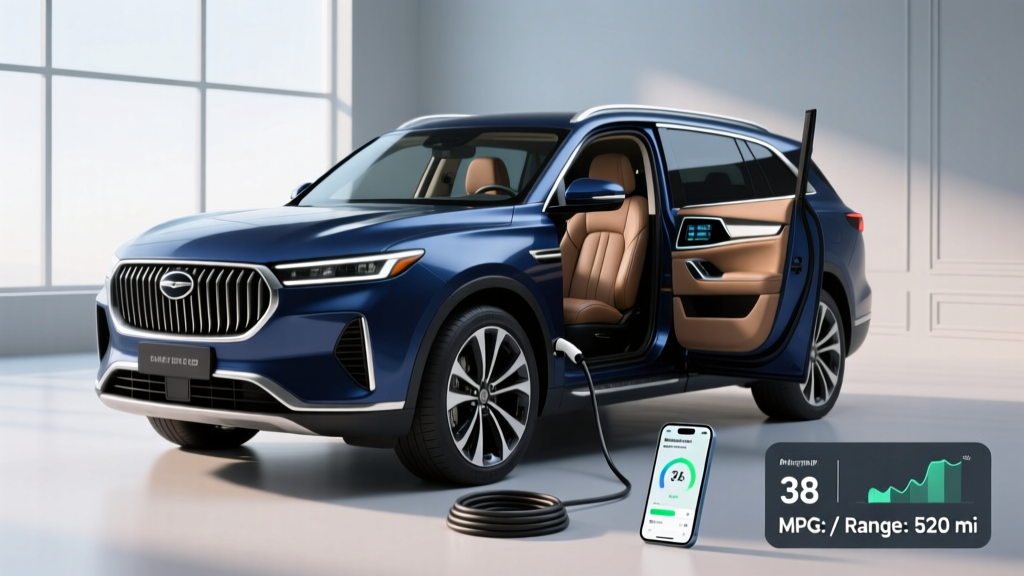
Jeep Grand Cherokee L 4xe: Approximately 26 miles of electric-only range. This covers shorter commutes but falls short for drivers with 30+ mile one-way trips. The 17.3 kWh battery charges fully in about 3.5 hours on a Level 2 (240V, 7.2 kW) home charger, or roughly 10–12 hours on a standard 120V household outlet (Level 1). No DC fast charging is available — this is typical for PHEVs in this class, as the battery is too small to benefit from high-power DC infrastructure.
Kia Sorento PHEV: Around 32 miles electric-only — enough for most suburban round-trip commutes. The 13.8 kWh pack charges in approximately 3.25 hours at Level 2. Again, no DC fast charging capability.
Charging cost reality: At the US average residential electricity rate of ~$0.17/kWh (EIA 2025 data), fully charging the Sorento PHEV's 13.8 kWh battery costs roughly $2.35 — the equivalent of less than a gallon of gasoline for 32 miles of driving. That's approximately 7.3 cents per mile on electricity vs. 15–18 cents per mile on gasoline at $3.50/gallon and 22 MPG in a comparable non-hybrid SUV.
Battery Longevity, Warranty, and Replacement Costs
Hybrid battery degradation is the number-one concern among first-time hybrid buyers. Here's what the data actually shows.
Federal mandate: All hybrid and PHEV battery packs sold in the US must carry a minimum warranty of 8 years / 100,000 miles (10 years / 150,000 miles in CARB states including California, New York, Massachusetts, and others). This covers defects and capacity loss below a manufacturer-defined threshold, typically 60–70% of original capacity.
| Model | Hybrid Battery Warranty | Powertrain Warranty | Estimated Out-of-Warranty Replacement |
|---|---|---|---|
| Toyota Grand Highlander Hybrid | 10 yr / 150,000 mi | 5 yr / 60,000 mi | $3,000–$4,500 (NiMH pack) |
| Jeep Grand Cherokee L 4xe | 8 yr / 100,000 mi | 5 yr / 60,000 mi | $6,000–$9,000 (17.3 kWh Li-ion) |
| Kia Sorento PHEV | 10 yr / 100,000 mi | 10 yr / 100,000 mi | $5,000–$7,500 (13.8 kWh Li-ion) |
In practice, hybrid battery replacements are rare before 150,000 miles. Toyota's hybrid synergy drive system has accumulated over two decades of field data, with many Prius and Highlander Hybrid packs lasting 200,000+ miles with only 15–20% degradation. PHEV packs experience more cycling stress but benefit from active liquid thermal management. The larger concern for PHEV buyers is the cost of an out-of-warranty replacement — the larger Li-ion packs in the Jeep and Kia are substantially more expensive than a conventional HEV's small NiMH battery.
Reliability indicators: Toyota's hybrid systems consistently earn top marks in long-term reliability surveys. Kia's 10-year/100,000-mile powertrain warranty provides strong coverage for the PHEV powertrain. Jeep's 4xe system is newer and has had some software-related recalls in earlier model years — check NHTSA recall data for the specific VIN before purchasing.
Tax Credits and Pricing: What You'll Actually Pay
The federal §30D clean vehicle credit can significantly reduce the effective price of a qualifying PHEV — but conventional hybrids do not qualify. Here's the current landscape for 2026.
- Vehicle type: Only PHEVs (and BEVs) qualify. The Grand Highlander Hybrid (HEV) is not eligible for §30D.
- MSRP cap: SUVs/vans must have an MSRP at or below $80,000. All three models here clear this threshold at base trims, but loaded Grand Cherokee L 4xe trims may exceed it.
- Buyer income cap: Modified AGI must not exceed $150,000 (single), $225,000 (head of household), or $300,000 (joint). Check IRS §30D guidelines for current-year thresholds.
- Battery sourcing: The credit is split into two halves ($3,750 + $3,750) based on critical-mineral sourcing and battery-component manufacturing requirements. These rules tighten annually — consult a tax professional for your specific model-year eligibility.
- Point-of-sale transfer: As of 2024, buyers can transfer the credit to the dealer at purchase, reducing the sale price directly rather than waiting for a tax refund.
Effective pricing examples (base MSRP, before dealer fees):
| Toyota Grand Highlander Hybrid LE | ~$42,500 — no federal credit (HEV) |
| Kia Sorento PHEV EX | ~$51,500 — potentially $3,750–$7,500 credit, effective ~$44,000–$47,750 |
| Jeep Grand Cherokee L 4xe | ~$62,000 — potentially $3,750–$7,500 credit, effective ~$54,500–$58,250 |
State incentives may stack on top. California, Colorado, New York, and others offer additional rebates for PHEVs — check your state energy office for current programs. Conventional hybrids may qualify for minor state or utility incentives in some jurisdictions, but these are typically $500–$1,500 at most.
Who Should Buy a Full Size SUV Hybrid — And Who Shouldn't
Choose a conventional HEV (Grand Highlander Hybrid) if:
- You lack reliable access to home or workplace charging
- You want three rows and strong fuel economy with zero plug-in routine
- You regularly tow (up to 5,000 lbs with the Hybrid MAX powertrain)
- You prioritize proven long-term reliability and lower battery replacement cost
Choose a PHEV (Sorento PHEV or Grand Cherokee L 4xe) if:
- You can install a Level 2 (240V) home charger and your commute is under 35 miles round-trip
- You want near-EV daily driving costs with gas-engine road-trip freedom
- You qualify for the §30D federal tax credit (income and sourcing requirements met)
- You value the additional combined horsepower that the electric motor provides
Choose a full BEV (e.g., Rivian R1S, Tesla Model X, Kia EV9) instead if:
- Your daily driving rarely exceeds 250 miles and you have home charging
- You want to eliminate gasoline purchases and oil changes entirely
- You're eligible for the full $7,500 federal credit on a qualifying BEV
- You're comfortable planning around DC fast-charging stops on road trips
Pros of Full Size SUV Hybrids
- 30–50% better fuel economy than gas-only equivalents in the same class
- No range anxiety — gas engine provides 450–550+ miles total range
- PHEVs offer $2–$3 daily "fuel" cost for electric commutes
- Strong resale value, especially Toyota hybrids
- Regenerative braking reduces brake pad wear significantly
Cons and Trade-Offs
- Higher base MSRP than gas-only trims ($3,000–$8,000 premium)
- PHEVs lose efficiency advantage if you never plug in
- Out-of-warranty battery replacement is costly ($3,000–$9,000)
- Most PHEVs in this class cannot DC fast charge
- Added weight from hybrid components slightly reduces payload vs gas trims
Frequently Asked Questions
How many MPG does a full size SUV hybrid actually get?
The Toyota Grand Highlander Hybrid achieves an EPA-rated 36 MPG combined (37 city / 34 highway). In real-world driving, city-heavy routes often yield 36–38 MPG thanks to regenerative braking, while sustained 75+ mph highway driving may drop to 31–33 MPG. PHEV models like the Kia Sorento return 34 MPG combined in gas-only mode after the electric range is depleted, but effective fuel consumption can approach zero if your commute stays within the 32-mile electric window and you charge nightly.
How far can a PHEV full size SUV go on electric only?
The Kia Sorento PHEV delivers approximately 32 miles of electric-only range, while the Jeep Grand Cherokee L 4xe provides about 26 miles. These figures assume moderate temperatures and mixed driving; cold weather (below freezing) can reduce electric range by 20–30% due to cabin heating demands. For commutes exceeding the electric range, the gas engine seamlessly extends total range to 400–500+ miles.
Is a hybrid SUV reliable, and what does battery replacement cost?
Modern hybrid systems are among the most reliable powertrains on the market. Toyota's hybrid components have two decades of field-proven data, and Kia backs its PHEV powertrain with a 10-year/100,000-mile warranty. Out-of-warranty hybrid battery replacement ranges from approximately $3,000–$4,500 for a conventional HEV (smaller NiMH pack) to $5,000–$9,000 for a PHEV (larger Li-ion pack). In practice, most hybrid batteries last well beyond 150,000 miles with only modest degradation.
Does a full size SUV hybrid qualify for a tax credit?
Only plug-in hybrids (PHEVs) qualify for the federal §30D clean vehicle credit — conventional hybrids (HEVs) do not. The credit can be up to $7,500, split into two $3,750 halves based on battery-critical-mineral sourcing and component-manufacturing requirements. Buyer income must fall below IRS thresholds ($300,000 joint / $150,000 single for 2026), and SUV MSRP must not exceed $80,000. The credit can be transferred to the dealer at point of sale. Always verify eligibility at irs.gov or with a qualified tax professional before purchasing.
Do I need to plug in a hybrid SUV?
No — conventional hybrids (HEVs) like the Toyota Grand Highlander Hybrid charge their small battery entirely through regenerative braking and the gas engine. You never plug them in. Plug-in hybrids (PHEVs) can be driven without plugging in, but doing so forfeits the electric-only range and the primary cost advantage. To get the most from a PHEV, plan to plug in nightly at home using a standard 120V outlet (Level 1, ~8–12 hours) or a 240V Level 2 charger (~3–4 hours).
Hybrid vs PHEV vs EV — which is right for a three-row SUV buyer?
If you can't charge at home, choose a conventional HEV. If you can charge at home and commute under 35 miles daily, a PHEV gives you EV-like daily costs with gas-engine flexibility for road trips. If you can charge at home, rarely drive more than 250 miles in a day, and want to eliminate gasoline entirely, a full BEV like the Kia EV9 or Rivian R1S offers lower operating costs and stronger tax incentives — at the trade-off of needing DC fast-charging infrastructure for longer trips.