If you need a pickup that can tow, haul, and still cut your fuel bill in half compared to a traditional V8, a truck hybrid is the sweet spot in 2026. Unlike full electric pickups — which still face charging infrastructure gaps on rural job sites and long hauls — hybrid trucks give you immediate fuel savings with zero range anxiety. You refuel at any gas station, but an electric motor and battery pack do the heavy lifting in stop-and-go traffic, low-speed crawling, and initial acceleration.
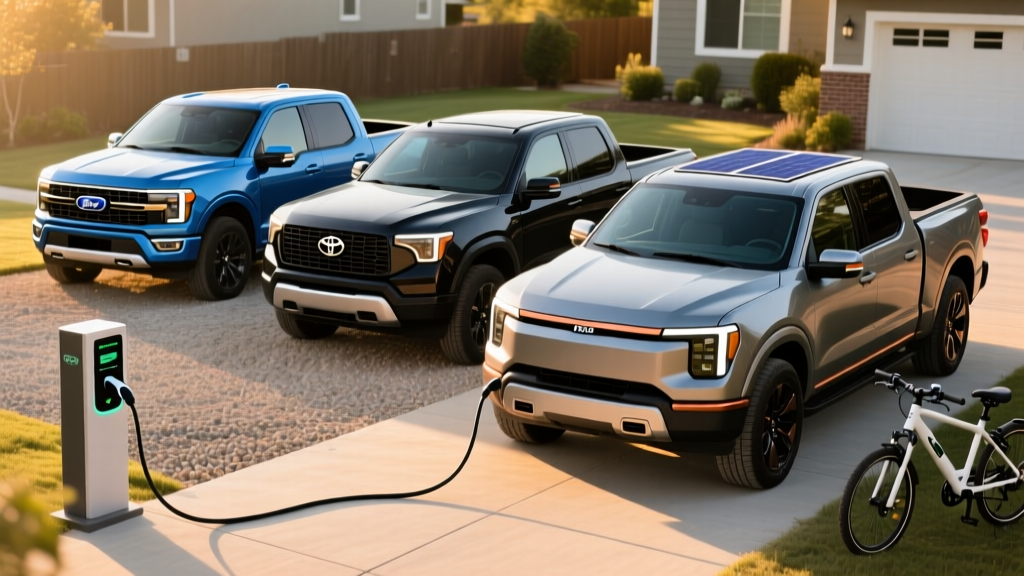
The truck hybrid market has matured significantly. Ford's PowerBoost hybrid F-150 has been on sale for years and continues to refine its formula, while Toyota's all-new Tundra i-FORCE MAX hybrid has proven itself as a serious competitor. There's also the plug-in hybrid (PHEV) question: should you consider one if it becomes available? Below, we break down every major truck hybrid on the market for the 2026 model year with exact EPA numbers, real-world expectations, towing specs, and ownership economics.
HEV vs PHEV: What Kind of Truck Hybrid Do You Actually Need?
Before diving into specific models, it's critical to understand the two types of hybridization available in pickups — because they serve very different use cases and have different infrastructure requirements.
Conventional Hybrid (HEV)
A standard hybrid truck like the F-150 PowerBoost or Tundra i-FORCE MAX uses a small battery (typically 1.5–2.5 kWh) that recharges through regenerative braking and the gas engine. You never plug it in. The electric motor assists the engine during acceleration and allows the engine to shut off at stops. Fuel savings come from reduced idling, smoother acceleration, and regenerative braking recapturing energy. Think of it as a more efficient gas truck — because that's exactly what it is.
Plug-In Hybrid (PHEV)
A plug-in hybrid truck carries a much larger battery (typically 12–20 kWh usable) that you charge from a wall outlet or Level 2 charger. This enables 20–40 miles of pure electric driving before the gas engine kicks in. PHEVs qualify for partial federal tax credits under IRS §30D rules, depending on battery sourcing and MSRP caps. As of early 2026, no mainstream full-size PHEV pickup is widely available in the US, though the segment is expected to grow.
Bottom line: Every truck hybrid you can buy today in the US is a conventional HEV — no plug required. That makes them ideal for buyers who want fuel savings without changing their fueling habits.
2026 Ford F-150 PowerBoost Hybrid: The Segment Benchmark
The F-150 PowerBoost remains the most proven truck hybrid on the road, now in its fifth model year with iterative refinements. It pairs Ford's 3.5L EcoBoost V6 with a 47-hp electric motor integrated into the 10-speed automatic transmission, fed by a 1.5 kWh lithium-ion battery pack.
| Spec | 2026 F-150 PowerBoost |
|---|---|
| Combined Horsepower | 430 hp / 570 lb-ft torque |
| Engine | 3.5L EcoBoost V6 + 47-hp electric motor |
| Battery | 1.5 kWh lithium-ion (not plug-in) |
| EPA MPG (City / Hwy / Combined) | 25 / 26 / 25 MPG (4WD) |
| Max Towing Capacity | 12,700 lbs (properly equipped) |
| Payload | Up to 2,120 lbs |
| 0–60 mph | ~5.8 seconds |
| Pro Power Onboard | Up to 7.2 kW (built-in generator) |
| Starting MSRP | ~$58,995 (XLT PowerBoost, est.) |
| Hybrid Battery Warranty | 8 years / 100,000 miles |
Real-World MPG vs EPA
The EPA rates the 4WD F-150 PowerBoost at 25 MPG combined. In real-world driving, owners consistently report 22–24 MPG on the highway at 70–75 mph, but 26–28 MPG in city and suburban driving where regenerative braking and engine-off coasting shine. Hybrid trucks, like all hybrids, are more efficient in stop-and-go conditions than on open interstates — the opposite of a diesel.
If your commute is urban or suburban with frequent stops, expect to beat the EPA city number. If you spend 90% of your time at highway speeds, expect to fall 1–3 MPG short of the combined rating. Towing drops economy significantly — expect 12–15 MPG under heavy trailer loads, which is still competitive with non-hybrid V8 trucks doing the same work.
The Pro Power Onboard Advantage
One feature that sets the PowerBoost apart for tradespeople: the available 7.2 kW Pro Power Onboard system turns the truck into a mobile generator. You can run power tools, lights, a welder, or even back up essential home circuits through the bed-mounted 240V outlet. This is unique to the hybrid powertrain because the high-voltage battery and electric motor can sustain high electrical output without the engine constantly revving. A conventional gas F-150 offers a 2.0 kW version, but the 7.2 kW system requires the PowerBoost.
2026 Toyota Tundra i-FORCE MAX: The Reliability Play
Toyota's Tundra i-FORCE MAX hybrid takes a different approach. Rather than a turbocharged V6, it uses a twin-turbo 3.4L V6 (i-FORCE MAX) with a 48-hp electric motor sandwiched between the engine and 10-speed automatic. The result is a powertrain tuned more for low-end torque than peak horsepower — ideal for towing and off-road crawling.
| Spec | 2026 Tundra i-FORCE MAX |
|---|---|
| Combined Horsepower | 437 hp / 583 lb-ft torque |
| Engine | 3.4L twin-turbo V6 + 48-hp electric motor |
| Battery | 1.87 kWh nickel-metal hydride (not plug-in) |
| EPA MPG (City / Hwy / Combined) | 20 / 24 / 22 MPG (4WD CrewMax) |
| Max Towing Capacity | 12,000 lbs (properly equipped) |
| Payload | Up to 1,940 lbs |
| 0–60 mph | ~5.7 seconds |
| Starting MSRP | ~$57,000 (Limited trim, est.) |
| Hybrid Battery Warranty | 10 years / 150,000 miles |
Why the Tundra Hybrid Gets Fewer MPG
At 22 MPG combined, the Tundra i-FORCE MAX trails the F-150 PowerBoost by about 3 MPG. This comes down to a few factors: the Tundra is heavier, its aerodynamics are less optimized, and Toyota's hybrid system prioritizes smooth torque delivery over aggressive engine shut-off. The NiMH battery pack is also smaller in usable capacity.
That said, the Tundra's real-world numbers tend to land very close to its EPA ratings. Owners report 20–23 MPG in mixed driving with less variance than the Ford. In city driving, expect 20–22 MPG; on the highway, 23–25 MPG. The gap between city and highway is narrower because Toyota's hybrid tuning doesn't shut the engine off as aggressively at low speeds.
Toyota's Hybrid Battery Warranty Advantage
Toyota's hybrid battery warranty is the strongest in the truck segment. At 10 years / 150,000 miles, it exceeds Ford's 8-year / 100,000-mile coverage by a significant margin. Toyota also has the deepest track record in hybrid battery longevity — the Prius battery architecture has been refined over 25+ years, and the Tundra's system shares DNA with that lineage. Replacement cost, should you ever need it out of warranty, is estimated at $3,500–$5,000 for the Tundra's NiMH pack — substantially less than a full EV battery replacement.
Truck Hybrid MPG Comparison: Side by Side
Here's how the two main truck hybrid contenders stack up against each other and against their non-hybrid siblings. Data sourced from fueleconomy.gov.
| Model | City MPG | Highway MPG | Combined MPG | Powertrain |
|---|---|---|---|---|
| F-150 PowerBoost Hybrid 4WD | 25 | 26 | 25 | 3.5L V6 Turbo + Electric Motor |
| F-150 3.5L EcoBoost (non-hybrid) 4WD | 18 | 23 | 20 | 3.5L V6 Turbo |
| Tundra i-FORCE MAX Hybrid 4WD | 20 | 24 | 22 | 3.4L V6 Twin-Turbo + Electric Motor |
| Tundra i-FORCE (non-hybrid) 4WD | 17 | 22 | 19 | 3.4L V6 Twin-Turbo |
| Silverado 1500 5.3L V8 4WD (baseline) | 15 | 20 | 17 | 5.3L V8 |
The hybrid premium pays off at the pump. The F-150 PowerBoost delivers 25% better combined fuel economy than its non-hybrid EcoBoost sibling and roughly 47% better than a traditional V8 Silverado. Over 15,000 miles per year at $3.40/gallon, that's roughly $700–$900 in annual fuel savings versus a non-hybrid V6 and $1,200+ versus a V8.
Pricing, Trims, and Tax Credit Reality for Truck Hybrids
Here's where many buyers get confused. Let's be precise about what credits apply — and what don't.
Federal §30D Clean Vehicle Credit — Does a truck hybrid qualify?
- Conventional HEVs (F-150 PowerBoost, Tundra i-FORCE MAX): NO. The §30D credit applies only to plug-in electric vehicles (BEVs and PHEVs) with a minimum battery capacity of 7 kWh. Standard hybrids with 1.5–2 kWh packs do not qualify.
- Future PHEV trucks: Possibly. If a plug-in hybrid truck launches with ≥7 kWh battery capacity and meets IRS critical mineral and battery component sourcing requirements, it could qualify for up to $7,500 — subject to MSRP caps ($80,000 for trucks/vans/SUVs) and buyer income limits ($300K joint / $150K single).
- Used hybrid credit (§25E): You may qualify for up to $4,000 (30% of sale price, capped) on a used hybrid truck if the vehicle is at least 2 model years old, purchased from a dealer, and you meet income limits. This is one way to get a federal incentive on a hybrid.
State incentives vary widely. Some states offer rebates for hybrids, but most incentive programs have shifted toward full EVs and PHEVs. Check your state's energy office or AFDC state law database for current programs in your jurisdiction.
Reliability and Battery Longevity: What Truck Hybrid Owners Should Know
Hybrid battery anxiety is understandable but largely misplaced for modern truck hybrids. Here's the data:
Ford PowerBoost: Now in its fifth model year, the PowerBoost system has accumulated millions of real-world miles across the F-150 fleet. The 1.5 kWh lithium-ion pack is small and lightly stressed — it never fully depletes or fully charges, which preserves longevity. Ford's hybrid battery warranty covers 8 years / 100,000 miles against defects and excessive capacity loss. Out-of-warranty replacement cost is estimated at $4,000–$6,000 based on current parts pricing.
Toyota i-FORCE MAX: Toyota's hybrid expertise is unmatched in the industry. The Tundra's NiMH battery is proven chemistry with excellent thermal stability and a long cycle life. Toyota's 10-year / 150,000-mile warranty provides the longest hybrid battery coverage in the segment. NiMH replacement costs are typically lower than lithium-ion — estimated at $3,500–$5,000 out of warranty.
Key insight: Hybrid truck batteries are far smaller and less expensive to replace than full EV batteries. A 1.5–2 kWh hybrid pack costs $3,500–$6,000 to replace; a 100+ kWh EV pack can run $12,000–$20,000+. The hybrid battery is also under far less stress because it operates in a narrow state-of-charge window (typically 40–60%), which dramatically slows degradation. Most hybrid batteries outlast the vehicle itself.
Who Should Buy a Truck Hybrid — and Who Shouldn't?
Choose a truck hybrid (HEV) if:
- You drive 12,000+ miles per year and want meaningful fuel savings without changing your fueling routine
- Your driving includes significant city, suburban, or stop-and-go conditions where hybrid efficiency peaks
- You need a truck for work (towing, job-site power) but also use it as a daily driver
- You want Pro Power Onboard (F-150) for running tools and equipment on-site
- You're not ready for EV charging logistics or live in an area with sparse DC fast-charging infrastructure
- You plan to keep the truck 8+ years (the hybrid premium pays back in fuel savings over time)
Choose a conventional gas truck if:
- You drive under 8,000 miles per year (the hybrid premium won't pay back in fuel savings)
- You primarily drive highway miles at constant speed (minimal hybrid benefit)
- Every dollar of upfront cost matters and you can't absorb the ~$3,000–$5,000 hybrid powertrain premium
Choose a full EV truck (F-150 Lightning, Silverado EV, R1T) if:
- You have reliable home Level 2 charging and your daily driving is under 250 miles
- You want maximum fuel-cost savings (electricity is roughly equivalent to 80–100 MPG in cost per mile)
- You qualify for the full $7,500 federal tax credit, which offsets the higher purchase price
- You want instant torque, a front trunk (frunk), and near-zero drivetrain maintenance
Pros and Cons of Owning a Truck Hybrid
Pros
- 20–25 MPG combined — 25–47% better than non-hybrid equivalents
- No plug-in required; fuel at any gas station
- Instant electric torque improves acceleration and towing feel
- Pro Power Onboard (F-150) provides up to 7.2 kW mobile power
- Hybrid battery warranties cover 8–10 years / 100K–150K miles
- Lower brake wear thanks to regenerative braking
- Proven reliability with millions of fleet miles accumulated
Cons
- $3,000–$5,000 powertrain premium over non-hybrid models
- No federal §30D tax credit for conventional HEVs
- Highway MPG advantage is modest (hybrid benefit is city-dominant)
- Slightly reduced payload vs. lightest non-hybrid configurations
- Fewer trim/powertrain combinations available (hybrid not offered on base trims)
- Battery replacement cost ($3,500–$6,000) if needed out of warranty
Frequently Asked Questions
How many MPG does a truck hybrid get?
The 2026 Ford F-150 PowerBoost 4WD is EPA-rated at 25 city / 26 highway / 25 combined MPG. The Toyota Tundra i-FORCE MAX 4WD is rated at 20 city / 24 highway / 22 combined. In real-world driving, the F-150 hybrid typically achieves 26–28 MPG in city conditions and 22–24 MPG on the highway. Both trucks significantly outperform their non-hybrid counterparts.
Do truck hybrids need to be plugged in?
No. Every truck hybrid currently sold in the US (F-150 PowerBoost, Tundra i-FORCE MAX) is a conventional hybrid (HEV). The battery recharges through regenerative braking and the gas engine. You fuel it exactly like a normal truck — at a gas station. No plug, no charger, no change in routine.
Is a truck hybrid reliable? What about battery replacement cost?
Modern truck hybrids are highly reliable. Toyota has 25+ years of hybrid battery data, and Ford's PowerBoost has proven itself over five model years with millions of fleet miles. Hybrid batteries are warrantied for 8–10 years / 100,000–150,000 miles. If replacement is ever needed out of warranty, expect $3,500–$6,000 — far less than an EV battery. The battery operates in a narrow charge window (40–60%), which greatly extends its lifespan.
Does a truck hybrid qualify for a federal tax credit?
Conventional hybrids (HEVs) like the F-150 PowerBoost and Tundra i-FORCE MAX do not qualify for the federal §30D Clean Vehicle Credit, which requires a plug-in vehicle with ≥7 kWh battery. However, you may qualify for the §25E used vehicle credit (up to $4,000) if purchasing a qualifying used hybrid from a dealer. State-level incentives vary — check your local programs.
Hybrid vs PHEV vs EV truck — which is right for me?
A conventional hybrid (HEV) is right if you want fuel savings with zero infrastructure changes — just drive and fuel normally. A plug-in hybrid (PHEV) would be ideal if you can charge at home and want 20–40 miles of electric commuting with gas-engine backup, but no PHEV full-size truck is widely available yet. A full EV (F-150 Lightning, Silverado EV) makes sense if you have home charging, drive under 250 miles daily, and want maximum operating cost savings plus the $7,500 federal credit. For most truck buyers today, the conventional HEV offers the best balance of savings, capability, and convenience.
Can a hybrid truck tow as much as a regular truck?
Yes — and sometimes more. The F-150 PowerBoost is rated for up to 12,700 lbs of towing, which is competitive with or exceeds many non-hybrid F-150 configurations. The electric motor's instant torque actually improves low-speed trailer maneuvering. However, towing drops fuel economy to roughly 12–15 MPG, which is typical for any truck under load.
How long do hybrid truck batteries last?
Based on Toyota's and Ford's track records, hybrid truck batteries routinely last 150,000–200,000+ miles before significant degradation. The batteries are small (1.5–2 kWh) and operate in a narrow state-of-charge window, which minimizes wear. Both manufacturers warranty the hybrid battery for at least 8 years / 100,000 miles, and Toyota extends that to 10 years / 150,000 miles.