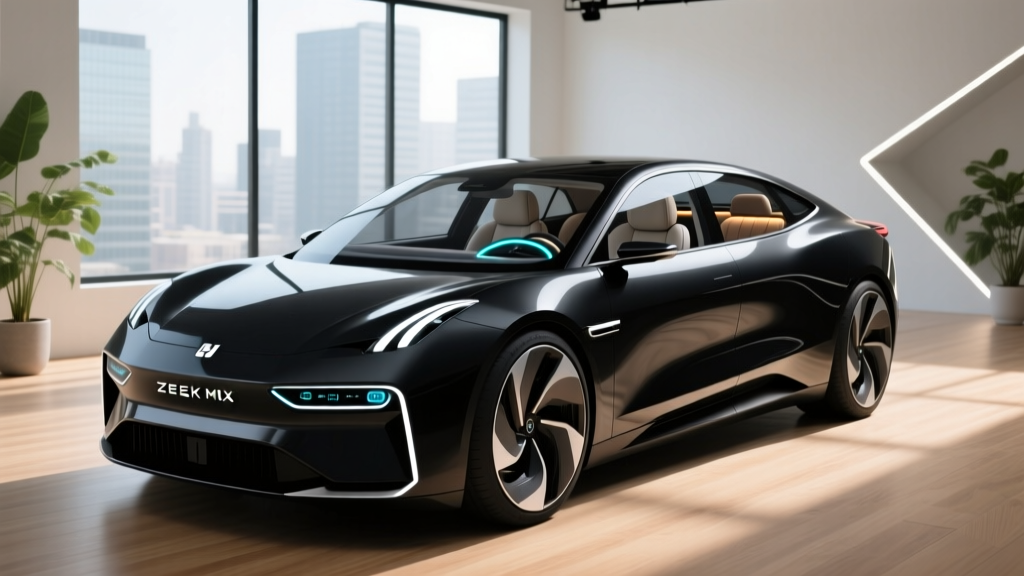
The Zeekr Mix has been turning heads at auto shows and on Chinese streets since its 2024 debut — a boxy, sliding-door electric vehicle that looks more like a rolling lounge than a conventional crossover. Naturally, US-based EV shoppers are searching for the Zeekr Mix USA availability timeline, eager to know if this radical people-mover will ever reach American showrooms. As of early 2026, the short answer is: not yet, and a US launch remains uncertain. But the Mix's specs, platform, and Geely's expanding global footprint make it worth a deep dive for anyone considering a premium electric family hauler.
Below, we break down everything confirmed about the Zeekr Mix — range, battery, charging, interior, pricing in China, and the geopolitical and regulatory hurdles standing between this EV and US buyers. We also compare it against vehicles you can buy stateside today.
Zeekr Mix USA Status: Where Things Stand in 2026
Zeekr is a premium EV brand under Zhejiang Geely Holding Group, the same parent company behind Volvo, Polestar, and Lotus. The Mix launched in China in late 2024 on Geely's Sustainable Experience Architecture (SEA) platform — the same skateboard underpinning the Polestar 4, Zeekr 001, and Smart #1. Despite Geely's established connections to the US market through Volvo and Polestar, Zeekr has not announced an official US launch date for the Mix or any other model.
Several factors complicate a potential Zeekr Mix USA debut:
- Tariffs: As of 2026, Chinese-manufactured EVs face a 100% tariff under Section 301, effectively doubling the import price and making direct Chinese exports economically unviable for the US market.
- FMVSS compliance: Any vehicle sold in the US must meet Federal Motor Vehicle Safety Standards, which differ significantly from Chinese GB standards — particularly regarding crash structures, lighting, and the Mix's unconventional pillarless sliding-door design.
- Dealer and service infrastructure: Zeekr has no US dealer network, parts distribution, or certified service centers.
- Geely's existing US strategy: Geely has historically funneled its US ambitions through Polestar and Volvo rather than launching the Zeekr brand stateside.
That said, Geely is building manufacturing capacity in Europe and Southeast Asia. If a localized production plan materializes — or if trade policy shifts — a Zeekr Mix USA launch could become feasible in the 2027–2028 timeframe. Until then, the Mix remains a China-market and select-export vehicle.
Zeekr Mix Specs: Battery, Range, and Efficiency
For the Mix as sold in China (2025 model year), Zeekr offers two battery configurations on the SEA platform:
| Specification | Standard Range | Long Range |
|---|---|---|
| Battery Capacity (usable) | 76 kWh | 102 kWh |
| Battery Chemistry | NMC (Nickel Manganese Cobalt) | NMC (CATL Qilin cell) |
| CLTC Range | ~342 miles (550 km) | ~435 miles (700 km) |
| Estimated EPA Range* | ~270–285 miles | ~340–360 miles |
| Motor Configuration | Rear-Wheel Drive (single motor) | Rear-Wheel Drive (single motor) |
| Horsepower | 310 kW / 416 hp | 310 kW / 416 hp |
| 0–60 mph (est.) | ~6.5 seconds | ~6.8 seconds |
| Efficiency (est.) | ~28 kWh/100 mi | ~29 kWh/100 mi |
*EPA range estimates are projected based on typical CLTC-to-EPA conversion ratios (~20–22% reduction) and the Mix's aerodynamic profile. Official EPA figures will only exist if the vehicle is certified for US sale.
Based on the Mix's boxy shape (estimated Cd ~0.27) and weight (~5,100 lbs for the long-range variant), expect real-world highway range to fall 15–20% below the CLTC sticker — roughly 290–310 miles for the 102 kWh variant at 70 mph in mild weather. In cold-weather conditions (below 32°F), NMC chemistry without a heat pump could see a further 20–30% reduction, dropping effective range to approximately 210–240 miles. Zeekr has confirmed a heat pump is standard, which mitigates cold-weather loss to the lower end of that range.
Charging Speed: DC Fast and Home Level 2
The Zeekr Mix supports DC fast charging at up to ~220 kW peak on the long-range (102 kWh) variant, thanks to CATL's Qilin battery's high C-rate capability. The standard-range model peaks at approximately 180 kW.
| Charging Level | Power / Rate | Time / Recovery |
|---|---|---|
| DC Fast Charge (peak) | 220 kW (Long Range) / 180 kW (Standard) | 10–80% in ~22 min (LR) / ~25 min (SR) |
| DC Fast Charge (sustained avg.) | ~140–160 kW average to 80% | Charge curve tapers significantly above 80% |
| Level 2 (AC, 240V) | 11 kW onboard charger | ~9–10 hours (0–100%, 102 kWh battery) |
| Level 2 Miles per Hour | ~35–38 miles of range per hour | Based on ~3.2 mi/kWh efficiency |
| Level 1 (120V, 12A) | ~1.4 kW | ~4–5 miles of range per hour |
The 220 kW peak is competitive with vehicles like the Hyundai Ioniq 5 (240 kW peak) and Kia EV9 (236 kW peak), though the Mix's large battery means absolute charge times are slightly longer. The 11 kW Level 2 onboard charger is generous — it means a standard 48-amp home wall connector will replenish the battery overnight with margin to spare.
Interior, Cargo, and the "Living Room on Wheels" Concept
The Mix's defining feature is its interior flexibility. Zeekr designed it around a pillarless body with dual electric sliding doors (one on each side), creating a massive, unobstructed opening. Key dimensions:
- Wheelbase: 118.5 inches (3,010 mm)
- Overall length: 192.7 inches (4,895 mm)
- Interior length (cargo area): ~76 inches with front seats folded
- Seating: 5-passenger standard; optional 6-seat layout with rotating front chairs
- Cargo volume: ~25 cu ft behind rear seats; ~68 cu ft with rear seats folded (estimated, pending SAE measurement)
- Rear legroom: ~41 inches (generous for the class)
The flat floor (enabled by the SEA platform's thin battery pack) and available rotating front seats allow configurations like a face-to-face lounge mode, a camping-bed mode, and a mobile-office mode with a deployable table. This is the Mix's strongest differentiator — no US-market EV currently offers this level of interior modularity.
The infotainment system runs on a 15.6-inch central touchscreen powered by a Qualcomm Snapdragon 8295 chip, with Zeekr's custom OS, wireless Apple CarPlay/Android Auto (China-spec; US spec would likely add native integration), and a 29-inch AR head-up display. Driver-assistance features include adaptive cruise, lane-centering, automatic parking, and highway assist — all SAE Level 2 (driver must remain engaged and hands-on or eyes-on at all times).
Pricing, Tax Credits, and the Tariff Problem
In China, the Zeekr Mix launched with the following pricing (converted to USD at early-2026 exchange rates):
| Trim | China MSRP (RMB) | China MSRP (USD equiv.) | Est. US MSRP (if imported)* |
|---|---|---|---|
| Standard Range (76 kWh) | ¥269,900 | ~$37,200 | ~$52,000–$55,000 |
| Long Range (102 kWh) | ¥299,900 | ~$41,300 | ~$58,000–$62,000 |
| Long Range Max (102 kWh, fully loaded) | ¥329,900 | ~$45,500 | ~$64,000–$68,000 |
*Estimated US MSRP accounts for shipping, homologation, dealer markup, and standard market positioning — but does NOT include the 100% Section 301 tariff on Chinese-manufactured EVs. With the tariff, prices would effectively double, making the Mix economically non-viable as a direct import.
Federal Tax Credit Eligibility (§30D)
If the Zeekr Mix were sold in the US, its eligibility for the IRS §30D Clean Vehicle Credit would face significant hurdles:
- MSRP cap: The Mix would likely fall under the $55,000 (sedan/wagon) or $80,000 (SUV/truck/van) cap depending on how NHTSA classifies it — likely the $80,000 cap given its minivan-like form factor.
- Buyer income cap: AGI must not exceed $150,000 (single), $225,000 (head of household), or $300,000 (joint filers).
- Battery sourcing: At least 60% of critical minerals and 75% of battery components must be sourced from the US or FTA partners (2026 thresholds). CATL's Chinese supply chain would almost certainly disqualify the Mix from the full $7,500 credit.
- FEOC restriction: Vehicles with battery components from a Foreign Entity of Concern (which includes many Chinese battery firms) are ineligible for any credit beginning in 2024 (components) and 2025 (critical minerals).
- Final assembly: Must occur in North America. A China-built Mix fails this requirement outright.
Bottom line: Even if Zeekr sold the Mix in the US, it would almost certainly not qualify for the federal EV tax credit under current §30D rules due to Chinese battery sourcing and final assembly.
Zeekr Mix vs. US-Market Alternatives
Since the Mix isn't available stateside, here's how its specs compare against electric vehicles you can actually buy in the US that serve similar family-hauler or modular-interior roles:
| Spec | Zeekr Mix (LR, China) | Kia EV9 (LR AWD) | Volkswagen ID. Buzz (LR) | Chrysler Pacifica PHEV |
|---|---|---|---|---|
| EPA Range | ~340–360 mi (est.) | 283 mi | 234 mi | 32 mi electric + 520 mi gas |
| Battery (usable) | 102 kWh NMC | 99.8 kWh NMC | 86 kWh NMC | 16 kWh NMC |
| DC Fast Charge (peak) | 220 kW | 236 kW | 200 kW | N/A (Level 2 only) |
| 10–80% Time | ~22 min | ~20 min | ~26 min | ~2 hrs (Level 2) |
| 0–60 mph | ~6.8 sec | 5.0 sec (AWD) | 7.9 sec | 7.5 sec |
| Seating | 5–6 passengers | 6–7 passengers | 7 passengers | 7 passengers |
| Starting MSRP | Not sold in US | $59,900 | $59,995 | $51,095 |
| Federal Tax Credit | Not eligible | $7,500 (select trims) | $7,500 | $7,500 |
| Sliding Doors | Yes (both sides) | No | No | Yes (power) |
The Mix's combination of sliding doors, flat-floor modularity, and projected 340+ mile range is unmatched among current US-market EVs. The VW ID. Buzz comes closest in spirit but falls short on range and charging speed. The Kia EV9 offers three-row capacity and strong charging but lacks the Mix's lounge-like interior flexibility.
Pros, Cons, and Who the Zeekr Mix Would Suit
- Class-leading interior modularity with pillarless sliding doors
- Projected 340+ mile EPA-equivalent range (102 kWh variant)
- 220 kW DC fast charging with competitive 10–80% times
- Flat-floor SEA platform enables flexible seating/bed/office configurations
- Generous 11 kW Level 2 onboard charger
- Premium infotainment with Snapdragon 8295 and AR HUD
- Not available in the US — no announced launch timeline
- Would not qualify for §30D tax credit due to Chinese sourcing
- 100% tariff makes direct import economically unfeasible
- No US service/parts infrastructure
- AWD option not offered (RWD only as of 2025)
- FMVSS crash-test compliance unproven for pillarless design
- Families wanting minivan practicality with EV powertrains: The Mix's sliding doors, flat floor, and lounge modes directly target parents tired of SUV cargo compromises — if it ever reaches the US.
- Vanlife and camping enthusiasts: The bed-mode configuration and large interior volume make it an EV camper candidate.
- Urban commuters with home charging: 285+ miles of real-world range handles most commutes easily with overnight Level 2 charging.
- NOT ideal for: Towing (no tow rating published), rural buyers in charging deserts, or anyone needing AWD for snow/ice (currently RWD only).
Zeekr Mix Warranty and Long-Term Ownership
In China, Zeekr provides the following coverage (US equivalents would likely differ if the brand launched stateside):
- Battery warranty: 8 years / 160,000 km (~100,000 miles) with a minimum 70% capacity retention threshold — consistent with industry norms.
- Vehicle warranty: 6 years / 150,000 km (~93,000 miles).
- Powertrain: Covered under the battery warranty period.
If Zeekr entered the US market, it would need to match or exceed the standard 8-year/100,000-mile battery warranty that competitors like Hyundai, Kia, and Tesla offer. Given Geely's backing and the SEA platform's proven track record (Polestar, Volvo), long-term battery degradation should be comparable to other NMC-based EVs — expect ~8–12% capacity loss over 5 years / 75,000 miles based on fleet data from similar Geely/CATL packs.
Frequently Asked Questions
Will the Zeekr Mix be sold in the USA?
As of early 2026, Zeekr has not announced plans to sell the Mix in the United States. The 100% tariff on Chinese EVs, FMVSS compliance requirements, and lack of a US dealer network are significant barriers. A US launch is possible in the 2027–2028 window if Geely localizes production or trade policy changes, but nothing is confirmed.
What is the real-world range of the Zeekr Mix?
The long-range (102 kWh) variant carries a CLTC rating of ~435 miles. Converting to EPA-equivalent testing, expect approximately 340–360 miles. In real-world highway driving at 70 mph, plan for 290–310 miles. In freezing temperatures, that drops to approximately 210–240 miles despite the standard heat pump.
How fast does the Zeekr Mix charge?
The long-range Mix peaks at 220 kW DC fast charging, reaching 10–80% State of Charge in approximately 22 minutes under ideal conditions. On a Level 2 home charger (240V, 48A), the 11 kW onboard charger delivers roughly 35–38 miles of range per hour, fully replenishing the 102 kWh battery in about 9–10 hours.
Does the Zeekr Mix qualify for the $7,500 federal EV tax credit?
No. Even if sold in the US, the Mix would fail multiple §30D requirements: it is not assembled in North America, its CATL battery uses Chinese-sourced critical minerals and components (triggering the FEOC exclusion), and it would not meet the 2026 battery-sourcing thresholds. See the IRS Clean Vehicle Credit page for current eligibility rules.
How much would the Zeekr Mix cost in the US?
Based on its China pricing and estimated localization costs, a US-spec Mix would likely start around $52,000–$55,000 for the standard-range and $58,000–$62,000 for the long-range — before any tariff impact. With the current 100% Section 301 tariff on Chinese EVs, those figures would roughly double, making import unfeasible without localized manufacturing.
Is the Zeekr Mix worth waiting for vs. buying a Kia EV9 or VW ID. Buzz now?
If you need a vehicle in 2026, waiting is not practical — there is no US launch timeline, no guarantee of eligibility for tax credits, and no service infrastructure. The Kia EV9 is the better buy for three-row families who want strong range, fast charging, and $7,500 tax-credit eligibility now. The VW ID. Buzz suits buyers who prioritize retro styling and minivan practicality over range. The Chrysler Pacifica PHEV remains the pragmatic choice for families who need sliding doors, road-trip flexibility, and don't have reliable home charging.
Sources: Zeekr official specifications (zeekrlife.com), Geely Holding Group press releases, IRS §30D Clean Vehicle Credit guidelines, EPA fueleconomy.gov for US-market competitor data.