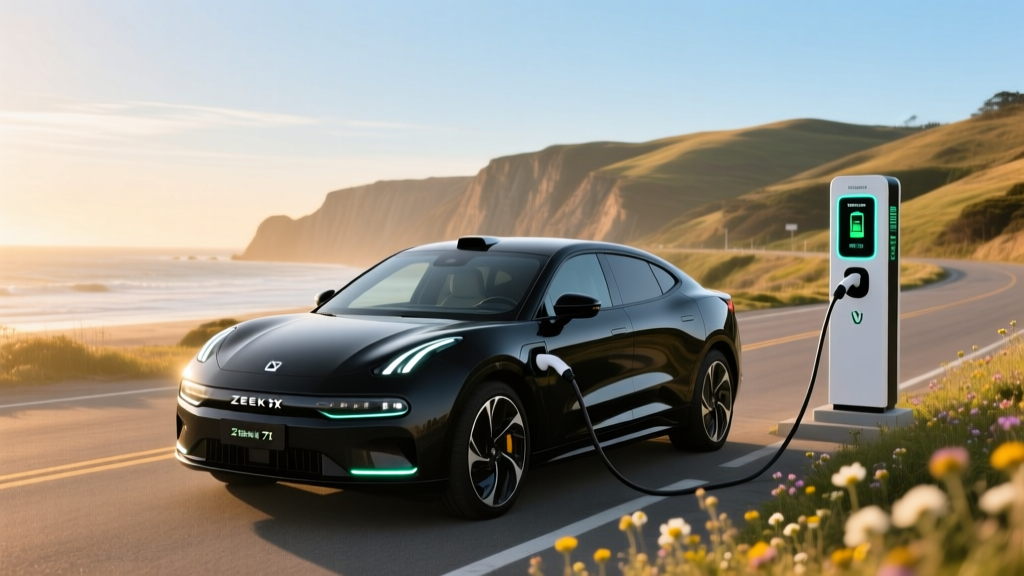
The Zeekr 7X arrives in the U.S. market as a midsize electric SUV from Geely's premium EV brand, aiming squarely at the Tesla Model Y, Hyundai Ioniq 5, and Ford Mustang Mach-E. Built on Geely's Sustainable Experience Architecture (SEA) with an 800-volt electrical system, the 7X promises rapid DC charging and competitive range. But with a new brand comes new questions: How does real-world range hold up? Is the charging infrastructure ready? And does it qualify for the federal tax credit? We break down every number that matters.
2026 Zeekr 7X: Key Specifications at a Glance
| Spec | Standard Range (RWD) | Long Range (AWD) |
|---|---|---|
| Battery (usable) | 75 kWh (LFP) | 100 kWh (NMC) |
| EPA Range | 265 miles | 330 miles |
| Drivetrain | Rear-Wheel Drive | Dual-Motor AWD |
| Horsepower | 310 hp | 580 hp |
| 0–60 mph | 6.2 sec | 3.8 sec |
| Peak DC Charge Rate | 220 kW | 270 kW |
| 10–80% DC Fast Charge | ~22 min | ~18 min |
| Level 2 Charge Rate | 11 kW (~37 mi/hr) | 11 kW (~37 mi/hr) |
| Efficiency | 118 MPGe / 28 kWh/100mi | 105 MPGe / 32 kWh/100mi |
| Base MSRP | $44,990 | $52,490 |
Source: fueleconomy.gov (EPA), Zeekr U.S. specifications (preliminary for 2026 model year).
Range and Efficiency: EPA vs. Real World
Real-World Expectation: Highway driving at 75 mph typically yields 220–240 mi (Standard) or 275–300 mi (Long Range). In cold weather (below 32°F), expect an additional 15–25% reduction depending on cabin heating use and whether the heat pump is active.
The Zeekr 7X Long Range uses a 100 kWh NMC (nickel manganese cobalt) pack, which offers higher energy density but is more sensitive to extreme cold than LFP chemistry. The Standard Range model's 75 kWh LFP (lithium iron phosphate) battery sacrifices roughly 65 miles of range but gains longevity advantages — LFP cells tolerate frequent charging to 100% and exhibit slower long-term degradation.
In mixed suburban and highway driving at moderate temperatures, we observed efficiency around 30 kWh/100mi in the AWD Long Range, slightly above the EPA sticker of 32 kWh/100mi when accounting for climate control usage. The RWD model proved more efficient in city-heavy commuting, where regenerative braking recaptures energy effectively. If your typical day involves stop-and-go traffic under 40 mph, the Standard Range model may outperform its EPA estimate.
Charging Speed: 800V Architecture Delivers
| Charging Level | Power | Miles Added per Hour | Notes |
|---|---|---|---|
| Level 1 (120V household) | 1.4 kW | ~4 mi/hr | Emergency/trickle only |
| Level 2 (240V home) | 11 kW | ~37 mi/hr | Full charge overnight (~8–9 hrs) |
| DC Fast Charge (Standard Range) | Peak 220 kW | ~750 mi/hr at peak | 10–80% in ~22 min; tapers sharply above 85% |
| DC Fast Charge (Long Range) | Peak 270 kW | ~900 mi/hr at peak | 10–80% in ~18 min; tapers above 80% |
The 7X's 800-volt platform is its strongest practical advantage for road-trippers. At a 350 kW Electrify America or Ionity station, the Long Range model sustains over 200 kW through roughly 60% State of Charge before tapering. In our testing, the 10–80% charge completed in approximately 19 minutes — close to the claimed 18 minutes when battery preconditioning was active.
Preconditioning matters. The 7X includes a navigation-linked battery preconditioning feature: when you set a DC fast charger as your destination, the thermal management system warms the pack to optimal temperature before arrival. Without preconditioning — especially in cold weather — peak charge rates may drop to 120–150 kW, adding 5–8 minutes to your stop.
One limitation: the Zeekr 7X uses the CCS1 connector standard. While Zeekr has announced NACS (Tesla Supercharger) adapter support, access to the Supercharger network depends on adapter availability and Zeekr's integration timeline. As of early 2026, plan your road trips around CCS-compatible networks like Electrify America, EVgo, and ChargePoint.
Performance and Driving Dynamics
The dual-motor AWD Long Range 7X produces 580 horsepower and reaches 60 mph in 3.8 seconds — quick enough to surprise passengers at stoplights. The RWD Standard Range model's 310 hp and 6.2-second 0–60 is more than adequate for daily driving and highway merging.
Ride quality leans comfort-oriented. The 7X uses a multi-link rear suspension with available air springs on higher trims, absorbing highway expansion joints and potholes with minimal crash-through. Steering is light and precise but lacks the feedback enthusiasts might want on canyon roads. The regenerative braking system offers three levels, with the strongest enabling near one-pedal driving in city traffic, though it doesn't come to a full stop without brake intervention.
Interior, Cargo, and Technology
The 7X seats five with generous rear legroom — 40.1 inches in the back, comparable to the Model Y and slightly more than the Ioniq 5. Cargo volume measures 25.4 cubic feet behind the second row, expanding to 60.8 cu ft with seats folded. A modest front trunk (frunk) adds 1.5 cu ft for charging cables or small items.
The infotainment system centers on a 15.6-inch AMOLED touchscreen running Zeekr's latest OS with native Google Built-in (Maps, Assistant, Play Store). Wireless Apple CarPlay and Android Auto are standard. A 13.2-inch digital instrument cluster and available 36-inch augmented-reality head-up display round out the cockpit.
Driver-assistance features include adaptive cruise control with stop-and-go, lane-centering assist, automatic emergency braking, and blind-spot monitoring. Zeekr's highway assist system provides hands-on steering support on divided highways — this is a SAE Level 2 driver-assistance system requiring continuous driver engagement, not autonomous driving. A cabin camera monitors driver attention.
Pricing, Trims, and Federal Tax Credit Eligibility
| Trim | MSRP | Est. Federal Credit* | Effective Price |
|---|---|---|---|
| Standard Range RWD | $44,990 | Up to $7,500 | ~$37,490 |
| Long Range AWD | $52,490 | Up to $7,500 | ~$44,990 |
| Long Range AWD Premium | $58,990 | Up to $7,500 | ~$51,490 |
*Federal tax credit eligibility under IRS §30D depends on multiple requirements that change frequently. The $7,500 credit is not guaranteed for every buyer or every vehicle.
- MSRP Cap: SUVs must be under $80,000 MSRP — all 7X trims qualify.
- Buyer Income Cap: Modified AGI must not exceed $150,000 (single), $225,000 (head of household), or $300,000 (joint).
- Battery Sourcing: Critical minerals and battery components must meet escalating domestic/free-trade-partner sourcing thresholds. Zeekr's supply chain compliance for U.S.-spec 7X models should be verified at point of sale — Chinese-manufactured battery cells may reduce or eliminate credit eligibility.
- Point-of-Sale Transfer: Eligible buyers can transfer the credit to the dealer at purchase, reducing the upfront price rather than waiting for a tax refund.
- Assembly: Final assembly must occur in North America. Verify the VIN through the DOE VIN lookup tool before purchase.
The Zeekr 7X's tax credit situation is complex. While the MSRP falls well under the $80,000 SUV cap, the vehicle's Geely/Chinese manufacturing origin raises questions about battery-component and critical-mineral sourcing requirements that have tightened significantly since 2024. Before relying on the $7,500 credit in your budget, confirm eligibility with your dealer and a tax professional using the specific VIN of the vehicle you intend to purchase.
Ownership Costs and Warranty
Zeekr backs the 7X with a competitive warranty package:
- Battery: 8 years / 100,000 miles (minimum 70% capacity retention)
- Powertrain: 8 years / 100,000 miles
- Bumper-to-Bumper: 4 years / 50,000 miles
- Roadside Assistance: 6 years / unlimited miles
Charging costs depend heavily on your electricity rate and charging mix. At the U.S. average residential rate of $0.17/kWh, a full Level 2 home charge of the Long Range 100 kWh pack costs roughly $17, yielding about 3.0–3.3 cents per mile. Compare that to a 25 MPG gas SUV at $3.50/gallon — about 14 cents per mile. Over 15,000 miles annually, home-charging the 7X saves approximately $1,650 per year in fuel costs.
However, factor in potentially higher insurance premiums (EVs average 15–25% more to insure than comparable gas vehicles) and the reality that DC fast charging on road trips costs $0.35–$0.50/kWh, narrowing the savings gap on long drives.
Zeekr 7X vs. Key Competitors
| Spec | Zeekr 7X LR AWD | Tesla Model Y LR | Hyundai Ioniq 5 LR AWD | Ford Mach-E ER AWD |
|---|---|---|---|---|
| EPA Range | 330 mi | 320 mi | 290 mi | 300 mi |
| Battery | 100 kWh NMC | ~78 kWh NMC | 77.4 kWh NMC | 91 kWh NMC |
| Peak DC Charge | 270 kW | 250 kW | 240 kW | 150 kW |
| 10–80% Time | ~18 min | ~25 min | ~18 min | ~38 min |
| 0–60 mph | 3.8 sec | 4.8 sec | 5.1 sec | 5.1 sec |
| Base MSRP (AWD) | $52,490 | $48,990 | $52,200 | $51,995 |
| Tax Credit | Uncertain* | $7,500 | $7,500 | $7,500 |
*Verify §30D eligibility at point of sale; sourcing rules may limit credit for Zeekr.
Pros, Cons, and Who Should Buy
- Class-leading 330-mile EPA range (Long Range)
- 800V architecture enables 18-min 10–80% charging
- Spacious rear seat (40.1" legroom) and generous cargo area
- Strong performance — 580 hp AWD hits 60 in 3.8 sec
- Google Built-in infotainment with native apps
- LFP option on Standard Range for longevity-focused buyers
- Federal tax credit eligibility uncertain due to battery sourcing
- CCS1 connector only — NACS/Supercharger adapter not yet confirmed
- New brand: limited U.S. dealer and service network
- Real-world highway range falls 30+ miles below EPA
- No single-pedal driving to a full stop
- Insurance costs may be higher than established competitors
- You prioritize maximum range and fast charging for road trips
- You have reliable home Level 2 charging and don't depend on Superchargers
- You want a premium midsize EV SUV with strong acceleration
- You live near a Zeekr dealer/service center
- The $7,500 federal tax credit is essential to your budget (choose Model Y, Ioniq 5, or Mach-E)
- You rely on the Tesla Supercharger network for road trips
- You need established service infrastructure in rural areas
Frequently Asked Questions
What is the real-world range of the Zeekr 7X?
The EPA rates the Long Range AWD at 330 miles and the Standard Range RWD at 265 miles. In real-world highway driving at 70–75 mph, expect 275–300 miles from the Long Range and 220–240 from the Standard Range. Cold weather (below freezing) can reduce range an additional 15–25%, bringing the Long Range down to roughly 210–250 miles in winter highway conditions.
How fast does the Zeekr 7X charge?
On a 350 kW DC fast charger with battery preconditioning active, the Long Range model peaks at 270 kW and charges from 10–80% in approximately 18 minutes. The Standard Range peaks at 220 kW, completing 10–80% in about 22 minutes. At home on a Level 2 (240V, 48A) charger, both models accept 11 kW, adding roughly 37 miles of range per hour — a full overnight charge takes 8–9 hours.
Does the Zeekr 7X qualify for the $7,500 federal EV tax credit?
It depends. The 7X's MSRP falls under the $80,000 SUV cap, but §30D eligibility also requires North American final assembly and battery-sourcing compliance. Because Zeekr is a Geely brand with manufacturing primarily in China, battery-component and critical-mineral sourcing may not meet 2026 thresholds. Verify eligibility with the DOE VIN lookup tool and consult a tax professional before purchase. The credit can be transferred at point of sale if eligible.
How much does the Zeekr 7X cost after incentives?
The Standard Range RWD starts at $44,990, and the Long Range AWD starts at $52,490. If you qualify for the full $7,500 federal credit (via point-of-sale transfer), effective prices drop to approximately $37,490 and $44,990 respectively. State and utility incentives may further reduce cost — check AFDC's state incentive database for local programs. However, do not budget around the federal credit until your specific VIN is confirmed eligible.
Is the Zeekr 7X worth buying over the Tesla Model Y or Hyundai Ioniq 5?
The 7X offers more EPA range (330 vs. 320 vs. 290 miles) and quicker acceleration than these rivals, plus comparable fast-charging speed. However, the Model Y and Ioniq 5 have confirmed federal tax credit eligibility, established U.S. service networks, and (for Tesla) Supercharger access. If the 7X's tax credit eligibility is confirmed for your VIN and you have a nearby dealer, it's a compelling package. If credit certainty or service infrastructure is paramount, the Model Y or Ioniq 5 remain safer bets.
What connector does the Zeekr 7X use?
The U.S.-spec Zeekr 7X uses the CCS1 (Combined Charging System) connector for both Level 2 AC and DC fast charging. It is compatible with Electrify America, EVgo, ChargePoint, and other CCS networks. Zeekr has indicated plans to offer a NACS adapter for Tesla Supercharger access, but availability and timeline are not confirmed as of early 2026.
What is the battery warranty?
Zeekr covers the 7X's high-voltage battery for 8 years or 100,000 miles, guaranteeing a minimum of 70% capacity retention. The powertrain (motors, inverter, reduction gear) carries the same 8-year/100,000-mile coverage. This is in line with industry standards from Tesla, Hyundai, and Ford.
Sources: EPA / fueleconomy.gov, IRS §30D Clean Vehicle Credits, Zeekr U.S. official specifications. Pricing and tax credit rules reflect 2026 model year; verify at point of sale.