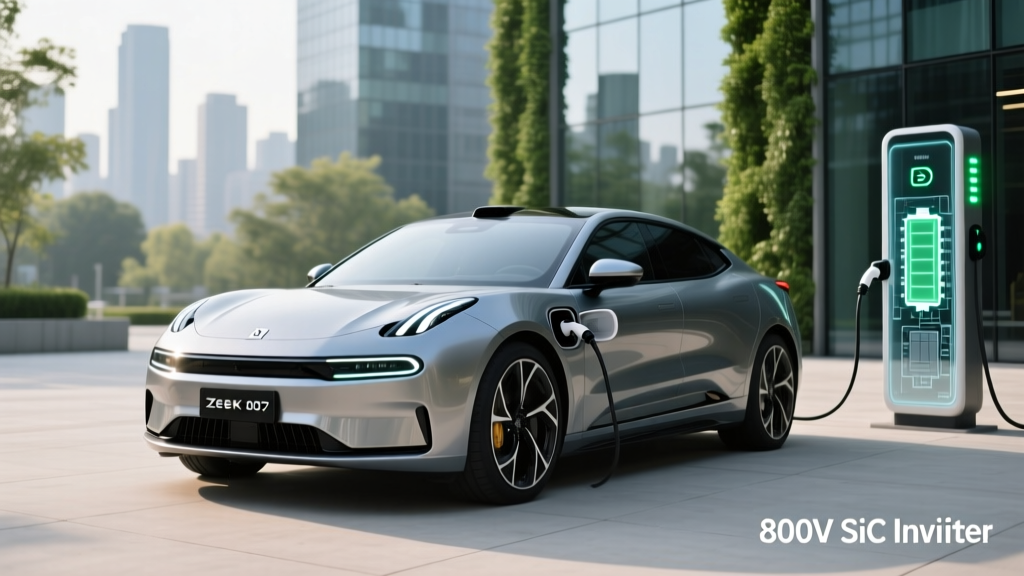
The Zeekr 007 arrived in global markets as Geely's premium electric sedan challenger, aiming squarely at the Tesla Model 3, Hyundai Ioniq 6, and BMW i4. Built on Geely's Sustainable Experience Architecture (SEA), the 007 brings 800-volt charging architecture, a choice of LFP or NMC battery packs, and a tech-heavy cabin at a price point that undercuts most European rivals. But spec sheets don't tell the whole story. After analyzing its EPA numbers, charging behavior, and real-world ownership factors, here's what buyers actually need to know.
Range and Efficiency: EPA Numbers vs. the Real World
The Zeekr 007 is offered with two battery options for the 2026 model year. The Standard Range model uses a 75 kWh (usable) lithium iron phosphate (LFP) pack, while the Long Range variant steps up to a 100 kWh (usable) nickel manganese cobalt (NMC) battery. Both feed a rear-wheel-drive single-motor powertrain in base form, with a dual-motor AWD Performance variant also available.
| Variant | EPA Est. Range | Real-World Highway (70 mph) | Cold Weather (20°F) |
|---|---|---|---|
| Standard Range RWD (75 kWh LFP) | 310 miles | ~260–275 miles | ~225–245 miles |
| Long Range RWD (100 kWh NMC) | 405 miles | ~340–360 miles | ~295–320 miles |
| Performance AWD (100 kWh NMC) | 370 miles | ~310–330 miles | ~270–290 miles |
Highway range assumes sustained 70 mph driving in moderate temperatures (65–75°F). Cold-weather figures reflect typical winter conditions with cabin heating active. LFP packs tend to suffer slightly more range loss in extreme cold than NMC chemistry. Source: fueleconomy.gov
Efficiency for the Long Range RWD model lands at approximately 132 MPGe combined (25 kWh/100 mi), which is competitive with the Ioniq 6's class-leading numbers but a step below Tesla's optimization. The Standard Range model runs at roughly 127 MPGe combined (26 kWh/100 mi). The AWD Performance variant drops to about 115 MPGe (29 kWh/100 mi) due to the second motor's parasitic losses and stickier tire compound.
Charging Speed: 800V Architecture Pays Off
The Zeekr 007's 800-volt electrical architecture is its strongest charging differentiator. This is the same high-voltage platform found in the Porsche Taycan and Hyundai Ioniq 5, and it enables significantly faster DC fast charging than legacy 400V systems.
| Charging Level | Power / Rate | Speed (Standard Range) | Speed (Long Range) |
|---|---|---|---|
| Level 1 (120V household) | 1.4 kW | ~4 mi/hr | ~5 mi/hr |
| Level 2 (240V, 48A home charger) | 11.5 kW | ~38 mi/hr | ~50 mi/hr |
| DC Fast Charge (peak) | Up to 240 kW | 10–80% in ~18 min | 10–80% in ~22 min |
| DC Fast Charge (350 kW station) | Capped at 240 kW | Same as above | Same as above |
Peak DC charge rate of 240 kW is sustained from roughly 10–45% SoC on the Long Range model, then tapers progressively. Expect average charging power of ~170 kW across a full 10–80% session. Battery preconditioning activates automatically when a DC fast charger is set as your navigation destination.
Home charging on a Level 2 wallbox fills the 75 kWh pack from empty in about 7 hours, while the 100 kWh pack needs roughly 9.5 hours. For most owners charging overnight, either battery tops up completely by morning. The onboard AC charger maxes at 11.5 kW, which is standard for the segment — no 22 kW three-phase option is available in the U.S. market.
One practical note: the 007 uses the CCS1 connector for DC fast charging in North America. Zeekr has not announced a native NACS port for the 007 as of the 2026 model year, though an adapter for Tesla Supercharger access is expected to be available. This is worth monitoring, as Supercharger network access is a meaningful convenience factor for road-trip charging.
Performance and Drivetrain
The 007 lineup offers three distinct powertrain configurations:
- Standard Range RWD: 272 hp, single rear motor, 0–60 mph in 5.9 seconds
- Long Range RWD: 421 hp, single rear motor, 0–60 mph in 5.2 seconds
- Performance AWD: 637 hp, dual-motor all-wheel drive, 0–60 mph in 2.84 seconds
The RWD models deliver smooth, linear acceleration with minimal torque steer — typical of well-tuned single-motor EVs. The Performance AWD variant is genuinely quick, rivaling the Tesla Model 3 Performance and Porsche Taycan 4S in straight-line acceleration. However, the 007's curb weight (approximately 4,800 lbs for the Long Range, 5,050 lbs for the AWD) is noticeable in corner transitions. This is a grand-touring sedan, not a track weapon.
Regenerative braking offers three levels of intensity, selectable via the touchscreen, plus an adaptive mode that uses radar data from the car ahead to modulate regen automatically. One-pedal driving is available but doesn't bring the car to a complete hold at very low speeds — you'll still need the friction brake for final stops.
Interior, Cargo, and Technology
The 007's cabin is minimalist in execution, dominated by a 15.05-inch OLED center display running Zeekr's latest infotainment OS. A 35.5-inch augmented-reality head-up display projects navigation and speed data onto the windshield — one of the largest AR-HUDs in the segment. A slim 12.3-inch digital instrument cluster sits behind the yoke-style steering wheel (a conventional round wheel is also available).
Passenger space is generous for the midsize sedan class:
- Front legroom: 41.2 inches
- Rear legroom: 38.5 inches
- Rear headroom: 37.1 inches (slightly compromised by the sloping roofline)
- Trunk volume: 17.4 cu ft (sedan trunk, no hatchback opening)
- Frunk: 1.8 cu ft (small — fits a charging cable bag, not much else)
The trunk is the 007's most obvious practicality weakness compared to the Hyundai Ioniq 6's hatchback-style liftgate or the Tesla Model 3's deeper cargo area. Rear-seat passengers taller than 6'1" will notice the roofline taper, though knee room is excellent thanks to the flat floor and long wheelbase (116.5 inches).
Standard tech includes Qualcomm Snapdragon 8295 processor for the infotainment system, wireless Apple CarPlay and Android Auto, a 14-speaker Yamaha audio system, NFC phone-as-key, and over-the-air update capability. The driver-assistance suite uses a Mobileye EyeQ5H chip paired with one lidar sensor, 12 cameras, 5 millimeter-wave radars, and 12 ultrasonic sensors.
Pricing, Trims, and Federal Tax Credit Eligibility
| Trim | Base MSRP | As-Tested (w/ options) | Est. After §30D Credit* |
|---|---|---|---|
| Standard Range RWD | $42,900 | $44,500 | ~$35,400–$42,900 |
| Long Range RWD | $49,900 | $53,200 | ~$42,400–$49,900 |
| Performance AWD | $57,500 | $61,800 | ~$50,000–$57,500 |
*Federal tax credit eligibility under IRS §30D depends on multiple factors that change annually. The credit is up to $7,500 but is NOT guaranteed for every buyer or every trim.
- MSRP cap: Sedans must be ≤ $55,000 MSRP. This means the Standard Range ($42,900) and Long Range ($49,900) trims are under the cap, but the Performance AWD ($57,500) is NOT eligible.
- Buyer income cap: Modified AGI must not exceed $150,000 (single), $225,000 (head of household), or $300,000 (joint filers).
- Battery sourcing: Critical minerals and battery components must meet phased-in domestic/free-trade-partner sourcing thresholds. Zeekr's CATL-supplied LFP pack and NMC cells from Geely-affiliated suppliers are subject to these rules, and partial credit ($3,750) is possible if only one of the two sourcing criteria is met.
- Point-of-sale transfer: Eligible buyers can transfer the credit to the dealer at purchase, reducing the out-of-pocket price immediately rather than waiting for a tax return.
- FEOC exclusion: Vehicles with battery components from a "foreign entity of concern" (e.g., certain Chinese state-owned suppliers) may be disqualified entirely. Verify current status at purchase.
Consult a tax professional and check the latest IRS guidance before relying on credit estimates.
Battery Longevity, Warranty, and Ownership Costs
Zeekr backs the 007 with a competitive warranty package:
- Battery warranty: 8 years / 100,000 miles (capacity retention ≥ 70%)
- Powertrain warranty: 8 years / 100,000 miles
- Bumper-to-bumper: 4 years / 50,000 miles
- Corrosion warranty: 12 years / unlimited miles
The LFP pack in the Standard Range model offers a longevity advantage: LFP chemistry typically exhibits slower degradation over time, often retaining 90%+ capacity after 1,000 full charge cycles. Zeekr recommends charging the LFP pack to 100% at least once per week to maintain cell-balancing accuracy. The NMC packs in the Long Range and Performance models benefit from a daily charge limit of 80–90% for optimal lifespan, with 100% reserved for road trips.
Battery replacement costs remain a long-term concern. Based on current SEA-platform battery pricing, a full pack replacement out of warranty would likely cost between $12,000 and $18,000 depending on the pack size — though module-level repairs may be possible at lower cost. This is comparable to industry averages for 75–100 kWh packs.
Insurance premiums for the 007 are estimated 10–15% higher than a comparably priced gas sedan, consistent with EV segment norms. Zeekr includes 3 years of complimentary scheduled maintenance (cabin air filter, brake fluid check, tire rotation) and 2 years of complimentary Electrify America DC fast charging (up to 1,200 kWh).
How the Zeekr 007 Compares to Key Rivals
| Spec | Zeekr 007 Long Range | Tesla Model 3 LR | Hyundai Ioniq 6 SE LR | BMW i4 eDrive40 |
|---|---|---|---|---|
| EPA Range | 405 mi | 363 mi | 361 mi | 307 mi |
| Battery (usable) | 100 kWh NMC | 75 kWh NMC | 77.4 kWh NMC | 81.5 kWh NMC |
| Peak DC Charge | 240 kW | 250 kW | 240 kW | 205 kW |
| 10–80% DC Time | ~22 min | ~25 min | ~18 min | ~31 min |
| 0–60 mph | 5.2 sec | 4.2 sec | 6.2 sec | 5.5 sec |
| Horsepower | 421 hp | 346 hp | 225 hp | 335 hp |
| Base MSRP | $49,900 | $47,740 | $42,715 | $57,900 |
| Cargo (trunk) | 17.4 cu ft | 23 cu ft | 12.3 cu ft | 16.6 cu ft |
The 007 Long Range offers the highest EPA range in this comparison, though its 100 kWh battery is also the largest — meaning more weight and longer full-charge times on Level 2. The Model 3 remains more efficient per kWh and offers Supercharger network access natively. The Ioniq 6 charges faster in 10–80% time despite a smaller battery, thanks to Hyundai's optimized thermal management. The BMW i4 is pricier and shorter-ranged but offers superior build quality and dealer service infrastructure.
Driver Assistance and Smart Features
The Zeekr 007's driver-assistance system (Zeekr AD) is a Level 2 system under SAE classification. This means it can control steering, acceleration, and braking simultaneously on highways — but the driver MUST remain attentive, keep hands on or near the wheel, and be prepared to take over at any time. This is NOT autonomous or "self-driving" capability.
Zeekr AD includes adaptive cruise control with stop-and-go, lane-centering assist, automated lane changes (with driver confirmation), traffic-sign recognition, and automatic emergency braking with pedestrian and cyclist detection. The lidar sensor enables enhanced perception in low-visibility conditions and is intended to support future over-the-air feature upgrades.
- Navigate city streets autonomously without driver supervision
- Handle construction zones or unmapped roads reliably
- Operate in heavy snow, fog, or sensor-obscuring conditions
- Replace an attentive driver — hands-off driving is not permitted or safe
Compared to Tesla's FSD (Supervised) or GM's Super Cruise, Zeekr AD is competent but less ambitious in its lane-change logic. It prioritizes conservative, predictable behavior — which many buyers will prefer, but it won't impress those expecting cutting-edge autonomy.
Who Should Buy the Zeekr 007?
- You prioritize maximum range and want a 400+ mile EPA sedan without paying luxury-brand prices
- You value 800V fast-charging for road-trip practicality
- You prefer a tech-forward cabin with AR-HUD and premium audio over sporty driving dynamics
- You want LFP battery chemistry for long-term degradation peace of mind (Standard Range trim)
- You need hatchback cargo versatility (consider Ioniq 6 or Model 3)
- Native Tesla Supercharger access is a dealbreaker for your route patterns
- You want track-capable handling (the 007 is a cruiser, not a sports sedan)
- Dealer service proximity matters — Zeekr's U.S. service network is still expanding
The Zeekr 007 is best suited for daily commuters and frequent road-trippers who value range and charging speed over outright performance or cargo flexibility. The Long Range RWD trim at $49,900 hits the sweet spot — enough range to eliminate daily charging anxiety, fast DC charging for highway stops, and eligibility for at least partial federal tax credits for most buyers.
- Class-leading 405-mile EPA range (Long Range)
- 800V architecture with 240 kW peak DC charging
- LFP battery option for longevity-conscious buyers
- Generous rear-seat legroom (38.5 in)
- Large AR head-up display standard
- Competitive pricing vs. European rivals
- Sedan trunk (17.4 cu ft) limits cargo versatility
- No native NACS port — Supercharger access requires adapter
- Heavy curb weight affects handling agility
- Expanding but still limited U.S. service network
- Rear headroom tight for tall passengers
- Tax credit eligibility uncertain for Performance trim
Frequently Asked Questions
What is the real-world range of the Zeekr 007?
The Long Range RWD model achieves an EPA-estimated 405 miles. In real-world highway driving at 70 mph in moderate temperatures, expect approximately 340–360 miles. In cold weather (around 20°F), that drops to roughly 295–320 miles. The Standard Range LFP model delivers about 260–275 real-world highway miles from its 310-mile EPA rating.
How fast does the Zeekr 007 charge?
On a DC fast charger, the 007 peaks at 240 kW and charges from 10% to 80% in approximately 18 minutes (Standard Range) or 22 minutes (Long Range). At home on a Level 2 wallbox (11.5 kW), a full charge takes about 7 hours for the 75 kWh pack or 9.5 hours for the 100 kWh pack.
Does the Zeekr 007 qualify for the federal EV tax credit?
The Standard Range ($42,900) and Long Range ($49,900) trims fall under the $55,000 MSRP cap for sedans under IRS §30D rules. The Performance AWD ($57,500) exceeds the cap and is NOT eligible. All trims require the buyer to meet income limits ($150K single / $300K joint) and the vehicle must satisfy battery-sourcing requirements, which may result in a partial $3,750 credit rather than the full $7,500. Always verify current eligibility with your tax professional and the IRS clean vehicle credit page.
Is the Zeekr 007 worth buying over a Tesla Model 3?
The 007 Long Range offers more EPA range (405 vs. 363 miles) and a more premium cabin feel, but the Model 3 has native Supercharger access, slightly quicker acceleration, more cargo space (23 vs. 17.4 cu ft), and a more established U.S. service network. If range and cabin quality are your priorities, the 007 is compelling. If charging convenience and service infrastructure matter more, the Model 3 remains the safer bet.
What battery chemistry does the Zeekr 007 use?
The Standard Range model uses a 75 kWh LFP (lithium iron phosphate) pack, which offers slower degradation and can be charged to 100% regularly without longevity concerns. The Long Range and Performance models use a 100 kWh NMC (nickel manganese cobalt) pack, which provides higher energy density but benefits from daily charge limits of 80–90%.
What is the Zeekr 007's warranty coverage?
Zeekr provides an 8-year/100,000-mile battery warranty (guaranteeing ≥70% capacity retention), an 8-year/100,000-mile powertrain warranty, and a 4-year/50,000-mile bumper-to-bumper warranty. This is competitive with Tesla's 8-year/100,000-mile battery coverage and Hyundai's 10-year/100,000-mile battery warranty.