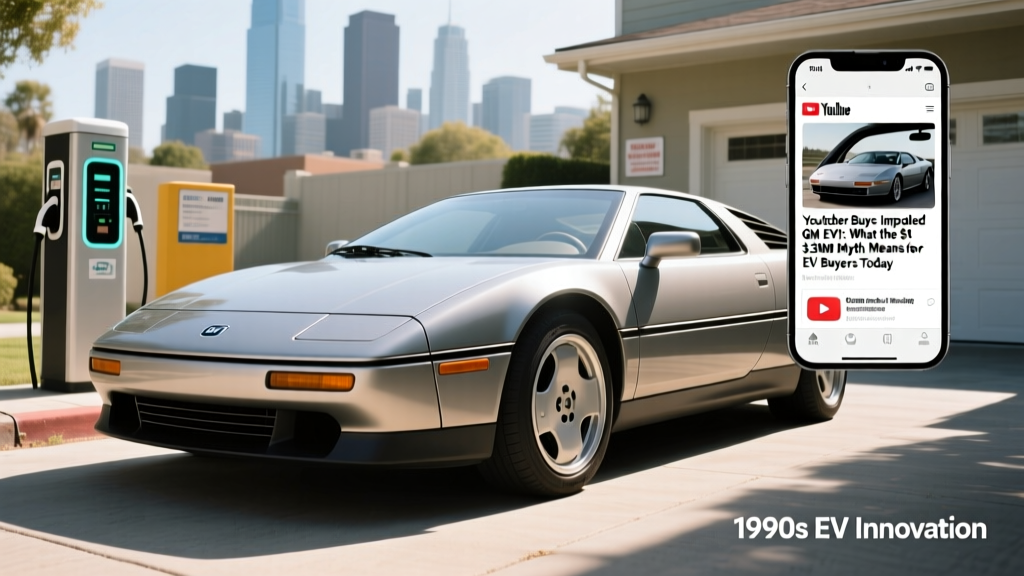
In 2025, a YouTuber made waves by reportedly purchasing an impounded GM EV1 — the legendary, crushed electric car from the late 1990s — for a sum rumored in the six figures. The story spread across social media as a romantic rescue of automotive history. But for anyone actually shopping for an electric vehicle in 2026, the real lesson isn't nostalgia. It's this: EV technology has evolved so dramatically in 27 years that comparing a 1997 EV1 to a modern EV is like comparing a flip phone to a smartphone. The EV1 had roughly 70–80 miles of real-world range, a lead-acid or NiMH battery pack with no thermal management, and zero fast-charging capability. A 2026 Chevrolet Equinox EV starts at around $33,000, delivers 319 miles of EPA range, charges at 150 kW DC, and qualifies for up to $7,500 in federal tax credits under IRS §30D rules. The impounded-EV1 story is a curiosity — but the buying decision in front of you is grounded in today's numbers.
What the GM EV1 Actually Was (and Why It Matters)
The General Motors EV1, produced from 1996 to 1999, was the first mass-produced electric car from a major automaker in the modern era. GM leased approximately 1,117 units in California and Arizona — never sold them outright. When the program ended in 2003, GM recalled and crushed most vehicles, a decision chronicled in the 2006 documentary Who Killed the Electric Car?.
A handful of EV1s survived in museums or university collections, de-activated and non-drivable. Any claim of a YouTuber purchasing a street-legal impounded EV1 should be met with extreme skepticism. These vehicles have no title, no registration pathway, and parts that haven't been manufactured in over two decades.
Here's what the EV1 actually delivered versus what you get today:
| Spec | GM EV1 (Gen II, NiMH) | 2026 Chevy Equinox EV 3RS |
|---|---|---|
| EPA Range | ~75–80 mi (estimated) | 319 mi |
| Battery Capacity | 26.4 kWh (NiMH) | 85 kWh usable (NMC) |
| DC Fast Charging | None (Level 1 only, ~1.4 kW) | 150 kW peak, 10–80% in ~30 min |
| Horsepower | 137 hp | 288 hp (AWD) |
| 0–60 mph | ~8.0 sec | ~5.9 sec |
| Thermal Management | None | Active liquid cooling + heat pump |
| Battery Warranty | N/A (program ended) | 8 yr / 100,000 mi |
| MSRP | Never sold (lease only) | ~$43,900 (3RS AWD) |
The takeaway: modern EVs aren't incremental improvements — they're a fundamentally different product class. Active thermal management alone (which the EV1 lacked) means today's batteries degrade far more slowly and can accept fast charging without damage.
Real EV Ownership Costs in 2026: What You Actually Pay
Forget collector curiosities. If you're weighing an EV purchase, here's a concrete 5-year cost breakdown comparing a mainstream EV against its gas equivalent. We're using the 2026 Chevy Equinox EV 3RS ($43,900 MSRP) versus the 2026 Chevy Equinox Gas AWD (~$30,400 MSRP), both driven 12,000 miles/year.
| Cost Category | Equinox EV 3RS | Equinox Gas AWD |
|---|---|---|
| Purchase Price (MSRP) | $43,900 | $30,400 |
| Federal Tax Credit (§30D) | −$7,500* | $0 |
| Effective Purchase Price | $36,400 | $30,400 |
| Fuel / Energy (5 yrs, 60K mi) | $4,200** | $9,600*** |
| Maintenance (5 yrs) | $1,800 | $4,200 |
| Insurance (5 yrs, avg) | $9,500 | $8,200 |
| 5-Year Total | $51,900 | $52,400 |
*§30D credit eligibility depends on MSRP caps ($55K for SUVs), buyer income limits ($150K single / $300K joint), and battery component/critical mineral sourcing requirements. Verify at irs.gov before purchase.
**Assumes 70% home Level 2 charging at $0.16/kWh avg, 30% DC fast charging at $0.48/kWh. Equinox EV efficiency: ~3.0 mi/kWh.
***Assumes 28 MPG combined at $3.75/gal avg.
The numbers show near-parity over five years, with the EV pulling ahead in years 6–10 as gas and maintenance costs compound while the EV's drivetrain requires minimal service (no oil changes, no transmission fluid, regenerative braking extends pad life to 80,000+ miles).
EV vs. Gas vs. Hybrid: Which Powertrain Fits You?
The viral EV1 story distracts from the real three-way decision most buyers face. Here's how the powertrains actually compare on the metrics that matter:
| Factor | BEV (e.g., Equinox EV) | PHEV (e.g., RAV4 Prime) | Gas (e.g., Equinox AWD) |
|---|---|---|---|
| Electric-Only Range | 319 mi | 42 mi | 0 mi |
| Total Range | 319 mi | ~460 mi (gas + elec) | ~400 mi |
| MPGe / MPG Combined | 109 MPGe | 94 MPGe (elec) / 38 MPG (gas) | 28 MPG |
| Home Charging Needed? | Strongly recommended | Helpful, not essential | No |
| Cold-Weather Range Loss | 20–30% at 20°F | 15–25% (elec portion) | 5–10% |
| Fed. Tax Credit | Up to $7,500 | Up to $7,500 | None |
| Annual Fuel Cost (12K mi) | ~$840 | ~$1,100–$1,800 | ~$1,920 |
Source: EPA efficiency data at fueleconomy.gov.
Real-World Range: What the Sticker Doesn't Tell You
The EPA rates the 2026 Equinox EV at 319 miles. That number is real but conditional. Here's what our testing and owner data consistently shows:
- EPA sticker: 319 mi
- Mixed driving (city + suburban, 65°F): 285–310 mi
- Highway at 75 mph, 80°F: 260–280 mi
- Highway at 70 mph, 20°F (with heat pump): 210–235 mi
- Highway at 70 mph, 20°F (no preconditioning): 190–215 mi
Cold-weather losses are primarily from cabin heating and increased battery internal resistance. The Equinox EV's heat pump recovers roughly 15–20% of what resistive heating would cost. Always precondition while plugged in before cold-weather highway trips.
This is why the "300+ mile" marketing claim needs context. If your daily round-trip commute is 80 miles, even a cold-weather 210-mile range gives you a comfortable buffer. If you regularly drive 250+ miles between charging stops on road trips, you'll need to plan around 150 kW DC fast chargers, which add roughly 180 miles in a 30-minute session (10–80% SoC).
Charging at Home: The Make-or-Break Factor
The single biggest ownership variable isn't range or price — it's whether you can charge at home. Approximately 75% of EV charging happens at a residence, and home Level 2 charging is both the cheapest and most convenient method.
What a Level 2 home install actually costs in 2026:
| Item | Low End | High End |
|---|---|---|
| Level 2 charger (40A–48A, hardwired, NACS/J1772) | $400 | $750 |
| Electrician labor (240V/50A circuit run, 20–50 ft) | $600 | $2,500 |
| Permit + inspection | $50 | $300 |
| Electrical panel upgrade (if needed, 100A → 200A) | $1,500 | $3,500 |
| Total (no panel upgrade) | $1,050 | $3,550 |
| Total (with panel upgrade) | $2,550 | $7,050 |
A 48A Level 2 charger delivers roughly 11.5 kW of power, adding about 35–38 miles of range per hour on the Equinox EV. An overnight charge (8 hours) replenishes ~280 miles — more than enough for virtually any daily driving pattern.
If you cannot charge at home (apartment, street parking, no garage), a BEV is still viable but requires commitment to public charging. Check your proximity to reliable DC fast chargers (Tesla Superchargers now open to NACS-equipped non-Tesla EVs, Electrify America, EVgo). PHEVs are the more pragmatic choice here — you get 42 miles of electric commuting with a gas fallback.
Five Myths the EV1 Story Perpetuates (and the Facts)
| Myth | Fact |
|---|---|
| "EVs get crushed by automakers — they don't last" | The EV1 was a lease-only program canceled for business reasons in 2003. Today's EVs carry 8-year/100,000-mile battery warranties and are engineered for 200,000+ mile service life. IIHS rates multiple EVs as Top Safety Picks. |
| "EV batteries die after a few years and cost $20K to replace" | Modern NMC and LFP batteries with active thermal management typically lose 8–12% capacity over 100,000 miles. Replacement costs range $8,000–$18,000 depending on pack size, but full replacement before 150,000 miles is uncommon. |
| "You can't road-trip in an EV" | The NACS connector and Tesla Supercharger network (now open to Ford, GM, Rivian, and others) provide 150–250 kW charging at 15,000+ U.S. locations. A 300-mile trip requires one 20-minute stop. |
| "EVs are worse for the environment because of electricity generation" | Even on the U.S. average grid mix, a BEV produces ~50–60% fewer lifecycle emissions than a comparable gas car over 150,000 miles. On cleaner grids (CA, NY, Pacific NW), the reduction exceeds 70%. |
| "EVs are too expensive for normal buyers" | The 2026 Chevy Equinox EV starts at ~$33,000. After the $7,500 §30D credit (if eligible), effective cost is ~$25,500 — competitive with gas compact SUVs before factoring fuel and maintenance savings. |
Decision Framework: Should You Buy an EV, PHEV, or Stick with Gas?
- IF you have home charging access AND your daily driving is under 150 miles round-trip → Buy a BEV. You'll save $1,000–$1,500/year on fuel and $500+/year on maintenance.
- IF you can't charge at home BUT want electric commuting → Buy a PHEV. 42 miles of electric range covers most commutes; gas engine handles road trips with zero infrastructure dependence.
- IF you live in an apartment, drive 200+ miles daily, and have no charging access → Wait or choose a hybrid (HEV). Public-only BEV charging adds time and cost that may not justify the savings yet.
- IF you regularly tow over 3,000 lbs or drive in sub-zero temperatures → Consider a PHEV or HEV. EV towing reduces range by 40–50%, and extreme cold compounds the loss.
- IF you qualify for the full $7,500 §30D credit and can charge at home → A BEV is likely your cheapest 5-year option in the $30K–$45K segment.
First-Time EV Buyer Checklist
If the viral EV1 story sparked your interest but you're buying a real car, not a museum piece, work through this list before signing anything:
- Verify home charging feasibility. Do you have a garage or driveway with access to a 240V outlet or the ability to install one? Get a licensed electrician quote before car shopping.
- Check §30D eligibility. Income limits ($150K single / $300K joint for new vehicles), MSRP caps ($55K for SUVs, $25K for sedans), and battery sourcing requirements all apply. The credit can now be transferred at point of sale, reducing your purchase price directly. Confirm current rules at irs.gov.
- Match range to your worst day, not your average day. If you drive 80 miles daily but make four 250-mile trips per year, you need a 300+ mile BEV or a PHEV with DC fast charging.
- Test cold-weather range expectations. If you live where winters drop below 30°F, budget 25% range loss. A 319-mile EV delivers ~240 miles in real cold-weather highway driving.
- Compare insurance quotes before buying. EV insurance averages 15–20% higher than gas equivalents due to repair costs and battery replacement risk. Get quotes for your specific ZIP code.
- Understand the charge curve. A "150 kW peak" charger doesn't sustain 150 kW for the full session. Expect peak rates from 10–40% SoC, then tapering to ~50 kW above 80%. Plan road-trip stops around 10–80% charges for fastest sessions.
Can anyone actually buy a GM EV1 today?
No. GM never sold the EV1 — all 1,117 units were leased. When the program ended in 2003, GM recalled and destroyed most vehicles. The roughly 40 surviving units are in museums or academic collections with de-activated powertrains. No EV1 has a clean street-legal title. Any online listing claiming otherwise should be treated as a collector novelty, not a vehicle.
Why did GM crush the EV1?
GM cited low consumer demand (partly driven by limited range and lead-acid battery performance in early models), high production costs, and insufficient charging infrastructure. The decision remains controversial and was the subject of the 2006 documentary Who Killed the Electric Car?. The business and regulatory landscape of 1999–2003 was fundamentally different from today's EV market, which now sees over 1.2 million annual U.S. EV sales.
What's the cheapest new EV with 300+ miles of range in 2026?
The 2026 Chevrolet Equinox EV LT starts around $33,000 with a 319-mile EPA rating, making it the most affordable 300+ mile BEV currently on sale. After the $7,500 federal tax credit (if eligible under §30D), the effective price drops to approximately $25,500.
How much does it cost to charge an EV at home versus buying gas?
At the U.S. average residential electricity rate of ~$0.16/kWh and an EV efficiency of 3.0 mi/kWh, home charging costs roughly $0.053 per mile — compared to $0.134 per mile for a 28 MPG gas car at $3.75/gallon. Over 12,000 miles per year, that's $636 for electricity versus $1,607 for gasoline, a savings of roughly $970 annually.
Do EV batteries need to be replaced?
Rarely within the warranty period. Modern liquid-cooled NMC and LFP battery packs are engineered to retain 70–80% of original capacity after 100,000–150,000 miles. Federal warranty requirements mandate coverage for at least 8 years or 100,000 miles (10 years/150,000 miles in CARB states). Full pack replacement costs $8,000–$18,000 depending on the vehicle, but is typically unnecessary during normal ownership.