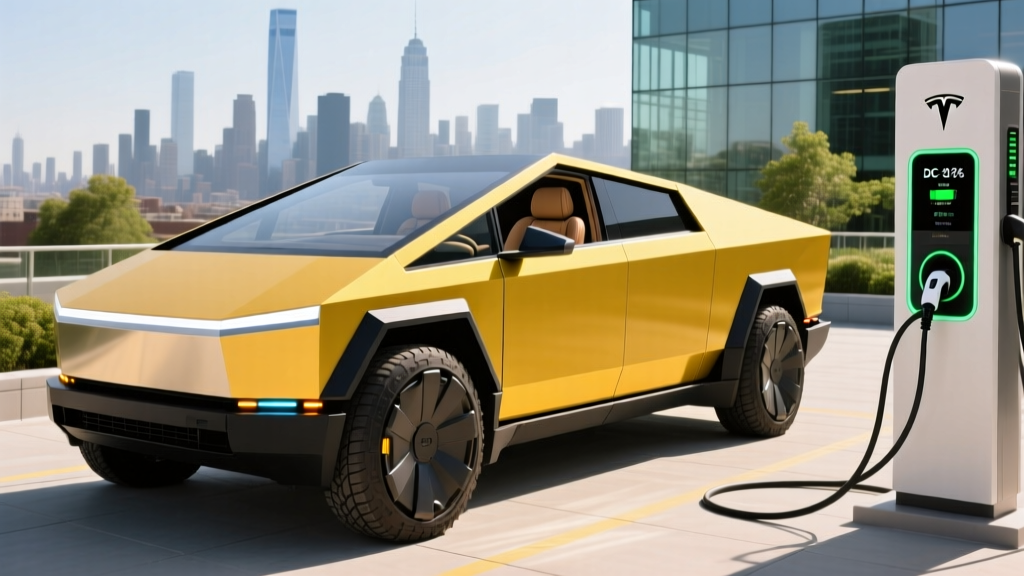
The Tesla Cybertruck has polarized the automotive world since its 2023 delivery event, but few configurations generate the visceral reaction of the yellow Cybertruck — officially offered as a color delete or third-party wrap option in Tesla's 2025 lineup. Beyond the polarizing aesthetics, the Cybertruck is a serious piece of engineering: an 800V architecture, stainless-steel exoskeleton, and available tri-motor powertrain that challenges every full-size electric truck on the market. This review digs into the numbers that actually matter for buyers considering a Cybertruck in 2025 and 2026: real-world range, charging curves, tax-credit eligibility, and whether the spec sheet survives contact with daily ownership.
Quick Verdict: Who Should Consider the Yellow Cybertruck?
The Cybertruck targets a narrow but passionate buyer: someone who wants an electric truck that stands out visually, tows moderately (up to 11,000 lbs on AWD trims), and leverages Tesla's Supercharger network for road trips. The yellow wrap option (typically a PPF or vinyl wrap over the stainless body, running $3,500–$6,000 at specialty shops) amplifies the truck's already aggressive presence. But if you need a work truck with a traditional bed configuration, max interior refinement, or sub-$60,000 pricing, the Rivian R1T, Ford F-150 Lightning, or Chevrolet Silverado EV may serve you better. The Cybertruck is a statement vehicle first and a utility platform second.
EPA Range, Battery, and Real-World Efficiency
Tesla offers the Cybertruck in three main configurations for the 2025 model year, each with distinct range profiles:
| Trim | Battery (usable) | Chemistry | EPA Range | MPGe (combined) | kWh/100 mi |
|---|---|---|---|---|---|
| RWD (Long Range) | ~123 kWh | NMC (4680 cells) | ~340 mi | 67 MPGe | 50 kWh |
| AWD (Long Range) | ~123 kWh | NMC (4680 cells) | ~340 mi | 64 MPGe | 52 kWh |
| Cyberbeast (Tri-Motor) | ~123 kWh | NMC (4680 cells) | ~320 mi | 59 MPGe | 57 kWh |
Tesla's 4680 NMC cells are manufactured in-house at Giga Texas. These cells offer high energy density but are more temperature-sensitive than LFP chemistries. Expect 8–12% degradation over the first 100,000 miles based on early owner data, which is typical for NMC packs under heavy use.
Charging Speed: DC Fast and Home Level 2
The Cybertruck uses Tesla's proprietary NACS connector natively — no adapter needed for the Supercharger network, and it's the de facto standard for most new EVs sold in North America.
| Charging Level | Peak Power | Rate / Miles Added | Typical Use Case |
|---|---|---|---|
| Level 1 (120V) | ~1.2 kW | ~3 mi/hr | Emergency / trickle |
| Level 2 (240V, 48A) | ~11.5 kW | ~28–32 mi/hr | Home daily charging |
| DC Fast (V3 Supercharger) | 250 kW peak | ~150 mi in 15 min | Road trips |
| DC Fast (V4 Supercharger) | Up to 350 kW* | ~180 mi in 15 min | Next-gen stations |
*V4 Supercharger availability is limited as of early 2026; most deployments cap the Cybertruck at 250 kW.
Charging curve reality: The Cybertruck peaks at 250 kW only between roughly 10–30% SoC. By 50%, power tapers to ~180 kW; above 80%, it drops sharply to ~60 kW to protect the NMC cells. A realistic 10–80% session on a V3 Supercharger takes about 30–35 minutes — not the "15 minutes" marketing implies, which refers only to miles added in the fastest window. Always precondition the battery via navigation routing to a Supercharger; skipping this step can add 10+ minutes to your charge time in cold weather.
For home Level 2 charging, a Tesla Wall Connector on a 60A circuit delivers up to 11.5 kW (44A continuous), adding roughly 30 miles per hour of charging. A full 10–100% charge takes about 12–13 hours — fine for overnight top-ups but slow for consecutive heavy-use days.
Performance: 0-60, Horsepower, and Drivetrain
| Trim | Motors | Horsepower | 0-60 mph | Top Speed | Towing (max) |
|---|---|---|---|---|---|
| RWD | Single (rear) | ~600 HP | ~6.5 sec | 112 mph | 7,500 lbs |
| AWD | Dual | ~600 HP | ~4.1 sec | 130 mph | 11,000 lbs |
| Cyberbeast | Tri-motor | 845 HP | 2.6 sec | 130 mph | 11,000 lbs |
The Cyberbeast's 2.6-second 0-60 time makes it one of the quickest production trucks ever built, rivaling supercars from a decade ago. However, the 6,800+ lb curb weight is noticeable in corners and emergency lane changes — this is a straight-line performer, not a canyon carver. The steer-by-wire system (no mechanical connection between wheel and rack) takes about a week of daily driving to trust, and feedback is synthetic rather than natural.
Pricing, Trims, and Federal Tax Credit Eligibility
| Trim | Base MSRP (2025) | Destination | As-Tested (typical) |
|---|---|---|---|
| RWD | $60,990 | $1,995 | $64,000–$67,000 |
| AWD | $79,990 | $1,995 | $83,000–$90,000 |
| Cyberbeast | $99,990 | $1,995 | $103,000–$110,000 |
The yellow Cybertruck factor: Tesla does not currently offer yellow as a factory paint option. Achieving the look requires a third-party vinyl wrap or PPF (paint protection film) in a yellow hue — budget $3,500–$6,000 for a quality wrap from a reputable installer. This does not affect warranty but should be disclosed on resale.
- MSRP cap: Trucks/vans/SUVs capped at $80,000. This means the Cybertruck RWD qualifies, but the AWD ($79,990 base) is right at the edge — options that push it over $80,000 disqualify it. The Cyberbeast at $99,990 does NOT qualify.
- Buyer income limits: AGI ≤ $150,000 (single), $225,000 (head of household), $300,000 (married filing jointly).
- Battery sourcing: Critical minerals and battery components must meet escalating domestic-content thresholds. Tesla's 4680 cells use a mix of domestic and imported materials — confirm current-year eligibility on IRS.gov before purchase.
- Point-of-sale transfer: Eligible buyers can apply the up-to-$7,500 credit at the dealership to reduce the purchase price directly.
Source: IRS Clean Vehicle Credits
Interior, Cargo, and Daily Livability
The Cybertruck's interior is minimalist even by Tesla standards: an 18.5-inch front touchscreen handles virtually all controls, with a smaller rear screen for back-seat passengers. Build quality has improved significantly over early 2024 deliveries, but panel gaps and trim rattles still appear on some units.
| Dimension | Measurement |
|---|---|
| Front legroom | 41.5 in |
| Rear legroom | 38.2 in |
| Bed length | 72 in (6 ft) |
| Bed cargo volume | 67 cu ft (bed locked), ~120 cu ft with tonneau open |
| Front trunk (frunk) | 7.1 cu ft |
| Max payload | 2,500 lbs |
The power-retractable tonneau cover is a standout feature — it's lockable, supports 300 lbs of distributed weight (you can stand on it), and seals the bed from weather. However, the bed's stainless-steel floor is slippery and lacks built-in tie-downs in early models; Tesla has since added integrated L-track rails.
Driver Assistance and Tech
Every Cybertruck ships with Tesla's Basic Autopilot (lane centering + adaptive cruise). Full Self-Driving (Supervised) is a $8,000 add-on or $99/month subscription.
The Cybertruck's 48-volt electrical architecture (a first for a production vehicle at this scale) enables faster-responding drive-by-wire systems and reduces wiring harness weight by ~70%. It also powers the adaptive air suspension, which offers 12 inches of ground clearance in Off-Road mode and drops 2 inches for highway efficiency.
Warranty and Long-Term Ownership
| Coverage | Term |
|---|---|
| Basic Vehicle Limited Warranty | 4 years / 50,000 miles |
| Battery & Drive Unit | 8 years / 120,000 miles (min 70% retention) |
| Restraint System | 5 years / 60,000 miles |
Tesla's battery warranty guarantees 70% capacity retention over 8 years or 120,000 miles — competitive with Rivian and slightly better than Ford's 8-year/100,000-mile coverage. A full battery replacement out of warranty is estimated at $15,000–$22,000 based on current 4680 pack pricing, though this is expected to decline as cell manufacturing scales.
Pros and Cons
- Tri-motor Cyberbeast: 845 HP, 2.6s 0-60 — quickest truck on the market
- NACS native: full access to 25,000+ Superchargers without adapters
- Stainless exoskeleton: dent-resistant, no paint to chip
- Lockable powered tonneau with 300-lb load rating
- 48V architecture: industry-first, reduces complexity
- OTA updates continuously add features
- Highway range loss significant (~20-30%) due to aero and weight
- Steer-by-wire yoke takes weeks to build muscle memory
- Cyberbeast and most AWD builds exceed $80K tax-credit cap
- Yellow requires aftermarket wrap ($3,500-$6,000)
- Rear visibility poor; camera dependency for lane changes
- Service center wait times remain long in many metro areas
Cybertruck vs. Key Competitors
| Spec | Cybertruck AWD | Rivian R1T Dual-Motor | Ford F-150 Lightning Lariat |
|---|---|---|---|
| EPA Range | 340 mi | 352 mi (Max Pack) | 320 mi (Ext. Range) |
| 0-60 mph | 4.1 sec | 4.5 sec | ~5.0 sec |
| Max Tow | 11,000 lbs | 11,000 lbs | 10,000 lbs |
| Bed Length | 72 in | 54 in (+ Gear Tunnel) | 67 in |
| Base Price | $79,990 | $79,900 | $69,995 |
| Charging Network | Supercharger (native) | Supercharger (adapter) | Supercharger (adapter) |
The Cybertruck wins on raw acceleration, native Supercharger access, and tech novelty. The R1T wins on interior refinement, off-road capability (quad-motor available), and the innovative Gear Tunnel. The F-150 Lightning wins on traditional truck usability, lower pricing, and dealer service infrastructure.
Frequently Asked Questions
What is the real-world range of the yellow Cybertruck?
The EPA rates the AWD Cybertruck at 340 miles, but real-world highway driving at 75 mph yields approximately 270–290 miles. In freezing weather, expect 230–260 miles. The yellow wrap itself has negligible impact on range — it adds less than 5 lbs and does not change aerodynamics.
How fast does the Cybertruck charge at home and on the road?
At home on a Level 2 Tesla Wall Connector (48A/240V), the Cybertruck charges at ~11.5 kW, adding roughly 30 miles per hour — a full charge takes about 12–13 hours. On DC fast charging, it peaks at 250 kW on V3 Superchargers, with a realistic 10–80% session taking 30–35 minutes due to charge-curve taper above 50% SoC.
Does the Cybertruck qualify for the $7,500 federal EV tax credit?
The RWD trim at $60,990 MSRP qualifies if the buyer meets income limits (≤$150K single, $300K married) and the battery sourcing requirements are met for the current tax year. The AWD at $79,990 is borderline — any factory options pushing total MSRP above $80,000 disqualify it. The Cyberbeast at $99,990 does not qualify. Always verify current eligibility at IRS.gov before purchasing.
Is the yellow Cybertruck worth buying over the Rivian R1T or F-150 Lightning?
Choose the Cybertruck if you prioritize acceleration, native Supercharger access, and head-turning design. Choose the R1T if you need a refined interior, serious off-road capability, and a longer bed via the Gear Tunnel. Choose the F-150 Lightning if you want traditional truck ergonomics, lower pricing, and a widespread dealer service network. The yellow wrap adds cost but also resale distinctiveness in a market saturated with grey and white EVs.
How long will the Cybertruck battery last?
Tesla warranties the 4680 NMC battery for 8 years or 120,000 miles with a minimum 70% capacity retention. Based on early fleet data and Tesla's historical degradation curves, expect 8–12% loss in the first 100,000 miles, with the pack remaining functional well beyond 200,000 miles at reduced capacity. Out-of-warranty replacement is estimated at $15,000–$22,000 as of 2026.
Can I get a factory yellow Cybertruck from Tesla?
No. Tesla does not offer yellow as a factory color. The Cybertruck ships in unpainted stainless steel or a limited selection of factory wraps (Stealth Grey, Satin Black, etc.). A yellow finish requires a third-party vinyl wrap or PPF, typically costing $3,500–$6,000 installed. This modification does not void the vehicle warranty but should be documented for future resale.