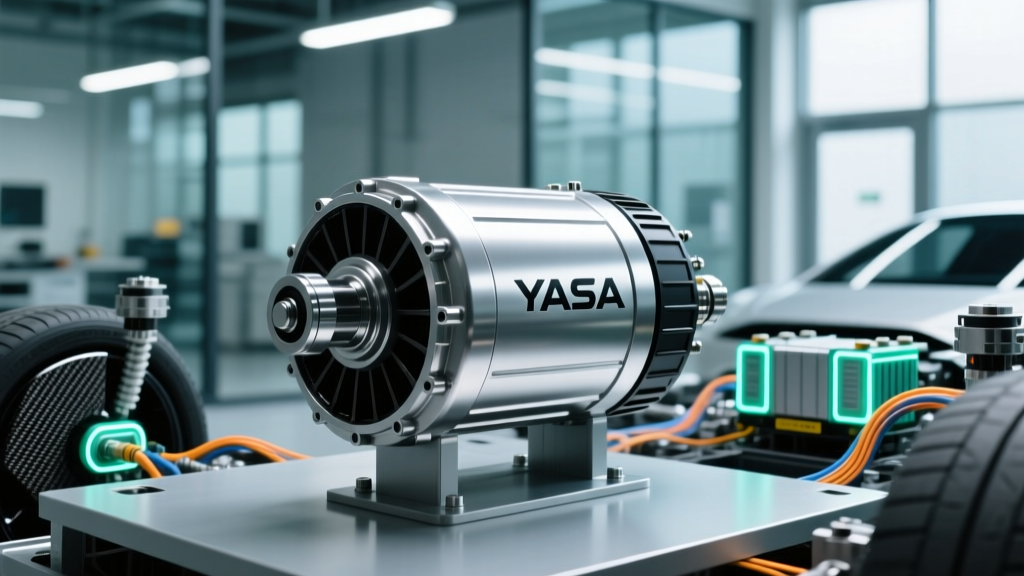
What is a YASA electric motor? YASA (Yokeless and Segmented Armature) is a type of axial-flux electric motor that delivers more power in a smaller, lighter package than the radial-flux motors found in most EVs. Mercedes-Benz acquired YASA in 2021, and the technology currently appears in the Mercedes-AMG ONE hypercar and is slated for high-performance AMG EV models arriving in the 2026–2027 timeframe. For most EV shoppers today, YASA motors are not something you can buy off a dealer lot in a mainstream EV — they represent the next wave of powertrain tech aimed at cutting weight and boosting efficiency.
How YASA Axial-Flux Motors Differ from Standard EV Motors
Most EVs on the road in 2026 — from the Tesla Model Y to the Hyundai Ioniq 5 to the Ford Mustang Mach-E — use radial-flux permanent magnet synchronous motors (PMSM) or induction motors. These are proven, cost-effective, and mass-producible. They work well, but they have physical limits in terms of power density (kilowatts per kilogram).
YASA's axial-flux architecture flips the geometry. Instead of the rotor spinning inside a cylindrical stator (radial), the rotor sits between two disc-shaped stators (axial). The "yokeless and segmented armature" design eliminates the heavy iron yoke that typically channels magnetic flux, replacing it with a segmented winding structure that reduces weight and copper losses.
The practical results, based on YASA's published specifications:
- Power density: Up to ~5.8 kW/kg continuous — roughly 2–3x what a comparable radial-flux motor delivers
- Torque density: Significantly higher per unit volume, enabling compact packaging
- Efficiency: Peak efficiency above 96%, with a broader high-efficiency operating range than many radial designs
- Weight: A YASA P750 motor weighs approximately 12.5 kg while delivering up to 750 Nm of torque
For context, a typical radial-flux motor in a mainstream EV produces around 2–3 kW/kg. The weight savings compound: lighter motors mean less unsprung mass (when mounted at the axle), less total vehicle weight, and marginally better range and handling.
Which Vehicles Use YASA Motors Today (and Coming Soon)
As of 2026, YASA motor availability in production vehicles is limited but expanding:
| Vehicle | YASA Motor Role | Status | Output |
|---|---|---|---|
| Mercedes-AMG ONE | Two front-axle motors + one on crankshaft | Production (275 units) | ~160 hp per front motor |
| Next-gen Mercedes-AMG EV (MMA platform) | Primary drive motor(s) | Announced, expected 2026–2027 | Up to ~480 hp per motor (estimated) |
| Ferrari (future models) | Reported supply agreement | Announced | TBD |
The Mercedes-AMG ONE uses three YASA motors as part of its Formula 1-derived hybrid powertrain, producing a combined 1,063 hp. The two front-axle YASA units enable individual-wheel torque vectoring. This is hypercar territory — the AMG ONE had an MSRP exceeding $2.7 million.
More relevant to mainstream buyers: Mercedes has confirmed that YASA-developed axial-flux motors will power upcoming high-performance AMG electric models built on the Mercedes Modular Architecture (MMA) platform. These vehicles are expected to pair the motors with Mercedes' next-generation 800V battery architecture, targeting improved efficiency and sustained power delivery. Expect pricing in the $80,000–$150,000 range for these AMG EVs — premium, but not hypercar-exclusive.
Performance and Efficiency: YASA vs. Radial-Flux Motors
The engineering advantages of axial-flux design translate to measurable ownership benefits — but with important nuances.
| Metric | YASA Axial-Flux (P750) | Typical Radial-Flux PMSM | AC Induction Motor |
|---|---|---|---|
| Power Density | ~5.8 kW/kg | ~2.5–3.0 kW/kg | ~1.5–2.0 kW/kg |
| Peak Torque | 750 Nm | 400–600 Nm (typical EV) | 300–500 Nm |
| Motor Weight | ~12.5 kg | ~30–50 kg | ~40–60 kg |
| Peak Efficiency | >96% | ~94–96% | |
| Partial-Load Efficiency | Higher (broader sweet spot) | Good, but drops off at low loads | Lower at partial load |
| Packaging | Compact, disc-shaped | Cylindrical, longer axial length | Bulky |
What this means for range: A motor that is 1–2 percentage points more efficient at partial load (the kind of load you see during suburban driving and cruising) can translate to roughly 3–8 additional miles of EPA-rated range on a 100 kWh battery pack. That's modest. The bigger gain is weight reduction: saving 40–80 kg on motors alone improves handling, reduces tire wear, and allows either a smaller (cheaper, lighter) battery for the same range, or more range from the same battery.
What this means for performance: Higher torque density means stronger acceleration from a smaller motor package. An AMG EV using twin YASA motors could deliver 600+ hp while keeping total motor weight under 30 kg — something that would require 100+ kg of radial-flux motors today.
Real-World Ownership Costs: What YASA-Powered EVs Will Actually Cost You
Since YASA-powered EVs for mainstream buyers are still forthcoming (the MMA-based AMG models), we can project ownership costs based on Mercedes' announced platform specs and current EV market data.
| Cost Category | Projected YASA AMG EV (2026–2027) | 2026 Tesla Model Y LR AWD | 2026 BMW i4 M50 |
|---|---|---|---|
| Base MSRP | ~$90,000–$120,000 (est.) | $48,590 | $67,795 |
| Federal §30D Tax Credit | Subject to MSRP cap ($80K SUVs/$55K sedans) — likely ineligible at sedan pricing | Potentially up to $7,500 (check IRS sourcing rules) | Likely ineligible (MSRP cap) |
| Estimated Range (EPA) | ~350–400 mi (MMA platform target) | 320 mi | 276 mi |
| Charging Cost ($/mi, home L2) | ~$0.04–0.05/mi | ~$0.04/mi | ~$0.05/mi |
| Annual Insurance (est.) | $3,500–$5,000+ | $1,800–$2,400 | $2,200–$3,000 |
| Maintenance (5-yr est.) | $2,500–$4,000 | $1,500–$2,000 | $2,000–$3,000 |
| Battery Warranty | 8 yr / 100,000 mi (typical Mercedes) | 8 yr / 120,000 mi | 8 yr / 100,000 mi |
Fuel cost comparison: A gas-powered equivalent like the BMW M3 Competition (starting ~$78,000, 18 MPG combined) costs roughly $0.22/mile to fuel at $3.50/gallon. The projected YASA AMG EV at $0.04–0.05/mile on home Level 2 charging saves approximately $2,500–$3,000 annually for a driver covering 15,000 miles. However, DC fast charging at public stations (averaging $0.35–$0.48/kWh in 2026) pushes the per-mile cost to $0.12–$0.16 — still below gas, but the gap narrows significantly.
Insurance is the wildcard: High-performance EVs with exotic powertrain components carry steep premiums. AMG-badged vehicles already attract surcharges, and YASA motors — while potentially more reliable due to fewer iron losses and lower thermal stress — are not yet common enough for insurers to offer volume discounts. Budget $4,000+ annually for comprehensive coverage.
Common Misconceptions About YASA and Axial-Flux Motors
| Myth | Fact |
|---|---|
| "YASA motors will double EV range." | Motor efficiency gains of 1–3% add single-digit miles. Range is primarily a function of battery kWh, vehicle weight, and aerodynamics. YASA's weight savings help, but won't transform a 300-mi EV into a 600-mi EV. |
| "Axial-flux motors are brand-new, unproven tech." | The axial-flux concept dates to the 1820s (Faraday disc). YASA's specific implementation has been in development since 2009 and has been validated in production (AMG ONE) and extensive bench testing. The risk is manufacturing scale, not fundamental reliability. |
| "I can buy a YASA-powered EV today at a normal price." | As of 2026, the only production vehicle with YASA motors is the $2.7M+ Mercedes-AMG ONE (sold out). Mainstream YASA EVs are expected in 2026–2027 at $80K+. |
| "YASA motors eliminate range loss in cold weather." | Cold-weather range loss is dominated by battery chemistry and cabin heating demands, not motor type. Expect the same 20–35% range reduction at 20°F regardless of motor architecture. |
| "Axial-flux is always better than radial-flux." | Radial-flux motors remain cheaper to manufacture at scale and are perfectly adequate for most use cases. Axial-flux excels in power-density-critical applications (performance, aviation, weight-sensitive platforms) but carries higher per-unit cost at current production volumes. |
Should You Wait for a YASA-Powered EV or Buy Now?
This is where practical decision-making separates hype from ownership reality. Here's a framework based on your situation:
Buy a current EV now if:
- You need a vehicle within 6–12 months and your current car is costing you money in repairs or fuel
- Your budget is under $60,000 — YASA-powered EVs will debut well above this threshold
- You want to take advantage of the current §30D federal tax credit before potential rule changes (check income caps: $150K single / $300K joint, and MSRP caps: $55K sedans / $80K SUVs and trucks)
- Your daily driving is under 60 miles and you have home Level 2 charging — current radial-flux motors are already 94%+ efficient, and you won't notice a 2% efficiency gap
Wait for a YASA-powered AMG EV if:
- You're shopping in the $90,000–$150,000 performance EV segment and want the latest powertrain technology
- You prioritize weight reduction and handling dynamics — a 50–80 kg motor weight savings is meaningful on a track or canyon road
- You plan to keep the vehicle 5+ years and want a platform that represents Mercedes' next-generation 800V architecture
- You already own a capable daily driver and can afford to wait 12–24 months for production and delivery
What First-Time EV Buyers Should Know (Regardless of Motor Type)
Whether you're eyeing a future YASA AMG or a currently available Tesla, Hyundai, or Chevrolet, these ownership fundamentals apply:
Home charging is non-negotiable for cost savings. The $0.04/mile figure assumes Level 2 home charging at ~$0.13/kWh (national average residential rate in 2026). If you rely exclusively on public DC fast charging at $0.35–$0.48/kWh, your per-mile cost triples. A home Level 2 installation (240V, 48A circuit) costs $800–$2,500 for equipment and electrician labor, depending on panel capacity and run distance. If your home electrical panel is maxed out at 100A, a panel upgrade to 200A adds $1,500–$3,500.
EPA range is optimistic for highway and cold-weather driving. Plan for 70–80% of EPA range at sustained 75+ mph highway speeds, and 65–75% in sub-30°F winter conditions. A 350-mile EPA rating realistically means 245–280 miles on a winter road trip.
Battery degradation is real but manageable. Modern NMC and LFP batteries lose roughly 5–10% capacity over the first 100,000 miles, then degradation slows. Mercedes, Tesla, and Hyundai all warrant their batteries for 8 years / 100,000+ miles at a minimum 70% capacity retention threshold.
The motor type matters less than the total package. A YASA axial-flux motor is an impressive engineering achievement, but your ownership experience is shaped more by charging access, battery size, thermal management, software quality, and dealer support than by whether the motor is axial or radial.
Can I retrofit a YASA motor into an existing EV?
No. YASA motors are integrated into vehicle platforms with specific inverter, cooling, and software architectures. They are not available as aftermarket components, and the control electronics are proprietary to Mercedes-Benz/YASA.
Will YASA motors make EVs cheaper?
Not initially. The manufacturing processes for segmented armature windings are more complex than traditional stator lamination stacking. At current volumes, YASA motors cost more per unit than mass-produced radial-flux motors. Cost parity depends on Mercedes scaling production at their Berlin Untertürkheim facility to tens of thousands of units annually.
Are axial-flux motors used in any non-Mercedes EVs?
YASA supplies primarily Mercedes-Benz and reportedly Ferrari. Other axial-flux motor manufacturers exist — Magnax (Belgium) and Infinitum Electric (US) produce similar architectures — but these have not yet reached mainstream automotive production volumes. The technology is gaining traction in aviation and industrial applications.
How does YASA motor efficiency compare to Tesla's carbon-wrapped rotor motor?
Tesla's permanent-magnet reluctance motor with a carbon-fiber-sleeved rotor (used in the Model S Plaid) achieves excellent power density (~4.5 kW/kg) through a different approach — containing rotor expansion at high RPM. Both are impressive, but YASA's axial-flux design achieves higher torque density at lower speeds, while Tesla's radial design excels at sustained high-RPM power delivery. The real-world efficiency gap at the vehicle level is small — both exceed 94% peak efficiency.
What's the expected maintenance cost for a YASA motor?
Electric motors have far fewer moving parts than internal combustion engines — no oil changes, no timing belts, no exhaust systems. YASA motors use the same basic bearing and cooling systems as other EV motors. Expect motor-related maintenance to be minimal. The primary long-term ownership cost risk is out-of-warranty inverter replacement ($2,000–$5,000), which applies to all EV motor types.