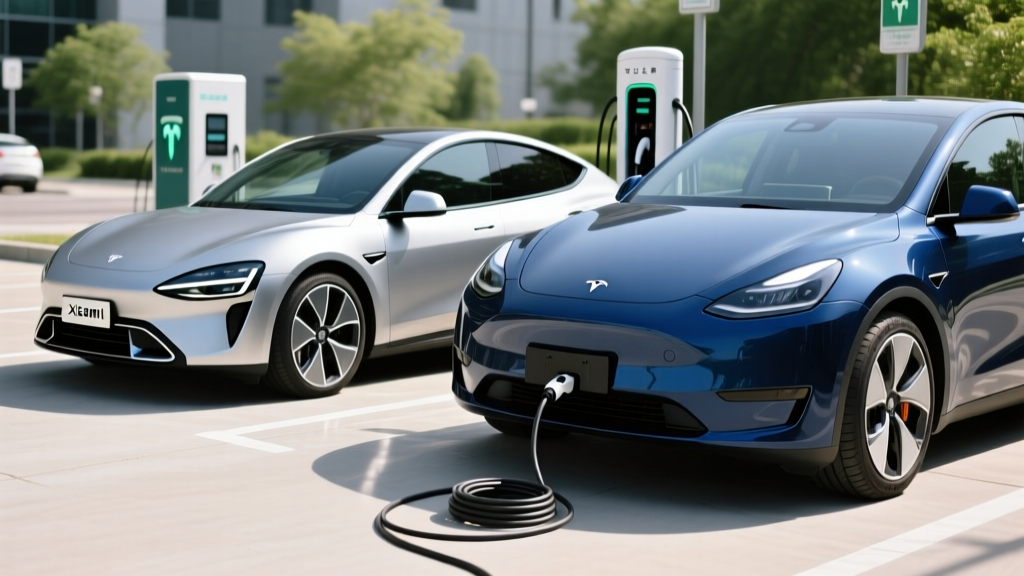
The Xiaomi SU7 and Tesla Model Y represent two fundamentally different approaches to the electric crossover/sedan market. While the Tesla Model Y remains the global EV benchmark with a mature Supercharger network and US-built manufacturing, Xiaomi's SU7 has disrupted the Chinese market with aggressive pricing, rapid 800V charging, and smartphone-integrated tech. This Xiaomi vs Tesla Model Y study breaks down the data that matters to real buyers: range, charging curves, pricing, tax-credit eligibility, and long-term ownership economics as of early 2026.
Side-by-Side Spec Comparison
| Specification | Xiaomi SU7 Max | Tesla Model Y LR (Juniper) |
|---|---|---|
| Body Style | 4-door sedan | 5-door crossover SUV |
| Drivetrain | Dual-motor AWD | Dual-motor AWD |
| Horsepower | 673 hp (combined) | 384 hp (combined) |
| 0–60 mph | 2.78 seconds | 4.8 seconds |
| Battery Capacity | 101 kWh (NMC, CATL Qilin) | 78.1 kWh (NMC) |
| EPA-Est. Range | ~375 mi (estimated; CLTC 502 mi) | 320 mi |
| Efficiency | ~3.8 mi/kWh (est.) | 4.1 mi/kWh / 122 MPGe |
| Max DC Fast Charge | ~260 kW (800V architecture) | ~250 kW (Supercharger V4) |
| 10–80% DC Charge Time | ~19 minutes (claimed) | ~25 minutes |
| Level 2 Home Charge Rate | 11 kW (AC) | 11.5 kW (48A) |
| Cargo Volume | 17.7 cu ft (trunk) + 3.7 cu ft (frunk) | 30.2 cu ft (rear) + 76.2 cu ft (max) + 4.1 cu ft (frunk) |
| Base MSRP (China / US) | ¥299,900 (~$41,500 in China) | $48,990 (US, before destination) |
| US Federal Tax Credit | Not eligible (not sold in US) | Up to $7,500 (§30D, subject to income/MSRP/sourcing rules) |
| Battery Warranty | 8 yr / 160,000 km (~99,400 mi) | 8 yr / 120,000 mi |
Range and Efficiency: Sticker vs. Reality
The single biggest point of confusion in any Xiaomi vs Tesla Model Y study is range methodology. China uses the CLTC testing cycle, which is significantly more optimistic than the US EPA cycle. Xiaomi's headline 800 km (502 mi) CLTC figure for the SU7 Max sounds dominant, but when adjusted to EPA-equivalent testing — which includes higher sustained speeds, aggressive acceleration phases, and climate-load penalties — the realistic US sticker would land around 370–390 miles.
The 2026 Tesla Model Y Long Range AWD carries an official EPA rating of 320 miles, per fueleconomy.gov. But EPA numbers represent a blended cycle. In real-world ownership:
- Highway driving (75 mph, mild weather): Expect 275–295 miles before needing to charge. Aerodynamic drag dominates at speed, and the Model Y's crossover profile creates more drag than a sedan like the SU7.
- City / suburban mixed driving: Range often exceeds the EPA sticker, hitting 310–330 miles thanks to regenerative braking and lower average speeds.
- Cold weather (below 32°F / 0°C): Expect a 20–35% range reduction depending on cabin heating demand. The Model Y's heat pump (standard since 2021) mitigates this compared to resistive heating, but battery chemistry still suffers in extreme cold. Plan for 210–250 miles of usable range in sub-freezing winter conditions.
The Xiaomi SU7, being a sleek sedan with a larger 101 kWh battery, will outperform the Model Y on raw range in most conditions. However, its efficiency (miles per kWh) is slightly lower due to its heavier curb weight (~4,850 lbs vs. the Model Y's ~4,400 lbs).
Charging Speed: DC Fast Charging and Home Setup
Charging speed is where the Xiaomi SU7's 800V architecture gives it a measurable edge. Higher voltage systems allow faster charging at lower current, reducing heat buildup and cable thickness.
| Charging Level | Xiaomi SU7 Max | Tesla Model Y LR |
|---|---|---|
| Level 1 (120V household) | ~1.4 kW — ~4 mi/hr | ~1.4 kW — ~4 mi/hr |
| Level 2 (240V home) | 11 kW — ~33 mi/hr | 11.5 kW — ~35 mi/hr |
| DC Fast Charge (peak) | ~260 kW (800V) | ~250 kW (400V) |
| 10–80% DC Time | ~19 min (claimed) | ~25 min (typical) |
| Charging Architecture | 800V (CATL Qilin pack) | 400V |
| Connector (China / US) | GB/T (China); no CCS/NACS | NACS (native Supercharger access) |
Charging-curve reality check: Neither vehicle sustains peak kW for the full session. The Model Y typically peaks around 250 kW between 10–30% State of Charge (SoC), then tapers progressively — dropping to ~100 kW by 60% and ~40 kW above 85%. The SU7's 800V system holds higher power longer (sustaining ~200+ kW through 40% SoC), which is why its 10–80% time is meaningfully shorter despite a similar peak kW figure.
For home charging, both vehicles charge at roughly 11 kW on a Level 2 wall connector, adding approximately 33–35 miles of range per hour. A full overnight charge (8–10 hours on a 48A circuit) replenishes the Model Y from near-empty. The SU7's larger 101 kWh pack requires about 9–10 hours for a full charge at the same rate. Home Level 2 installation typically costs $800–$2,500 depending on panel capacity and run length — budget for a possible 200A panel upgrade ($1,500–$3,500) if your home has an older 100A service.
Performance and Driving Dynamics
In straight-line acceleration, the Xiaomi SU7 Max is in a different league. Its dual-motor setup produces 673 hp (299 hp front / 374 hp rear) and delivers a 2.78-second 0–60 mph time — supercar territory that undercuts the Model Y Long Range's 4.8-second run by a wide margin.
However, raw acceleration is only one dimension of driving dynamics:
- Tesla Model Y: Tuned for comfort and efficiency. The 2026 Juniper refresh improved ride quality with revised dampers and additional sound insulation. Steering is precise but light. The low center of gravity (battery pack floor) keeps body roll minimal for a crossover.
- Xiaomi SU7: Xiaomi partnered with a former BMW chassis engineer, and the SU7 Max features adaptive air suspension, torque vectoring, and a sportier driving character. Its lower sedan profile gives it a handling edge in spirited driving, though it's heavier overall.
For daily commuting and family use, the Model Y's crossover ride height, easier ingress/egress, and superior cargo versatility make it more practical. The SU7's performance advantage matters primarily to enthusiasts who prioritize acceleration and handling over utility.
Pricing, Tax Credits, and Total Cost of Ownership
This is where the Xiaomi vs Tesla Model Y study gets complicated — because the SU7 is not sold in the United States and has no announced US launch timeline as of early 2026.
| Factor | Xiaomi SU7 Max | Tesla Model Y LR (2026) |
|---|---|---|
| Base MSRP | ¥299,900 (~$41,500 China) | $48,990 (US) |
| Destination Fee | N/A (not sold in US) | $1,390 |
| Federal Tax Credit (§30D) | Not eligible | Up to $7,500 (point-of-sale or tax filing) |
| Effective Price After Credit | N/A | ~$42,880 (if full credit applies) |
| US Availability | Not available | Available nationwide |
Federal tax credit rules (§30D) for the 2026 Model Y: According to IRS guidelines, the full $7,500 credit requires meeting all of the following:
- MSRP cap: SUVs/crossovers must be under $80,000 (the Model Y qualifies).
- Buyer income cap: Modified AGI must not exceed $150,000 (single), $225,000 (head of household), or $300,000 (joint).
- Battery sourcing: Critical minerals and battery components must meet escalating domestic-content thresholds. Tesla's US-built Model Y with its LFP and NMC supply chains has generally qualified, but sourcing requirements tighten annually. Verify current eligibility at the time of purchase on the IRS qualified vehicle list.
- Point-of-sale transfer: As of 2024, buyers can transfer the credit to the dealer at purchase, reducing the upfront price immediately rather than waiting for a tax refund.
5-year total cost of ownership (US buyer, Model Y LR):
- Purchase (after credit): ~$42,880
- Electricity (15,000 mi/yr × 5 yrs at $0.14/kWh avg): ~$3,200
- Insurance (5 yrs, national avg for Model Y): ~$12,000–$15,000 (EV premiums remain higher than ICE equivalents)
- Maintenance (5 yrs — no oil changes, minimal brake wear with regen): ~$1,500
- Estimated 5-yr TCO: ~$59,500–$62,500
The SU7's China-market price of ~$41,500 is striking, but importing it to the US would face 100%+ tariffs on Chinese-made EVs (as of 2025 tariff schedules), eliminating any price advantage. Xiaomi has not announced plans to manufacture outside China for Western markets.
Interior, Cargo, and Technology
The Model Y's crossover body delivers a clear practicality advantage. With 30.2 cubic feet behind the second row and 76.2 cubic feet with seats folded, it accommodates family gear, road-trip luggage, and bulk shopping far better than the SU7's 17.7 cubic-foot trunk. The Model Y also offers a 4.1 cu ft frunk for additional storage.
Interior dimensions favor the Model Y for rear-seat passengers:
- Model Y rear legroom: 41.6 inches
- SU7 rear legroom: ~38.5 inches (estimated from wheelbase and packaging)
Tech and infotainment:
- Tesla Model Y (2026 Juniper): 15.4-inch center touchscreen, rear 8-inch screen for passengers, AMD Ryzen infotainment chip, native navigation with Supercharger routing, over-the-air updates. Tesla's Autopilot (Level 2 SAE driver-assist) is standard; Full Self-Driving (Supervised) remains an $8,000 option and requires active driver supervision at all times — it is not autonomous driving.
- Xiaomi SU7: 16.1-inch 3K center display, Qualcomm Snapdragon 8295 chip, deep integration with Xiaomi's HyperOS ecosystem (phones, smart home, wearables), 56-inch HUD, and Xiaomi Pilot ADAS (Level 2). The ecosystem integration is a genuine differentiator for existing Xiaomi device users — the car can sync navigation from your phone, control smart home devices, and mirror apps seamlessly.
Pros and Cons at a Glance
Tesla Model Y LR — Pros
- Access to 6,000+ Tesla Superchargers in North America (most reliable DC network)
- US-built, full §30D tax credit eligibility (when sourcing rules are met)
- Class-leading cargo space for a midsize EV crossover
- Mature OTA update platform with years of feature improvements
- Strong resale value relative to other EVs
- Established service center network across all 50 states
Tesla Model Y LR — Cons
- Higher base price than many competitors (pre-credit)
- Insurance premiums 20–40% above segment average
- Panel gaps and paint quality remain inconsistent on some units
- FSD (Supervised) costs $8,000 extra and still requires full driver attention
- 400V architecture limits peak charging speed vs. newer 800V rivals
Xiaomi SU7 Max — Pros
- 800V architecture delivers faster 10–80% DC charging (~19 min)
- 673 hp / 2.78-sec 0–60 at a price that undercuts most performance EVs
- Deep HyperOS ecosystem integration for Xiaomi device users
- Air suspension and sport-tuned chassis
- Aggressive China-market pricing (~$41,500)
Xiaomi SU7 Max — Cons
- Not available in the United States — no announced US launch
- GB/T charging connector incompatible with US/EU infrastructure
- No US service network, parts supply, or warranty enforcement
- Sedan body limits cargo utility vs. crossover competitors
- 100%+ tariffs on Chinese EVs would eliminate price advantage if imported
Who Should Buy Which?
Choose the Tesla Model Y if: You live in the US, need a practical family crossover with strong cargo capacity, want access to the Supercharger network for road trips, and value federal tax credit eligibility. The Model Y remains the default EV recommendation for American buyers who want proven infrastructure, domestic service support, and a vehicle that holds value reasonably well in a volatile EV resale market.
Watch the Xiaomi SU7 if: You're a performance-oriented EV enthusiast tracking the global market, you live in a market where the SU7 is sold (China, and potentially Southeast Asia or Europe in the future), or you're deeply embedded in the Xiaomi device ecosystem. For US buyers, the SU7 is a fascinating benchmark but not a purchasable option — its value lies in understanding where the competitive pressure is heading.
Frequently Asked Questions
What is the real-world range of the Tesla Model Y in 2026?
The EPA rates the 2026 Model Y Long Range AWD at 320 miles. In real-world highway driving at 70–75 mph, expect 275–295 miles. In cold weather (below freezing), plan for 210–250 miles. City driving with regenerative braking can push past the EPA sticker to 310–330 miles.
How fast does the Model Y charge at home and on the road?
On a Level 2 home charger (11.5 kW / 48A), the Model Y adds approximately 35 miles of range per hour, fully charging overnight in 8–9 hours. On a Tesla Supercharger V4 (up to 250 kW DC), a 10–80% session takes about 25 minutes, though the charge curve tapers significantly above 60% SoC.
Can I buy the Xiaomi SU7 in the United States?
No. As of early 2026, Xiaomi has not announced any US sales plans for the SU7. The vehicle uses China's GB/T charging connector, has no US homologation or NHTSA certification, and would face tariffs exceeding 100% on Chinese-manufactured EVs. There is no legal pathway to purchase and register one in the US today.
Does the Tesla Model Y qualify for the $7,500 federal tax credit?
The Model Y can qualify for up to $7,500 under IRS §30D, but eligibility depends on your income (AGI caps: $150K single / $300K joint), the vehicle's MSRP (must be under $80K for SUVs — the Model Y qualifies), and current battery-sourcing requirements. The credit can be applied as a point-of-sale reduction at the dealer. Always verify eligibility on the IRS clean vehicle credit page before purchasing, as sourcing rules tighten annually.
Is the Xiaomi SU7 better than the Tesla Model Y?
On paper specs — acceleration (2.78s vs 4.8s), charging speed (19 min vs 25 min for 10–80%), and battery capacity (101 kWh vs 78.1 kWh) — the SU7 Max outperforms the Model Y. However, "better" depends on your market. In the US, the Model Y wins by default: it's purchasable, serviceable, tax-credit eligible, and supported by the Supercharger network. The SU7 is a compelling product in China but irrelevant to American buyers until Xiaomi establishes a US presence.
How long will the Tesla Model Y battery last?
Tesla warranties the Model Y battery for 8 years or 120,000 miles, whichever comes first, with a guaranteed minimum 70% capacity retention. Real-world degradation data from Tesla's fleet suggests most Model Y packs retain 85–90% capacity at 100,000 miles. NMC chemistry degrades faster if routinely charged to 100% — Tesla recommends daily charging to 80–90% and reserving 100% for road trips.
What are the biggest ownership costs beyond the purchase price?
Insurance is the most significant ongoing cost. Model Y insurance averages $2,400–$3,000 per year nationally (higher in urban areas), roughly 20–40% above comparable ICE crossovers. Electricity costs are low — approximately $640/year at 15,000 miles and $0.14/kWh. Maintenance is minimal (cabin air filters, wiper fluid, tire rotation). Budget for tire replacement every 30,000–40,000 miles, as EVs wear tires faster due to instant torque and heavier weight.