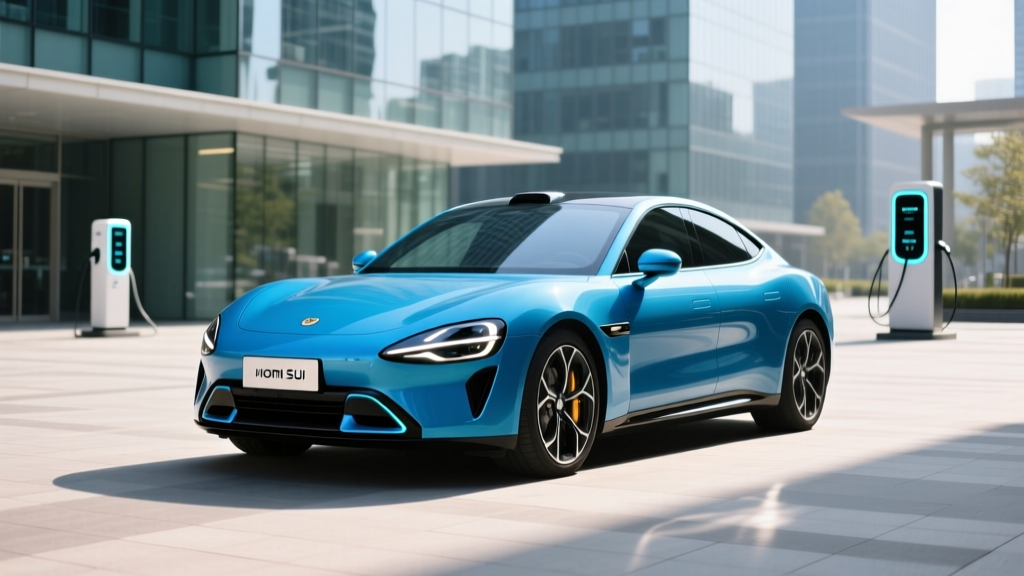
Xiaomi's leap from smartphones to electric vehicles has been one of the most closely watched industrial pivots in the EV space. For buyers tracking whether Xiaomi is a credible automaker or a flash-in-the-pan tech experiment, the answer lies in hard output data. Here's the direct answer to what most searchers want to know:
Xiaomi EV Production Numbers — Quick Answer
Xiaomi produced and delivered approximately 136,000+ SU7 units (including the SU7 Pro and SU7 Max variants) from its Beijing Phase 1 factory by the end of 2025, far exceeding its original 100,000-unit annual target. The company raised its 2025 delivery target to 130,000 mid-year and surpassed it. Phase 2 of the Beijing factory, expected online in 2026, will push combined annual capacity toward 300,000 units. Xiaomi has also announced the YU7 SUV, with preliminary production expected mid-2026.
Those numbers matter because production volume directly affects parts availability, service network growth, resale value stability, and whether Xiaomi will ever sell outside China. Let's break down what these production figures mean in practical terms — and whether a Xiaomi EV makes sense if you're evaluating it against established competitors.
Xiaomi SU7 by the Numbers: Specs That Matter for Ownership
Production volume only tells half the story. The other half is what Xiaomi is actually building. The SU7 sedan lineup — the standard SU7, SU7 Pro, and SU7 Max — targets the premium electric sedan segment occupied by the Tesla Model 3 and Porsche Taycan. Here's what the current specs look like:
| Specification | SU7 Standard | SU7 Pro | SU7 Max |
|---|---|---|---|
| Battery (usable) | 73.6 kWh (LFP) | 94.3 kWh (NMC) | 101 kWh (NMC) |
| CLTC Range | 700 km (~435 mi) | 830 km (~516 mi) | 800 km (~497 mi) |
| Estimated Real-World Range | ~330-370 mi | ~390-430 mi | ~370-410 mi |
| Peak DC Fast Charge | ~180 kW | ~210 kW | ~290 kW (800V) |
| 10-80% DC Charge Time | ~28 min | ~25 min | ~19 min |
| 0-100 km/h (0-62 mph) | 5.28 sec | 5.27 sec | 2.78 sec |
| Horsepower | 299 hp | 299 hp | 673 hp |
| Drivetrain | RWD | RWD | AWD |
| China Starting Price | ~¥215,900 (~$29,700) | ~¥245,900 (~$33,800) | ~¥299,900 (~$41,200) |
Range caveat: Xiaomi publishes CLTC range figures, the Chinese testing standard that tends to overestimate by 15-25% compared to the US EPA cycle. The real-world estimates above factor in typical highway driving, moderate climate control use, and mild cold-weather degradation. If you're in a region with harsh winters, expect an additional 15-30% reduction from those real-world figures.
Charging curve reality: The SU7 Max's 800-volt architecture enables that impressive 290 kW peak, but like all EVs, the charge rate tapers significantly above 80% state of charge. The 10-80% time of ~19 minutes is the useful metric — a full 0-100% session will take considerably longer. On a typical 150 kW public charger, expect the Max to charge at its infrastructure-limited peak for most of the session.
Production Capacity vs. Demand: The Waitlist Reality
Xiaomi's Beijing factory in Yizhuang was purpose-built for EV production. Phase 1 has a nameplate capacity of roughly 150,000 units per year on two shifts, and Xiaomi ran it near maximum utilization through 2025 to meet overwhelming demand. At various points in 2024-2025, SU7 order wait times stretched to 20-30 weeks — a clear signal that production, not demand, was the bottleneck.
The Phase 2 expansion, designed to add approximately 150,000 units of annual capacity, targets mid-2026 production start. This facility will likely handle the upcoming YU7 crossover SUV, which Xiaomi has confirmed is in development. Combined, the two phases give Xiaomi a theoretical 300,000-unit annual ceiling — enough to compete with mid-tier global EV manufacturers but still far below BYD's multi-million-unit output or Tesla's ~1.8 million annual deliveries.
For prospective buyers, the production ramp matters practically: higher volumes mean shorter wait times, more robust spare-parts supply chains, and a growing authorized service network. Xiaomi had over 700 retail and service touchpoints in China by late 2025, leveraging its existing electronics-store footprint — a distribution advantage most EV startups lack.
Cost Comparison: Xiaomi SU7 vs. the Gas and EV Competition
If Xiaomi expands to your market, the SU7's pricing positions it aggressively. Here's how ownership costs stack up against comparable vehicles over a 5-year, 60,000-mile horizon:
| Cost Factor (5 yr / 60k mi) | Xiaomi SU7 Max (est.) | Tesla Model 3 LR AWD | BMW 330i (Gas) |
|---|---|---|---|
| Purchase Price | ~$41,200 (China) | ~$47,740 (US MSRP) | ~$46,500 (US MSRP) |
| Fuel / Energy | ~$3,200 (home L2) | ~$3,500 (home L2) | ~$8,400 (gas @ $3.50/gal, 30 MPG) |
| Maintenance | ~$1,200 | ~$1,400 | ~$4,500 |
| Insurance (est.) | ~$9,000 | ~$10,500 | ~$7,800 |
| Est. Depreciation | Unknown (new brand) | ~$18,000 | ~$16,500 |
| Est. 5-Year Total | ~$54,600+ | ~$81,140 | ~$83,700 |
Key caveats: Xiaomi's US pricing is speculative — the company has not announced North American sales as of early 2026, and any imported vehicle would face tariffs that could add 25%+ to the base price. The depreciation figure for Xiaomi is genuinely unknown; first-generation vehicles from new brands historically depreciate steeply until the brand proves long-term reliability. The Tesla and BMW figures reflect established US market data.
For the fuel/energy comparison, the SU7 Max's efficiency of roughly 15-17 kWh/100 km (real-world) translates to approximately 120-130 MPGe. Charging at home on a Level 2 setup at the US average electricity rate of ~$0.16/kWh keeps per-mile costs around $0.05-0.06, versus ~$0.12-0.14/mile for the gas BMW. Public DC fast charging at $0.35-0.48/kWh narrows that gap significantly.
Real-World Ownership: What First-Time EV Buyers Must Consider
Production numbers and spec sheets don't capture the daily ownership experience. Whether you're evaluating Xiaomi or any EV, these factors determine satisfaction more than 0-60 times:
Home Charging Access
Over 80% of EV charging happens at home. If you have a garage or dedicated parking with access to a 240V circuit, a Level 2 home charger (7-11 kW) will fully replenish the SU7's battery overnight — roughly 25-40 miles of range added per hour of charging. Installation costs range from $500-$2,500 depending on your electrical panel's capacity and the distance from panel to charger location. A panel upgrade from 100A to 200A service can add $1,500-$3,000.
If you live in an apartment or lack home charging access, public charging infrastructure becomes your lifeline. Check apps like PlugShare or ChargePoint for DC fast chargers within a 10-minute drive of your home or workplace. Relying exclusively on public charging adds cost (2-3x home rates) and time (20-40 minute sessions, 2-3 times per week).
Climate and Driving Patterns
Lithium-ion batteries lose efficiency in cold weather. In sustained sub-freezing temperatures, expect 15-30% range reduction depending on how aggressively you use cabin heating. The SU7 Max's heat pump (standard on higher trims) mitigates this compared to resistive heating, but physics still applies. If your commute is 80+ miles round-trip in a cold climate, the Standard SU7's ~330 real-world miles could shrink to ~250 — still workable, but with less buffer than you'd expect from the sticker.
Highway driving at sustained 70-80 mph speeds also reduces range by roughly 10-15% versus the mixed-cycle real-world estimates above. EVs are most efficient in stop-and-go city driving where regenerative braking recovers energy.
Service and Parts Availability
Xiaomi's production volume directly impacts parts logistics. At 136,000+ units produced, the company is building sufficient volume to justify regional parts warehouses — but only within China currently. International buyers would face the same early-adopter service challenges that plagued early Tesla, Rivian, and Lucid owners: long waits for body panels, limited certified collision repair shops, and a service network still filling in gaps.
Common Misconceptions About Xiaomi's EV Ambitions
| Myth | Fact |
|---|---|
| "Xiaomi is just rebadging another company's EV." | Xiaomi designed the SU7 on its own proprietary "Modena" platform, developed in-house over 3+ years with a reported $10B+ investment commitment. |
| "A phone company can't build a reliable car." | Xiaomi contracted experienced automotive manufacturing talent and built a dedicated, highly automated factory. Early reliability data from 136,000+ units is still maturing, but initial build-quality reviews from Chinese automotive media have been broadly positive. |
| "Xiaomi EVs will be cheap globally like their phones." | China pricing starts under $30K, but tariffs, homologation costs, shipping, and local service infrastructure would push US/EU prices significantly higher — likely $45K-60K+ for comparable trims. |
| "Production numbers this high mean they're cutting corners." | Xiaomi's factory uses advanced die-casting (similar to Tesla's gigacasting) and high automation. Volume production with quality control is standard for modern EV plants — the real test is long-term durability data, which requires more time. |
| "The SU7 qualifies for the US $7,500 tax credit." | The SU7 is not sold in the US. Even if it were, §30D credit eligibility requires final assembly in North America and compliance with battery-sourcing and critical-mineral requirements — none of which the SU7 currently meets. |
Decision Framework: Should You Wait for Xiaomi or Buy Now?
If / Then Guide
Choose to buy a current EV now (Tesla Model 3, Hyundai Ioniq 6, BMW i4) if:
- You need a vehicle within the next 3-6 months
- You live outside China and have no confirmed Xiaomi availability timeline
- Established service networks and known depreciation curves matter to you
- You want to take advantage of current-year §30D federal tax credits (up to $7,500 for qualifying new EVs assembled in North America, subject to MSRP caps of $55K for sedans / $80K for SUVs, buyer income limits of $150K single / $300K joint, and battery-sourcing requirements — see IRS.gov for current eligibility rules)
Consider waiting for Xiaomi if:
- You're based in China or a confirmed Xiaomi EV export market
- You want a premium-performance EV at a potentially lower price point than Tesla or European competitors
- You're evaluating the YU7 SUV (expected mid-2026) and prefer a crossover form factor
- You're comfortable with first-generation product risk and an unproven long-term reliability record
- You have reliable home charging and don't depend on an immature public service network
What Xiaomi's Production Trajectory Signals for the EV Market
Xiaomi reaching 136,000+ units in essentially its first full production year is significant context. For comparison, Tesla delivered roughly 142,000 vehicles globally in its first full year of Model 3 production (2018), and Rivian produced approximately 57,000 vehicles in its first full year (2022). Xiaomi's ramp is competitive with the fastest EV production scaling in history — though it benefits from entering the market a decade later with mature supply chains and a massive domestic market.
The question for global buyers isn't whether Xiaomi can build EVs at scale — the production numbers answer that. It's whether Xiaomi will navigate the regulatory, tariff, and service-network challenges required to sell outside China. The EU's countervailing tariffs on Chinese EVs (ranging from 17-35%+ depending on manufacturer) and the US's effective tariff wall make near-term Western market entry economically challenging. Markets in Southeast Asia, the Middle East, and Latin America are more likely initial export targets.
For US-based shoppers, the practical takeaway: Xiaomi's production success validates the competitive pressure on established EV makers. Even if you never buy a Xiaomi, the SU7's pricing in China is forcing Tesla, Volkswagen, and others to accelerate cost reduction. That competition benefits every EV buyer through lower prices and faster innovation across the market.
Frequently Asked Questions
Can I buy a Xiaomi SU7 in the United States?
No. As of early 2026, Xiaomi has not announced any plans to sell vehicles in the US market. The SU7 is currently available only in China. Even if Xiaomi announced US sales, the vehicle would need to pass NHTSA homologation, meet US safety standards, and navigate significant import tariffs that would substantially increase its price.
How does the SU7's range compare to a Tesla Model 3?
The SU7 Pro's estimated real-world range of ~390-430 miles is competitive with the Tesla Model 3 Long Range (EPA 341 miles). However, Xiaomi uses the more generous CLTC testing standard. On a comparable basis, the SU7 Pro likely delivers 350-380 EPA-equivalent miles — roughly on par with or slightly above the Model 3 LR. The SU7 Max trades some range for its dual-motor AWD performance, similar to the Model 3 Performance.
What battery chemistry does the SU7 use?
The base SU7 uses an LFP (lithium iron phosphate) battery supplied by BYD — offering excellent cycle life and thermal stability but lower energy density. The Pro and Max variants use NMC (nickel manganese cobalt) cells from CATL, providing higher energy density for longer range and performance. LFP batteries can be charged to 100% regularly without degradation concerns; NMC batteries benefit from daily charging limits of 80-90% with periodic 100% charges for cell balancing.
Is Xiaomi's EV production sustainable long-term?
Xiaomi has committed over $10 billion to its automotive division over a 10-year horizon and has the financial backing of its profitable consumer electronics business. The Phase 2 factory expansion signals confidence in sustained demand. The risk factors include intense Chinese EV price competition (a brutal price war has been ongoing since 2023), thin or negative margins on vehicle sales, and the capital intensity of international expansion.
Does Xiaomi's EV qualify for any US tax credits?
No. The Xiaomi SU7 is not sold in the US and would not qualify for the federal §30D clean vehicle credit even if it were. The credit requires final assembly in North America, compliance with critical-mineral and battery-component sourcing rules, and adherence to MSRP and buyer income caps. Always verify current rules at IRS.gov or consult a tax professional.