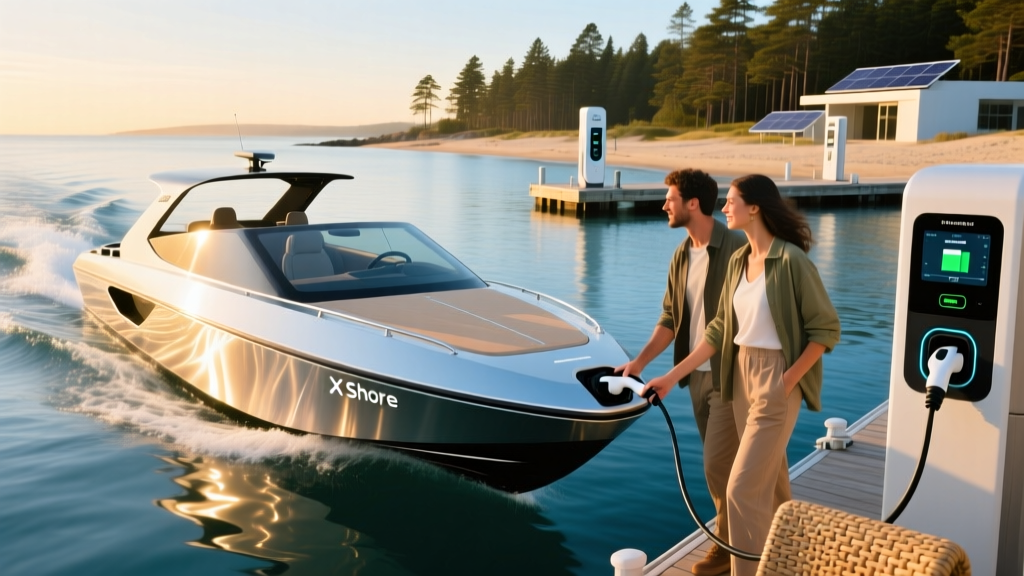
Quick Answer: X Shore electric boats are premium, zero-emission watercraft from a Swedish manufacturer that applies EV-style battery and motor technology to boating. The flagship X Shore 1 (announced 2023, deliveries ongoing into 2026) carries a 125 kWh battery pack, a 150 kW electric motor, and a starting price around $230,000–$250,000 depending on configuration. If you're an EV owner curious about electric boating, X Shore represents the Tesla-equivalent of the marine world — but with important differences in range, charging infrastructure, and ownership economics that this guide breaks down with real numbers.
As electric vehicle adoption accelerates on roads, the marine industry is following a similar electrification trajectory. X Shore, founded in Stockholm in 2016 by former Tesla engineers, is one of the most prominent names in premium electric boating. For EV owners already familiar with kWh, DC charging curves, and battery degradation, the leap to electric boating feels intuitive — but the physics, infrastructure, and economics of moving a hull through water are fundamentally different from rolling tires on asphalt.
This guide examines X Shore electric boats through the lens of an experienced EV analyst: exact battery specs, realistic range expectations, charging logistics, cost of ownership, and a practical framework for deciding whether electric boating makes sense for you.
X Shore Electric Boats: Models, Battery Specs, and Performance
X Shore's current product strategy centers on the X Shore 1, a 6.5-meter (21.3-foot) day cruiser designed for coastal and lake use. Here are the key specifications based on manufacturer data:
| Specification | X Shore 1 (Evasion / Cabin) |
|---|---|
| Battery Capacity | 125 kWh (LFP chemistry) |
| Motor Power | 150 kW (~200 HP equivalent) |
| Top Speed | ~30 knots (~35 mph) |
| Cruising Speed | ~15–20 knots |
| Range (at cruising speed) | ~50 nautical miles (~58 statute miles) |
| Range (at top speed) | ~20–25 nautical miles |
| Charging (AC Level 2) | ~22 kW onboard charger |
| Charging (DC Fast Charge) | Up to 100 kW (0–80% in ~1 hour) |
| Hull Material | Carbon fiber composite |
| Length | 6.5 m (21.3 ft) |
| Starting Price (estimated) | $230,000–$250,000+ |
A few things jump out if you're coming from the EV world. First, 125 kWh is a massive battery — roughly the size of a GMC Hummer EV or two Tesla Model 3 Long Range packs. Second, range is measured in nautical miles and is heavily speed-dependent, much like how highway driving at 80 mph slashes an EV's EPA range. At cruising speed, 50 nautical miles is workable for a day trip; at full throttle, you'll drain the pack in under an hour.
The LFP (lithium iron phosphate) chemistry choice mirrors the trend in ground EVs: LFP offers superior cycle life (3,000+ cycles to 80% capacity) and thermal stability, though at lower energy density than NMC. For a boat where weight is less critical than in a car and safety near water is paramount, LFP is a logical pick.
Charging an Electric Boat: What EV Owners Need to Know
If you've installed a Level 2 home charger for your EV, you might assume charging a X Shore at your dock is straightforward. It's more complex than that.
Charging Reality Check: A 125 kWh battery at 22 kW AC takes roughly 5.5–6 hours for a full charge. At a marina with DC fast charging (still rare), a 100 kW charger delivers 0–80% in about an hour. Most marinas in 2026 do not yet have DC fast-charging infrastructure comparable to highway EV networks.
Here's how marine charging compares to what EV owners experience on land:
| Charging Level | Power | Time (125 kWh) | Availability at Marinas |
|---|---|---|---|
| Standard Shore Power (30A/120V) | ~3.6 kW | ~35 hours (full) | Common |
| Marina AC (50A/240V) | ~11–22 kW | ~6–12 hours | Available at modern marinas |
| DC Fast Charge (marine) | ~50–100 kW | ~1–2 hours (0–80%) | Limited; growing in Scandinavia, US coasts |
Key takeaway for EV owners: Unlike road trips where Electrify America or Tesla Supercharger networks offer 150–350 kW DC fast charging every 50–100 miles, marine charging infrastructure in 2026 is still developing. Most X Shore owners charge overnight at their dock on AC power, similar to Level 2 home charging for an EV. Planning longer coastal trips requires advance research on marina charging capabilities.
Electric Boat vs. Gas Boat: Cost and Ownership Comparison
The most common question from prospective buyers: does an electric boat save money compared to a gas-powered equivalent? The answer depends heavily on usage patterns, but here's a data-driven breakdown comparing the X Shore 1 to a comparably sized gas-powered day cruiser (e.g., a 21-foot bowrider with a 200 HP outboard).
| Factor | X Shore 1 (Electric) | Gas Day Cruiser (200 HP) |
|---|---|---|
| Purchase Price | $230,000–$250,000 | $50,000–$80,000 |
| Fuel/Energy Cost per Hour (cruising) | ~$8–$15 (at $0.15/kWh) | ~$40–$70 (at $4.50/gal, 5–8 GPH) |
| Annual Fuel/Energy (100 hrs/yr) | ~$1,000–$1,500 | ~$4,000–$7,000 |
| Annual Maintenance | ~$500–$1,000 (minimal) | ~$1,500–$3,000 (engine, winterization, oil) |
| Winterization | Not required (no raw-water cooling) | $300–$600/year |
| Insurance (estimated annual) | $3,000–$5,000 | $1,000–$2,000 |
| 5-Year Energy + Maintenance Total | ~$7,500–$12,500 | ~$27,500–$50,000 |
The numbers tell a clear story: operating costs for an electric boat are dramatically lower, saving $3,000–$6,000+ per year in fuel and maintenance. However, the purchase price premium is enormous — roughly $150,000–$180,000 more than a gas equivalent. At current savings rates, the payback period stretches well beyond a decade unless you log very high annual hours.
This mirrors the early days of EVs, where high upfront costs were offset by lower operating expenses. The difference is that marine electrification is further behind the cost curve than ground vehicles. Battery costs per kWh have dropped significantly (from ~$1,200/kWh in 2010 to roughly $100–$130/kWh at the cell level in 2026, per BloombergNEF data), but marine-grade packaging, waterproofing, and low production volumes keep system-level costs high.
Federal Tax Credits and Incentives: Does §30D Apply to Boats?
A critical point that trips up many EV owners exploring electric boats: the IRS §30D Clean Vehicle Credit does not apply to boats. The federal tax credit under the Inflation Reduction Act covers new and used electric motor vehicles for road use — specifically those with four wheels and a gross vehicle weight under 14,000 lbs, per IRS guidelines.
| Myth | Fact |
|---|---|
| "I'll get the $7,500 EV tax credit for my electric boat." | §30D applies only to road vehicles. Boats are excluded. |
| "Electric boats qualify for the used-EV $4,000 credit." | Same restriction — road vehicles only. |
| "My state offers incentives for electric marine vessels." | Possibly. Some coastal states (CA, WA, FL) and Scandinavian countries offer marine electrification grants. Check your state energy office or local clean-marina programs. |
| "Commercial electric vessels get federal incentives." | The EPA's Clean Ports Program and certain DOT maritime grants may cover commercial electric vessels — consult a tax professional for business-use eligibility. |
For private recreational buyers in the US, expect to pay full price with no federal tax offset. This is a significant factor in the total-cost-of-ownership calculation and one of the main reasons electric boating adoption lags behind electric cars.
Real-World Range: What the Numbers Actually Mean on the Water
EV owners already know that EPA range is a best-case scenario. Highway speeds, cold weather, and elevation changes all reduce real-world range. The same principles apply — but are amplified — on the water.
X Shore rates the X Shore 1 at approximately 50 nautical miles at cruising speed. Here's what to expect in practice:
- Calm conditions, 15-knot cruise: ~45–50 nmi (close to rated)
- Choppy water or headwinds: ~30–40 nmi (20–40% reduction)
- Full throttle (30 knots): ~20–25 nmi (50%+ reduction)
- Cold water / cold air (below 45°F): ~10–15% range loss from battery chemistry slowdown, similar to EV winter range loss
- Heavily loaded (max passengers + gear): ~5–10% reduction
Unlike an EV on a highway where you can pull into any charging station, running low on battery in open water is a genuine safety concern. Most experienced X Shore owners plan routes conservatively, keeping a 30–40% battery buffer for the return trip — similar to how EV road-trippers plan around charger availability but with far fewer backup options.
Decision Framework: Should You Buy a X Shore Electric Boat?
Choose X Shore if:
- You boat primarily on lakes, calm coastal waters, or protected bays within a 25-nmi radius of your dock
- You have reliable dock power (at minimum 50A/240V shore power) for overnight charging
- You value silence, zero exhaust fumes, and instant torque on the water
- You log 80–150+ hours per year, making fuel savings meaningful
- You view the purchase as a premium lifestyle product (like a Porsche Taycan vs. a Toyota Camry — the economics don't pencil out purely on savings)
- You want minimal maintenance — no oil changes, no winterization, no impeller replacements
Stick with gas (or wait) if:
- You regularly boat more than 40 nmi from your dock or need open-ocean range
- Your marina lacks adequate shore power and DC fast charging isn't available nearby
- Budget is a primary concern — a gas boat costs 70–80% less upfront
- You need towing capacity for water sports (electric boats currently lag in sustained high-power towing)
- You boat in remote areas with no charging infrastructure whatsoever
What First-Time Electric Boat Buyers Should Know
If you're an EV owner considering your first electric boat, here are the ownership realities that differ from cars:
1. Battery degradation still applies, but differently. LFP batteries in X Shore vessels are rated for 3,000+ cycles to 80% capacity. At 100 outings per year, that's 30+ years of use before meaningful degradation — far longer than most owners keep a boat. Marine environments add corrosion risk to connections and cooling systems, so annual inspections of the battery enclosure are wise.
2. Insurance is more expensive and less standardized. Marine insurers are still developing actuarial models for electric boats. Expect premiums 50–100% higher than gas equivalents, partly due to the higher replacement value and partly because claims data on electric marine batteries is limited. Get quotes before purchasing.
3. Resale value is uncertain. The EV market has seen steep depreciation as battery costs fall and new models launch (check used Tesla Model 3 prices for reference). Electric boats, with even smaller production volumes and faster-moving technology, may depreciate significantly in the first 3–5 years.
4. Service networks are thin. Unlike EVs where mobile technicians and dealership service departments are increasingly trained, electric boat service often requires contacting the manufacturer directly or finding a marine electrician with specific X Shore training. In the US, X Shore's service network is still expanding as of 2026.
5. Slip fees don't decrease. Marina slip fees are based on boat length, not propulsion type. You'll pay the same monthly dockage as a gas boat of the same size.
The Bottom Line on X Shore Electric Boats
X Shore represents the leading edge of electric boating — impressive technology, genuine environmental benefits, and an ownership experience that feels futuristic. For EV owners who already understand battery management, charging logistics, and the trade-offs of early-adopter technology, the transition to electric boating is conceptually smooth.
But the economics don't favor electric boats the way they increasingly favor electric cars. The upfront premium is 3–4x a gas equivalent, federal tax credits don't apply, charging infrastructure is sparse, and range is genuinely limiting for anything beyond day trips. This is a purchase driven by values (zero emissions, silent operation, minimal maintenance) and lifestyle rather than pure financial logic.
If you're ready to spend $250,000+ on a premium day cruiser and your boating habits align with the range envelope, X Shore delivers a remarkable experience. If you need versatility, long range, or budget efficiency, gas or a hybrid marine setup remains the pragmatic choice in 2026 — with electric options likely improving significantly by 2028–2030 as battery costs continue their downward trend.
Frequently Asked Questions
How long does a X Shore electric boat battery last?
X Shore uses LFP chemistry rated for 3,000+ charge cycles to 80% capacity. At typical recreational use (50–100 cycles per year), the battery should retain over 80% capacity for 20+ years. X Shore provides a battery warranty, though specific terms vary by market — confirm current warranty details with your dealer.
Can I charge a X Shore boat at my home dock?
Yes, if your dock has adequate electrical service. A standard 30A/120V marine shore power connection charges at ~3.6 kW (full charge in ~35 hours). A 50A/240V connection delivers ~11–22 kW (full charge in 6–12 hours). You may need an electrician to upgrade your dock's electrical panel for faster charging, similar to upgrading your home panel for an EV Level 2 charger.
How does X Shore compare to other electric boat brands?
X Shore competes with brands like Candela (hydrofoiling electric boats, ~$300,000+), Frauscher (Austrian electric boats, various sizes), and Arc One (US-based, backed by venture funding). X Shore differentiates on Scandinavian design, LFP battery safety, and a relatively accessible price point within the premium electric boat segment. Range and charging speeds are broadly comparable across the category.
Do electric boats work in saltwater?
Yes. X Shore designs its vessels for both freshwater and saltwater use, with corrosion-resistant materials and sealed battery enclosures. Post-outing freshwater rinses of the hull and fittings are recommended, just as with any boat. The electric drivetrain itself is sealed and doesn't require the raw-water cooling that gas marine engines need — one fewer corrosion point.
Is an electric boat actually better for the environment?
It depends on your electricity source. If your marina's grid power comes from renewables or nuclear, the lifecycle emissions advantage over gas is substantial. If you're on a coal-heavy grid, the advantage narrows but doesn't disappear — electric motors are 85–90% efficient vs. 25–30% for gas outboards, so even dirty-grid electricity produces fewer emissions per mile. Plus, zero on-water emissions means no fuel spills, no exhaust fumes, and no oil sheen in sensitive waterways.