The Quick Answer
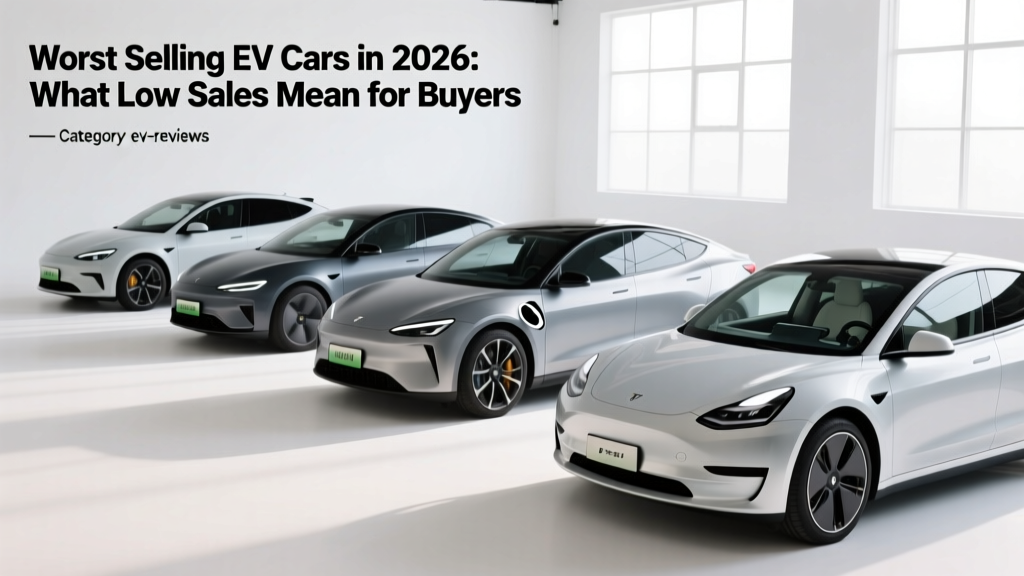
The worst selling EV cars in early 2026 share a common pattern: they are either overpriced relative to their EPA range, stuck with slow DC fast-charging speeds (under 100 kW peak), or discontinued models with uncertain parts support. Models like the outgoing Nissan LEAF (149-mile base range), the MINI Cooper SE (114-mile range), and several luxury EVs with six-figure price tags and sub-250-mile ranges have posted the steepest sales declines. Low sales volume translates directly into higher depreciation — some of these vehicles lose 50–65% of their value within three years, compared to 30–40% for high-volume EVs like the Tesla Model Y or Hyundai IONIQ 5. If you are shopping for an EV in 2026, sales data is a useful proxy for long-term ownership risk.
Why Some EVs Barely Sell — And Why It Matters to You
EV sales in the U.S. crossed 1.3 million units in 2025, but that growth has not been evenly distributed. While models like the Tesla Model Y, Chevrolet Equinox EV, and Hyundai IONIQ 5 dominate volume charts, a long tail of EVs is struggling to move metal. Understanding why certain EVs are the worst selling cars in the segment is the fastest way to avoid a costly ownership mistake.
The reasons cluster into four categories:
- Range-to-price mismatch: A $45,000 EV with 150 miles of EPA range cannot compete with a $38,000 EV offering 300+ miles. Buyers have done the math.
- Charging speed deficits: In 2026, competitive DC fast charging means a peak rate of at least 150 kW and a 10–80% charge in under 25 minutes. Models stuck at 50 kW or below are functionally obsolete for road trips.
- Discontinuation risk: When an automaker announces an EV is being phased out, dealers discount heavily, but buyers face long-term parts scarcity and plummeting resale values.
- Connector obsolescence: The industry's shift to the North American Charging Standard (NACS) means older CCS-only vehicles without adapters face reduced access to Tesla Superchargers, the largest fast-charging network in the U.S.
2026's Lowest-Volume EVs: The Data
Below is a snapshot of EVs posting the weakest U.S. sales figures through late 2025 and into the 2026 model year, along with the specs that explain their market struggles. Note: sales figures are approximate based on industry reporting and manufacturer disclosures.
| Model | Base MSRP | EPA Range | Battery (kWh) | Peak DC Charge (kW) | 10–80% Time | 0–60 mph |
|---|---|---|---|---|---|---|
| MINI Cooper SE (2025) | $30,900 | 114 mi | 32.6 (NMC) | 50 kW | ~36 min | 6.9 sec |
| Nissan LEAF S (2025 final yr) | $29,135 | 149 mi | 40 (LMO) | 50 kW (CHAdeMO) | ~40 min | 7.4 sec |
| Mazda MX-30 (discontinued) | $35,385 | 100 mi | 35.5 (NMC) | 50 kW | ~36 min | 9.1 sec |
| Fisker Ocean (company bankrupt) | $38,999 | 250 mi | 113 (NMC) | 250 kW (theoretical) | N/A (infra collapsed) | 3.6 sec |
| Mercedes EQS 450+ (2025) | $105,550 | 352 mi | 118 (NMC) | 200 kW | ~31 min | 5.9 sec |
Real-World Range Reality: The EPA range figures above are laboratory estimates. In real-world highway driving at 70 mph, expect a 10–15% reduction. In cold weather (below 30°F), range can drop 20–35% depending on whether the vehicle has a heat pump. The MINI Cooper SE's 114-mile EPA range can shrink to roughly 75–85 miles in winter — making it viable only as a dedicated city commuter with reliable home charging.
What Low Sales Mean for Your Wallet
Buying one of the worst selling EV cars is not automatically a bad decision — steep dealer discounts can create bargains — but it introduces specific financial risks you need to quantify before signing.
Depreciation: The Hidden Cost
High-volume EVs benefit from established demand in the used market. Low-volume or discontinued models do not. According to iSeeCars depreciation data, discontinued or low-volume EVs can lose 55–65% of their MSRP within three years. By contrast, a Tesla Model Y or Toyota bZ4X typically retains 55–65% over the same period.
| Cost Factor | High-Volume EV (e.g., IONIQ 5) | Low-Volume / Discontinued EV |
|---|---|---|
| Purchase Price (after incentives) | ~$37,000 | ~$28,000 (heavy discount) |
| 3-Year Depreciation | ~$12,000 (32%) | ~$16,000 (57%) |
| Insurance (annual avg) | $1,800 | $1,600–$2,400 (varies wildly) |
| Parts Availability (5-yr outlook) | Strong | Risk of scarcity |
| Charging Network Access | NACS adapter or native | CHAdeMO/CCS — shrinking networks |
| Estimated 5-Yr Total Cost | ~$52,000 | ~$50,000–$56,000 |
The discounted purchase price of a slow-selling EV can be wiped out by worse depreciation and higher long-term ownership friction. Run the numbers before you buy.
Federal Tax Credit Eligibility
Under the IRS §30D clean vehicle credit, eligibility depends on MSRP caps ($55,000 for sedans, $80,000 for SUVs/trucks), buyer income limits ($150K single / $300K joint), and battery critical-mineral and component sourcing rules that tighten annually. Many of the worst selling EVs — especially luxury models like the EQS — exceed MSRP caps, and several discontinued models no longer qualify because their battery supply chains do not meet 2026 sourcing thresholds. Always verify eligibility on the IRS portal before assuming a $7,500 credit.
EV vs. Gas vs. Hybrid: Putting the Costs in Context
If you are cross-shopping a low-volume EV against a conventional hybrid or gas car, here is how the math stacks up over five years and 75,000 miles of driving.
| Category | Budget EV (Low-Volume) | Toyota Prius (HEV) | Toyota Corolla (Gas) |
|---|---|---|---|
| Purchase Price | $28,000 | $29,450 | $23,000 |
| Fuel / Electricity (5 yr) | $3,750 (home L2, $0.14/kWh) | $5,625 (57 MPG, $3.50/gal) | $8,400 (33 MPG, $3.50/gal) |
| Maintenance (5 yr) | $1,500 | $2,800 | $3,500 |
| Depreciation (5 yr) | $16,000 | $10,500 | $11,000 |
| Total 5-Yr Cost | $49,250 | $48,375 | $45,900 |
The low-volume EV's fuel savings are real — roughly $4,650 less than a gas Corolla over five years — but its steep depreciation erases the advantage. A high-volume EV with better resale value (e.g., Model Y, IONIQ 5) would win this comparison handily. The lesson: the EV has to be the right EV, not just any EV.
Common Misconceptions About Low-Selling EVs
| Myth | Fact |
|---|---|
| "A cheap EV is always a good deal." | A $28,000 EV with 114 miles of range and 50 kW charging may cost more per usable mile than a $35,000 EV with 300+ miles and 200 kW charging. Calculate cost per mile of range. |
| "I can just use public chargers." | Public DC fast charging costs $0.35–$0.55/kWh in 2026 — often more expensive per mile than a fuel-efficient hybrid. Without home or workplace Level 2 charging, EV ownership costs rise sharply. |
| "All EVs qualify for the $7,500 tax credit." | Under current IRS §30D rules, eligibility depends on MSRP, income, and battery sourcing. Many low-volume or discontinued models fail sourcing requirements. Always check before purchase. |
| "Discontinued models are fine — parts are always available." | EV-specific parts (battery modules, power electronics, thermal management components) have limited aftermarket supply. If the manufacturer exits the segment, parts lead times can stretch to months. |
| "CHAdeMO charging still works fine." | CHAdeMO infrastructure is shrinking in the U.S. as networks prioritize NACS and CCS. Nissan LEAF owners increasingly rely on adapters or face limited fast-charging options on road trips. |
Decision Framework: Should You Buy One of the Worst Selling EV Cars?
Buy a low-volume EV if:
- You have reliable home Level 2 charging (240V, 32A+ circuit) and drive under 60 miles round-trip daily.
- The dealer discount is steep enough (30%+ off MSRP) that even 60% depreciation over three years leaves you ahead versus a higher-priced alternative.
- You plan to drive the car into the ground (8+ years) rather than resell — depreciation matters less if you keep the vehicle long-term.
- The model has a strong battery warranty (8 yr / 100,000 mi) still in effect and the manufacturer continues to support service.
Avoid a low-volume EV if:
- You regularly drive more than 150 miles between charging opportunities.
- You lack home or workplace charging and would rely on public DC fast chargers daily.
- You plan to sell or trade the vehicle within 3–4 years — depreciation will sting.
- The model uses CHAdeMO or an orphaned connector with no NACS adapter available.
- The manufacturer has filed for bankruptcy or announced the model's discontinuation without a clear service-support plan.
What First-Time EV Buyers Should Know
If this is your first EV purchase, the worst selling EV cars are the wrong place to start. Here is a practical checklist:
- Confirm home charging feasibility. A Level 2 home charger (7.7–11.5 kW) costs $500–$2,500 installed depending on your electrical panel. If you need a 200A panel upgrade, add $1,500–$3,500. Consult a licensed electrician for a site assessment.
- Calculate your real-world range needs. Take your longest regular weekly drive, add 30% for highway/cold-weather losses, and ensure the EV's EPA range covers it.
- Verify tax credit eligibility on the IRS portal — not the dealer's word — before committing.
- Test the charging network. Download the EV's native charging app plus PlugShare and EVgo/Electrify America apps. Confirm working chargers exist on your common routes.
- Check insurance quotes before purchase. EV insurance premiums can be 15–30% higher than equivalent gas vehicles, especially for low-volume models with expensive replacement parts.
Frequently Asked Questions
Are the worst selling EV cars unreliable?
Not necessarily. Low sales often reflect poor value propositions (range, price, charging speed) rather than mechanical reliability. The Nissan LEAF, for example, has a strong reliability record — its problem is a 149-mile range and CHAdeMO connector in a market that has moved on. However, discontinued models from bankrupt companies (e.g., Fisker) carry genuine long-term support risks.
Can I save money by buying a slow-selling EV at a steep discount?
Possibly, but model the total cost. A $10,000 discount on purchase price means little if the car depreciates $15,000 more than the alternative over three years. Run a five-year total cost of ownership calculation including depreciation, energy, maintenance, and insurance before deciding.
Will I have trouble charging a discontinued EV?
It depends on the connector. If the vehicle uses CCS1, most public networks still support it, and NACS adapters are increasingly available. If it uses CHAdeMO (like the LEAF), your fast-charging options are narrowing. For home Level 2 charging, the J1772 connector is universal and will remain supported indefinitely.
How do I check if a specific EV qualifies for the federal tax credit?
Visit the IRS clean vehicle credits page and cross-reference the vehicle's VIN, MSRP, and your adjusted gross income. The credit is up to $7,500 and can be transferred to the dealer as a point-of-sale discount, but battery sourcing rules tighten each year. A tax professional can confirm your specific eligibility.
What is a better alternative to the worst selling EVs?
For budget buyers, the 2026 Chevrolet Equinox EV (319 mi EPA, ~$33,000 base, eligible for §30D credit) and Hyundai IONIQ 5 (303 mi EPA, ~$42,000, NACS native) offer substantially better range, charging speed, and resale value. For city-only drivers who want the cheapest option, a used Tesla Model 3 (272+ mi EPA, Supercharger access) often costs less than a new low-range EV and holds value better.