The Quick Answer
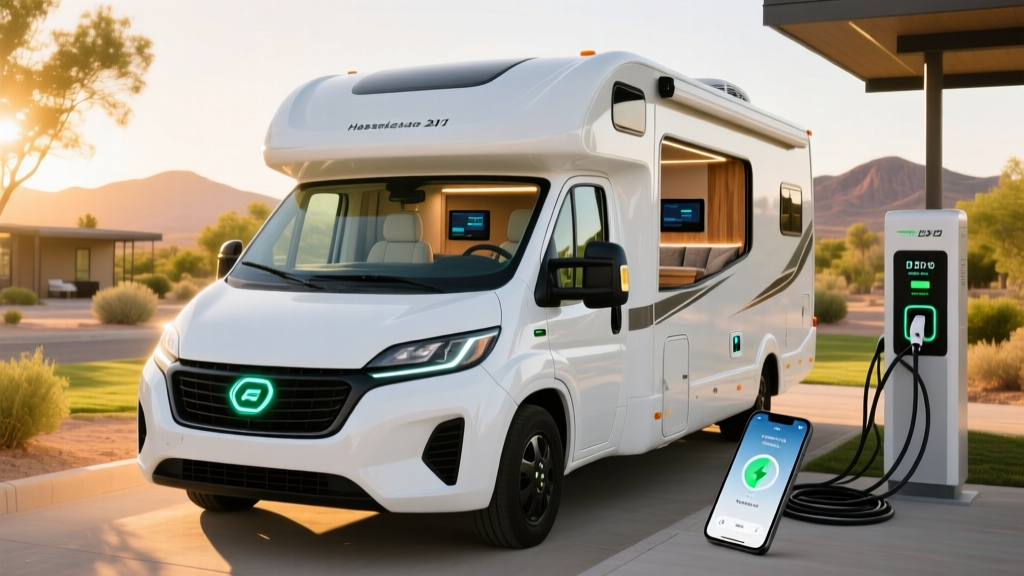
As of 2026, Winnebago does not sell a fully electric (BEV) motorhome or travel trailer in the U.S. market. The company's electrified lineup consists of the Winnebago e-RV (an all-electric Class C motorhome based on the Ford E-Transit chassis, announced as a limited-production concept) and the Winnebago Roam plug-in hybrid (PHEV) Class B van built on the Chrysler Pacifica Hybrid platform. If you're searching for a "Winnebago electric RV" you can actually buy and register today, the Roam PHEV is the closest production option, offering roughly 32 miles of electric-only range before the gas engine engages. For a pure BEV RV experience, buyers currently look to competitors like the Lightship L1 travel trailer or the Thor Motor Coach eDeluxe concept, while Winnebago's e-RV remains in fleet/limited-release status. This guide covers what's real, what's coming, and how to evaluate the costs and trade-offs of an electrified RV purchase in 2026.
Winnebago's Electrified RV Lineup: What Actually Exists
Winnebago has been vocal about electrification since debuting the e-RV concept in late 2022, but translating a 7,500-pound motorhome into a viable battery-electric vehicle involves serious physics constraints. Here's where each model stands as of the 2026 model year:
| Model | Powertrain | Status (2026) | Est. Electric Range | Base Price |
|---|---|---|---|---|
| Winnebago e-RV | BEV (Ford E-Transit chassis) | Limited production / fleet | ~108 mi (EPA chassis est.) | ~$115,000 (announced) |
| Winnebago Roam | PHEV (Chrysler Pacifica Hybrid) | Production — available | ~32 mi electric-only | ~$135,000 MSRP |
| Winnebago Solis (gas) | Gas (Ram ProMaster) | Production | N/A | ~$108,000 MSRP |
The e-RV uses the Ford E-Transit's 68 kWh usable battery pack and 266-hp electric motor. On paper, the E-Transit van chassis carries an EPA range of 108 miles. In a motorhome conversion, the added weight of living quarters (water tanks, cabinetry, appliances) pushes real-world range significantly lower — expect 70–90 miles in mixed driving, and potentially 50–60 miles at sustained highway speeds of 65–70 mph or in cold weather below 40°F.
The Roam, by contrast, pairs a 3.6L V6 with a 16 kWh battery delivering 32 miles of electric-only driving (per EPA figures for the Pacifica Hybrid platform). Once the battery depletes, it operates as a conventional hybrid at roughly 30 MPG combined — a meaningful improvement over the 16–18 MPG typical of gas Class B vans.
Electric RV vs. Gas RV: Real Cost and Efficiency Data
The core question for any electrified RV buyer is whether the premium over a gas model pays for itself. Let's compare the Winnebago Roam PHEV against the gas-powered Solis over five years of typical RV ownership (approximately 8,000 miles/year, or 40,000 miles total).
| Cost Factor | Winnebago Roam (PHEV) | Winnebago Solis (Gas) |
|---|---|---|
| Base MSRP | ~$135,000 | ~$108,000 |
| Fuel/Energy Cost (40k mi) | ~$4,800 (mix of electric + gas) | ~$10,500 (gas at $3.50/gal, 17 MPG avg) |
| Maintenance (5 yr) | ~$2,200 (oil changes, regen brake savings) | ~$3,800 (oil, brakes, transmission) |
| Insurance (5 yr est.) | ~$9,500 | ~$8,200 |
| 5-Year Total (excl. depreciation) | ~$151,500 | ~$130,500 |
| Fuel Savings vs. Gas | +$5,700 | Baseline |
The math is clear: the Roam's $27,000 price premium over the Solis is not recouped through fuel and maintenance savings alone within five years. You'd net roughly $7,200 in savings but paid $27,000 more upfront, leaving a ~$19,800 gap. The Roam makes financial sense primarily for buyers who value the electric-only campsite capability (silent operation, no generator fumes), reduced emissions, or who drive significantly more than the 8,000-mile average.
For the e-RV, the economics shift further. A full BEV motorhome eliminates fuel costs almost entirely (~$1,200 in electricity for 40,000 miles at $0.15/kWh), but the limited 70–90 mile real-world range means most trips require DC fast charging stops — and RV-sized charging infrastructure remains extremely sparse.
Charging an Electric RV: Infrastructure Reality Check
This is where most "electric RV" enthusiasm meets hard reality. Charging a BEV motorhome like the e-RV involves challenges that passenger EVs simply don't face:
| Charging Scenario | BEV RV (e-RV) | PHEV RV (Roam) | Gas RV (Solis) |
|---|---|---|---|
| Home Level 2 (240V, 48A) | ~11.5 kW; 0–100% in ~6 hrs | ~6.6 kW; 0–100% in ~2.5 hrs | N/A |
| DC Fast Charge (peak) | ~115 kW; 10–80% in ~45 min | N/A (no DC inlet) | N/A |
| Campsite 120V (Level 1) | ~1.4 kW; adds ~4 mi/hr | ~1.4 kW; adds ~4 mi/hr electric | N/A |
| Fueling/charging time per 200 mi | ~2–3 charge stops, 45+ min each | ~1 gas stop, 10 min | ~1 gas stop, 10 min |
| RV park pull-through charging | Rare — most parks lack 50A+ EVSE | Standard 30A/50A shore power works | N/A |
A critical detail most buyers overlook: a 20-foot motorhome physically cannot fit into most standard DC fast charging stalls. Electrify America and Tesla Supercharger stalls are designed for passenger vehicles. Pulling a 25-foot Class C into a charging plaza often means blocking multiple stalls or being unable to reach the cable. The e-RV's CCS1 connector is compatible with most networks, but accessing the charger is the real bottleneck.
For the Roam PHEV, this is largely a non-issue. You charge the 16 kWh battery at home or at a campground (a standard 30-amp RV outlet delivers roughly 3.6 kW, fully recharging in about 4.5 hours), and the gas engine handles longer highway segments. This is why PHEVs remain the pragmatic electrified RV choice in 2026.
Real-World Ownership Considerations
Beyond range and charging, electric RV ownership introduces practical factors that differ sharply from passenger EVs:
Weight and payload: The e-RV's battery pack adds roughly 1,000 lbs to the chassis. Combined with water (a full 40-gallon fresh tank weighs 333 lbs), propane, and cargo, payload capacity becomes tight. Winnebago lists the e-RV's GVWR at 9,500 lbs with an estimated cargo capacity around 1,200 lbs — less than comparable gas Class C models.
Cold-weather range loss: Battery chemistry doesn't care that you're on vacation. LFP and NMC packs lose 20–35% range in sub-freezing temperatures. The e-RV's heat pump (standard on the E-Transit platform) mitigates cabin heating draw, but the battery itself still suffers reduced efficiency. Expect 50–65 miles of real range in winter conditions — enough for local camping, not cross-country travel.
Boondocking capability: The e-RV's 68 kWh battery can power household systems (lights, fridge, water pump) for roughly 2–3 days of dry camping without driving — a genuine advantage over gas RVs that rely on generators. Winnebago integrates the house battery system with the traction battery, though this further reduces driving range when camping off-grid.
Towing: Neither the e-RV nor the Roam is rated for significant towing. The E-Transit chassis maxes out at roughly 3,800 lbs of tow capacity, meaning a small utility trailer at most. If you need to tow a car behind your motorhome (a common RV practice), a gas or diesel Class C remains the practical choice.
Federal Tax Credit Eligibility for Electric RVs
The IRS §30D Clean Vehicle Credit applies to qualifying new EVs and PHEVs, but RVs face unique hurdles:
- Vehicle classification: The credit requires the vehicle to be a "motor vehicle for use on public streets" with four wheels. Motorhomes qualify, but the MSRP cap differs: $80,000 for vans/SUVs/sedans and $80,000 for pickup trucks. Most Class C motorhomes, including the e-RV (~$115,000) and Roam (~$135,000), exceed this cap and are ineligible for the $7,500 federal credit.
- Buyer income limits: Even if MSRP qualified, adjusted gross income must be under $150,000 (single) or $300,000 (joint). Many RV buyers exceed these thresholds.
- Battery sourcing requirements: The credit splits into $3,750 for critical minerals and $3,750 for battery component sourcing. The E-Transit's battery sourcing has partially qualified in prior years, but final assembly and component rules shift annually.
- Point-of-sale transfer: If eligible, buyers can transfer the credit to the dealer for an upfront price reduction — but again, MSRP caps disqualify most RVs.
The bottom line: don't count on a federal tax credit to offset an electric RV purchase in 2026. Some states (California, Colorado, New York) offer additional EV incentives that may apply to motorhomes, but check your specific state's program rules before relying on them.
Decision Framework: Should You Buy an Electric or Electrified RV?
Choose the Winnebago Roam PHEV if:
- You want electric-only campsite operation (silent, no generator) but need gas range for highway travel
- You primarily camp within 100 miles of home and can charge at your destination
- You value the 30 MPG hybrid efficiency on longer trips over a gas Class B's 16–18 MPG
- You can absorb the ~$27,000 premium over a gas Solis without expecting full payback from fuel savings
Wait for a production BEV motorhome (e-RV or competitor) if:
- You exclusively camp locally (under 80 miles from home) and have reliable Level 2 home charging
- You want true zero-tailpipe-emission travel and accept the range/charging trade-offs
- You don't need to tow a vehicle or heavy trailer
- You're comfortable being an early adopter with limited service infrastructure for high-voltage RV systems
Stick with a gas/diesel RV if:
- You regularly travel 300+ miles between campsites
- You need to tow 5,000+ lbs (car, boat, or cargo trailer)
- You camp in remote areas far from DC fast charging infrastructure
- You want established service networks and lower upfront cost
Common Misconceptions About Electric RVs
| Myth | Fact |
|---|---|
| "Electric RVs can go 200+ miles on a charge" | No production electric motorhome exceeds 110 miles EPA. Real-world range for the e-RV is 70–90 miles, less in cold or highway driving. Travel trailers like the Lightship L1 (aerodynamic, ~250 mi range) are the exception, but they require a separate tow vehicle. |
| "You can charge an electric RV at any campground" | Most campgrounds offer 30A or 50A shore power for house systems, not EV-grade Level 2 charging. A 50A RV outlet at 240V delivers ~12 kW — adequate for overnight charging, but many parks prohibit using shore power for vehicle propulsion charging. |
| "Electric RVs are cheaper to own" | Fuel savings are real (~$6,000–$9,000 over 5 years), but the $25,000–$50,000 price premium, potentially higher insurance, and uncertain resale value mean total cost of ownership often favors gas models unless you drive very high annual miles. |
| "The e-RV is available to order" | As of 2026, the e-RV remains in limited/fleet production. Winnebago has not opened general consumer ordering. Check with a Winnebago dealer for current availability before planning a purchase. |
| "Solar panels on the roof can extend range meaningfully" | A typical RV roof solar array (400–800W) generates roughly 2–4 kWh per day in good sun — enough to power house systems but adding only 3–6 miles of driving range. Solar maintains your house battery, not your traction battery. |
Frequently Asked Questions
Can I buy the Winnebago e-RV in 2026?
The e-RV has been produced in very limited quantities, primarily for fleet customers and select dealers. General consumer availability remains restricted. Contact a Winnebago dealer directly for current stock, but expect limited inventory and potentially long wait times. The Roam PHEV is the readily available electrified option.
What's the real-world range of the Winnebago e-RV?
The E-Transit chassis carries an EPA estimate of 108 miles, but the motorhome conversion adds 1,500–2,000 lbs of living space. Real-world range drops to approximately 70–90 miles in moderate conditions, 50–65 miles at sustained highway speeds or in cold weather. Plan trips around this reality, not the sticker number.
Does the Winnebago Roam PHEV qualify for the $7,500 federal tax credit?
Almost certainly not. The IRS §30D credit caps eligible vans at $80,000 MSRP, and the Roam's ~$135,000 price exceeds this threshold. Consult a tax professional for your specific situation, but plan your budget without assuming the credit.
How do I charge an electric RV at home?
The e-RV requires a Level 2 home charger (240V, 48A recommended) delivering ~11.5 kW for a full charge in roughly 6 hours. Installation typically costs $1,500–$3,500 including equipment, electrical work, and permits, and may require a 200-amp panel upgrade if your home currently has 100-amp service. The Roam PHEV can charge on a standard 120V outlet (Level 1) in about 12 hours, or a 240V Level 2 in roughly 2.5 hours.
Is an electric RV practical for full-time living?
For stationary full-time use (parked at a campground with shore power), the e-RV works well — the traction battery supplements house power, and you avoid generator noise and fuel. For full-time travel involving frequent moves, the limited range and sparse RV-compatible charging infrastructure make gas or diesel more practical in 2026.
What competitors offer electric RVs I can actually buy?
The Lightship L1 is an all-electric travel trailer (not a motorhome) with an estimated 250-mile range and integrated battery, expected for delivery starting in 2025–2026 at roughly $125,000. Thor Motor Coach has shown the eDeluxe electric Class A concept but has not announced production pricing or availability. For motorhomes, Winnebago's e-RV and the Roam remain the primary nameplate options.