Quick Verdict: Can Windrose Actually Challenge Tesla's Electric Semi?
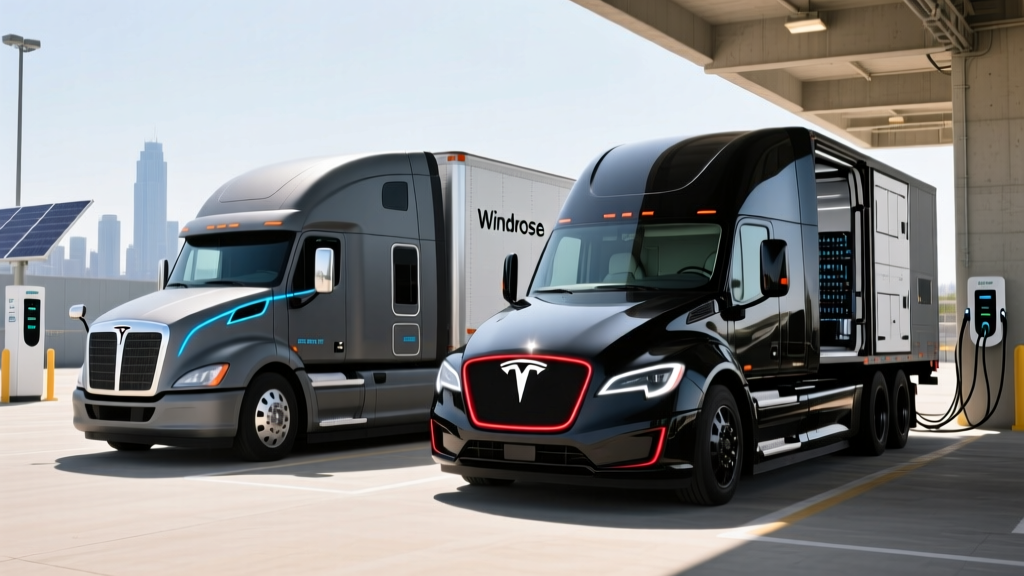
Windrose Technology has emerged as one of the most credible challengers to Tesla's dominance in the electric Class 8 trucking segment. The Chinese-American startup's cabover semi tractor targets fleet operators with a compelling proposition: comparable range to the Tesla Semi, faster DC charging capability, and a purpose-built design for hub-and-spoke freight routes. But spec sheets don't move freight — real-world reliability, charging infrastructure compatibility, and total cost of ownership do.
After analyzing Windrose's published specifications, early fleet operator feedback, and cross-referencing against the Tesla Semi's now-established performance baseline, we've built this profile to answer the question fleet buyers actually need answered: is the Windrose a viable Tesla Semi competitor for your operation in 2026?
Range, Battery, and Efficiency: The 500-Mile Question
The Windrose electric semi ships with a massive lithium iron phosphate (LFP) battery pack rated at approximately 600 kWh of usable capacity. LFP chemistry is a deliberate choice for commercial trucking: it sacrifices some energy density compared to NMC (nickel manganese cobalt) cells but delivers significantly longer cycle life (3,000+ full cycles before 80% capacity retention), superior thermal stability, and lower raw-material cost. For fleet operators planning 8-10 year service life, this trade-off makes sense.
EPA Estimated Range: 500 miles (fully loaded, 80,000 lb GCW)
Real-World Highway Expectation: ~400-440 miles at sustained 65-70 mph with a full trailer load
Cold-Weather Impact (below 32°F): Expect 15-25% range reduction, bringing effective range to ~300-375 miles depending on cabin heating and battery preconditioning
Urban/Stop-and-Go: Regenerative braking recovers significant energy — urban delivery routes may see 460-490 miles effective range
The Tesla Semi advertises 500 miles at 82,000 lb GCW on its longest-range variant, making the two trucks spec-for-spec competitors on paper. However, Tesla's NMC-based pack achieves its range with somewhat less total capacity (estimated ~500-550 kWh usable) thanks to superior energy density. The practical difference: Tesla's truck may weigh slightly less at the battery level, leaving more payload capacity under the 80,000 lb federal bridge limit.
Windrose quotes energy consumption at approximately 1.7 kWh/mile under typical highway cruise conditions. That translates to roughly 170 kWh per 100 miles — competitive with the Tesla Semi's observed 1.5-1.8 kWh/mile in real-world fleet testing documented by the National Renewable Energy Laboratory.
| Specification | Windrose Semi | Tesla Semi (Long Range) |
|---|---|---|
| EPA Est. Range (loaded) | 500 miles | 500 miles |
| Battery Capacity (usable) | ~600 kWh | ~500-550 kWh (est.) |
| Battery Chemistry | LFP | NMC |
| Efficiency (kWh/mile) | ~1.7 | ~1.5-1.8 |
| Drivetrain | Dual-motor, 6x4 | Tri-motor, 6x4 |
Charging Speed: Where Windrose Makes Its Strongest Case
For Class 8 trucks, charging downtime is revenue lost. Windrose's DC fast-charging architecture supports a peak rate of 350 kW via CCS1 connector — the North American standard for heavy-duty electric vehicles. At this rate, a 10-80% charge takes approximately 35-40 minutes, which aligns neatly with federally mandated 30-minute driver rest breaks.
However, fleet buyers should understand the charging curve reality: peak 350 kW is sustained only between roughly 10-40% state of charge. Above 60%, the charge rate tapers to protect the LFP cells, dropping to approximately 150-180 kW. This means the last 20% (60-80%) takes nearly as long as the first 50%. Smart fleet operations will charge to 80% and rotate trucks rather than wait for a full top-off.
| Charging Level | Power (kW) | Miles Added/Hour | Notes |
|---|---|---|---|
| Level 1 (120V) | Not practical | ~1-2 | Emergency trickle only |
| Level 2 (AC, depot) | 19.2-40 kW | ~11-24 | Overnight depot charging; 10+ hours for full charge |
| DC Fast (peak) | 350 kW | ~200+ | 10-80% in ~35-40 min; tapers above 60% SoC |
| Megawatt Charging (future) | Up to 1,000 kW | ~500+ | Hardware-ready; infrastructure not yet widely deployed |
The Tesla Semi uses a proprietary charging connector (compatible with Tesla's Megacharger network) that peaks at an estimated 600+ kW — but this infrastructure is exclusive to Tesla's ecosystem. Windrose's CCS1 approach gives fleet operators access to third-party heavy-duty charging networks including Electrify America's commercial stations, WattEV, and TeraWatt Infrastructure depots being built along major freight corridors.
Depot Level 2 charging is where most fleet trucks will spend their nights. Windrose supports up to 40 kW AC charging, which adds roughly 24 miles of range per hour. A fully depleted pack requires approximately 15-18 hours at 40 kW — adequate for single-shift operations with overnight layovers but tight for two-shift fleets. Budget for 2-3 depot chargers per truck to manage scheduling.
Performance, Drivetrain, and Payload
The Windrose semi uses a dual-motor configuration on the rear axles (6x4 layout), producing a combined output of approximately 700 horsepower and over 2,500 lb-ft of axle torque. The 0-60 mph time with a loaded trailer is estimated at under 20 seconds — not sports-car territory, but significantly quicker than a comparable diesel Class 8 truck, which typically takes 35-45 seconds to reach highway speed at full weight.
Unladen (bobtail), the Windrose can hit 60 mph in approximately 8-10 seconds, making highway merging confident even in dense traffic. The instant torque delivery of electric motors eliminates the turbo lag and gear-hunting that diesel drivetrains exhibit on grades.
One area where Tesla's tri-motor design holds an edge: the Semi uses one motor for efficient cruise and two additional motors for acceleration and regenerative braking. Windrose's dual-motor setup is simpler and likely lighter, but may sacrifice some regenerative braking efficiency on long downhill grades — a real consideration for mountainous routes like I-70 through Colorado or I-5 through the Siskiyou Mountains.
Payload capacity is the critical commercial metric. The Windrose tractor's curb weight (including the 600 kWh LFP pack) is estimated at approximately 20,000-22,000 lbs. Under the federal 80,000 lb gross combination weight limit, that leaves roughly 12,000-14,000 lbs for trailer and cargo — slightly less than some diesel tractors at ~16,000 lbs. However, the federal government's 2,000-lb weight exemption for electric trucks partially offsets this, allowing 82,000 lb GCW for battery-electric vehicles.
Cab Design, Tech, and Driver Experience
Windrose takes a distinctly modern approach to the cab, borrowing heavily from the Tesla Semi's center-seat driving position. The driver sits centrally with panoramic forward visibility, flanked by dual touchscreen displays handling navigation, telematics, camera feeds, and vehicle controls. There is no traditional instrument cluster — all information flows through the screens.
Standout tech features include:
- 360° camera system eliminating blind spots that plague conventional hooded trucks
- Integrated fleet telematics with real-time energy monitoring, route optimization for remaining charge, and depot charging scheduling
- Level 2 driver assistance including adaptive cruise control, lane-keeping assist, and automatic emergency braking — note that this requires active driver supervision at all times (SAE Level 2, not autonomous driving)
- Over-the-air software updates for powertrain calibration, battery management, and feature additions
- Electronic side mirrors (camera-based) reducing aerodynamic drag, though some drivers report adjustment-period challenges
The sleeper compartment is compact but functional, designed for day-cab and short-haul regional routes rather than long-haul cross-country operations. If your drivers need a full 80-inch sleeper berth for multi-day runs, the Windrose's cabover design may feel constrained compared to conventional long-nose trucks like the Freightliner eCascadia.
Pricing, Tax Credits, and Total Cost of Ownership
Windrose has targeted a base MSRP of approximately $180,000-$200,000 for its standard-range tractor, with the long-range 500-mile variant expected to price around $220,000-$250,000. For context, the Tesla Semi's 500-mile variant was announced at $250,000 (though actual contract pricing for fleet buyers like PepsiCo has not been publicly disclosed in detail).
A conventional diesel Class 8 tractor costs approximately $150,000-$180,000 new, meaning the Windrose carries a $30,000-$70,000 upfront premium. The question is whether operating-cost savings close that gap within a reasonable payback period.
| Cost Category | Windrose Electric | Diesel Class 8 |
|---|---|---|
| Purchase Price | $230,000 | $165,000 |
| Federal Tax Credit (§45W) | -$40,000 | $0 |
| Fuel/Energy (5 yr, 500K mi) | $85,000 | $250,000 |
| Maintenance (5 yr) | $18,000 | $45,000 |
| Depot Charging Install | $25,000 | $0 |
| 5-Year Total | $318,000 | $460,000 |
Important tax credit note: Commercial electric trucks do not qualify for the §30D consumer tax credit (which applies to light-duty vehicles under 14,000 lb GVWR). Instead, they fall under IRC §45W — the Commercial Clean Vehicle Credit, which provides up to $40,000 for qualifying heavy-duty electric trucks. Eligibility depends on battery sourcing requirements, manufacturer certification, and the vehicle being placed in service for business use. Always verify current-year rules with the IRS §45W guidance and consult a tax professional before purchasing.
State-level incentives can further improve the equation. California's Hybrid and Zero-Emission Truck and Bus Voucher Incentive Project (HVIP) has historically offered $40,000-$120,000 per Class 8 electric truck, though voucher availability fluctuates. Check your state's current incentive programs before finalizing purchase decisions.
Warranty and Service Infrastructure
Windrose offers a 5-year / 500,000-mile battery warranty guaranteeing 70% capacity retention — competitive for the heavy-duty segment. The powertrain (motors, inverter, reduction gear) carries a 5-year / 400,000-mile warranty. The base vehicle warranty is 3-year / 300,000-mile bumper-to-bumper.
This is where the Tesla Semi competitor comparison becomes nuanced. Tesla has an established (though sometimes criticized) service network with mobile technicians and existing Supercharger/Megacharger infrastructure. Windrose, as a newer entrant, is building its North American service footprint primarily through partnerships with third-party heavy-duty service providers and a growing depot-based support model.
For fleet operators, this means: verify that Windrose has certified service partners within a practical distance of your operating routes before committing to a large order. A truck down for parts availability is a truck not generating revenue. Early adopter fleets in California and Texas report improving but still-developing support networks.
Who Should Buy the Windrose — And Who Should Wait?
✅ Choose Windrose If:
- You run hub-and-spoke regional routes under 400 miles round-trip with predictable depot charging
- Your fleet already operates in states with strong ZEV incentives (CA, NY, NJ)
- You value CCS1 charging compatibility for access to third-party public charging networks
- LFP battery longevity aligns with your 8-10 year truck lifecycle plans
- You want to diversify away from a single OEM supplier
⏳ Wait or Choose Tesla Semi If:
- Your routes regularly exceed 450 miles without reliable mid-route charging
- You need immediate nationwide service coverage with OEM-backed mobile technicians
- Your operation requires the Tesla Megacharger network's exclusive high-speed charging
- You're risk-averse on a startup's first-generation North American product
- Long-haul sleeper operations are your primary use case
Frequently Asked Questions
What is the real-world range of the Windrose electric semi?
Windrose claims a 500-mile EPA-estimated range at 80,000 lb GCW. In real-world highway operation at sustained speeds of 65-70 mph, expect approximately 400-440 miles. In cold weather (below freezing), range drops to roughly 300-375 miles depending on conditions and whether the battery is preconditioned. Urban delivery routes with frequent regenerative braking may approach 460-490 miles.
How fast does the Windrose charge at DC fast chargers and at the depot?
At a 350 kW DC fast charger, the Windrose achieves a 10-80% charge in approximately 35-40 minutes, though charging tapers significantly above 60% state of charge. At depot Level 2 chargers (40 kW AC), expect roughly 24 miles of range added per hour, requiring 15-18 hours for a full charge — suitable for overnight single-shift operations.
Does the Windrose qualify for the federal EV tax credit?
Not the §30D consumer credit, which applies only to light-duty vehicles. As a Class 8 commercial truck, the Windrose qualifies under IRC §45W (Commercial Clean Vehicle Credit) for up to $40,000, subject to battery component sourcing requirements, manufacturer certification, and business-use placement. Consult the IRS §45W page and a qualified tax professional for your specific situation.
Is the Windrose worth buying vs the Tesla Semi?
For regional fleet operators prioritizing CCS1 charging interoperability, LFP battery longevity, and competitive pricing, the Windrose is a credible alternative. For operators needing maximum service infrastructure maturity, exclusive Megacharger access, or long-haul sleeper capability, the Tesla Semi (or waiting for additional Windrose network development) may be the safer choice. Run your specific route energy models before committing.
What are the biggest pros and cons of the Windrose semi?
Pros: 500-mile range, 350 kW DC fast charging on standard CCS1, LFP battery longevity (3,000+ cycles), competitive pricing at ~$220-250K, center-seat cab with excellent visibility, integrated fleet telematics.
Cons: Still-developing North American service network, cabover design limits sleeper size, payload slightly reduced by heavy LFP pack, LFP energy density means more battery weight than NMC competitors, limited real-world fleet track record compared to Tesla Semi's multi-year deployment with PepsiCo and others.
Can the Windrose handle cold-weather routes?
Yes, with planning. LFP chemistry is more thermally stable than NMC but still experiences 15-25% range loss in sub-freezing temperatures. The Windrose includes battery thermal management and preconditioning (warming the pack before fast charging or departure). For routes in Minnesota, Michigan, or the Northeast corridor in winter, plan for 300-375 mile effective range and ensure mid-route charging availability.