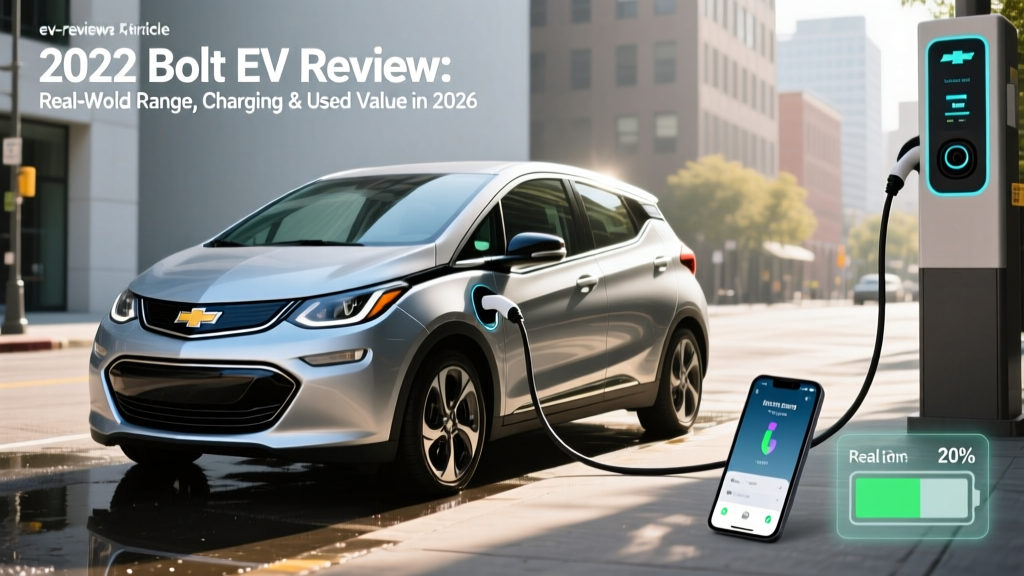
Quick Verdict: The 2022 Bolt EV as a Used-EV Bargain
Chevrolet discontinued the Bolt EV after the 2023 model year, but the 2022 Bolt EV remains one of the most compelling used electric vehicles on the market. With an EPA-estimated 259 miles of range, a spacious hatchback body, and a price that has depreciated into deep bargain territory, it serves as an ideal entry point for first-time EV buyers and budget-conscious commuters. Its biggest limitation — sluggish 55 kW DC fast charging — means road-trippers should look elsewhere, but daily drivers will find few compromises for the money.
| Spec | Value |
|---|---|
| EPA Range | 259 miles |
| Battery (Usable) | 65 kWh (NMC lithium-ion) |
| Efficiency | 120 MPGe combined / 28 kWh/100 mi |
| Motor Output | 200 hp / 266 lb-ft torque |
| Drivetrain | Front-wheel drive (single motor) |
| 0–60 mph | ~6.5 seconds |
| Max DC Fast Charge | 55 kW (CCS1) |
| Level 2 Home Charge | 11.5 kW (~39 mi/hr) |
| Cargo Volume | 57.0 cu ft (rear seats folded) |
| Battery Warranty | 8 years / 100,000 miles |
| Original MSRP (1LT) | $32,495 (incl. destination) |
Range and Efficiency: 259 EPA Miles, but Plan for Less
The 2022 Bolt EV carries a 65 kWh usable NMC (nickel manganese cobalt) battery pack. Chevrolet's official EPA rating of 259 miles placed it among the most efficient affordable EVs of its era. Efficiency is rated at 120 MPGe combined, translating to roughly 28 kWh per 100 miles — a figure that rivals the Hyundai Kona Electric and beats many larger crossovers.
Real-World Range Expectations
EPA sticker: 259 miles
City/commuter driving (mild weather): 260–280 miles — regenerative braking in stop-and-go traffic extends range.
Highway driving (70–75 mph): 210–230 miles — the Bolt's boxy shape and lack of a heat pump hurt at sustained speed.
Cold weather (below 32°F): 170–200 miles — NMC chemistry loses 20–30% in freezing temps without a heat pump to mitigate cabin draw.
Owners consistently report that the Bolt EV excels in urban and suburban driving, where one-pedal mode and aggressive regen recapture energy effectively. On extended highway trips, however, the range drops noticeably. If your commute is under 80 miles round-trip, you'll rarely need to charge outside the home.
Charging Speed: The Bolt's Biggest Weakness
Charging is where the 2022 Bolt EV shows its age most clearly. The DC fast-charging system peaks at just 55 kW on a CCS1 connector — a figure that was modest in 2022 and feels dated by today's standards, when competitors routinely hit 150–250 kW.
| Charging Level | Power (kW) | Speed | Notes |
|---|---|---|---|
| Level 1 (120V) | ~1.4 kW | ~4 mi/hr | Emergency/trickle only |
| Level 2 (240V, 48A) | 11.5 kW | ~39 mi/hr | Full charge in ~7 hours |
| DC Fast (CCS1) | 55 kW peak | ~100 mi in 30 min | 10–80% in ~55–65 min |
A 10–80% DC fast charge takes roughly 55 to 65 minutes, and the charge curve tapers significantly above 80% SoC. The Bolt does not precondition its battery for fast charging (there's no navigation-linked thermal prep), so cold-weather DC charging can be even slower. For daily use, Level 2 home charging at 11.5 kW is excellent — a full overnight replenishment is effortless. But on road trips, plan for long stops and don't rely on the Bolt for frequent 300-mile days.
Performance and Driving Dynamics
The Bolt EV's single front-mounted motor delivers 200 horsepower and 266 lb-ft of torque, sending power to the front wheels. The instant torque delivery makes the Bolt feel punchy around town, with a 0–60 mph time of approximately 6.5 seconds. That's competitive with the Nissan Leaf Plus and Kona Electric, though noticeably slower than a Tesla Model 3 or Hyundai Ioniq 5.
Ride quality is firm but compliant, and the low center of gravity (battery pack under the floor) keeps body roll in check. The steering is light and numb — this is an appliance, not a sports sedan — but the turning radius is tight, making the Bolt ideal for urban parking. Road noise becomes noticeable above 65 mph, and the suspension struggles with sharp impacts at speed.
Interior, Cargo, and Technology
Inside, the 2022 Bolt EV offers a practical, if dated, cabin. The 10.2-inch touchscreen runs Chevrolet Infotainment 3 Plus with wireless Apple CarPlay and Android Auto — a highlight at this price point. A 10.2-inch digital driver display replaces traditional gauges with customizable range and efficiency readouts.
Passenger space: Front legroom is generous at 42.8 inches, but rear legroom (38.1 inches) is tight for adults on long trips. The rear seat fits two adults comfortably or three in a pinch.
Cargo: 57.0 cubic feet with the rear seats folded and 57.0 cu ft maximum — competitive with compact crossovers. The flat load floor and wide hatch opening make it easy to haul bulky items. There is no frunk (front trunk); that space houses drive electronics.
Standard driver-assist features include Chevy Safety Assist: automatic emergency braking, forward collision alert, lane keep assist, following distance indicator, and IntelliBeam auto high beams. Adaptive cruise control was optional on 2LT and standard on the Premier trim. Notably, the Bolt lacks a 360-degree camera and offers no advanced semi-autonomous driving system (no Super Cruise availability).
Pricing, Tax Credits, and Used Value
When new, the 2022 Bolt EV started at $32,495 for the 1LT trim (including destination), with the 2LT at $34,695 and the Premier at $38,395. Aggressive dealer discounts and a late-2022 MSRP cut brought transaction prices well below sticker.
| Trim | Original MSRP | Est. Used Price (2026) | Used EV Credit (§25E) |
|---|---|---|---|
| 1LT | $32,495 | $14,000–$17,000 | Up to $4,000 |
| 2LT | $34,695 | $16,000–$19,000 | Up to $4,000 |
| Premier | $38,395 | $18,000–$22,000 | Up to $4,000 |
Federal tax credit note: The §30D new-vehicle credit no longer applies to the Bolt EV since it is out of production. However, buyers purchasing from a dealer may qualify for the §25E Used Clean Vehicle Credit, which offers up to $4,000 (30% of sale price, capped at $4,000) on used EVs priced at or below $25,000. Income caps apply: $75,000 single / $112,500 head of household / $150,000 joint filers. The vehicle must be at least two model years old and purchased from a licensed dealer. Consult a tax professional for eligibility specifics.
Battery Health, Warranty, and Recall History
The 2022 Bolt EV uses an NMC battery manufactured by LG Energy Solution. This is significant: earlier Bolt models (2017–2019) were subject to a massive battery recall due to manufacturing defects that caused fires. By 2022, GM had replaced affected packs and implemented updated manufacturing controls. The 2022 model year Bolt EV was built with the revised battery and was not subject to the original recall campaign.
GM's battery warranty covers 8 years or 100,000 miles (whichever comes first) against defects and capacity loss below 60% of original capacity. That warranty transfers to subsequent owners, meaning a 2022 Bolt purchased in 2026 still has roughly 4 years / ~60,000+ miles of battery coverage remaining.
Battery care tips for NMC chemistry: Avoid routinely charging to 100% or discharging below 10%. Daily charging to 80–90% SoC maximizes long-term health. The Bolt's infotainment system allows you to set a custom charge target — use it.
Who Should Buy the 2022 Bolt EV?
Choose the 2022 Bolt EV If:
- Your daily commute is under 100 miles round-trip
- You can install a Level 2 home charger
- You want maximum range per dollar in a used EV
- You prioritize cargo versatility (hatchback utility)
- You rarely take road trips over 200 miles
Look Elsewhere If:
- You need frequent DC fast charging for road trips (55 kW is too slow)
- You regularly carry rear-seat passengers (legroom is tight)
- You live in a cold climate without garage parking (no heat pump)
- You want the latest ADAS or semi-autonomous features
Pros
- 259-mile EPA range at a used bargain price
- Strong 11.5 kW Level 2 home charging
- Wireless Apple CarPlay / Android Auto standard
- Spacious cargo area (57 cu ft)
- Transferrable 8-yr battery warranty
- Eligible for $4,000 used EV tax credit
Cons
- 55 kW DC fast charging is painfully slow
- No battery preconditioning for DC charging
- No heat pump — cold-weather range suffers
- Rear legroom is tight for adults
- No advanced driver-assist (Super Cruise unavailable)
- Discontinued — no future OTA updates expected
Frequently Asked Questions
What is the real-world range of the 2022 Bolt EV?
Expect 260–280 miles in city driving during mild weather, 210–230 miles on the highway at 70+ mph, and 170–200 miles in freezing temperatures. The EPA sticker of 259 miles is achievable in mixed suburban driving but optimistic for highway-only or cold-weather trips.
How fast does the 2022 Bolt EV charge?
At home on a Level 2 (240V, 48A) charger, it pulls 11.5 kW and adds roughly 39 miles per hour — a full charge takes about 7 hours. On a DC fast charger, it peaks at 55 kW, taking 55–65 minutes for a 10–80% session. This is the Bolt's most significant drawback for road-trip use.
Does the 2022 Bolt EV qualify for any federal tax credit?
Not the §30D new-vehicle credit (the Bolt is discontinued). However, it may qualify for the §25E Used Clean Vehicle Credit — up to $4,000 when purchased from a dealer for $25,000 or less, subject to buyer income caps. Verify eligibility with a tax professional.
Is the 2022 Bolt EV affected by the battery fire recall?
The 2022 model year Bolt EV was built with the updated LG Energy Solution battery and was not part of the original recall that affected 2017–2019 models. However, always verify the specific VIN on NHTSA's recall lookup before purchasing to confirm no open campaigns remain.
Is the 2022 Bolt EV worth buying vs. competitors?
Against a used Hyundai Kona Electric (258 mi EPA, slightly faster DC charging) or Nissan Leaf Plus (226 mi EPA, CHAdeMO connector), the Bolt EV offers the best range-per-dollar ratio. If road-trip charging speed is a priority, a used Hyundai Ioniq 5 or Tesla Model 3 will serve you better, but at a higher price. The Bolt is the value champion for commuters who charge at home.
How long will the Bolt EV battery last?
NMC batteries in the Bolt platform have shown modest degradation — typically 5–10% capacity loss over 100,000 miles when properly maintained (avoiding routine 100% charges and deep discharges). GM's 8-year/100,000-mile battery warranty provides a safety net, and it transfers to second owners.