Quick Answer: Is the Windrose Electric Semi Worth It for Fleets?
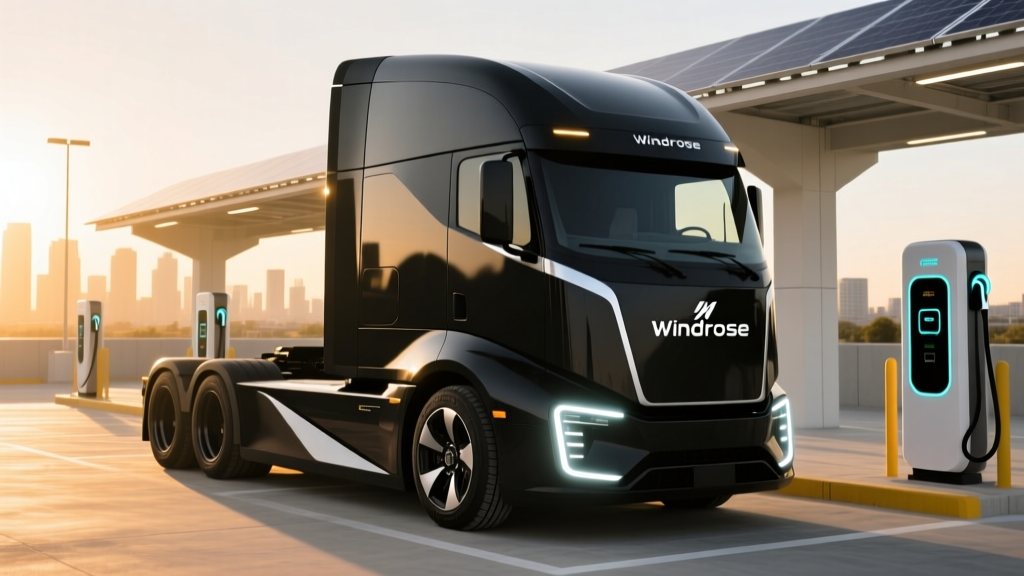
The Windrose electric semi (officially the Windrose HD) is a Class 8 battery-electric truck targeting regional-haul and drayage fleets. With an announced EPA-estimated range of up to 300 miles (in the long-range configuration), a 500+ kWh LFP battery pack, and DC fast-charging capability peaking at approximately 350 kW, the Windrose HD aims to undercut diesel operating costs on routes under 250 miles. Base pricing is expected around $150,000–$180,000 before incentives — significantly higher than a comparable diesel rig ($130,000–$150,000), but with fuel and maintenance savings that can close the gap within 3–5 years for high-utilization fleets. Availability remains limited as of early 2026, with initial deliveries focused on California and select logistics corridors.
What Is the Windrose Electric Semi?
Windrose Technology is a Chinese-American commercial vehicle manufacturer that has been developing Class 8 electric trucks for the North American and European markets. The company's flagship product, the Windrose HD (Heavy Duty), is a battery-electric semi-tractor designed for regional freight, port drayage, and distribution-haul routes. Unlike consumer EVs, Class 8 electric trucks must balance massive energy storage with payload capacity, charging infrastructure demands, and duty cycles that can exceed 200,000 miles per year.
The Windrose HD competes in a growing but still niche segment alongside the Ford e-Transit Super Duty concepts, Tesla Semi, Freightliner eCascadia, Volvo VNR Electric, and the upcoming Peterbilt 579EV. What distinguishes Windrose is its emphasis on LFP (lithium iron phosphate) battery chemistry — a choice that trades some energy density for lower cost, longer cycle life, and reduced reliance on cobalt and nickel.
Specs: Range, Battery, Charging & Performance
Because the Windrose HD is still ramping production with limited publicly verified testing, many figures below reflect announced/preliminary manufacturer specifications. Independent EPA or third-party validation data remains scarce as of early 2026. Fleet buyers should request validated test-cycle data directly from Windrose before committing.
| Specification | Windrose HD (Standard) | Windrose HD (Long Range) |
|---|---|---|
| Battery Capacity (usable) | ~390 kWh | ~540 kWh |
| Battery Chemistry | LFP (lithium iron phosphate) | LFP |
| EPA-Est. Range (announced) | ~200 miles | ~300 miles |
| Real-World Range (loaded, highway) | ~150–170 miles | ~220–260 miles |
| Peak DC Fast Charge Rate | ~350 kW | ~350 kW |
| 10–80% Charge Time (est.) | ~55–65 min | ~80–100 min |
| Level 2 (AC) Charge Rate | ~40–80 kW (depot charging) | ~40–80 kW |
| Motor Output | ~550 HP (410 kW) peak | ~550 HP (410 kW) peak |
| Peak Torque | ~1,800 lb-ft | ~1,800 lb-ft |
| GCWR (Gross Combined Weight Rating) | 82,000 lbs | 82,000 lbs |
| Base MSRP (estimated) | ~$150,000 | ~$180,000 |
Real-World Range Reality Check
Class 8 electric semis lose range faster than passenger EVs under real-world conditions. A fully loaded Windrose HD (80,000 lbs GCW) running at sustained highway speeds of 65–70 mph can expect to consume 2.0–2.5 kWh per mile — compared to the 0.25–0.35 kWh/mile typical of a passenger EV like the Tesla Model Y. In cold weather (below 32°F), battery heating and cabin climate demands can reduce range by 15–25%. Fleets operating in mountainous terrain or stop-and-go urban drayage will see different consumption profiles — regenerative braking helps in urban cycles but is less effective at highway speeds.
Windrose Electric Semi vs. Diesel: Cost Comparison
The purchase price of any Class 8 electric truck is substantially higher than its diesel equivalent. The total cost of ownership (TCO) equation, however, depends heavily on utilization, electricity rates, diesel prices, and available incentives. Below is a simplified 5-year TCO model for a fleet running 60,000 miles per year on a regional route.
| Cost Factor | Windrose HD (Electric) | Class 8 Diesel (Comparable) |
|---|---|---|
| Purchase Price | $180,000 | $140,000 |
| Federal Tax Credit (§45W Commercial Clean Vehicle) | –$40,000 | $0 |
| Net Acquisition Cost | $140,000 | $140,000 |
| Fuel/Energy Cost (5 yrs, 300k mi) | $54,000 (at $0.18/kWh, 2.2 kWh/mi) | $165,000 (at $4.20/gal, 6.5 MPG) |
| Maintenance (5 yrs) | $12,000 | $35,000 |
| Depot Charger Install (per truck share) | $25,000 | $0 |
| Insurance (5 yrs, est.) | $45,000 | $38,000 |
| Total 5-Year Cost | $276,000 | $378,000 |
| Cost Per Mile | $0.92 | $1.26 |
Key caveats: The §45W Commercial Clean Vehicle Credit provides up to $40,000 for qualified commercial EVs over 14,000 lbs GVWR — this is the fleet equivalent of the consumer §30D credit and has its own sourcing and eligibility rules. Electricity rates vary enormously by region and time-of-use schedule; fleets charging overnight on industrial rates in Texas or the Pacific Northwest may pay $0.08–$0.12/kWh, while California peak rates can exceed $0.30/kWh. Diesel prices are equally volatile.
Charging Infrastructure: The Fleet Buyer's Biggest Hurdle
Unlike passenger EV owners who can rely on public networks like Tesla Superchargers or Electrify America, Class 8 electric truck operators must largely build or contract their own depot charging infrastructure. This is the single largest barrier to adoption — and it applies directly to the Windrose HD.
| Infrastructure Component | Cost Range (Per Stall) | Notes |
|---|---|---|
| DC Fast Charger (150–350 kW unit) | $80,000–$150,000 | CCS or megawatt-charging standard |
| Electrical Service Upgrade (transformer, switchgear) | $50,000–$200,000 | Depends on existing site capacity |
| Trenching, Conduit, Wiring | $15,000–$50,000 | Distance from utility connection |
| Permits & Engineering | $5,000–$20,000 | Varies by municipality |
| Software/Network Management | $2,000–$5,000/yr | Fleet charge management platform |
| Total Per-Stall Estimate | $150,000–$425,000 | Multi-stall depots share infrastructure costs |
For a 10-truck fleet, total depot charging investment can reach $1.5M–$3M+ before utility rebates. Programs like California's CEC and utility-specific EV infrastructure incentives can offset 50–75% of these costs in certain air-quality districts, but application timelines are lengthy and funding is competitive.
Charging speed reality: At a peak rate of 350 kW, the Windrose HD's 540 kWh battery can theoretically add ~175 miles of range in 30 minutes. However, charging curves taper significantly above 80% state of charge (SoC) to protect battery health. Fleet operators typically plan for 10–80% charging sessions during driver meal breaks or shift changes, with overnight depot charging at lower power levels (40–80 kW AC) to minimize electricity demand charges.
LFP Battery Chemistry: Why It Matters for Commercial Trucks
Windrose's choice of LFP chemistry is strategic for fleet use. Here's how LFP compares to the NMC (nickel manganese cobalt) chemistry used in many passenger EVs and some competing electric trucks:
| Factor | LFP (Windrose HD) | NMC (Common Alternative) |
|---|---|---|
| Energy Density | Lower (~160 Wh/kg cell-level) | Higher (~220–260 Wh/kg) |
| Cycle Life | 3,000–5,000+ cycles | 1,500–2,500 cycles |
| Thermal Stability | Excellent (lower runaway risk) | Good (requires more thermal management) |
| Cold-Weather Performance | Weaker (more range loss below freezing) | Better |
| Cost per kWh | ~$80–$100 (2026) | ~$110–$140 |
| Cobalt/Nickel Dependency | None | Significant |
| Warranty (announced) | 8 years / 1,000,000 miles, 70% capacity retention | Varies |
For a fleet truck running 200,000 miles per year, cycle life is paramount. An LFP pack rated for 4,000 cycles at 80% depth of discharge can theoretically deliver 800,000+ miles before reaching end-of-warranty capacity thresholds — potentially outlasting the truck's chassis. The trade-off is heavier weight (LFP's lower energy density means a larger, heavier pack for equivalent range), which slightly reduces payload capacity compared to an NMC-equipped competitor.
Common Misconceptions About Electric Semis
| Myth | Fact |
|---|---|
| "Electric semis can't haul full loads." | The Windrose HD carries a GCWR of 82,000 lbs — the federal standard. Battery weight (~8,000–10,000 lbs) reduces payload by roughly 3,000–5,000 lbs vs. diesel, but the federal 2,000-lb weight exemption for EVs partially offsets this. |
| "Charging takes too long for freight." | A 10–80% charge at 350 kW takes ~80–100 minutes for the long-range pack. This aligns with mandatory 30-minute driver rest breaks (after 8 hours of driving) for two breaks per shift, plus overnight depot charging. |
| "Batteries won't last in commercial use." | LFP chemistry is specifically chosen for high-cycle durability. At 4,000+ rated cycles, the battery can outlast the truck's economic life in many fleet applications. |
| "Electric trucks are always cheaper to run." | Not universally. High electricity demand charges, cold-climate operation, and routes exceeding 250 miles without mid-route charging can erode or eliminate the cost advantage. TCO depends on specific duty cycles. |
| "There's no charging infrastructure for trucks."Public truck-specific charging is indeed scarce. Most fleet operations rely on depot-based charging, which requires significant upfront investment but offers predictable costs and scheduling. |
Decision Framework: Is the Windrose HD Right for Your Fleet?
Choose the Windrose Electric Semi If:
- Your routes are under 200 miles round-trip (standard range) or under 280 miles (long range), with predictable schedules
- You operate a depot-based fleet where trucks return nightly for charging
- You're in a state with strong commercial EV incentives (California HVIP, New York Truck Voucher, etc.)
- Your fleet runs 50,000+ miles per year per truck — higher utilization accelerates payback
- You have access to industrial electricity rates below $0.15/kWh or can install solar + storage at your depot
- Your operations include drayage, regional distribution, or port operations where regenerative braking offsets stop-and-go consumption
Stick With Diesel (or Wait) If:
- Your routes regularly exceed 300 miles without reliable mid-route charging
- You operate in extreme cold climates (Northern Plains, mountain passes) where LFP range loss is most pronounced
- Your fleet runs under 30,000 miles per year — low utilization won't justify the acquisition premium
- You lack depot ownership or long-term lease control to install charging infrastructure
- Your utility has high demand charges (over $15/kW/month) that erode fuel-cost savings
- You need immediate delivery — Windrose production volumes remain limited in 2026
Frequently Asked Questions
Is the Windrose electric semi available to buy in 2026?
Windrose has begun limited deliveries, primarily to fleet customers in California and select logistics corridors. Production volumes are ramping but remain constrained. Interested fleets should contact Windrose directly for reservation and delivery timelines — do not expect immediate availability like a conventional Class 8 dealer lot.
How does the Windrose HD compare to the Tesla Semi?
The Tesla Semi (announced 500-mile range, ~$250,000 long-range) targets a longer-haul segment with higher range but also higher cost. The Windrose HD focuses on regional routes with a more accessible price point (~$150,000–$180,000). Tesla Semi production has been limited to PepsiCo and a few fleet partners as of early 2026, while Windrose is similarly early-stage. Neither truck has large-scale independent validation data yet.
What federal incentives apply to the Windrose electric semi?
The IRS §45W Commercial Clean Vehicle Credit offers up to $40,000 for qualified commercial vehicles over 14,000 lbs GVWR. Unlike the consumer §30D credit, §45W applies to business purchases and has different sourcing requirements. Additional state-level incentives (California's HVIP can stack up to $120,000+ for Class 8 EVs in disadvantaged communities) can dramatically reduce net cost. Consult a tax professional and check current IRS guidance for eligibility.
What happens to the battery after its truck life?
LFP batteries from commercial trucks are strong candidates for second-life stationary storage applications — their robust cycle life means meaningful capacity remains even after 800,000+ miles. Windrose has not publicly detailed a battery recycling or second-life program; fleet buyers should ask about end-of-life battery disposition and residual value guarantees in purchase agreements.
Can the Windrose HD operate in cold weather?
Yes, but with range penalties. LFP chemistry is more sensitive to cold temperatures than NMC. Expect 15–25% range reduction below freezing, with additional energy consumed by battery thermal preconditioning and cabin heating. Fleets in Minnesota, Montana, or New England should model routes using worst-case winter range, not EPA sticker numbers.
How long does depot charger installation take?
From site assessment to energized charger, expect 6–18 months for a multi-stall depot installation. Utility service upgrades (new transformers, switchgear) are often the longest lead-time item. Fleets planning electric truck adoption should begin infrastructure planning 12+ months before expected vehicle delivery.