If you follow Elon Musk's companies, you've likely encountered the question: will Tesla and SpaceX merge? The speculation resurfaces every few months — usually triggered by a Musk tweet, a Tesla earnings call, or a SpaceX funding round. As of early 2026, Tesla and SpaceX remain separate publicly traded and privately held entities, respectively. But the question isn't just corporate gossip. For current and prospective Tesla EV buyers, a merger could have real implications for vehicle pricing, technology development, charging infrastructure, and long-term brand stability.
This article breaks down the facts behind the merger speculation, what Musk has actually said, the financial and regulatory hurdles, and — most importantly — what this means for you if you're considering buying a Tesla Model Y, Model 3, Cybertruck, or any upcoming Tesla vehicle in 2026.
The Current Corporate Reality: Tesla and SpaceX in 2026
Tesla, Inc. (TSLA) is a publicly traded company listed on NASDAQ with a market capitalization that has fluctuated between $600 billion and $1.2 trillion over the past two years. SpaceX remains a private company, last valued at approximately $350 billion in secondary market transactions as of late 2025, with Musk holding roughly 42% equity and 79% voting control.
The two companies share a founder and CEO but operate with entirely different:
- Governance structures: Tesla has a public board of directors and shareholder voting; SpaceX is privately controlled
- Revenue models: Tesla earns from vehicle sales, energy products, and services; SpaceX from launch contracts, Starlink subscriptions, and government agreements
- Regulatory environments: Tesla faces NHTSA, EPA, and global automotive regulations; SpaceX operates under FAA, FCC, and ITAR frameworks
- Capital requirements: Tesla funds gigafactories and R&D through public markets; SpaceX funds Starship and Star constellation expansion through private rounds and government contracts
According to Tesla's SEC filings, there is no disclosed merger agreement, letter of intent, or board-level discussion about combining with SpaceX as of the most recent 10-K filing.
Where the 'Will Tesla and SpaceX Merge' Speculation Comes From
The merger rumor has several recurring sources:
Musk's Cross-Company Technology Sharing
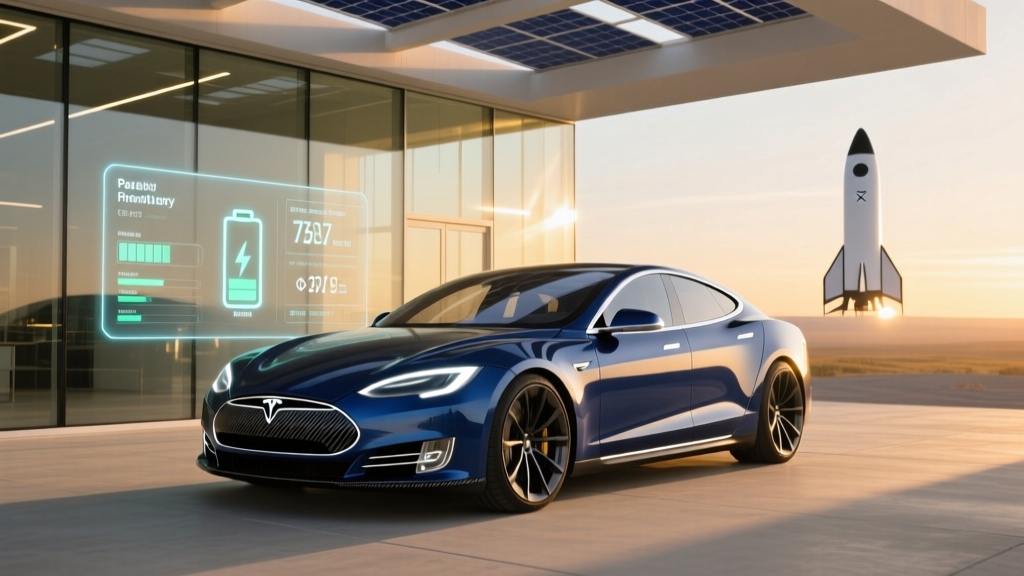
Tesla and SpaceX already share engineering talent and certain technologies. SpaceX uses Tesla battery cells in some applications. Tesla has adopted aerospace-grade materials and manufacturing techniques. The Cybertruck's stainless-steel exoskeleton was explicitly inspired by SpaceX's Starship construction. This cross-pollination fuels speculation that a formal merger would streamline these synergies.
Starlink Integration in Tesla Vehicles
Starting with 2024 model-year updates, Tesla began integrating Starlink satellite connectivity as a backup communication channel in vehicles equipped with Hardware 4.0 and later. This deepening integration between SpaceX's Starlink division and Tesla's vehicle platform is frequently cited as evidence of a future merger. However, commercial partnerships between separate companies are common in the auto industry and do not require corporate consolidation.
The 2024–2025 Compensation Package Controversy
When a Delaware court voided Musk's 2018 Tesla compensation package in early 2024, and the subsequent shareholder re-vote and legal battles continued into 2025, some analysts speculated Musk might merge Tesla with SpaceX to consolidate his control and simplify his compensation structure. This remains speculation with no formal proposal.
Financial and Regulatory Hurdles to a Merger
Even if Musk wanted to merge Tesla and SpaceX, the barriers are enormous:
| Barrier | Details | Likelihood of Resolution |
|---|---|---|
| Valuation gap | Tesla (~$800B–$1T market cap) vs. SpaceX (~$350B private valuation) — merging would require a fair exchange ratio that satisfies Tesla public shareholders | Difficult but possible with independent valuation |
| Shareholder approval | Tesla's public shareholders would need to approve dilution or a stock-swap structure; institutional investors like Vanguard and BlackRock would scrutinize heavily | Challenging — fiduciary duty concerns |
| Antitrust / national security | SpaceX holds classified government contracts (DoD, NASA, NRO); CFIUS and ITAR regulations may restrict combining with a publicly traded entity with foreign institutional shareholders | Significant — likely requires government waivers |
| Conflict of interest | Musk controls SpaceX while serving as Tesla CEO — a merger at any price could face shareholder lawsuits alleging self-dealing | High litigation risk |
| Cultural mismatch | Automotive mass manufacturing vs. aerospace project-based engineering have fundamentally different operational tempos and margin structures | Integration risk |
Wall Street analysts at firms like Morgan Stanley and Goldman Sachs have published notes acknowledging the speculation but assigning a low probability (under 10%) to a merger within the next three to five years.
What a Merger Would Mean for Tesla EV Buyers
If a merger were somehow executed, here's how it could affect you as a Tesla owner or buyer:
Potential Benefits
- Advanced battery technology: SpaceX's extreme energy-density requirements for Starship could accelerate Tesla's battery R&D, potentially bringing next-generation cells (4680+ variants or solid-state) to consumer vehicles faster
- Starlink-native connectivity: Deeper integration could mean free or bundled Starlink connectivity in every Tesla, eliminating the need for cellular-based Premium Connectivity subscriptions
- Material science advances: Aerospace alloys, thermal protection systems, and lightweight composites developed for SpaceX could trickle down to vehicle platforms, improving efficiency and range
- Financial stability: SpaceX's growing Starlink revenue ($15B+ projected for 2026) could provide a massive, stable cash flow that insulates Tesla from automotive cyclical downturns
Potential Risks
- Diluted automotive focus: Tesla's capital and engineering talent could be diverted toward SpaceX priorities, slowing vehicle development cycles
- Stock volatility: A merger announcement would likely trigger significant TSLA price swings, affecting resale values and lease residuals
- Regulatory complications: Government scrutiny of a combined entity could slow Tesla's autonomous driving approvals if regulators view the merged company as too powerful
- Brand perception: Some buyers choose Tesla specifically as an automotive company; aerospace entanglements could alienate environmentally focused consumers who view SpaceX rocket launches as carbon-intensive
What This Means for Your Tesla Purchase Decision in 2026
The practical answer for EV shoppers: the merger question should not drive your purchase decision. Here's why:
Tesla's 2026 vehicle lineup — the refreshed Model 3 Highland, the Model 3 Juniper update, the Model Y, the Cybertruck, and the upcoming next-generation compact platform — stands on its own merits regardless of corporate structure. The Supercharger network, which now serves all NACS-equipped vehicles from competing brands, continues to expand. Battery technology, FSD (Supervised) development, and manufacturing efficiency are driven by Tesla's engineering teams, not by corporate-level M&A activity.
If you're evaluating a Tesla purchase, focus on what matters for ownership:
Current 2026 Tesla Model 3 (Highland Refresh) Key Specs
| Spec | Value |
|---|---|
| EPA Range | 341 miles |
| Battery Capacity | ~79 kWh usable (NMC chemistry) |
| Efficiency | 132 MPGe combined / 25 kWh/100mi |
| Max DC Fast Charge | 250 kW peak (Supercharger V3/V4) |
| 10–80% DC Charge Time | ~27 minutes |
| Level 2 Home Charge Rate | 11.5 kW (~44 miles/hour) |
| 0–60 mph | 4.2 seconds |
| Horsepower | 346 hp (dual motor AWD) |
| Drivetrain | Dual Motor AWD |
| Cargo Volume | 23 cu ft (rear trunk + frunk combined) |
| Base MSRP | $47,740 (before destination) |
| Battery Warranty | 8 years / 120,000 miles |
| Federal Tax Credit (§30D) | Up to $7,500 (eligibility varies — see below) |
Federal Tax Credit Eligibility (IRS §30D)
The Tesla Model 3 Long Range AWD may qualify for up to $7,500 under the IRS §30D Clean Vehicle Credit, but eligibility depends on multiple factors that change periodically:
- MSRP cap: Sedans must be under $55,000 MSRP (including destination). The Model 3 LR at ~$47,740 qualifies on price.
- Buyer income cap: Modified adjusted gross income must not exceed $150,000 (single), $225,000 (head of household), or $300,000 (joint filers).
- Battery sourcing: Critical minerals and battery component requirements phase in annually. Tesla has shifted significant battery supply chain to North America, but specific eligibility can change mid-year. Always verify on fueleconomy.gov before purchasing.
- Point-of-sale transfer: As of 2024, buyers can transfer the credit to the dealer for an immediate price reduction at purchase, rather than waiting to claim it on their tax return.
Consult a tax professional for your specific situation. Credit rules are subject to change.
Tesla vs. Key Competitors: Does the Merger Question Change the Math?
| Spec | Tesla Model 3 LR AWD | Hyundai Ioniq 6 SE LR | BMW i4 eDrive40 |
|---|---|---|---|
| EPA Range | 341 mi | 361 mi | 307 mi |
| Battery | ~79 kWh (NMC) | 77.4 kWh (NMC) | 83.9 kWh (NMC) |
| Max DC Charge | 250 kW | 240 kW | 205 kW |
| 10–80% Time | ~27 min | ~18 min | ~31 min |
| 0–60 mph | 4.2 sec | 5.1 sec | 5.5 sec |
| Base MSRP | $47,740 | $42,450 | $57,900 |
| Charging Network | Supercharger (native NACS) | NACS adapter / CCS | NACS adapter / CCS |
| Federal Credit | Up to $7,500* | Up to $7,500* | Up to $7,500* |
*Credit eligibility varies by buyer income, MSRP, and battery sourcing. Verify current status before purchase.
The competitive landscape shows that Tesla's advantages remain the Supercharger network, software ecosystem, and performance-per-dollar. The Hyundai Ioniq 6 beats Tesla on EPA range and 10–80% charge speed, while the BMW i4 offers premium build quality at a higher price. None of these comparisons change based on whether Tesla and SpaceX merge.
The Bottom Line for EV Buyers
Reasons to Buy Tesla Now (Regardless of Merger Speculation)
- Supercharger network remains the most reliable DC fast-charging ecosystem in North America
- NACS standard adoption means Tesla's charging advantage is becoming an industry standard
- FSD (Supervised) continues to improve, though it remains SAE Level 2 — requiring full driver attention
- Strong resale value relative to most EV competitors
- Over-the-air updates continuously add features post-purchase
Reasons to Wait or Look Elsewhere
- Musk's public controversies and divided attention across Tesla, SpaceX, xAI, and X (formerly Twitter) raise governance concerns
- Build quality and panel gaps, while improved, still trail legacy luxury automakers
- Minimalist interior lacks physical controls some drivers prefer
- Competitors like Hyundai, Kia, and BMW now offer compelling alternatives with strong charging speeds
- Insurance costs for Teslas remain above segment average in many states
Whether Tesla and SpaceX eventually merge is a corporate governance question that will play out over years, not months. For EV buyers in 2026, the decision should rest on the vehicle's specs, your charging access, total cost of ownership, and whether Tesla's technology ecosystem fits your daily driving needs. The Model 3 Highland remains one of the best value propositions in the electric sedan segment — merger or no merger.
Frequently Asked Questions
Has Elon Musk confirmed that Tesla and SpaceX will merge?
No. As of early 2026, Musk has not announced, proposed, or confirmed any merger between Tesla and SpaceX. He has occasionally referenced synergies between the companies but has taken no formal corporate action toward combining them.
Would a Tesla-SpaceX merger affect my vehicle's warranty?
In any merger scenario, existing warranties would almost certainly be honored — this is standard in automotive M&A. Tesla's current battery warranty of 8 years/120,000 miles (Long Range) and 8 years/100,000 miles (RWD) would remain binding on the successor entity.
Could SpaceX Starship technology improve Tesla batteries?
Potentially. SpaceX's extreme thermal management and energy-density requirements push battery technology in ways that could benefit consumer EVs. However, technology transfer between the companies already happens informally without a formal merger.
Does the Tesla Model 3 qualify for the $7,500 federal tax credit in 2026?
The Model 3 Long Range AWD qualifies on MSRP (under the $55,000 sedan cap). However, buyer income limits, battery critical-mineral sourcing requirements, and battery-component sourcing rules all affect eligibility. Always verify current status on fueleconomy.gov and consult a tax professional before relying on the credit.
Should I delay my Tesla purchase because of merger uncertainty?
No. Corporate-level merger speculation has no bearing on current vehicle availability, pricing, features, or near-term support. If a Tesla model fits your needs and budget today, there is no practical reason to delay based on unconfirmed merger speculation.
Is Tesla's FSD actually self-driving?
No. Tesla's Full Self-Driving (Supervised) is an SAE Level 2 driver-assistance system. It requires continuous driver supervision, hands-on-wheel readiness, and full situational awareness. It is not autonomous driving. Only Level 4 services like Waymo operate without a human driver, and those are limited to specific geofenced areas.