The Short Answer: Still Announced, Still Not Here
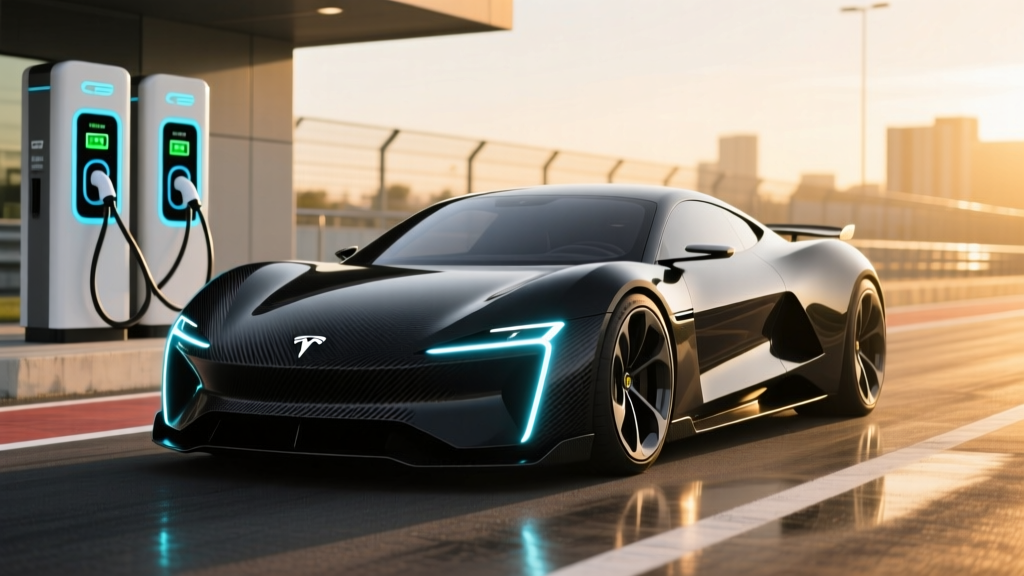
If you've been following Tesla's second-generation Roadster since its 2017 unveiling, you already know the pattern: bold promises, shifting timelines, and silence. As of early 2026, the Roadster remains an announced but unreleased vehicle. It is not available for purchase, test drives, or delivery. Tesla has not published a confirmed production start date, final EPA certification, or definitive spec sheet.
This article compiles every confirmed and estimated data point Tesla has released about the Roadster, contextualizes those claims against real-world EV physics, and helps you decide whether holding a reservation — or waiting for a competitor — makes financial sense.
Tesla has claimed a 620-mile EPA-estimated range for the Roadster with the optional SpaceX cold-gas thruster package. Without that package, Tesla previously cited 620 miles on a ~200 kWh battery pack. No independent EPA testing has been published as of 2026. Real-world expectations: highway driving at 75+ mph typically reduces EV range by 15-25%, and cold weather (below 32°F) can cut range by 20-35%. A realistic highway estimate for a 620-mile sticker would be ~465-525 miles, dropping to ~400-470 miles in winter conditions. A 200 kWh pack is extraordinarily large and heavy, which affects efficiency at speed.
Announced Specs vs. EV Physics: What the Numbers Mean
| Spec | Tesla Claim (Preliminary) | Analyst Note |
|---|---|---|
| Battery Capacity | ~200 kWh (usable, estimated) | Would be the largest pack in any production passenger car. Likely NMC chemistry given energy-density requirements. Weight estimated at 1,200-1,400 lbs for cells alone. |
| EPA Range | 620 miles (claimed) | Unverified. Would require ~3.1 mi/kWh efficiency — extremely aggressive for a 4,400+ lb sports car. Lucid Air Grand Touring achieves ~4.0 mi/kWh with a 118 kWh pack and 4,100 lbs. |
| 0-60 mph | 1.9 seconds (base) / under 1 sec (SpaceX package) | 1.9s is achievable (Rimac Nevera does 1.85s). Sub-1-second claims rely on cold-gas thrusters for downforce/traction — unproven in any street-legal production vehicle. |
| Top Speed | 250+ mph | Aerodynamic drag at 250 mph requires ~800+ HP sustained. Plausible with tri-motor AWD but will devastate range at that speed. |
| Drivetrain | AWD, tri-motor (one front, two rear) | Consistent with Tesla's Plaid architecture. Torque vectoring likely. |
| Horsepower | Not officially disclosed; estimated 1,000+ HP | Tri-motor Plaid powertrains in the Model S Plaid produce 1,020 HP. Roadster likely similar or higher. |
Charging: The 200 kWh Problem
A ~200 kWh battery pack creates an enormous charging challenge. Even at Tesla's current V4 Supercharger peak of 350 kW, charging a 200 kWh pack from 10-80% (140 kWh of energy) would take a minimum of ~28-35 minutes under ideal conditions — and that assumes the battery can sustain peak charge rate, which no current pack does. Charge curves taper significantly above 50-60% State of Charge (SoC).
| Charging Level | Power (kW) | Estimated Speed | 10-80% Time (Est.) |
|---|---|---|---|
| Level 1 (120V household) | ~1.4 kW | ~4-5 mi/hr | 100+ hours (impractical) |
| Level 2 (240V home, 48A) | 11.5 kW | ~35-40 mi/hr | ~14-17 hours (overnight + day) |
| Level 2 (240V, 80A — Wall Connector) | 19.2 kW | ~58-65 mi/hr | ~9-11 hours |
| DC Fast Charge (V4 Supercharger, est.) | Up to 350 kW (peak) | Variable; avg ~200 kW sustained | ~40-50 minutes (est.) |
Key insight: kW (kilowatts) measures charge power — how fast energy flows. kWh (kilowatt-hours) measures battery capacity — how much energy the pack holds. A 200 kWh battery at a sustained 200 kW average charge rate needs roughly one hour to go from 10-80%. Tesla would need either a new, higher-power Supercharger generation (500+ kW) or acceptance of long charge stops. Neither has been confirmed for Roadster compatibility as of 2026.
The Delay Timeline: A History of Moving Targets
Understanding the Roadster's status requires looking at its timeline of announcements:
- November 2017: Tesla unveils the Roadster prototype, claims 620-mile range, 1.9s 0-60, 250+ mph top speed. Base price announced at $200,000 with a $250,000 "Founders Series." Reservations open at $50,000 deposits (later reduced).
- 2019: Elon Musk states production would begin in 2020.
- 2020: Production delayed to 2021, then 2022.
- 2021: Tesla removes the Roadster from its public ordering page briefly; Musk tweets it will ship in 2023.
- 2022: Musk announces the Roadster design is "done" but production pushed to 2024. Mentions possible SpaceX thruster package.
- 2023: Musk says production would begin in late 2024, then shifts to 2025.
- 2024-2025: No firm production date given. Tesla's focus shifts heavily to Cybertruck production ramp, Optimus robotics, and FSD development. Roadster falls to the back burner publicly.
- Early 2026: Roadster remains listed as "upcoming" on Tesla's site. No EPA filing, no crash-test data, no confirmed specs beyond 2017-era claims. Reservations may still be open but delivery timeline is unknown.
This pattern mirrors the original 2008 Roadster, which was also delayed multiple years past its initial announcement. However, that vehicle eventually shipped. The second-generation Roadster's timeline has now stretched to over eight years since unveiling with no production units delivered.
Pricing, Tax Credits, and the $200,000 Question
| Item | Amount / Status |
|---|---|
| Base MSRP (2017 announcement) | $200,000 |
| Founders Series MSRP | $250,000 (limited run) |
| Expected 2026 MSRP (adjusted) | $200,000-$250,000+ (likely higher given inflation and R&D costs) |
| Federal §30D Tax Credit Eligibility | Not eligible. IRS §30D caps the credit at vehicles with MSRP ≤ $55,000 (sedans/coupes). The Roadster at $200,000+ far exceeds this threshold. |
| Buyer Income Cap (§30D) | Even if eligible: AGI ≤ $150,000 single / $300,000 joint. Most Roadster buyers would exceed this. |
| Point-of-Sale Transfer | N/A — credit does not apply to this vehicle. |
Tax credit bottom line: Under current IRS §30D rules, the Tesla Roadster will almost certainly never qualify for the $7,500 federal EV tax credit. The MSRP cap for non-SUVs is $55,000, and buyer income limits further restrict eligibility. At $200,000+, this is a vehicle purchased entirely out-of-pocket or through financing, with no federal purchase incentive.
Competitors You Can Actually Buy Today
The Roadster's promised specs place it in hypercar territory, but several competitors offer real, purchasable alternatives in 2026:
| Vehicle | Status | 0-60 mph | EPA Range | Price |
|---|---|---|---|---|
| Tesla Roadster (Gen 2) | Announced / Unreleased | 1.9s (claimed) | 620 mi (claimed) | ~$200,000+ |
| Rimac Nevera | In production (150 units) | 1.85s | ~340 mi (WLTP) | ~$2,400,000 |
| Lotus Evija | Limited production | ~3.0s | ~250 mi (WLTP est.) | ~$2,100,000 |
| Tesla Model S Plaid | Available now | 1.99s | 396 mi (EPA) | ~$89,990 |
| Porsche Taycan Turbo GT | Available now | 2.1s | ~280 mi (EPA est.) | ~$230,000 |
The Tesla Model S Plaid is the elephant in the room. For under $90,000, buyers get a 1.99-second 0-60 time (matching the Roadster's base claim), 396 miles of EPA range, full Autopilot/FSD (Supervised) capability (SAE Level 2), Supercharger access, and immediate availability. The Roadster would need to deliver meaningfully on its 620-mile range and sub-$250K price to justify the premium and wait.
Who the Roadster Is For (If It Ships)
If Tesla ever delivers this vehicle, its target buyer is narrow:
- EV enthusiasts with hypercar budgets who want the ultimate Tesla halo vehicle and don't need a daily driver.
- Collectors betting on long-term value appreciation (though Tesla's production volume intentions could limit scarcity value).
- Tech-forward performance seekers who prioritize straight-line acceleration above all else.
Who it's NOT for: Anyone needing practical cargo space (sports cars sacrifice this), daily commuters (a 200 kWh pack means expensive and slow home charging), families (2+2 seating at best, likely 2-seat), or budget-conscious buyers. The Roadster is a flagship, not a volume vehicle.
Warranty, Tech, and Ownership Unknowns
Because the Roadster is unreleased, no warranty terms, crash-test ratings (NHTSA or IIHS), or real-world efficiency data (MPGe, kWh/100mi) exist. For reference, Tesla's current warranty framework on the Model S provides:
- Basic vehicle warranty: 4 years / 50,000 miles
- Battery and drive unit warranty: 8 years / 150,000 miles (with minimum 70% capacity retention)
A 200 kWh NMC battery pack replacement, if ever needed out of warranty, would likely cost $25,000-$40,000+ based on current cell pricing trends and pack complexity. This is a significant long-term ownership risk for any high-mileage buyer.
Expected tech features (based on Tesla's current platform): Full Self-Driving (Supervised) hardware — note this is SAE Level 2, requiring active driver supervision, not autonomous driving. Tesla's current infotainment system, over-the-air updates, and Supercharger network access are near-certainties. The SpaceX cold-gas thruster package, if it ships, would be a first in production automotive history, but regulatory approval for thruster-equipped road vehicles is untested.
✅ Potential Pros (If Delivered)
- Unmatched straight-line performance (sub-2s 0-60)
- 620-mile range would eliminate range anxiety entirely
- Tesla Supercharger network access
- OTA updates and continuous improvement
- Halo-car status and brand cachet
❌ Known and Likely Cons
- Not available — eight years of delays with no end date
- Specs are unverified claims, not EPA-certified data
- No federal tax credit eligibility (§30D MSRP cap)
- 200 kWh pack = extremely long home charging times
- DC fast-charge times likely 40-50 min minimum
- $200,000+ price competes with proven hypercars
- Model S Plaid delivers similar performance for under $90K
- Cold-gas thruster package may face regulatory hurdles
- Depreciation risk on a high-priced, low-volume EV
Should You Hold Your Reservation or Move On?
This is the core decision for anyone who placed a Roadster deposit years ago:
Decision Framework
Keep your reservation if:
- The deposit amount is not materially impacting your finances
- You already own a daily-driver EV and the Roadster would be a weekend/halo car
- You're willing to wait potentially 2-4 more years with no guarantee of delivery
- You believe in Tesla's long-term ability to deliver on ambitious engineering claims
Move on and buy something available now if:
- You need a performance EV within the next 12 months
- The $50,000+ deposit could be earning returns elsewhere
- You want verified EPA data, crash-test ratings, and warranty certainty
- A Model S Plaid ($89,990) or Porsche Taycan Turbo GT ($230,000) satisfies your performance needs today
Frequently Asked Questions
Will the Tesla Roadster ever come out?
There is no confirmed answer. Tesla has delayed the Roadster repeatedly since its 2017 unveiling, pushing production from 2020 to 2021, 2022, 2023, 2024, and now potentially 2025-2026 or beyond. As of early 2026, no production date is confirmed, no EPA certification exists, and the vehicle remains in "announced" status. Tesla has a history of eventually delivering announced products (Cybertruck shipped in late 2023 after years of delays), but the Roadster's timeline has been uniquely extended.
What is the real-world range of the Tesla Roadster?
Unknown, as the vehicle has not been EPA-tested. Tesla claims 620 miles, but real-world highway driving at 75+ mph typically reduces EV range by 15-25%, and cold weather can cut it by 20-35%. A realistic estimate, if the 620-mile claim is accurate, would be ~465-525 miles on the highway and ~400-470 miles in winter. A 200 kWh pack is massive and heavy, which works against efficiency at high speeds.
How fast does the Roadster charge?
Charging specs are unconfirmed. With an estimated 200 kWh battery, even at 350 kW peak DC fast charging, a 10-80% session would likely take 40-50 minutes due to charge-curve tapering. At home on a Level 2 Tesla Wall Connector (19.2 kW / 80A), a full charge could take 9-11 hours. Level 1 (standard outlet) would be impractical at 100+ hours.
Does the Tesla Roadster qualify for the federal EV tax credit?
No. Under IRS §30D rules, the federal clean vehicle credit is capped at vehicles with an MSRP of $55,000 or less for sedans/coupes (or $80,000 for SUVs/trucks/vans). The Roadster at $200,000+ far exceeds this cap. Additionally, buyer income limits ($150,000 single / $300,000 joint AGI) would disqualify many potential buyers even if the vehicle were eligible. Battery sourcing and critical mineral requirements add further restrictions.
Is the Roadster worth waiting for vs. a Model S Plaid?
For most buyers, the Model S Plaid is the rational choice today. At ~$89,990, it delivers 1.99-second 0-60, 396 miles EPA range, full Supercharger access, Autopilot/FSD (Supervised), and immediate availability. The Roadster's promised advantages — 620-mile range and sub-1-second acceleration (with SpaceX package) — are compelling on paper but remain unverified and undelivered after eight years. Unless you specifically want the halo-car experience and can afford to wait indefinitely, the Plaid covers 90% of the performance envelope at half the price.
What battery chemistry will the Roadster use?
Tesla has not confirmed, but a ~200 kWh pack targeting maximum range in a performance vehicle would almost certainly use NMC (nickel manganese cobalt) chemistry rather than LFP (lithium iron phosphate). NMC offers higher energy density, which is critical for fitting that much capacity into a sports car footprint. LFP is heavier per kWh and is typically used in standard-range vehicles where cost matters more than weight.
How much cargo and passenger space will it have?
Exact dimensions are unpublished. The Roadster is a 2+2 sports car (two front seats, two small rear seats), consistent with the original 2008 Roadster's layout. Cargo space will be minimal — likely under 10 cubic feet total between any rear storage area and potential frunk. This is not a practical daily driver for groceries, luggage, or families.
Editorial note: This article reflects publicly available information as of early 2026. Tesla has not provided updated Roadster specifications, pricing, or a production timeline beyond its original 2017 claims. All specs listed as "claimed" or "estimated" are preliminary and subject to change. We will update this article if Tesla releases confirmed data or begins deliveries.