The Valuation Question Every EV Shopper Eventually Asks
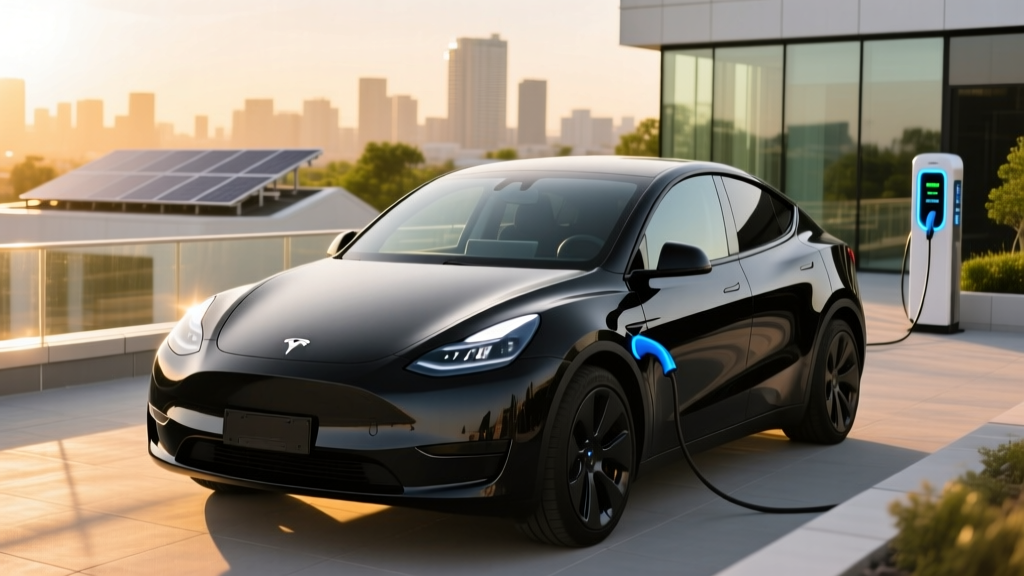
Tesla's market capitalization has routinely exceeded the combined value of legacy automakers, yet the company sells a fraction of their vehicle volume. For buyers, the more practical question is narrower: why does a Tesla cost what it costs, and does the ownership experience justify the sticker price versus a growing field of competitors? To answer that, we need to look past stock-market narratives and examine what you actually get when you buy the company's highest-volume vehicle — the 2026 Tesla Model Y.
This review dissects the Model Y's specifications, real-world efficiency, charging behavior, tax-credit eligibility, and competitive positioning. The goal is to give you the data to decide whether Tesla's pricing reflects genuine engineering and infrastructure advantages, or whether rival EVs now close the gap at a lower entry cost.
2026 Model Y By the Numbers: Spec Table
| Attribute | Value |
|---|---|
| EPA Estimated Range | 320 miles |
| Real-World Highway Range | ~265–285 mi (70°F); ~220–240 mi (20°F) |
| Battery Capacity | ~78 kWh usable (NMC chemistry) |
| Efficiency (EPA) | 122 MPGe combined / 28 kWh per 100 mi |
| Peak DC Fast Charge | 250 kW (V3 Supercharger) |
| 10–80% DC Charge Time | ~25 minutes |
| Home Level 2 Charge Rate | 11.5 kW / ~44 mi/hr (48A Wall Connector) |
| 0–60 mph | 4.8 seconds |
| Horsepower | 384 hp (dual-motor AWD) |
| Cargo Volume (rear seats up / down) | 34.3 / 72.1 cu ft |
| Rear Legroom | 40.5 inches |
| Battery & Drive Unit Warranty | 8 years / 120,000 miles |
| Base MSRP (Long Range AWD) | $48,990 |
Sources: fueleconomy.gov, Tesla official specifications.
Real-World Range: What the EPA Sticker Doesn't Tell You
The Model Y Long Range AWD carries a 320-mile EPA estimate. In mixed suburban driving at moderate temperatures, owners routinely report 290–310 miles on a full charge. Sustained highway driving at 75+ mph drops that to roughly 265–285 miles due to aerodynamic drag. In sub-freezing conditions (20°F and below), expect 220–240 miles — a 25–30% reduction typical of NMC lithium-ion packs without a dedicated heat-pump preconditioning cycle engaged.
Tesla's thermal management system is among the most efficient in the segment. The octovalve heat pump, introduced with the Model Y platform, scavenges waste heat from the drive units and battery to warm the cabin, reducing the winter range penalty compared to resistive-heater EVs. Still, physics governs all lithium-ion chemistry: cold slows ion transport, and the battery management system (BMS) restricts charge and discharge rates until the pack reaches operating temperature.
If your commute is 40 miles round-trip and you charge nightly at home, the 320-mile EPA figure provides substantial buffer. If you regularly drive 250+ miles one-way in winter, you'll need to plan a DC fast-charge stop — which leads directly into the next critical question.
Charging Speed and Infrastructure: Tesla's Strongest Moat
The reason many analysts cite for Tesla's valuation premium isn't the car itself — it's the Supercharger network. As of early 2026, Tesla operates over 6,500 Supercharger stalls in North America, and with the adoption of the North American Charging Standard (NACS), rival automakers now access portions of that network. However, Tesla owners still benefit from native integration: plug-and-charge authentication, automatic battery preconditioning when a Supercharger is set as the navigation destination, and real-time stall availability displayed in-car.
| Charging Level | Power (kW) | Miles Added per Hour | Typical Use Case |
|---|---|---|---|
| Level 1 (120V household) | ~1.4 kW | ~4–5 mi/hr | Emergency / overnight trickle |
| Level 2 (240V Wall Connector, 48A) | 11.5 kW | ~44 mi/hr | Home daily charging (~7 hrs empty to full) |
| DC Fast Charge (V3 Supercharger) | Peak 250 kW | Up to ~1,000 mi/hr (at peak) | Road trips; 10–80% in ~25 min |
| DC Fast Charge (V4 Supercharger) | Peak 250+ kW | Similar to V3 | Next-gen stalls with CCS/NACS integration |
A critical nuance: the 250 kW peak is not sustained across the entire charging session. The Model Y's charge curve peaks between 10–30% state of charge (SoC), then tapers progressively. From 50–80%, you'll see rates closer to 80–120 kW. This is standard behavior for NMC chemistry — charging too fast at high SoC accelerates degradation, so the BMS intentionally restricts current. Tesla's preconditioning feature mitigates this by warming the battery en route to the charger, allowing the pack to accept peak rates sooner upon arrival.
For home charging, the Tesla Wall Connector at 48 amps on a 240V/60A circuit delivers 11.5 kW — adding roughly 44 miles of range per hour of charging. Most owners arriving home with 40–60% battery will be fully charged by morning. Installation costs vary: expect $500–$1,500 for the electrician work if your panel has capacity, or $2,000–$4,000+ if a panel upgrade to 200A is needed.
Performance, Efficiency, and Daily Livability
The 2026 Model Y Long Range AWD uses a dual-motor setup with a permanent-magnet synchronous motor on the rear axle and an induction motor up front. The result is 384 horsepower, 4.8 seconds to 60 mph, and all-wheel-drive traction that performs confidently in rain and light snow. The Performance trim drops the 0–60 time to 3.5 seconds and adds adaptive dampers, but at a ~$5,000 premium and a slight range reduction.
Efficiency is where Tesla's engineering reputation is most defensible. At 122 MPGe combined (28 kWh/100 mi), the Model Y extracts more miles per kilowatt-hour than nearly every competing electric SUV. The Hyundai Ioniq 5 AWD, for comparison, rates at 110 MPGe combined with a similar battery size. Over 15,000 annual miles and a national average electricity cost of $0.16/kWh, that efficiency gap translates to roughly $80–$120 per year in electricity savings — meaningful over a decade of ownership.
Interior space is generous for the segment: 34.3 cubic feet of cargo volume behind the second row, expanding to 72.1 cubic feet with seats folded. The rear floor is flat (no transmission tunnel), and the front trunk (frunk) adds an additional 4.1 cubic feet for charging cables or groceries. Rear legroom measures 40.5 inches, sufficient for adults on longer trips, though the rear seat cushion is lower than some competitors, which can cause a knees-up seating posture for taller passengers.
Pricing, Tax Credits, and True Cost of Purchase
The 2026 Model Y Long Range AWD starts at a base MSRP of $48,990 before destination fees. A well-equipped example with Full Self-Driving (Supervised) capability ($8,000), premium interior upgrades, and 20-inch wheels can push the as-tested price above $62,000.
| Trim | Base MSRP | §30D Credit Eligibility | Effective Price (with credit) |
|---|---|---|---|
| Long Range AWD | $48,990 | Up to $7,500 (if sourcing/income rules met) | ~$41,490 |
| Performance AWD | $53,990 | Up to $7,500 (if sourcing/income rules met) | ~$46,490 |
Federal tax credit eligibility under IRS §30D is not guaranteed for every buyer. The rules require:
- MSRP cap: SUVs must not exceed $80,000 MSRP (Model Y qualifies).
- Buyer income cap: Modified adjusted gross income must not exceed $150,000 (single), $225,000 (head of household), or $300,000 (joint).
- Battery sourcing: A percentage of critical minerals and battery components must be sourced from the U.S. or free-trade-agreement countries. Tesla's shifting supply chain means eligibility can change by production batch — always verify the specific VIN on the IRS clean vehicle credit portal before purchase.
- Point-of-sale transfer: As of 2024, qualifying buyers can transfer the credit to the dealer at purchase, reducing the upfront cost rather than waiting for a tax refund.
Because battery-sourcing requirements tighten annually, a Model Y built in January 2026 may have different credit eligibility than one built in June. This is not a Tesla-specific issue — it affects all EVs — but it means you should never assume the full $7,500 applies without checking your specific vehicle and tax situation. Consult a tax professional for your circumstances.
Tech, Autopilot, and the Software Question
Tesla's Autopilot and Full Self-Driving (Supervised) are Level 2 driver-assistance systems under the SAE J3016 standard. This means the driver must remain fully engaged, hands on or near the wheel, and eyes on the road at all times. Tesla's FSD is not autonomous driving — it does not replace the driver. Only Level 4 services like Waymo operate without a human driver, and those are geofenced to specific cities.
The Model Y's infotainment runs on a 15.4-inch center touchscreen with no physical buttons for climate or media — a design choice that draws polarized reactions. The system is fast, receives over-the-air updates, and integrates navigation, media, and vehicle controls fluidly. However, the lack of Apple CarPlay and Android Auto remains a dealbreaker for some buyers who prefer phone-mirrored interfaces.
Standard Autopilot includes Traffic-Aware Cruise Control and Autosteer (lane-centering). The optional FSD (Supervised) package adds automatic lane changes, traffic-light and stop-sign recognition, and navigation-guided on-ramp-to-off-ramp driving. Real-world performance varies: FSD handles well-mapped highways competently but can make unexpected decisions in construction zones or poorly marked intersections. It is a convenience feature, not a replacement for attention.
Notable drawbacks include the absence of a traditional instrument cluster (all information is on the center screen, requiring a glance to the right), panel-gap inconsistency that still surfaces on some delivery vehicles, and the reliance on a camera-only vision system (Tesla removed ultrasonic sensors and radar from production). The vision-only approach means parking-assist distance estimation is approximated rather than measured, which some owners find less precise than ultrasonic-equipped competitors.
Competitive Positioning: Is It Worth the Premium?
The Model Y's most direct competitors in 2026 include the Hyundai Ioniq 5, Ford Mustang Mach-E, Chevrolet Equinox EV, and the refreshed Kia EV6. Here is how they stack up on the dimensions that matter most:
| Attribute | Tesla Model Y LR AWD | Hyundai Ioniq 5 AWD | Ford Mach-E ER AWD |
|---|---|---|---|
| EPA Range | 320 mi | 290 mi | 305 mi |
| Battery (usable) | ~78 kWh (NMC) | ~77.4 kWh (NMC) | ~91 kWh (NMC) |
| Peak DC Charge | 250 kW | 240 kW | 150 kW |
| 10–80% Time | ~25 min | ~18 min (350 kW charger) | ~45 min |
| Efficiency (MPGe) | 122 combined | 110 combined | 101 combined |
| Base MSRP | $48,990 | $49,500 | $51,995 |
| Charging Network | Supercharger (native) | NACS adapter for Supercharger | NACS adapter for Supercharger |
The Ioniq 5 charges faster on 350 kW Electrify America stations (10–80% in roughly 18 minutes), but those chargers have historically lower uptime than Superchargers. The Mach-E's larger battery yields competitive range but at the cost of efficiency — it consumes more kWh per mile, which increases charging costs over time.
Tesla's pricing advantage has narrowed. The Model Y no longer undercuts every competitor on MSRP, and the Ioniq 5 and Equinox EV can be found at lower transaction prices with dealer incentives. Where Tesla retains an edge is in the integrated ownership experience: Supercharger reliability, OTA software updates that add features post-purchase, and a service model that handles many issues remotely via mobile rangers rather than requiring dealership visits.
Who the Model Y Suits Best — and Who Should Look Elsewhere
- Daily commuters with home Level 2 charging who want minimal charging-planning overhead.
- Frequent road-trippers who value Supercharger network coverage and reliability over 300+ mile single-charge range.
- Tech-forward buyers who prefer OTA updates, integrated navigation, and app-based vehicle control.
- Small families needing car-seat space and cargo flexibility without stepping up to a three-row SUV.
- You require Apple CarPlay / Android Auto for daily navigation and media.
- You frequently tow — the Model Y's 3,500-lb tow rating trails the Ford F-150 Lightning or Rivian R1S.
- You prefer physical buttons and a traditional instrument cluster.
- You need three rows of seating (look at the Model X, Kia EV9, or Rivian R1S).
Pros and Cons at a Glance
- Class-leading efficiency (122 MPGe combined)
- Supercharger network — still the most reliable DC fast-charge ecosystem
- Strong OTA update cadence adds features post-purchase
- Spacious cargo area (72.1 cu ft max) with flat load floor
- Competitive 0–60 performance (4.8 sec) for the price
- 8-year/120,000-mile battery warranty
- No Apple CarPlay or Android Auto
- Camera-only parking assist less precise than ultrasonic sensors
- Touchscreen-only controls require glances away from road
- FSD (Supervised) is expensive ($8,000) and remains Level 2
- Panel-gap quality can vary between delivery vehicles
- Tax credit eligibility varies by production batch and buyer income
Frequently Asked Questions
What is the real-world range of the 2026 Tesla Model Y?
The EPA rates the Model Y Long Range AWD at 320 miles. Real-world highway driving at 70–80 mph typically yields 265–285 miles. In cold weather (below 30°F), plan for 220–240 miles. Preconditioning the battery and cabin while plugged in recovers some of the winter deficit.
How fast does the Model Y charge at home and on road trips?
At home on a 240V/48A Wall Connector, the Model Y charges at 11.5 kW, adding roughly 44 miles of range per hour — a full charge from near-empty takes about 7 hours. On a V3 Supercharger, it peaks at 250 kW and charges from 10–80% in approximately 25 minutes, though the rate tapers significantly above 60% SoC.
Does the 2026 Model Y qualify for the $7,500 federal EV tax credit?
It can, but eligibility depends on three factors per IRS §30D: the buyer's income must be below the cap ($150K single / $300K joint), the vehicle MSRP must not exceed $80,000 (it doesn't), and the battery's critical-mineral and component sourcing must meet the year's thresholds. Because sourcing compliance can change by production batch, verify your specific VIN on the IRS portal before purchasing. A tax professional can confirm your personal eligibility.
How much does the Model Y cost after tax credits?
The Long Range AWD starts at $48,990. If you qualify for the full $7,500 §30D credit and apply it at point of sale, the effective price drops to approximately $41,490 before destination fees and options. Add FSD ($8,000) or premium wheels and the price climbs accordingly — and higher-MSRP configurations still fall under the $80,000 SUV cap.
Is the Model Y worth buying over the Ioniq 5 or Mach-E?
If Supercharger access and proven charging-network reliability are your top priorities, the Model Y retains a tangible advantage. If you value faster peak charging on third-party networks, Apple CarPlay, or a more conventional interior layout, the Ioniq 5 is a strong alternative at a similar price point. The Mach-E offers competitive range but trails on efficiency and charging speed. Test-driving all three back-to-back is the most effective way to decide.
How long will the Model Y battery last?
Tesla warranties the battery and drive unit for 8 years or 120,000 miles, whichever comes first, with a minimum 70% capacity retention threshold. Real-world data from high-mileage Tesla owners suggests NMC packs in the Model Y typically retain 85–90% capacity after 100,000 miles when charged primarily on Level 2 and kept between 20–80% SoC for daily use. Battery replacement, if needed out of warranty, currently ranges from $12,000–$16,000 including labor.