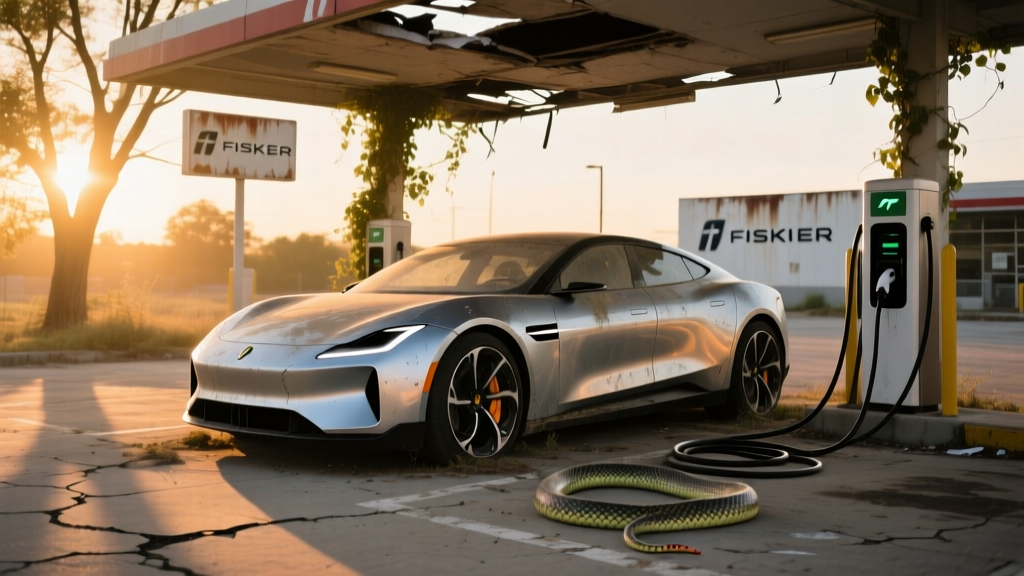
Fisker Inc. filed for Chapter 11 bankruptcy in June 2024, leaving thousands of Ocean SUV buyers with orphaned vehicles, shuttered service centers, and evaporating resale values. The question still echoes through EV forums and used-car listings: why did Fisker go out of business when the Ocean had competitive range, striking design, and legitimate fast-charging hardware?
The answer isn't one catastrophic flaw—it's a cascade of manufacturing delays, cash burn, software immaturity, and brutal price competition that no startup could survive without deep-pocketed backing. Below, we reconstruct the Ocean's full spec sheet (EPA range, battery chemistry, charging curve, pricing) and then dissect the business failures that turned a promising EV into a cautionary tale.
Fisker Ocean Specs: What the SUV Actually Delivered
Before examining the collapse, it's worth reviewing what Fisker engineered. The Ocean was a compact-to-midsize electric SUV built on a skateboard platform by Magna Steyr in Austria, offered in three main trims across the 2023–2024 model years.
| Spec | Ocean Sport | Ocean Ultra | Ocean Extreme / One |
|---|---|---|---|
| EPA Range | 250 mi | 340 mi | 360 mi |
| Battery (usable) | ~71 kWh (LFP) | ~113 kWh (NMC) | ~113 kWh (NMC) |
| Drivetrain | Single-motor FWD | Dual-motor AWD | Dual-motor AWD |
| Horsepower | 275 hp | 540 hp | 550 hp |
| 0–60 mph | 6.9 sec | 3.7 sec | 3.6 sec |
| Max DC Fast Charge | ~170 kW | ~250 kW | ~250 kW |
| 10–80% DC Time | ~33 min | ~30 min | ~30 min |
| Level 2 Home Rate | 11 kW (~37 mi/hr) | 11 kW (~37 mi/hr) | 11 kW (~37 mi/hr) |
| MPGe (combined) | ~95 MPGe | ~87 MPGe | ~84 MPGe |
| Cargo (rear seats up) | 32.5 cu ft | 32.5 cu ft | 32.5 cu ft |
| Cargo (rear folded) | 65.3 cu ft | 65.3 cu ft | 65.3 cu ft |
| Base MSRP (at launch) | $37,499 | $49,999 | $68,999 |
Charging Performance: Peak kW vs Sustained Reality
Fisker advertised 250 kW DC fast charging on the Ultra and Extreme trims, which positioned the Ocean alongside the Hyundai Ioniq 5 and Tesla Model Y at public chargers. However, peak kW is not sustained kW—a distinction every EV buyer must understand.
| Charging Level | Power | Speed / Notes |
|---|---|---|
| Level 1 (120V household) | ~1.4 kW | ~4–5 mi/hr (overnight trickle) |
| Level 2 (240V home) | 11 kW | ~37 mi/hr; full charge in ~10 hrs (113 kWh pack) |
| DC Fast (peak) | 250 kW (Ultra/Extreme) | 10–80% in ~30 min; tapers sharply above 80% |
| DC Fast (Sport) | ~170 kW | 10–80% in ~33 min |
The Ocean's charge curve was respectable but not exceptional. On a 350-kW Electrify America or Tesla Supercharger (via adapter), the 113-kWh NMC pack ramped to ~250 kW around 20% State of Charge (SoC), held that peak briefly, then tapered to ~150 kW by 50% SoC and ~80 kW by 70% SoC. This is typical thermal-management behavior for NMC chemistry, but it meant the advertised "30-minute" 10–80% time required a preconditioned battery and a reliably fast charger—conditions not always met on the road.
The LFP Sport charged more slowly but tolerated frequent 100% top-offs without degradation concerns—a trade-off LFP owners accept for lower energy density. Fisker's battery warranty was 6 years / 60,000 miles on the pack, notably shorter than the industry-standard 8 years / 100,000 miles mandated by many competitors and expected under EPA/IRS EV guidelines. This shorter warranty became a liability as the company's financial health deteriorated.
Who the Ocean Was Built For—and Who Actually Bought It
The Ocean targeted design-conscious urban and suburban buyers who wanted something distinct from the Tesla Model Y ubiquity. Henrik Fisker's styling—a solar roof panel (on Extreme/One trims), recycled interior materials, and the "California Mode" that dropped all windows simultaneously—gave the SUV boutique appeal.
In practice, the Ocean suited:
- Commuters with home Level 2 charging who valued 300+ mile range for weekly driving without public charging dependence.
- Design-forward buyers who found the Model Y too clinical and the Ioniq 5 too retro.
- Light road-trippers willing to plan around 250–300 real-world miles between DC fast-charge stops.
It did not suit families needing third-row seating (the Ocean was strictly two-row), buyers in charging deserts with no home charging access, or anyone prioritizing established dealer service networks. The lack of a frunk, mediocre rear visibility, and an infotainment system plagued by software bugs at launch further narrowed its audience.
Pricing, Tax Credits, and the Value Proposition That Disappeared
Fisker's original pricing strategy was aggressive. The Sport at $37,499 was positioned to undercut the Model Y and qualify for the full IRS §30D federal tax credit—up to $7,500 for eligible buyers meeting income caps ($150,000 single / $300,000 joint) and MSRP limits ($80,000 for SUVs). However, the §30D credit also requires battery component and critical-mineral sourcing thresholds that Fisker's CATL-supplied LFP pack and Magna-built NMC pack struggled to fully satisfy.
| Trim | Base MSRP | Est. §30D Credit | Effective Price |
|---|---|---|---|
| Sport (LFP) | $37,499 | $3,750–$7,500* | ~$29,999–$33,749 |
| Ultra (NMC) | $49,999 | $3,750–$7,500* | ~$42,499–$46,249 |
| Extreme / One | $61,999–$68,999 | $3,750–$7,500* | ~$54,499–$65,249 |
*Credit amount depends on battery-sourcing compliance and buyer income. Fisker's eligibility was inconsistent across model years; consult IRS guidance for current rules.
By late 2023, Fisker slashed prices dramatically—the Sport dropped to ~$24,999 in a desperate cash-generation move. This price collapse destroyed resale values for early buyers who paid MSRP and signaled to the market that the company was in distress. A vehicle's residual value is a core component of total cost of ownership, and Fisker's freefall made the Ocean a financial liability even before the bankruptcy filing.
The Core Reasons Fisker Failed: A Post-Mortem
Having driven and reviewed the Ocean, the hardware was never the primary problem. The failure was operational and financial:
1. Manufacturing Delays and Cash Burn
Fisker operated as an "asset-light" company, outsourcing production to Magna Steyr. While this avoided the capital expenditure of building a factory, it meant Fisker had limited control over production pacing and quality ramp-up. Deliveries began in mid-2023—months behind schedule—and early units had significant software and build-quality issues. The company burned through cash reserves while waiting for volume deliveries to generate revenue.
2. Software Wasn't Ready for Prime Time
The Ocean shipped with an incomplete infotainment and driver-assist stack. Owners reported frozen screens, phantom braking from the ADAS system, and over-the-air update failures. In the EV market, software reliability is as critical as powertrain reliability—Tesla, Hyundai, and Rivian all learned this lesson, but they had the capital to iterate. Fisker did not.
3. No Service Infrastructure
Fisker's direct-to-consumer model meant no dealer network for repairs. When problems arose—and they did, frequently—owners faced weeks-long waits for mobile technicians or parts shipped from Austria. This eroded brand trust faster than any spec-sheet shortfall could.
4. Brutal 2023–2024 Price Competition
Tesla's Model Y price cuts, Hyundai/Kia's aggressive Ioniq 5 and EV6 pricing, and Ford's Mustang Mach-E discounts squeezed the Ocean from every direction. Fisker's response—slashing its own prices—only accelerated the death spiral by destroying margins and resale values simultaneously.
5. Failed Strategic Partnerships
Fisker sought a major OEM partner or investor (Nissan was rumored, among others) to inject capital and share platform costs. No deal materialized. Without a backstop, the company ran out of runway in early 2024 and filed for Chapter 11 by June.
What the Ocean Got Right (and What Owners Still Appreciate)
Pros
- Class-leading EPA range on Extreme/One (360 mi)
- Striking design with solar roof and California Mode
- 250-kW DC fast charging on upper trims
- Spacious cargo area (65.3 cu ft folded)
- Sustainable interior materials
Cons
- Company bankrupt—no service network or OTA updates
- Software bugs plagued early and late units alike
- Battery warranty only 6 yr / 60,000 mi (below industry standard)
- No frunk; mediocre rear visibility
- Resale value collapsed 50–70% from MSRP
- LFP Sport range (250 mi EPA) was uncompetitive by 2024
Owners who secured local independent EV mechanics and treat the Ocean as a "drive it until it dies" vehicle still praise its ride quality, cabin space, and highway composure. But recommending the Ocean to a new buyer in 2026 is impossible—the orphaned-vehicle risk is simply too high.
Fisker Ocean vs. Competitors That Survived
The Ocean's direct competitors in 2023–2024 were the Tesla Model Y Long Range (EPA 330 mi, ~$48,000), Hyundai Ioniq 5 Long Range AWD (EPA 290 mi, ~$52,000), and Ford Mustang Mach-E Extended Range (EPA 312 mi, ~$51,000). All three offered established service networks, proven software stacks, and stronger resale value retention.
The Ioniq 5's 800-volt architecture delivered faster sustained DC charging (10–80% in ~18 min at a 350-kW station). The Model Y's Supercharger network access (pre-NACS standardization) and Autopilot maturity gave it an infrastructure moat. The Mach-E's Ford dealer network meant service was available in every major metro. The Ocean's 250-kW peak charging and 360-mile range were impressive on paper, but buyers correctly prioritized ecosystem reliability over spec-sheet peaks.
The Broader Lesson for EV Buyers in 2026
Fisker's collapse reinforces a principle every EV shopper should internalize: a vehicle is only as good as the company supporting it. Range, charging speed, and design matter—but so do software updates, service access, parts availability, and resale value. Startups like Rivian and Lucid have survived (so far) because they secured substantial capital backing and built service infrastructure in parallel with production. Fisker attempted to launch a vehicle without either.
For buyers considering newer EV startups in 2026, the Fisker checklist is essential:
- Does the company have at least 2–3 years of cash runway at current burn rates?
- Is there a service network (mobile or fixed) within 50 miles of your home?
- What is the battery/powertrain warranty, and who honors it if the company fails?
- How mature is the software stack, and what is the OTA update track record?
- What is the 12-month depreciation trend on used models?
If any of those answers are unclear, the discount on MSRP isn't worth the orphan-vehicle risk.
Frequently Asked Questions
What is the real-world range of the Fisker Ocean?
The Ocean Extreme/One delivers ~290–310 highway miles in mild weather, dropping to ~220–250 miles in freezing conditions. The Sport (LFP) achieves ~200 real-world highway miles in temperate weather. These figures assume 70 mph cruising; city driving with regenerative braking recovers some efficiency.
How fast does the Fisker Ocean charge?
Upper trims (Ultra/Extreme/One) peak at 250 kW on DC fast chargers, achieving 10–80% in approximately 30 minutes with a preconditioned battery. The Sport peaks at ~170 kW (10–80% in ~33 min). Home Level 2 charging at 11 kW adds ~37 miles per hour, fully replenishing the 113-kWh pack overnight in about 10 hours.
Does the Fisker Ocean qualify for the federal EV tax credit?
Eligibility under IRS §30D depended on model year, battery sourcing, buyer income (capped at $150K single / $300K joint), and MSRP limits ($80K for SUVs). Fisker's credit eligibility was inconsistent—some buyers received the full $7,500, others only $3,750 or none. With Fisker bankrupt, no new vehicles are available; used-Ocean buyers may qualify for the separate used-EV credit (up to $4,000, income-capped) if purchasing from a licensed dealer.
Is a used Fisker Ocean worth buying in 2026?
Only if you accept significant risk. Used Oceans trade at steep discounts (often $18,000–$30,000 depending on trim and mileage), but there is no manufacturer support for warranty claims, OTA software updates, or proprietary parts. You are effectively buying an orphan EV. If you have a trusted independent EV mechanic and treat the purchase as a depreciating asset you'll drive into the ground, the value can be compelling. For most buyers, a used Model Y, Ioniq 5, or Mach-E with active manufacturer support is the safer financial decision.
What battery chemistry does the Fisker Ocean use?
The Sport trim uses a ~71 kWh LFP (lithium iron phosphate) battery supplied by CATL—durable and tolerant of frequent 100% charging but lower in energy density. The Ultra, Extreme, and One trims use a ~113 kWh NMC (nickel manganese cobalt) pack—higher energy density for longer range but more sensitive to sustained high SoC storage and requiring careful thermal management during DC fast charging.
What happened to Fisker's service centers and parts supply?
Fisker's mobile service fleet and authorized collision centers were largely disbanded during the 2024 bankruptcy proceedings. Some third-party shops have acquired diagnostic tools and parts inventories, but coverage is patchy. Body panels, the solar roof assembly, and proprietary electronic modules are the hardest components to source. The NHTSA maintains recall records, but enforcement of any outstanding recalls falls to individual owners and independent shops.