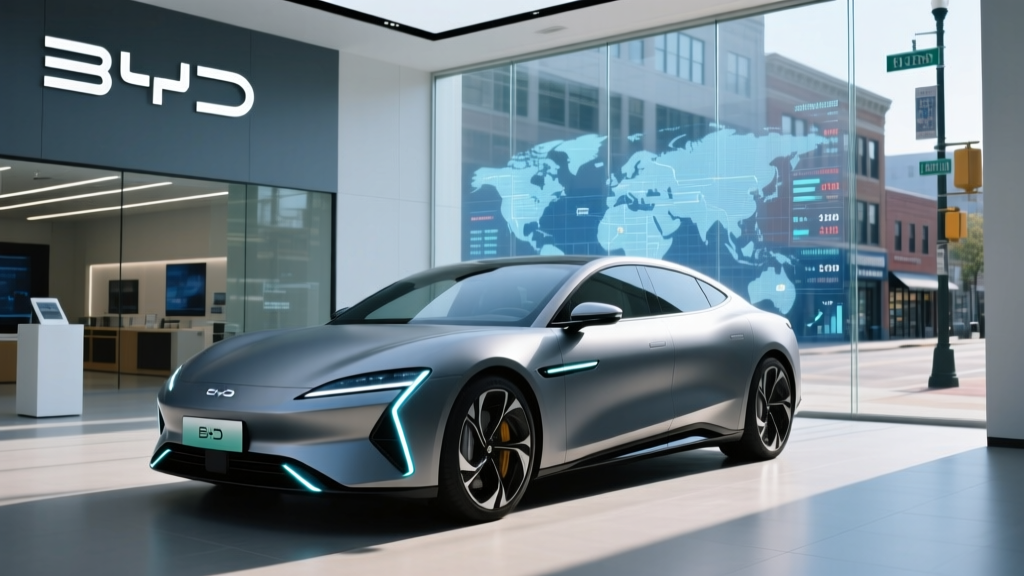
If you follow global electric-vehicle news, you've seen the headlines: BYD has surpassed Tesla as the world's top-selling EV brand, expanding aggressively across Europe, Southeast Asia, Latin America, and Australia. Yet in the United States—the world's second-largest auto market—BYD sells exactly zero passenger cars. The question why is BYD not sold in the US doesn't have a single answer. It's a collision of trade policy, national-security concerns, battery-sourcing regulations, and geopolitical tension that has effectively walled off the American market from China's dominant automaker.
As of 2026, BYD has no plans to sell passenger vehicles in the United States, and the regulatory environment makes a near-term entry virtually impossible. Below, we break down every barrier, examine what American buyers are missing, and explain why even BYD's most compelling models—like the globally popular Seal and Atto 3—remain unavailable on US soil.
The Tariff Wall: 100% Duties on Chinese EVs
The single biggest reason BYD cannot sell cars in the US is a 100% tariff on Chinese-made electric vehicles, enacted under Section 301 of the Trade Act and significantly expanded in 2024 under the Biden administration, then maintained through 2026. This tariff effectively doubles the price of any BYD vehicle imported from China, destroying the cost advantage that defines BYD's global strategy.
Consider the math: a BYD Seal sedan that retails for roughly $40,000 in Europe would carry an additional $40,000 in tariffs before it reached a US showroom floor. That pushes it into BMW i4 and Tesla Model 3 Performance territory—vehicles with established US service networks and domestic parts supply. BYD's entire competitive proposition is value; tariffs eliminate it.
Even if BYD attempted to build a US factory to bypass import tariffs, it would face a second layer of obstacles tied to federal incentives and battery sourcing.
The §30D Tax Credit Problem: Battery Sourcing and FEOC Rules
Federal EV tax credits under IRS §30D are a critical purchase driver for American EV buyers, offering up to $7,500 at the point of sale. But the credit's eligibility requirements are designed specifically to exclude Chinese battery supply chains—the same chains BYD relies on.
- Battery sourcing: Battery components must NOT be manufactured by a Foreign Entity of Concern (FEOC)—a designation that includes Chinese companies, and BYD is vertically integrated with Chinese battery production.
- Critical minerals: A percentage of critical minerals must be sourced from the US or free-trade-agreement partners. BYD's LFP chemistry relies heavily on Chinese lithium and iron phosphate processing.
- Final assembly: Must occur in North America. BYD has no US or North American passenger-vehicle plant.
- MSRP caps: Sedans capped at $55,000; SUVs/trucks at $80,000 (BYD's pricing would fit, but other rules block it).
- Buyer income caps: AGI limits of $150K single / $300K joint (applies to all buyers regardless of brand).
The result: even if BYD built a US assembly plant, its vehicles would almost certainly fail the battery-sourcing and FEOC requirements, making them ineligible for the $7,500 credit. That puts BYD at a massive disadvantage against Hyundai, Tesla, Ford, and GM—all of which have restructured supply chains to qualify.
National Security and Geopolitical Tensions
Beyond economics, there is a political dimension. US lawmakers from both parties have raised concerns about Chinese-connected vehicles on American roads, citing:
- Data security: Modern EVs are data-gathering platforms with cameras, microphones, GPS, and cellular connectivity. The US Commerce Department has proposed rules restricting Chinese and Russian connected-vehicle hardware and software, which would affect BYD's infotainment and ADAS systems.
- Supply-chain dependency: Policymakers want to reduce US reliance on Chinese battery production, not deepen it by allowing a vertically integrated Chinese automaker to dominate the low-cost EV segment.
- Intellectual-property disputes: Ongoing trade disputes and IP concerns between the US and China create additional legal risk for Chinese OEMs entering the market.
These concerns are bipartisan. Unlike tariffs, which can be adjusted by executive action, national-security restrictions on connected-vehicle technology would require significant legislative or regulatory reversal to undo.
What American Buyers Are Missing: BYD's Global Lineup
To understand what the tariff wall is blocking, here's a look at three BYD models that compete directly with popular US-market EVs. Note: these specs reflect international/WLTP figures, as no EPA testing exists for these vehicles.
| Spec | BYD Seal (AWD) | BYD Atto 3 | BYD Dolphin | Tesla Model 3 LR (US) | Hyundai Kona EV (US) |
|---|---|---|---|---|---|
| Battery (kWh) | 82.5 LFP Blade | 60.5 LFP Blade | 60.4 LFP Blade | 75 NMC | 65.4 NMC |
| Range (WLTP) | ~323 mi | ~261 mi | ~265 mi | ~363 mi (EPA) | ~261 mi (EPA) |
| 0-60 mph | 3.8 sec | 7.3 sec | 7.0 sec | 4.2 sec | 6.8 sec |
| Horsepower | 523 hp | 201 hp | 201 hp | 346 hp | 201 hp |
| Max DC Charge | 150 kW | 88 kW | 88 kW | 250 kW | 100+ kW |
| Price (intl. equiv.) | ~$42,000 | ~$35,000 | ~$30,000 | $47,740 | $34,975 |
BYD's LFP Blade Battery is the standout technology. Unlike the cylindrical NMC cells in most US-market EVs, BYD's Blade Battery uses a cell-to-pack architecture with lithium iron phosphate chemistry—offering superior thermal stability, longer cycle life, and lower cost, albeit with lower energy density than NMC. In nail-penetration tests, the Blade Battery has demonstrated resistance to thermal runaway, a meaningful safety advantage.
BYD's Blade Battery: What US Buyers Don't Get
BYD's vertical integration is unlike any other automaker. The company manufactures its own batteries, semiconductors, electric motors, and even owns lithium mining stakes. This integration is why BYD can price the Dolphin at roughly $30,000 internationally while offering competitive range and build quality.
The Blade Battery uses LFP (lithium iron phosphate) chemistry, which trades some energy density for:
- Safety: Higher thermal runaway threshold; no cobalt or nickel.
- Longevity: 3,000+ charge cycles before significant degradation—translating to well over 300,000 miles of driving.
- Cost: Iron and phosphate are dramatically cheaper than nickel and cobalt.
- 100% SoC charging: LFP batteries can be charged to 100% regularly without the degradation concerns that affect NMC packs.
For US buyers who prioritize long-term battery health and lower replacement costs, LFP is increasingly attractive—which makes BYD's absence more notable.
Could BYD Enter the US Market in the Future?
BYD executives have publicly stated they have no plans to enter the US passenger-vehicle market as of 2026. The company is focused on markets where it can compete on price and where regulatory environments are less hostile. BYD is building factories in Thailand, Brazil, Hungary, Indonesia, and Turkey—all markets with favorable or neutral trade relationships.
For BYD to sell in the US, several conditions would need to change simultaneously:
- The 100% Section 301 tariff would need to be reduced or eliminated (politically unlikely in either direction).
- BYD would need to build a North American assembly plant—potentially in Mexico, though USMCA rules and additional proposed tariffs on Mexican-made Chinese-brand vehicles complicate this.
- Battery-sourcing requirements under §30D would need to be relaxed, or BYD would need to establish non-Chinese battery supply chains specifically for the US market.
- Connected-vehicle national-security restrictions would need to be navigated or exempted.
None of these conditions show signs of shifting in the near term. The more likely scenario is that BYD continues to dominate everywhere except the US and a handful of other markets with similar trade barriers (India has also imposed restrictions on Chinese EVs).
What US Buyers Can Get Instead
If BYD's value proposition appeals to you, here are the closest US-market alternatives at similar price points:
- Tesla Model 3 RWD ($38,990 MSRP, EPA 272 mi, qualifies for partial §30D credit) — closest in performance and tech, faster charging.
- Hyundai Ioniq 6 SE ($37,500 MSRP, EPA 305 mi, full §30D credit eligible) — more efficient, 800V architecture for faster DC charging.
- Hyundai Kona EV ($34,975 MSRP, EPA 261 mi, §30D eligible) — similar size, competitive range, US service network.
- Chevrolet Equinox EV ($33,600 MSRP, EPA 319 mi, §30D eligible) — more range, larger interior, GM's Ultium platform.
- Nissan Leaf ($28,140 MSRP, EPA 149-212 mi) — limited range and CHAdeMO charging, but affordable.
- Used EV market — the $4,000 used-EV credit (§25E) makes pre-owned Teslas, Bolts, and Model 3s accessible in this price range.
The Bottom Line
The answer to why is BYD not sold in the US is a combination of punitive tariffs (100% on Chinese EVs), federal tax-credit rules designed to exclude Chinese battery supply chains, national-security concerns about connected-vehicle data, and a geopolitical environment that shows no signs of thawing. BYD has made a strategic decision to invest in markets where it can compete on its strengths—price and vertical integration—rather than fight a regulatory battle it cannot win in Washington.
For American EV buyers, this means missing out on some genuinely compelling and affordable electric vehicles. The BYD Seal's 523-hp AWD performance at $42,000 (international pricing) and the Dolphin's $30,000 entry point would reshape the US market's lower tiers. Instead, US buyers rely on Hyundai, Chevrolet, and Tesla's entry-level models to fill the value gap—and those brands have responded with increasingly competitive pricing and §30D credit eligibility.
Will BYD ever sell cars in the United States?
As of 2026, BYD has stated it has no plans to enter the US passenger-vehicle market. The 100% tariff on Chinese EVs, FEOC battery-sourcing restrictions, and national-security regulations create barriers that would require years of political change to overcome. BYD is instead investing in factories across Southeast Asia, Latin America, and Europe.
Can I import a BYD vehicle to the US privately?
Importing a BYD for personal use is technically possible under certain NHTSA exemptions (show-and-display, 25-year rule), but it is not practical. The vehicle would not meet US FMVSS safety standards, would lack EPA certification, and the 100% tariff would still apply at customs. Insurance, registration, and service would be nearly impossible.
Does BYD sell any products in the US?
BYD does sell electric buses and commercial vehicles in the US through its Lancaster, California facility, though this operation has faced its own political challenges and scrutiny. However, BYD has no consumer passenger-vehicle presence in the American market.
Why is BYD's Blade Battery considered significant?
BYD's Blade Battery uses LFP chemistry in a cell-to-pack architecture that offers superior thermal stability (resistant to thermal runaway in nail-penetration tests), long cycle life (3,000+ cycles), and lower material cost compared to NMC batteries. It can also be charged to 100% regularly without the degradation concerns associated with NMC chemistries.
What's the cheapest EV I can buy in the US that competes with BYD's pricing?
The Chevrolet Equinox EV (starting ~$33,600) and Hyundai Kona EV (~$34,975) are the closest US-market competitors to BYD's international pricing, and both qualify for the federal §30D tax credit (subject to income and sourcing requirements), potentially bringing effective prices below $27,000. The used-EV market with the $4,000 §25E credit also opens up additional options.
Are Chinese EVs banned in other countries too?
India has imposed similar restrictions on Chinese automotive investment and imports. The European Union has enacted countervailing tariffs on Chinese EVs (ranging from ~17% to ~36% depending on the manufacturer, on top of the standard 10% duty), but has not banned them outright. Turkey, Brazil, and other markets have adjusted tariff policies but generally still allow Chinese EV sales.