Who Manufactures Rivian Vehicles — and Where?
Rivian designs, engineers, and manufactures its vehicles entirely in-house at a repurposed 3.3-million-square-foot factory in Normal, Illinois — the same facility once operated by Mitsubishi Motors. Unlike many EV startups that rely on contract manufacturers or shared platforms, Rivian controls its own production line, battery pack assembly, and drive-unit fabrication under one roof. The company employs roughly 15,000 people as of early 2026, the vast majority at the Illinois plant.
Rivian's vertical integration extends to its battery modules (assembled on-site from cells sourced primarily from Samsung SDI), its proprietary skateboard chassis, and its quad-motor drive units. The company has also partnered with Samsung SDI on a joint-venture cell manufacturing plant in Stanton, Georgia, expected to come online in late 2027, which will further localize its supply chain.
In 2024, Volkswagen Group invested up to $5 billion in Rivian as part of a joint venture focused on shared electrical architecture and software — but VW does not manufacture Rivian vehicles. Rivian retains full control over production, branding, and vehicle design. The VW partnership is a technology collaboration, not a manufacturing merger.
2026 Rivian R1T: Full Spec Breakdown
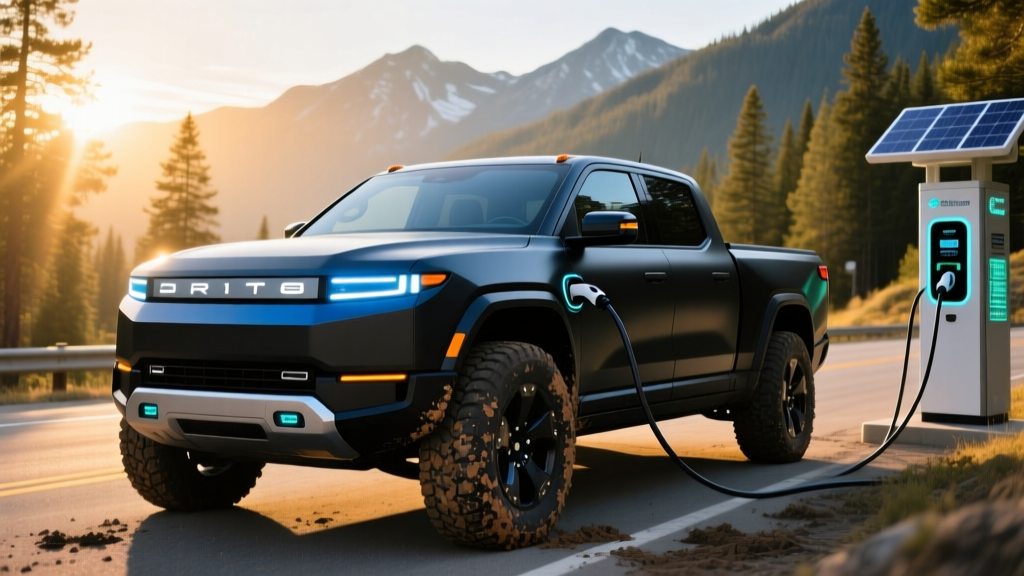
The R1T is Rivian's all-electric midsize pickup, competing with the Ford F-150 Lightning, Chevrolet Silverado EV, and GMC Sierra EV. For 2026, Rivian offers the R1T with Dual-Motor and Quad-Motor configurations, along with two battery sizes.
| Spec | Dual-Motor Standard | Dual-Motor Max | Quad-Motor Max |
|---|---|---|---|
| Base MSRP | $69,900 | $76,900 | $87,900 |
| Battery Capacity (usable) | 95 kWh (LFP) | 135 kWh (NMC) | 135 kWh (NMC) |
| EPA Range | 270 mi | 352 mi | 328 mi |
| MPGe (combined) | 73 MPGe | 70 MPGe | 65 MPGe |
| Efficiency | 46 kWh/100 mi | 48 kWh/100 mi | 52 kWh/100 mi |
| Horsepower | 533 hp | 533 hp | 1,025 hp |
| 0–60 mph | 4.5 sec | 4.5 sec | 2.6 sec |
| Drivetrain | Dual-Motor AWD | Dual-Motor AWD | Quad-Motor AWD |
| Max Tow Capacity | 11,000 lbs | 11,000 lbs | 11,000 lbs |
| Payload | 1,760 lbs | 1,760 lbs | 1,760 lbs |
| Bed Length | 4.5 ft (54 in) | 4.5 ft (54 in) | 4.5 ft (54 in) |
| Cargo Volume (bed) | ~34 cu ft | ~34 cu ft | ~34 cu ft |
| Frunk | 11 cu ft | 11 cu ft | 11 cu ft |
| Ground Clearance | 7.9–14.4 in (adjustable) | 7.9–14.4 in (adjustable) | 7.9–14.9 in (adjustable) |
2026 Rivian R1S: SUV Specs and Family Practicality
The R1S is the three-row SUV sibling of the R1T, sharing the same skateboard platform, battery options, and drive configurations. It competes most directly with the Tesla Model X, Kia EV9, and the upcoming Cadillac Escalade IQ — though at a notably lower starting price than the latter two's fully loaded trims.
| Spec | Dual-Motor Standard | Dual-Motor Max | Quad-Motor Max |
|---|---|---|---|
| Base MSRP | $74,900 | $81,900 | $92,900 |
| Battery Capacity (usable) | 95 kWh (LFP) | 135 kWh (NMC) | 135 kWh (NMC) |
| EPA Range | 264 mi | 340 mi | 316 mi |
| MPGe (combined) | 71 MPGe | 68 MPGe | 63 MPGe |
| Horsepower | 533 hp | 533 hp | 1,025 hp |
| 0–60 mph | 4.6 sec | 4.6 sec | 2.7 sec |
| Seating | 7 passengers (3 rows) | 7 passengers | 7 passengers |
| Cargo (behind 3rd row) | 10.4 cu ft | 10.4 cu ft | 10.4 cu ft |
| Cargo (behind 2nd row) | 46.7 cu ft | 46.7 cu ft | 46.7 cu ft |
| Cargo (max, 2nd+3rd folded) | 83.5 cu ft | 83.5 cu ft | 83.5 cu ft |
| Second-Row Legroom | 38.5 in | 38.5 in | 38.5 in |
| Third-Row Legroom | 30.4 in | 30.4 in | 30.4 in |
| Max Tow Capacity | 7,700 lbs | 7,700 lbs | 7,700 lbs |
The R1S's third row is genuinely usable for adults on shorter trips (30.4 inches of legroom is tighter than the Kia EV9's 32.0 inches, but more accommodating than the Tesla Model X). For families with younger children in the third row, it works well for daily school runs and weekend errands. The 10.4 cu ft behind the third row is enough for a couple of grocery bags or a compact stroller, but a full week of luggage for seven requires folding at least one row.
Charging: DC Fast Charge and Home Level 2 Speeds
Charging speed is one of the most critical factors for EV ownership satisfaction, and Rivian's Gen 2 platform delivers competitive — though not class-leading — rates. Here's what owners can expect:
| Charging Method | Standard Pack (95 kWh LFP) | Max Pack (135 kWh NMC) |
|---|---|---|
| Max DC Fast Charge Rate | 200 kW peak | 220 kW peak |
| 10–80% DC Fast Charge Time | ~30 minutes | ~38 minutes |
| DC Charge Curve Note | Peak rate sustained to ~55% SoC, then tapers. Expect 160–180 kW average from 10–80%. | |
| Level 2 Home Charger (11.5 kW / 48A) | ~16 mi/hr added | ~16 mi/hr added |
| Level 2 Full Charge Time (0–100%) | ~9 hours | ~13 hours |
| Level 1 (120V / 12A) | ~3 mi/hr | ~3 mi/hr |
| Connector | NACS (native, 2025+ models); CCS adapter included for older vehicles | |
Real-world charging insight: Rivian's peak DC charge rate of 220 kW (Max Pack) is solid but trails the Hyundai Ioniq 5's 240 kW and the Porsche Macan EV's 270 kW. The charge curve is the more important number: Rivian sustains strong rates through the mid-50s% state of charge, then tapers progressively. On a road trip, you'll typically add 150–180 miles of real-world range in a 20-minute stop — adequate for highway travel, but not the fastest in the segment.
For home charging, Rivian's onboard 11.5 kW Level 2 charger (48 amps) is a strong point. It fully replenishes the Standard Pack overnight and fills about 75% of the Max Pack in a typical 10-hour window. A 48-amp hardwired Level 2 charger (such as the Rivian Wall Charger or a ChargePoint Home Flex configured to 48A) is the recommended setup. Installation costs typically range from $800 to $2,500 depending on your panel capacity and conduit run — see a licensed electrician for a site assessment.
Federal Tax Credit: Does the Rivian R1T or R1S Qualify?
This is where Rivian buyers face a significant hurdle under current IRS §30D rules:
| Requirement | Rivian R1T | Rivian R1S | Status |
|---|---|---|---|
| MSRP Cap (trucks: $80,000; SUVs/vans: $80,000) | Base Dual-Motor Std: $69,900 ✓ | Base Dual-Motor Std: $74,900 ✓ | Base trims qualify; higher trims may exceed cap |
| Buyer Income Cap (MFJ: $300,000; single: $150,000) | Varies by buyer | Must self-verify | |
| Battery Component Sourcing (North America assembly) | Samsung SDI cells; pack assembled in Normal, IL | Partial — verify current-year battery sourcing requirement | |
| Critical Minerals Sourcing | Mixed global supply chain | Varies by production batch — check VIN-specific eligibility at purchase | |
| Point-of-Sale Transfer Available | Yes, if eligible | Dealer must be IRS-registered | |
Technology, Driver Assistance, and Standout Features
Rivian's software stack is proprietary and receives regular over-the-air updates. The 15.6-inch center touchscreen runs a custom interface with integrated navigation, streaming apps, and a detailed energy-consumption tracker. Notable tech features include:
- Driver+ (Level 2 ADAS): Adaptive cruise control with lane centering on divided highways. This is an SAE Level 2 system — the driver must remain attentive with hands on or near the wheel at all times. It is not autonomous driving.
- Highway Assist: Hands-on lane centering with automatic lane changes when the turn signal is activated (similar to Tesla's Autosteer with auto-lane-change, not hands-free like GM's Super Cruise).
- Phone-as-a-Key: Bluetooth-based passive entry and start; no fob required (though a key fob is included as backup).
- Camp Kitchen (R1T option): A slide-out electric induction kitchen system that deploys from the Gear Tunnel — a unique feature no competitor offers.
- Gear Tunnel (R1T): A 54-cu-ft pass-through storage compartment behind the rear seats, accessible from both sides of the bed — ideal for skis, golf bags, or camping gear.
- Adjustable Air Suspension: Up to 14.9 inches of ground clearance on Quad-Motor trims, with automatic ride-height adjustment based on speed and terrain.
- Vehicle-to-Load (V2L): Up to 2.4 kW of 120V AC power from bed outlets — enough to run power tools, a portable fridge, or campsite lighting.
- Third-row space (R1S): At 30.4 inches of legroom, the R1S third row is tighter than the Kia EV9 (32.0 in) and significantly tighter than a minivan. Best suited for children or occasional adult use.
- R1T bed length: At 4.5 feet (54 inches), the R1T bed is shorter than a conventional midsize truck. The Gear Tunnel compensates for enclosed storage, but full 4×8 sheets of plywood won't fit flat.
- DC charging speed: At 220 kW peak, the R1T/R1S charges slower than the Hyundai Ioniq 5 (240 kW) and Porsche Macan EV (270 kW). Road-trippers should plan for slightly longer stops.
- No hands-free driving: Rivian's Driver+ requires hands-on-wheel engagement. If you want true hands-off highway driving (eyes-on), GM's Super Cruise or Ford's BlueCruise are the alternatives — though Rivian's system is competitive in smoothness and reliability.
- Service center density: Rivian has expanded its service network, but coverage in rural areas and the Mountain West remains thinner than legacy brands. Mobile service handles many issues, but body repair may require a tow to a certified center.
Warranty Coverage and Long-Term Ownership
Rivian provides competitive warranty coverage, particularly for the battery — a key concern for any EV buyer:
| Component | Coverage |
|---|---|
| Limited Vehicle Warranty | 5 years / 60,000 miles |
| Battery & Drive Unit (Powertrain) | 8 years / 120,000 miles |
| Battery Capacity Retention Guarantee | ≥70% capacity retained over 8 years / 120,000 miles |
| Corrosion Perforation | 12 years / unlimited miles |
| Roadside Assistance | 5 years / 60,000 miles |
The 8-year/120,000-mile battery warranty with a 70% capacity retention floor is standard for the EV industry (Tesla offers the same terms). Rivian's LFP Standard Pack is expected to exhibit slower long-term degradation than the NMC Max Pack — LFP chemistry typically retains 90%+ capacity after 1,000+ full cycles, whereas NMC may drop to 80–85% over the same usage. For high-mileage owners or those in hot climates, the LFP pack offers a longevity advantage despite its lower energy density and shorter EPA range.
Who Should Buy a Rivian — and Who Shouldn't?
✓ Buy the R1T if:
- You want an electric truck for weekend towing, camping, or adventure use (11,000-lb tow rating, Gear Tunnel, Camp Kitchen)
- You value off-road capability (14.9 in clearance, quad-motor tank turns)
- You commute daily but also need a truck bed — the R1T is the only midsize electric pickup that balances both
- You can install a Level 2 home charger and don't rely solely on public fast charging
✗ Skip the R1T if:
- You need a full-size 6.5-ft+ truck bed for work (construction, landscaping)
- Your budget is under $65,000 — the R1T starts at $69,900 before options
- You frequently tow over 8,000 lbs long-distance (towing cuts range by 40–50%)
- You live in a rural area far from a Rivian service center
✓ Buy the R1S if:
- You need three rows of seating for a growing family but want EV efficiency
- You want SUV cargo versatility (83.5 cu ft max) with genuine off-road capability
- You prefer a purpose-built EV platform over a converted ICE chassis
- You value over-the-air updates and a software-first ownership experience
✗ Skip the R1S if:
- You regularly carry adults in the third row (Kia EV9 or a minivan is roomier)
- You want hands-free highway driving (look at GM Super Cruise or Ford BlueCruise vehicles)
- You need the longest possible EPA range in a three-row EV (the R1S Max at 340 mi trails the Tesla Model X at ~348 mi)
- You want the lowest possible purchase price in a three-row EV (Kia EV9 starts ~$20,000 less)
Is the Rivian Worth It vs. Key Competitors?
The R1T competes in a small but growing field. Against the Ford F-150 Lightning, the R1T offers more standard off-road capability, a more premium interior, and the unique Gear Tunnel — but the Lightning has a longer bed (5.5 ft standard), a lower starting price (~$55,000), and a far larger dealer/service network. The Chevrolet Silverado EV undercuts on price and offers a longer bed, but its interior quality and software lag behind Rivian's.
For the R1S, the Kia EV9 is the strongest value competitor: it starts around $55,000, offers more third-row legroom, and qualifies more easily for the federal tax credit due to its Georgia-built production and compliant battery sourcing. The Tesla Model X offers more EPA range and access to the Supercharger network natively, but its interior build quality and third-row comfort are weaker. If you prioritize adventure capability, build quality, and a unique ownership experience, Rivian holds a distinct position.
Frequently Asked Questions
Who manufactures Rivian vehicles?
Rivian manufactures all of its vehicles at its own factory in Normal, Illinois — a 3.3-million-square-foot facility formerly operated by Mitsubishi. Rivian handles body stamping, paint, battery pack assembly, drive unit fabrication, and final vehicle assembly in-house. No third-party contract manufacturer builds Rivian vehicles.
What is the real-world range of the Rivian R1T and R1S?
The R1T Dual-Motor Max is EPA-rated at 352 miles, but real-world highway driving at 70–75 mph yields approximately 280–310 miles. In cold weather (below 30°F), expect 240–265 miles. The R1S Dual-Motor Max is EPA-rated at 340 miles, with similar real-world reductions. The Standard Pack (LFP) models deliver roughly 210–240 miles in real-world mixed driving.
How fast does the Rivian charge?
On a DC fast charger, the Max Pack (135 kWh NMC) peaks at 220 kW and charges from 10–80% in approximately 38 minutes. The Standard Pack (95 kWh LFP) peaks at 200 kW with a 10–80% time of about 30 minutes. At home on a 48-amp Level 2 charger (11.5 kW), both vehicles add roughly 16 miles of range per hour.
How much does a Rivian cost after the federal tax credit?
The base R1T Dual-Motor Standard starts at $69,900. If you qualify for the full $7,500 federal tax credit under §30D (subject to income, MSRP, and battery-sourcing requirements), the effective price drops to approximately $62,400. However, battery-sourcing rules may limit the credit to $3,750 for some VINs. Always verify eligibility on the IRS portal before purchase. Quad-Motor trims exceed the $80,000 MSRP cap and do not qualify.
Does the Rivian qualify for the federal EV tax credit?
Base Dual-Motor trims of the R1T ($69,900) and R1S ($74,900) fall under the $80,000 MSRP cap and may qualify, depending on buyer income limits ($150,000 single / $300,000 married filing jointly) and battery-sourcing compliance. Rivian's Samsung SDI battery cells are manufactured in South Korea, and critical-mineral sourcing varies. Check VIN-specific eligibility via the fueleconomy.gov tax credit tool before purchasing.
Is the Rivian R1T a good truck for towing?
The R1T is rated to tow 11,000 lbs — competitive with midsize gas trucks. However, towing significantly impacts range: expect a 40–50% reduction when towing near max capacity, bringing a 352-mile EPA-rated R1T down to roughly 175–210 miles per charge. For short towing trips or light trailers (boats, small campers under 5,000 lbs), the R1T performs well. For frequent heavy towing over long distances, a diesel or gas truck remains more practical until charging infrastructure catches up.
What battery chemistry does Rivian use — LFP or NMC?
Rivian offers both. The Standard Pack uses LFP (lithium iron phosphate) chemistry, which offers longer cycle life, greater thermal stability, and tolerance for regular 100% charging — ideal for daily commuting. The Max Pack uses NMC (nickel manganese cobalt) chemistry, which provides higher energy density and longer range but degrades slightly faster over time. Rivian recommends charging NMC packs to 80% for daily use and 100% only before long trips.