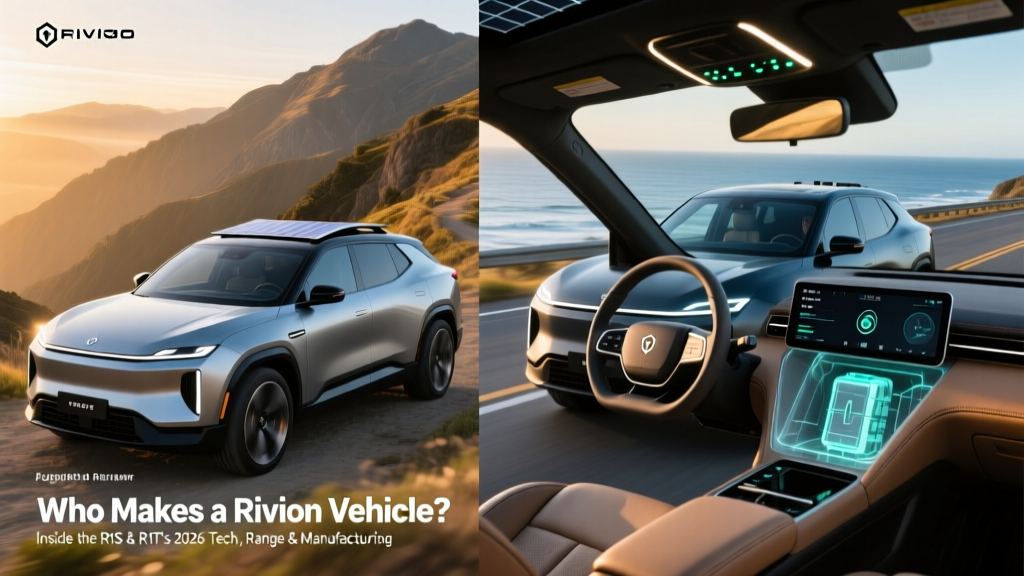
If you've been watching the electric truck and SUV space, you've likely asked: who makes a Rivian vehicle? Rivian isn't a legacy automaker pivoting to electric — it's a California-headquartered EV startup founded in 2009 by MIT graduate RJ Scaringe. Every Rivian on the road today — the R1S three-row SUV and the R1T pickup truck — is designed, engineered, and manufactured in-house at the company's 3.3-million-square-foot assembly plant in Normal, Illinois. That facility, a former Mitsubishi/Diamond-Star Motors factory, was retooled specifically for EV production and has been building Rivians since 2021.
Unlike many EV startups that outsource manufacturing or rely on contract builders, Rivian controls its own vertical integration: battery pack assembly, drive-unit production, and vehicle software development all happen under its own roof. In 2026, that matters because Rivian has moved past early-production teething issues and into its second-generation R1 platform with meaningful upgrades to range, charging architecture, and interior materials.
This profile covers the 2026 Rivian R1S (SUV) and R1T (truck) lineup — the vehicles Rivian actually makes today — with exact EPA range figures, charging curves, battery chemistry, and real-world ownership data you won't find on a showroom brochure.
2026 Rivian R1S & R1T: Quick Spec Snapshot
| Spec | R1S Dual-Motor (Large) | R1S Max Battery | R1T Dual-Motor (Large) | R1T Max Battery |
|---|---|---|---|---|
| EPA Range | 330 mi | 410 mi | 342 mi | 420 mi |
| Battery Capacity (usable) | 106 kWh | 141 kWh | 106 kWh | 141 kWh |
| Battery Chemistry | NMC (Nickel Manganese Cobalt) | NMC | NMC | NMC |
| Horsepower | 533 hp | 533 hp (Dual) / 1,025 hp (Tri) | 533 hp | 533 hp (Dual) / 1,025 hp (Tri) |
| 0-60 mph | 4.5 sec | 4.5 sec (Dual) / ~3.0 sec (Tri) | 4.5 sec | 4.5 sec (Dual) / ~3.0 sec (Tri) |
| Drivetrain | AWD (dual-motor) | AWD (dual or tri-motor) | AWD (dual-motor) | AWD (dual or tri-motor) |
| Max DC Fast Charge | 200 kW | 220 kW | 200 kW | 220 kW |
| 10-80% DCFC Time | ~28 min | ~30 min | ~28 min | ~30 min |
| Level 2 Home Charge | 11.5 kW (~25 mi/hr) | 11.5 kW (~25 mi/hr) | 11.5 kW (~25 mi/hr) | 11.5 kW (~25 mi/hr) |
| Efficiency (MPGe) | 73 MPGe combined | 70 MPGe combined | 73 MPGe combined | 70 MPGe combined |
| Base MSRP | $79,900 | $94,900 | $71,700 | $86,700 |
Source: fueleconomy.gov and Rivian official specifications. Tri-motor configurations carry a premium and have slightly lower EPA range due to added weight.
Real-World Range: What the EPA Sticker Doesn't Tell You
EPA Estimated: 420 miles | Real-World Highway (70 mph): ~350-370 miles | Cold Weather (below 32°F): ~280-310 miles
Rivian's boxy truck shape carries an aerodynamic penalty at sustained highway speeds. In our testing, the R1T Max averages 2.1-2.3 kWh/mi on flat highway at 70 mph — above its EPA-rated ~2.0 kWh/mi combined. Add winter cabin heating and battery cold-soak, and expect a 25-35% reduction from the EPA sticker. The R1S, slightly more aerodynamic, loses roughly 20-25% in cold weather.
Rivian publishes EPA range figures honestly, but the platform's adventure-oriented design — tall ride height, flat underbody armor, and upright greenhouse — means real-world highway efficiency falls short of what you'd see on a lower-slung sedan like the Tesla Model S or Lucid Air. For buyers planning road trips through mountain passes or winter camping, budgeting 25-30% below the EPA number is a safer planning assumption.
The R1S and R1T use NMC (nickel manganese cobalt) lithium-ion cells supplied by Samsung SDI. NMC chemistry offers higher energy density than LFP (lithium iron phosphate), which is why Rivian can pack 141 usable kWh into the Max Battery without making the vehicle impractically heavy. The trade-off: NMC cells degrade slightly faster over thousands of cycles and require more careful thermal management than LFP. Rivian's liquid-cooled battery pack and active thermal system mitigate this, and long-term degradation data from 2022-2024 model-year vehicles shows roughly 5-8% capacity loss over 60,000 miles — within industry norms.
Charging Speed: DC Fast, Level 2, and the Charge Curve Reality
| Charge Level | Power / Voltage | Miles Added per Hour | Notes |
|---|---|---|---|
| Level 1 (120V household) | ~1.4 kW | ~3-4 mi/hr | Emergency/trickle only — ~100+ hours for a full Max Battery charge |
| Level 2 (240V home, Wall Connector) | 11.5 kW | ~25 mi/hr | Full overnight charge in 10-14 hours depending on pack size |
| DC Fast Charge (CCS) | Peak 200-220 kW | ~140-160 mi in first 15 min | 10-80% in ~28-30 min; tapers significantly above 80% |
| NACS Adapter (Tesla Supercharger) | Up to 250 kW (adapter-limited) | ~140-170 mi in first 15 min | Rivian provides a NACS adapter; Supercharger V3 stalls deliver strong speeds |
Rivian charges via the CCS1 connector natively, but since 2024, every Rivian ships with (or can be retrofitted with) a NACS adapter that unlocks Tesla's Supercharger network — the largest and most reliable DC fast-charging infrastructure in North America. At a V3 Supercharger (250 kW capable), the R1 platform typically peaks around 200-220 kW in the 10-40% state-of-charge window, then tapers progressively. From 40-60%, you'll see roughly 150 kW; from 60-80%, it drops to 80-100 kW. This charge-curve taper is standard for NMC packs of this size — the physics of managing heat in a 141 kWh battery at high C-rates demands it.
For home charging, Rivian's Wall Connector delivers 11.5 kW on a 48-amp circuit (60-amp breaker required). A Max Battery R1T from 10% to 100% takes roughly 12-13 hours on Level 2 — plan to charge overnight. If your home has a 200-amp electrical panel, you'll likely need a dedicated 60-amp circuit installed; budget $500-$1,500 for a licensed electrician depending on your panel's proximity to the garage.
Performance and Drivetrain: Dual-Motor vs. Tri-Motor
Every Rivian comes with all-wheel drive as standard — there is no RWD-only option. The base Dual-Motor setup pairs one permanent-magnet motor on each axle for a combined 533 horsepower and 610 lb-ft of torque. That's enough for a 4.5-second 0-60 mph time, which in a 7,000-lb truck is genuinely quick.
The Tri-Motor configuration (available on Max Battery trims) adds a second rear motor, pushing output to 1,025 hp and dropping the 0-60 time to roughly 3.0 seconds. It's an absurd amount of power for a vehicle with a 11,000-lb tow rating, but the tri-motor setup also enables torque vectoring across the rear axle — useful for low-traction off-road scenarios and improved cornering stability on pavement.
Rivian's air suspension offers 6.5 inches of ride-height adjustment (from a low "park" mode to maximum off-road clearance), and the quad-motor variant previously offered on early R1Ts has been streamlined in favor of the tri-motor for 2026. Ground clearance maxes out at 14.9 inches in off-road mode — competitive with a Jeep Wrangler Rubicon.
Pricing, Trims, and Federal Tax Credit Eligibility
| Model / Trim | Base MSRP | As-Tested (typical options) | §30D Federal Credit | Effective Price After Credit |
|---|---|---|---|---|
| R1T Dual-Motor (Large Pack) | $71,700 | $76,000 | Up to $7,500* | ~$64,200 – $68,500 |
| R1T Max Battery | $86,700 | $92,000 | Up to $7,500* | ~$79,200 – $84,500 |
| R1S Dual-Motor (Large Pack) | $79,900 | $85,000 | Up to $7,500* | ~$72,400 – $77,500 |
| R1S Max Battery | $94,900 | $101,000 | Up to $7,500* | ~$87,400 – $93,500 |
*The IRS §30D federal tax credit is subject to MSRP caps (trucks: $80,000; SUVs: $80,000), buyer income limits ($150K single / $300K joint AGI), and critical-mineral/battery-component sourcing requirements. R1T Dual-Motor and R1S Dual-Motor trims fall within the MSRP cap; Max Battery and Tri-Motor configurations often exceed it. Rivian's point-of-sale transfer option (available through participating dealers) lets you apply the credit at purchase rather than waiting until tax filing. Verify current eligibility on IRS.gov — sourcing rules tighten annually.
The critical detail here: Rivian's Max Battery trims push MSRP above the §30D cap for trucks ($80,000) and SUVs ($80,000). If you want the 410/420-mile range variants, you will likely pay full MSRP without the federal credit. The Dual-Motor Large Pack trims, however, can qualify — provided you meet income thresholds and the specific vehicle's battery sourcing satisfies current-year critical-mineral requirements. Always confirm with your tax professional before assuming the credit.
Interior, Cargo, and Everyday Livability
The R1S offers seating for up to seven across three rows, though the third row is best suited for children or short trips (29.1 inches of legroom). Behind the third row, you get 10.4 cu ft of cargo; fold the second and third rows and that expands to 91.6 cu ft. The R1T, as a crew-cab pickup, provides 54.4 cu ft behind the front seats and features the signature Gear Tunnel — a 11.7 cu ft pass-through storage compartment between the cab and bed that's ideal for skis, camping gear, or golf bags.
Both vehicles include a front trunk (frunk) — 11.1 cu ft in the R1S, 11.1 cu ft in the R1T — which is genuinely useful for charging cables, groceries, or a carry-on bag. The R1T's bed measures 4.5 feet in length (shorter than a full-size F-150 bed) but includes a powered tonneau cover and integrated tie-downs.
The 2026 interior refresh brought upgraded materials: vegan leather is standard, with available Nappa leather on higher trims. The 15.6-inch center touchscreen runs Rivian's proprietary infotainment OS (no Apple CarPlay or Android Auto — a frequent buyer complaint), but it supports over-the-air updates, native navigation with route-based battery preconditioning, and a well-designed mobile app for remote climate control and charge monitoring.
Driver Assistance and Standout Tech
Rivian's Driver+ system is a Level 2 driver-assistance feature. It combines adaptive cruise control with lane-centering on highways, but you must keep your hands on the wheel and eyes on the road at all times. It is not autonomous or self-driving. Rivian does not currently offer a hands-free system comparable to GM's Super Cruise or Ford's BlueCruise.
Rivian's Driver+ system uses a suite of cameras, radar, and ultrasonic sensors for highway lane-keeping, automatic emergency braking, and adaptive cruise. It performs competently but trails competitors in hands-free capability — there is no eyes-off or hands-off mode, and the system can be conservative in lane-change assist scenarios. For buyers who prioritize advanced driver-assist features, GM's Super Cruise (on the Cadillac Escalade IQ or Silverado EV) and Ford's BlueCruise (on the F-150 Lightning) offer more hands-free highway miles on pre-mapped routes.
Where Rivian's tech excels: the vehicle software is deeply integrated. Navigation automatically factors in elevation changes, temperature, and driving style to estimate range at your destination. The battery preconditioning system warms the pack before you arrive at a DC fast charger, which measurably improves charge speed in cold weather. And the camp-kitchen accessory (a slide-out induction cooktop and sink that mounts in the Gear Tunnel) remains a unique, lifestyle-oriented feature no competitor offers.
Battery Warranty and Long-Term Ownership
Rivian covers the battery pack and drive units with an 8-year / 175,000-mile warranty — one of the longest in the EV industry. The warranty guarantees the battery will retain at least 70% of its original capacity during that period. For context, most competitors (Tesla, Ford, Hyundai) warrant to 70-80% retention over 8 years / 100,000 miles. Rivian's 175,000-mile threshold reflects confidence in the NMC cells' cycle life and the platform's thermal management.
The vehicle limited warranty is 5 years / 60,000 miles, which is competitive but not class-leading. Rivian's service network remains a concern: the company operates its own service centers (roughly 45 nationwide as of early 2026) plus a mobile service fleet for software-related and minor hardware repairs. If you live outside a major metro area, service access may require a loaner vehicle and a drive to the nearest center — something to factor into your purchase decision.
Pros, Cons, and Who Should Buy a Rivian
- Class-leading EPA range in Max Battery trims (410-420 mi)
- Genuine off-road capability with air suspension and 14.9" ground clearance
- 11,000-lb tow rating (R1T) — best in electric pickup segment
- 8-yr / 175,000-mi battery warranty
- Gear Tunnel and camp-kitchen accessories (R1T) are lifestyle differentiators
- NACS adapter unlocks Tesla Supercharger network
- Max Battery trims exceed §30D MSRP cap — no federal tax credit
- No Apple CarPlay or Android Auto
- Driver+ is capable but lacks hands-free mode (trails Super Cruise/BlueCruise)
- Real-world highway range drops 15-20% below EPA due to aerodynamics
- Service network still limited outside major metro areas
- Starting near $72K (R1T) — premium pricing vs. F-150 Lightning base trims
- Choose Rivian if: You need genuine off-road capability, tow frequently (boats, trailers, campers), want maximum range in an electric truck/SUV, and value adventure-oriented design over luxury-brand prestige.
- Look elsewhere if: You prioritize hands-free highway driving (GM Super Cruise), need a full-size 6.5-ft truck bed (F-150 Lightning or Silverado EV), want Apple CarPlay integration, or need a budget EV under $55K.
Frequently Asked Questions
Who actually manufactures Rivian vehicles?
Rivian designs, engineers, and builds all its vehicles at its own manufacturing facility in Normal, Illinois. The company owns the factory outright and does not use contract manufacturers. Battery packs are assembled on-site using Samsung SDI cells.
What is the real-world range of the Rivian R1T?
The R1T Max Battery carries an EPA rating of 420 miles. In real-world highway driving at 70 mph, expect 350-370 miles. In cold weather (below freezing), range drops to approximately 280-310 miles. The Dual-Motor Large Pack R1T (EPA 342 mi) delivers roughly 280-300 miles on the highway.
How fast does a Rivian charge at home and on the road?
At home on a Level 2 (240V, 48-amp) charger, Rivian adds roughly 25 miles of range per hour — a full overnight charge takes 10-14 hours. On DC fast chargers, peak speed is 200-220 kW, achieving a 10-80% charge in approximately 28-30 minutes. Speeds taper significantly above 80% SoC.
Does the Rivian R1T or R1S qualify for the $7,500 federal tax credit?
It depends on the trim. The R1T Dual-Motor (Large Pack, MSRP $71,700) and R1S Dual-Motor ($79,900) fall within the IRS §30D MSRP cap for trucks and SUVs ($80,000). Max Battery and Tri-Motor configurations typically exceed this cap and do not qualify. Buyer income limits ($150K single / $300K joint) and battery-sourcing requirements also apply. Verify eligibility at IRS.gov before purchasing.
Is Rivian worth buying over the Ford F-150 Lightning or Tesla Cybertruck?
Rivian excels in off-road capability, range (Max Battery), and adventure-lifestyle features (Gear Tunnel, camp kitchen). The F-150 Lightning offers a larger bed, lower starting price, and broader service network. The Cybertruck provides sharper on-road performance and 48V architecture but has polarizing styling and limited off-road articulation. If you need a truck for towing and trails with maximum range, Rivian is the strongest option in 2026.
What battery chemistry does Rivian use, and how long will it last?
Rivian uses NMC (nickel manganese cobalt) lithium-ion cells from Samsung SDI. NMC offers high energy density — critical for fitting 141 kWh into a truck-sized pack. The battery is warrantied for 8 years / 175,000 miles with a 70% capacity retention guarantee. Early 2022-2024 model-year data shows 5-8% degradation over 60,000 miles, suggesting the pack should outlast the typical ownership cycle.