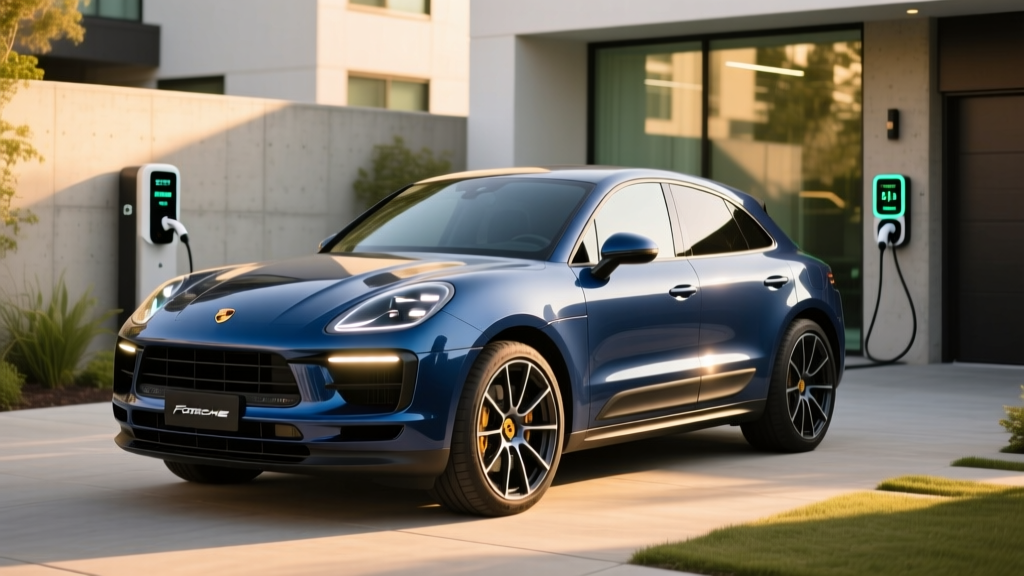
Is the 2026 Porsche Macan 4S Electric worth buying? The Macan 4S Electric delivers 308 miles of EPA-estimated range, charges from 10–80% in about 21 minutes at up to 270 kW, and starts at $84,900. It matches or beats the gas Macan GTS on performance (0–60 in 4.9 seconds, 442 hp) while costing roughly $1,200–$1,500 less per year to fuel and maintain — but only if you have reliable Level 2 home charging. Buyers without home charging access should weigh public-charging convenience carefully before committing to this $85K+ EV.
The Macan 4S Electric at a Glance
Porsche's electric Macan lineup sits on the Volkswagen Group's PPE (Premium Platform Electric) architecture, shared with the Audi Q6 e-tron. The 4S Electric occupies the middle of the range — above the base Macan Electric and below the Turbo variant — and it's the volume sweet spot for buyers wanting strong performance without the Turbo's $100K+ price tag.
| Spec | 2026 Macan 4S Electric |
|---|---|
| EPA Range | 308 miles |
| Battery (usable) | 95.8 kWh (NMC, 12 modules) |
| Max DC Fast Charge | 270 kW (peak) |
| 10–80% DC Charge Time | ~21 minutes |
| Level 2 AC Charge Rate | 11 kW (standard) / 22 kW (optional onboard charger) |
| 0–60 mph | 4.9 seconds (Launch Control) |
| Horsepower | 442 hp (509 hp w/ Launch Control) |
| Torque | 506 lb-ft |
| Drivetrain | Dual-motor AWD |
| MPGe (combined) | 84 MPGe |
| Base MSRP | $84,900 (before destination) |
| Battery/Powertrain Warranty | 8 years / 100,000 miles |
Source: EPA fueleconomy.gov and Porsche USA specifications.
Real-World Range: What the EPA Number Doesn't Tell You
EPA sticker: 308 miles
Real-world highway (70–80 mph): ~245–270 miles
Cold weather (below 32°F, highway): ~210–240 miles
Mixed city/highway (mild conditions): ~275–295 miles
The Macan 4S Electric's 308-mile EPA figure assumes a mix of city regenerative braking and moderate-speed highway driving. On a sustained 75-mph interstate run in 65°F weather, expect the trip computer to settle around 2.8–3.0 miles per kWh, yielding roughly 255–270 miles before you'd want to stop at 10–15% SoC. That's a meaningful reduction from the sticker — typical for heavy, aerodynamic crossover SUVs at highway speed.
Cold weather compounds the loss. Without preconditioning the battery, sub-freezing temperatures can push range down to 210–240 miles on the highway. The Macan 4S Electric includes a heat pump as standard equipment, which helps cabin efficiency but doesn't fully offset the physics of cold battery chemistry. Always precondition the battery via the Porsche app or scheduled departure before cold-weather fast charging — it's essential for hitting anywhere near the 270 kW peak rate.
Charging Speed and Infrastructure Reality
The Macan 4S Electric uses an 800-volt architecture, which is the real differentiator for daily charging practicality. Here's how each charging level breaks down:
| Level | Power | Miles Added per Hour | Typical Use Case |
|---|---|---|---|
| Level 1 (120V) | ~1.4 kW | ~4–5 mi/hr | Emergency / overnight trickle only |
| Level 2 (240V, 48A) | 11.5 kW | ~35–40 mi/hr | Home daily charging (full charge ~9 hrs) |
| DC Fast Charge | Up to 270 kW | ~150+ mi in 10 min (peak) | Road trips; 10–80% in ~21 min |
Charging curve reality: The 270 kW figure is a peak, not a sustained rate. On a 350 kW Electrify America or Tesla Supercharger (via NACS adapter), the Macan 4S will pull 250–270 kW between roughly 10–35% SoC, then taper progressively. From 50–80%, expect 120–150 kW. The 21-minute 10–80% claim assumes a capable charger and a preconditioned battery. In practice, at an older 150 kW station, plan on 30–35 minutes.
Porsche equips the Macan 4S Electric with a CCS1 port standard. A NACS adapter for Tesla Supercharger access is available, which is critical given that the Tesla Supercharger network remains the most reliable DC fast-charging infrastructure in the U.S. with over 30,000 stalls nationally.
Cost Breakdown: Macan 4S Electric vs. Gas Macan GTS
The natural comparison is against the gas-powered Macan GTS, which occupies a similar price and performance tier. Here's a five-year total cost of ownership estimate assuming 12,000 miles per year, $0.14/kWh home electricity, $3.80/gallon premium fuel, and standard insurance rates.
| Cost Category (5 Years / 60K Miles) | Macan 4S Electric ($84,900) | Gas Macan GTS (~$89,600) |
|---|---|---|
| Purchase Price (MSRP) | $84,900 | $89,600 |
| Federal Tax Credit (§30D) | $0 (MSRP cap & sourcing)* | $0 |
| Fuel / Energy | ~$3,100 (home charging) | ~$9,400 (premium gas, 19 MPG combined) |
| Maintenance | ~$1,800 | ~$4,200 |
| Insurance (est. average) | ~$14,500 | ~$12,800 |
| Depreciation (est. 5-yr) | ~$42,000 | ~$38,000 |
| Estimated 5-Year Total | ~$146,300 | ~$154,000 |
*The 2026 Porsche Macan 4S Electric does not qualify for the IRS §30D federal tax credit. The $84,900 MSRP exceeds the $80,000 SUV cap, and Porsche's battery sourcing does not meet the critical-minerals and battery-component requirements. Do not factor a $7,500 credit into your budget.
The EV saves roughly $6,300 in fuel and maintenance over five years — about $1,260 per year. But insurance runs $1,500–$2,000 more over the same period, and depreciation on luxury EVs remains steeper than on established gas Porsches. The net savings are real but modest: roughly $4,000–$7,000 over five years depending on your electricity rate and driving patterns. The value proposition is as much about the driving experience and daily convenience (no gas station stops, instant torque, quiet cabin) as it is about pure economics.
Federal Tax Credit and Incentive Reality
| Myth | Fact |
|---|---|
| "The Macan 4S Electric qualifies for the $7,500 federal credit." | It does not. The MSRP exceeds the $80,000 SUV cap, and battery sourcing fails §30D critical-mineral and component requirements for 2026. |
| "I can lease it and get the credit passed through." | The commercial-vehicle leasing loophole (§45W) was narrowed in 2025. Consult a tax professional — some lease structures may still offer a pass-through, but it's no longer guaranteed. |
| "State incentives will cover the difference." | Varies widely. California's CVRP has income caps; Colorado offers up to $5,000 but with phaseout schedules. Check your state's official energy office. |
| "Home charging installation is free." | A Level 2 home charger install typically costs $800–$2,500 (charger + electrician + permit). A panel upgrade to 200A can add $2,000–$4,000. |
First-Time EV Buyer: What You Must Know Before Committing
If the Macan 4S Electric is your first EV, here are the ownership realities no brochure covers:
Home charging is non-negotiable for daily satisfaction. A 240V Level 2 charger at home means you start every morning with a full battery. Without it, you're relying on public DC fast chargers or 120V trickle charging (which adds only ~20 miles overnight — inadequate for a 95.8 kWh battery). Budget $1,200–$2,500 for a quality Level 2 charger (ChargePoint Home Flex, Emporia Level 2, or Porsche's own Mobile Charger Connect) plus licensed electrician installation. If your electrical panel is maxed out, a 200A upgrade may be required.
Public charging reliability is improving but inconsistent. Electrify America, EVgo, and ChargePoint networks have expanded, but broken stalls, payment-app glitches, and occupied chargers remain common frustrations. The Macan 4S Electric's Plug & Charge capability (automatic authentication and billing at supported stations) helps, but it doesn't fix a physically broken cable. Plan road trips around charger availability using A Better Routeplanner or the Porsche Charging Planner.
Tire costs are higher. The Macan 4S Electric weighs approximately 5,300 lbs and delivers instant torque. Expect to replace tires every 25,000–35,000 miles instead of the 40,000–50,000 miles typical on lighter gas vehicles. A set of four Michelin Pilot Sport EV tires runs $1,400–$1,800 installed.
Brake wear is minimal. Regenerative braking handles most deceleration. Many EV owners report original brake pads lasting 80,000+ miles. This is where the maintenance savings come from — no oil changes, no transmission fluid, minimal brake service.
Decision Framework: Is the Macan 4S Electric Right for You?
Choose the Macan 4S Electric if:
- You have Level 2 home charging (or can install it) — this is the single biggest predictor of EV satisfaction
- Your daily commute is under 80 miles round-trip, meaning you rarely need to DC fast charge on weekdays
- You take 2–4 road trips per year of 200–400 miles and are comfortable planning ~20-minute charging stops
- You value instant torque, a near-silent cabin, and lower running costs over the traditional Porsche flat-six exhaust note
- You live in a mild-to-moderate climate, or you're willing to accept 20–25% range reduction in winter
Stick with the gas Macan GTS (or wait) if:
- You live in an apartment or condo without charging access and cannot install a Level 2 charger
- You regularly drive 300+ miles in a single day through areas with sparse DC fast-charging infrastructure (rural Mountain West, parts of the Great Plains)
- You need the full $7,500 federal tax credit to make the math work — the Macan 4S Electric does not qualify
- You frequently tow — the Macan 4S Electric is rated at 4,409 lbs towing capacity, but range drops dramatically under load (expect 160–200 miles while towing)
Frequently Asked Questions
What is the real-world range of the Porsche Macan 4S Electric?
The EPA rates it at 308 miles. In real-world mixed driving at moderate temperatures, expect 275–295 miles. Sustained highway driving at 75+ mph drops that to 245–270 miles. In cold weather below freezing, plan on 210–240 miles. Preconditioning the battery before departure and using the heat pump efficiently can recover some of these losses.
Does the Macan 4S Electric qualify for any federal tax credit?
No. The 2026 Macan 4S Electric's $84,900 MSRP exceeds the IRS §30D cap of $80,000 for SUVs, and its battery components and critical minerals do not meet the domestic-sourcing thresholds. Check IRS.gov for current rules, and consult a tax professional for your specific situation. Some state incentives may still apply.
How long does it take to charge the Macan 4S Electric at home?
On a Level 2 charger at 11 kW, a full charge from 10% to 100% takes approximately 9 hours. With the optional 22 kW onboard charger (requires a 100A circuit), that drops to roughly 4.5 hours. For daily use, most owners charge from 20% to 80% overnight, which takes about 5.5 hours at 11 kW — well within a typical overnight window.
Is the Macan 4S Electric faster than the gas Macan GTS?
Yes in straight-line acceleration: the 4S Electric hits 0–60 mph in 4.9 seconds (with Launch Control) versus the gas GTS at 4.5 seconds — so the GTS is marginally quicker. However, the EV delivers instant torque with no turbo lag and no shift delay, making it feel faster in real-world passing situations. The trade-off is weight: the EV is roughly 700 lbs heavier, which affects handling dynamics on tight canyon roads where the gas Macan traditionally excels.
What does it cost to charge versus fueling the gas Macan?
At $0.14/kWh (national average for residential electricity), a full 95.8 kWh charge costs about $13.40 and delivers roughly 275 real-world miles — about $0.049 per mile. The gas Macan GTS at 19 MPG combined on $3.80/gallon premium costs about $0.20 per mile. Over 12,000 miles per year, that's $588 in electricity versus $2,400 in fuel — a savings of roughly $1,800 annually. If you rely on public DC fast charging at $0.40–$0.50/kWh, the savings shrink to $400–$800 per year.
How does the battery warranty work?
Porsche covers the Macan 4S Electric's high-voltage battery for 8 years or 100,000 miles, whichever comes first. The warranty guarantees the battery will retain at least 70% of its original capacity during that period. If capacity drops below 70% under normal use, Porsche will repair or replace the battery at no cost. Based on current NMC chemistry data from PPE-platform vehicles, most owners can expect 85–90% capacity retention at 100,000 miles with normal charging habits (avoiding repeated 100% charges and frequent DC fast charging from very low SoC).